質子泵抑制劑發生小腸細菌過生長的臨床研究
2016-08-18 10:16:00周東曉陳光耀馬英杰鄭州人民醫院消化科河南鄭州45000鄭州消化疾病研究所河南鄭州45000新鄉醫學院研究生部河南新鄉4500
中國現代醫生 2016年14期
楊 麗 周東曉 陳光耀 高 曉 馬英杰▲1.鄭州人民醫院消化科,河南鄭州 45000;2.鄭州消化疾病研究所,河南鄭州 45000;.新鄉醫學院研究生部,河南新鄉 4500
質子泵抑制劑發生小腸細菌過生長的臨床研究
楊麗1,2周東曉3陳光耀3高曉3馬英杰1,2▲
1.鄭州人民醫院消化科,河南鄭州450003;2.鄭州消化疾病研究所,河南鄭州450003;3.新鄉醫學院研究生部,河南新鄉453003
目的探討長期口服質子泵抑制劑(proton pump inhibitors,PPI)引發小腸細菌過生長(small intestinal bacterial overgrowth,SIBO)的風險及干預措施。方法選取77例服用PPI為觀察組,41例健康志愿者作為對照組,采用前瞻性對照性研究,采用乳果糖氫呼氣試驗(lactulose hydrogen breath test,LHBT)檢測SIBO。SIBO陽性者給予停用PPI或不停用PPI加服左氧氟沙星口服(0.2 g,tid,1周),兩種干預均在4周時再次復查SIBO。結果研究開始前和8周后PPI組和對照組SIBO陽性率差異無統計學意義(P>0.05),24周后PPI組SIBO陽性率明顯高于對照組(P<0.05)。PPI組隨著用藥時間的延遲,SIBO發生率升高,0、8、24周間差異有統計學意義(P<0.05)。停藥和服用抗菌藥物SIBO轉陰率差異無統計學意義(P>0.05)。結論 服用PPI可增加小腸細菌過生長的風險,且這種風險隨服藥時間延長而升高,停藥或加用抗菌藥物可以使SIBO消失。
質子泵抑制劑;乳果糖氫呼氣試驗;小腸細菌過生長;干預
質子泵抑制劑(proton pump inhibitors,PPI)因其強大的抑酸作用及低毒性的特點,被廣泛應用于酸相關性疾病的臨床治療及預防非甾體抗炎藥相關的胃腸出血風險防范,具有良好的效果。但是,隨著臨床應用的日益廣泛以及對其藥物特性及安全性的進一步認識,其可能的潛在風險也受到了關注。該課題擬就長期服用PPI是否會增加小腸細菌過增長(small intestinal bacteria overgrowth,SIBO)的風險進行觀察研究,現報道如下。
1 資料與方法
1.1臨床資料
觀察組選取2013年6月~2015年6月在鄭州人民醫院消化科就診需常規劑量服用PPI的患者77例,男41例,女36例,年齡31~75歲,平均(42.9±10.1)歲,77例服用PPI療程均達8周以上,其中48例持續用藥24周以上;對照組為41例健康志愿者,男24例,女17例,年齡23~70歲,平均(37.5±11.9)歲,對照組患者不使用任何藥物。兩組的年齡、性別等一般資料比較差異均無統計學意義(P>0.05),具有可比性。
觀察組和對照組在入選前8周內均未使用過任何微生態制劑、抗生素及胃腸動力調節藥物;無胃腸道及腹部手術史。
1.2評估與干預
觀察對象開始(0周)、8周、24周時檢測小腸細菌,SIBO陽性者根據患者服藥要求和意愿分別給予停藥觀察4周、或不停用PPI加服左氧氟沙星口服(0.2 g,tid,1周),兩種干預措施均在4周時復查SIBO。
1.3SIBO檢測方法
應用乳果糖氫呼氣試驗(lactulose hydrogen breath test,LHBT)檢測小腸細菌過度生長情況。氣體檢測設備為英國Bedfont公司生產的EC60 Gastrolyzer,氫氣濃度以ppm表示,檢測范圍0~500 ppm,靈敏度為1 ppm,精度±5%。連接儀器的為新型D型接口。底物為荷蘭蘇威制藥生產的乳果糖口服液(商品名:杜密克)。按照操作手冊的操作規程對患者進行乳果糖氫氣呼氣試驗(LHBT)。先測空腹氫氣濃度,然后口服乳果糖10 g(可加少許溫水送服),每15分鐘測試1次呼氣氫濃度,共2 h。基礎值超過20 ppm或試餐后呼氣氫濃度上升超過12 ppm為SIBO陽性,如基礎值低于20 ppm或試餐后呼氣氫濃度上升低于12 ppm為SIBO陰性。
1.4統計學分析
采用SPSS17.0統計學軟件包進行數據處理,計數資料以率(%)表示,采用χ2檢驗;計量資料以表示,采用t檢驗,P<0.05為差異有統計學意義。
2 結果
2.1PPI與SIBO發生的相關性
開始時和8周時PPI組和對照組的SIBO陽性率比較差異無統計學意義(P>0.05)。其中48例繼續服PPI至24周者,有10例檢測出陽性,24周累計陽性率58.3%(28/48),其中23例SIBO陽性納入干預研究。對照組8周時檢出1例陽性,24周時檢測出1例,累計陽性率17.1%(7/41),兩組24周累計陽性率比較差異有統計學意義(P<0.05),對照組有6例納入干預研究。PPI組隨著用藥時間延遲,SIBO發生率升高,0、8、24周間差異有統計學意義(P<0.05)。見表1。
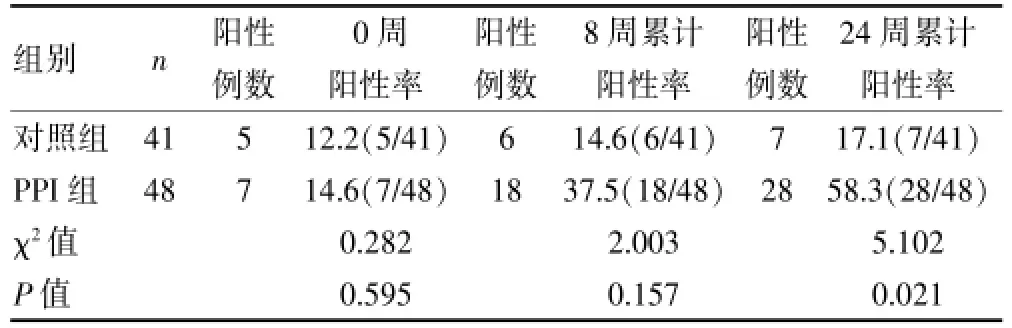
表1 PPI與SIBO發生的相關性[%(n/n)]
2.2SIBO陽性者的干預結果
共29例納入干預觀察,11例是完成PPI療程的觀察對象,均不給予抗菌藥物治療;18例為對照組的6例和PPI組的12例(繼續服用PPI)給予左氧氟沙星口服1周。4周復測LHBT。結果服用抗菌藥物和停藥PPI兩組SIBO轉陰率差異無統計學意義(P>0.05)。提示PPI引發者停用PPI大部分可自行恢復;服用抗菌藥物可使SIBO消失。見表2。
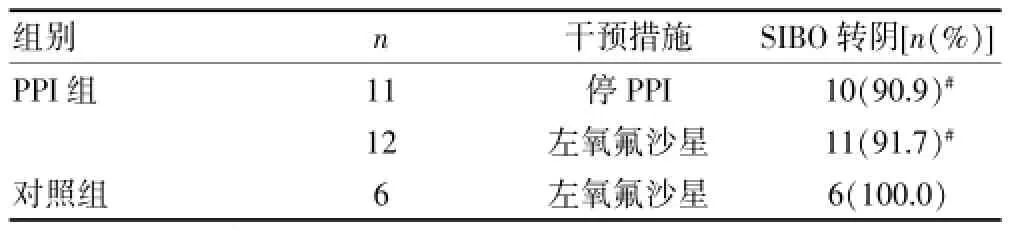
表2 SIBO陽性者的干預結果
3 討論
健康人的胃、十二指腸、空腸細菌的種類及數量極少,主要為革蘭陽性需氧菌,如鏈球菌、葡萄球菌和乳酸桿菌。回腸末端由于腸液流量少,蠕動減慢,細菌數逐漸增加,主要含乳酸桿菌、大腸埃希菌、類桿菌和梭狀芽胞桿菌等[1]。正常小腸腸道菌群,受到胃酸、膽酸、膽鹽、胃腸道的節律運動、黏膜分泌(消化酶、抗體免疫物質)和更新脫落、黏液流動、腸腔電位等調節,僅有極少量的革蘭陰性厭氧菌存在并維持著小腸生態的相對穩定[2]。SIBO是一種腸道內的細菌移位導致小腸內厭氧菌群數量增多或者種類改變的狀態,表現為腹脹、腹瀉、營養吸收不良以及小腸動力異常等的臨床綜合征[3]。引起SIBO的病因較多,成人報道較多的病因有胃酸減少或胃酸缺乏性、小腸壅積、小腸動力障礙、胰腺疾病[4-7]。
Husebye等[8]認為升高小腸1個pH值相當于小腸內微生物計數增加了13.8%。PPI制劑強效抑酸導致的胃酸分泌低下可能引起潛在副作用也受到關注。目前對PPI引起SIBO的機率、發病的時間、危害、明確的機制等問題,尚不十分清楚。Ratuapli等[9]對566例服用PPI的患者進行了LHBT,發現服用PPI組的SIBO陽性率與未服藥組的陽性率無明顯差異,但是并未將PPI的使用時間納入。Lombardo等[10]發現長期服用PPI制劑者SIBO患病率為50%。Lo WK等[11]最近對有關質子泵抑制劑的使用與SIBO關系進行了Meta分析,結果提示使用PPI的患者患SIBO的合并危險度是未使用者的2.282倍。國內研究認為PPI的使用時間與SIBO陽性率均存在正相關[12,13]。在PPI長期應用發生SIBO的機制中,推測PPI導致的胃酸分泌低下及對宿主防御能力的影響可能是主要原因。有研究表明,PPI在體外表現出對中性粒細胞功能的損害,降低其對內皮細胞的粘附能力[14]。
本研究通過乳果糖氫呼氣試驗,檢測服用PPI制劑患者的小腸細菌生長情況。結果發現服用PPI制劑8周SIBO累計陽性率為37.5%,24周SIBO累計陽性率為58.3%,而對照組同時點SIBO陽性率分別為12.2%、14.6%。說明SIBO在PPI制劑服用人群中有較高的發生率,且隨著服藥時間的延長,發生率有逐漸上升的趨勢。由于各種臨床癥狀的重疊,與PPI使用相關的SIBO常被忽視。文獻報道對癥狀輕微的SIBO患者,限制碳水化合物的膳食,增加脂肪、礦物質和維生素,相關癥狀可緩解。對于癥狀明顯者,推薦1~2周標準劑量的抗菌藥物,如利福昔明、左氧氟沙星等,或在1個短療程的抗菌藥物之后,給予益生菌[15,16]。本研究發現不停用PPI應用左氧氟沙星有較好效果。
[1]Erwin G Zoetendal,Jeroen Raes,Bartholomeus van den Bogert,et al.The human small intestinal microbiota is driven by rapid uptake and conversion of simple carbohydrates[J].ISME J,2012,6(7):1415-1426.
[2]Delphine M Saulnier,Yehuda Ringel,Melvin B Heyman,et al.The intestinal microbiome,probiotics and prebiotics in neurogastroenterology[J].Gut Microbes,2013,4(1):17-27.
[3]Jan Bures,Jiri Cyrany,Darina Kohoutova,et al.Small intestinal bacterial overgrowth syndrome[J].World J Gastroenterol,2010,16(24):2978-2990.
[4]MariaCarmenCollado,MariaCernada,ChristineBaüerl,etal. Microbial ecology and host-microbiota interactions during early life stages[J].Gut Microbes,2012,3(4):352-365.
[5]Sachdev AH,Pimentel M.Gastrointestinal bacterial overgrowth:Pathogenesis and clinical significance[J].Ther Adv Chronic Dis,2013,4(5):223-231.
[6]Richard A Schatz,Qing Zhang,Nilesh Lodhia,et al.Predisposing factors for positive D-Xylose breath test for evaluation of small intestinal bacterial overgrowth:A retrospective study of 932 patients[J].World J Gastroenterol, 2015,21(15):4574-4582.
[7]Larry S Miller,Anil K Vegesna,Aiswerya Madanam Sampath,et al.Lleocecal valve dysfunction in small intestinal bacterial overgrowth:A pilot study[J].World J Gastroenterol,2012,18(46):6801-6808.
[8]Husebye E,Hellstr?m PM,Sundler F,et al.Influence of microbial species on small intestinal myoelectric activity and transit in germ-free rats[J].Am J Physiol Gastrointest Liver Physiol,2001,280(3):368-380.
[9]Ratuapli SK,Ellington TG,O'Neill MT,et al.Proton pump inhibitor therapy use does not predispose to small intestinal bacterial overgrowth[J].Am J Gastroenterol,2012,107 (5):730-735.
[10]Lombardo L,Foti M,Ruggia O,et al.Increased incidence of small intestinal bacterial overgrowth during proton pump inhibitor therapy[J].Clin Gastroenterol Hepato,2010,8(6):504-508.
[11]Lo WK,Chan WW.Proton pump inhibitor use and the risk of small intestinal bacterial overgrowth:A metaanalysis[J].Clin Gastroenterol Hepatol,2013,11(5):483-490.
[12]宋明偉,姜葵.質子泵抑制劑與小腸細菌過生長關系的研究[J].天津醫科大學學報,2014,20(6):445-447,458.
[13]金玲肖,劉福,龍惠珍,等.應用質子泵抑制劑導致小腸細菌過度生長發生的可能性[J].中國微生態學雜志,2010,22(12):1113-1114.
[14]Yoshida N,Yoshikawa T,Tanaka Y,et al.A new mechanism for anti-inflammatory actions of proton pump inhibitors-inhibitory effects on neutrophil-endothelial cell interactions[J].AlimentPharmacolTher,2000,14(1):74-81.
[15]Rosania R,Giorgio F,Principi M,et al.Effect of probiotic or prebiotic supplementation on antibiotic therapy in the small intestinal bacterial overgrowth:A comparative evaluation[J].Curr Clin Pharmacol,2013,8(2):169-172.
[16]Hamvas J.Proton pump inhibitor therapy and small bowel bacterial contamination[J].Orv Hetil,2012,153(33):1287-1293.
Assessment and intervention of small intestinal bacterial overgrowth during proton pump inhibitor therapy
YANG Li1,2ZHOU Dongxiao3CHEN Guangyao3GAO Xiao3MA Yingjie1,2
1.Department of Gastroenterology,Zhengzhou People's Hospital,Zhengzhou 450003,China;2.Zhengzhou Institute of Digestive Disease,Zhengzhou450003,China;3.Graduate Division,Xinxiang Medical College,Xinxiang453003,China
Objective To investigate the prevalence of small intestinal bacterial overgrowth(SIBO)in patients with longterm treatment with proton pump inhibitors(PPI),and explore the intervention measures for SIBO.Methods 77 patients treatment of PPI were selected as observation group,41 healthy volunteers were selected as control group,all subjects were prospectively analysed by lactulose hydrogen breath test(LHBT).SIBO positive persons were given stopping PPI or levofloxacin(0.2 g,tid,1 w)and not stoping PPI,and all subjects
SIBO review in 4 weeks.Results The SIBO positive rates had no statistically significant differences between two groups before and 8 weeks after the PPI treatment (P>0.05).After 24 weeks,the SIBO positive rate of the PPI group was significantly higher than that of the control group (P<0.05).The SIBO positive rate of PPI treatment group was increased with the extension of treatment time.There was significant difference at pre-treatment,8 weeks post-treatment and 24 weeks post-treatment in PPI treatment group (P<0.05).The SIBO negative conversion had no significantly differences between the PPI stopping group and antibiotics treatment group(P>0.05).Conclusion Taking PPI can increase the risk of small intestinal bacterial overgrowth,and this risk increases with the time of drug administration,SIBO can be turned negative by using antibiotic or stop taking PPI. [Key words]Proton pump inhibitors;Lactulose hydrogen breath test;Small intestinal bacteria overgrowth;Intervention
R378
B
1673-9701(2016)14-0097-03
河南省鄭州市科技項目(CZSYJJ13015)