VISITS OF OPPORTUNITY
2016-07-12 22:40:34ByYuLintao
Beijing Review 2016年26期
By+Yu+Lintao
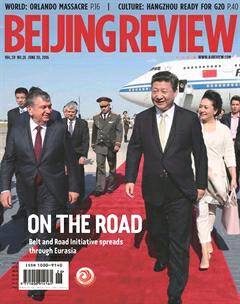
Though Chinese President Xi Jinping had many issues on the agenda during his latest overseas trip on June 17-24, his first priority was to advance the building of the Silk Road Economic Belt and the 21st-Century Maritime Silk Road. The Belt and Road Initiative dominated the interaction between Xi and his hosts in Serbia and Poland in Central and Eastern Europe (CEE) as well as Uzbekistan in Central Asia.
“The visits instill new vitality in the Belt and Road Initiative,” said Li Zuguo, a researcher on Central Asian and CEE studies at the China Institute of International Studies.
Both CEE and Central Asia are essential components of Chinas Belt and Road Initiative, which was proposed by Xi in 2013 to promote common prosperity across more than 60 countries along their routes in Asia, Africa and Europe through greater policy and infrastructure interconnectivity. In the meantime, CEE and Central Asian nations have a strong desire to cooperate with China for their own development. Serbia, Poland and Uzbekistan were among the first to respond to this initiative.
Big projects
CEE is a key platform for the Belt and Road Initiative to take hold in Europe. So far, among the 16 nations in the region, seven have signed a memorandum of understanding with China on jointly building the new overland and maritime silk roads.
Serbia, for example, hopes that its reindustrialization strategy can coincide with the Belt and Road Initiative, which is expected to generate more foreign invest- ment, Li told Beijing Review.
During interviews with the Chinese media in Belgrade ahead of Xis visit, Maja Gojkovic, President of the Serbian National Assembly, hailed the growing economic links between the two countries. She said that new Chinese industrial projects in Serbia could be on the horizon. She added that Chinese investment and a strategic partnership between the two countries will only serve to stimulate the Serbian economy.
Li claimed that based on their sound bilateral relations, China-Serbia economic cooperation can serve as a model for ChinaCEE collaboration.
Actually, over the past several years, China and Serbia have cooperated on a number of projects such as the BelgradeBudapest Railway, the Mihajilo Pupin Bridge over the Danube River in Belgrade, the Smederevo Steel Mill and the expansion and upgrading of the Kostolac Power Plant.
During Xis trip to Serbia, he paid a visit to the Smederevo mill, the only steel maker in Serbia. Established in 1913, the cashstrapped company was acquired in April for$51.6 million by the HeSteel Group which is based in north Chinas Hebei Province. HeSteel has announced a plan to invest at least $337.6 million in order to make Smederevo one of the most competitive steel mills in Europe as well as retaining its 5,000 or so workers.
The renovation of the railway line between Belgrade and Hungarys Budapest was launched last year. The project is partially financed by China. Upon its completion, travel time between the two cities will be shortened from eight to less than three hours.
At a joint press conference last July, Serbian Prime Minister Aleksander Vucic emphasized the railways importance in connecting his nation to other parts of Europe, while Hungarian Prime Minister Viktor Orbán praised the line as a“most hopeful enterprise.”
According to Liu Zuokui, a researcher with the Chinese Academy of Social Sciences, under the framework of the Belt and Road Initiative, the Belgrade-Budapest Railway will also be linked to other rail routes in Europe and, along with Greeces main port of Piraeus, form a China-Europe land and sea express passage.
Currently, Poland is Chinas largest trading partner in CEE, while China is Polands largest trading partner in Asia as well as its third-largest importer. During Xis visit, a series of cooperative documents on industrial capacity, finance and infrastructure construction were signed between the Chinese and Polish governments.
Li explained that because of Polands location in the heart of Europe, almost all China-Europe freight trains pass through the country, granting Poland the opportunity to play an important role in advancing the Belt and Road Initiative.
He added that the EU debt crisis and its sluggish growth have negatively affected Poland, the largest economy in CEE. Against this backdrop, Warsaw has sought greater economic cooperation with China, since the latter is a major engine of the global economy that can bring more opportunities to Poland.
In a recent article published on Chinas leading newspaper Peoples Daily, Wang Yiwei, a professor on European studies at Renmin University of China, analyzed Polands active China policy. He cited the expiration of EU aid to Poland in 2020 and a desire to increase its economic capacity as fundamental factors behind this trend toward China. As the only member of the China-led Asian Infrastructure Investment Bank belonging to the CEE region, Poland seeks to be a portal for Chinese investment in Europe, according to Wang.
A joint communiqué issued during Xis stay in Warsaw confirmed the both sides desire to integrate the Belt and Road Initiative with Polands own sustainable development strategy in order to promote common prosperity.
As for Uzbekistan, Li told Beijing Review that the landlocked country also looks forward to the Belt and Road Initiative to upgrade its transportation networks to facilitate exports of energy and agricultural products, two main pillars of the countrys economy.
“As a major cotton producer in the world, Uzbekistan has an edge in developing the textile industry. However, if its transportation weaknesses persist, it will continue to lose out to Pacific coastal nations such as Indonesia and Bangladesh in terms of attractiveness to investors and clients,” Li said. For this reason he explained that Uzbekistan has shown extraordinary interest in the Belt and Road Initiative, as it conforms to its strategic needs.
The 19.2-km Qamchiq Tunnel, the longest of its kind in Central Asia, is a key project in the Belt and Road Initiative in Uzbekistan. It forms part of the Angren-Pap Railway connecting the countrys capital Tashkent with the eastern city of Namangan. The project, undertaken by the China Railway Tunnel Group, was completed earlier this year and has become operational. In addition, ChinaUzbekistan cooperation on other programs such as the China-Central Asia gas pipeline and an industrial park is also going smoothly, covering energy, transportation, chemical and hi-tech sectors.
Xis recent visit saw the signing of a number of deals on cooperation in energy, finance, infrastructure and technology between the two countries.
China-CEE relations
Notably, Xis visit to Serbia and Poland was his second trip to CEE within three months, having gone to the Czech Republic in March.
Chinese observers said that it is rare for a Chinese head of state to set foot in the same region twice within such a short interval during overseas visits, therefore the move reflects the rising importance of the CEE region in Chinas diplomacy.
Geographically, Poland adjoins the Baltic Sea and Serbia lies at the center of the Balkan Peninsula. Along with the Czech Republic, the three countries constitute the principle axis of the CEE region. Through connections with these nations, China can expand cooperation throughout CEE, Li said.
Though the CEE region has achieved relatively fast growth in recent years, more challenges have begun to emerge. Current growth in CEE countries relies heavily on the EU, which accounts for over 80 percent of CEE exports. Economically developed members of the EU are also main sources of foreign direct investment in the region. Thus, the EUs weak economic recovery, particularly in the eurozone, has cast a shadow on CEEs development prospects. However, the EUs investment in CEE countries is diminishing, bringing greater economic uncertainty to the latter.
Comparatively, there is a lot of potential for China-CEE cooperation. Despite CEE countries accounting for 30 percent of Europes territory and one quarter of its population, imports and exports between China and CEE make up only 10 percent of ChinaEurope bilateral trade, standing at $56.2 billion in 2015.
“Successful cooperation projects such as the Belgrade-Budapest Railway and the Mihajlo Pupin Bridge demonstrate the dynamics of cooperation between China and CEE countries,” he said.
Liu echoed Lis views, pointing out the influence of Serbia and Poland in CEE countries and how their bilateral relations with China can become a precedent to ChinaEurope relations.
Poland has already shown a desire to bridge cooperation between China and CEE. The joint communiqué signed between China and Poland during Xis visit underscores an ambitious and extensive ChinaEU investment agreement, covering market access and investment protection. The two sides also pledged to enhance communication and coordination based on the principles of openness, inclusiveness and mutual benefit in order to promote ChinaCEE cooperation.
The CEE region now faces the task of upgrading its transportation networks, gas and oil pipelines, electricity grids and other infrastructure as well as industrial equipment. This has opened a path for cooperation, since China is strong in its capacity to pro- vide construction and supporting services. In the Balkan region alone, there are more than 1,000 km of railways in need of upgrades.
As a result, Wang remarked in his article that China is good at providing exactly what is needed in CEE.
To improve this cooperation, a 16+1 mechanism (the 16 CEE countries plus China) was established in 2012. Under this framework, exchanges in the fields of investment, energy, infrastructure, trade, tourism as well as science and technology are increasing rapidly.
The mechanism has also given fresh impetus to many projects between China and regional countries. For example, a direct freight train service linking China and Poland became operational in 2013. In 2014, the China Gezhouba Group signed an engineering, procurement and construction contract in Bosnia and Herzegovina. In addition, tourism and financial cooperation between the two sides have witnessed great progress in recent years.
More importantly, Chinese observers believe that closer China-CEE cooperation can have a positive effect on China-EU relations, since 11 of the 16 CEE countries are EU members and the remaining five are going through the application process.