
An Overview of the Inductive Approach Using in English Grammar Teaching
2016-07-04 05:28:22XuXiaofeiQiJiayan
校園英語·上旬 2016年3期
Xu Xiaofei Qi Jiayan
Introduction
This lesson plan focuses on passive voice and is designed for first grade students between 15 to 16 years old at senior high school in China. This essay will analyze the formation on the passive voice, as well as the usage and the errors. Secondly, I will briefly introduce my learners. Thirdly, it will discuss the inductive approach, the gap filling task and the writing task, which I chose to motivate my students to learn the passive voice well. Finally, it will mention about the learners errors in my lesson plan.
Analysis of the language point concerned
Swan (2005) explains that ‘when A does something to B, there are often two ways to talk about it. If we want B to be the subject, we use: was built, is spoken, is being repaired, will be changed. Swan also points out that the subject of an active is not always expressed in the corresponding passive sentence. In this case, it usually happens in an expression with by and the noun is called the ‘agent. According to Hewings (1999), we know that changing an active into a passive sentence involves move the object of the active sentence into the subject position in the passive sentence, and changing the main verb into the past participle form, preceded by the auxiliary be. A third step is optional, and may be left out if you wish, and that is to take the original subject of the active sentence and moving it to a position after the verb, preceded by the preposition by. The following example illustrates both possibilities: 1. ACTIVE: The earthquake destroyed the whole village. 2. PASSIVE: The whole village was destroyed. 3. PASSIVE: The whole village was destroyed by the earthquake.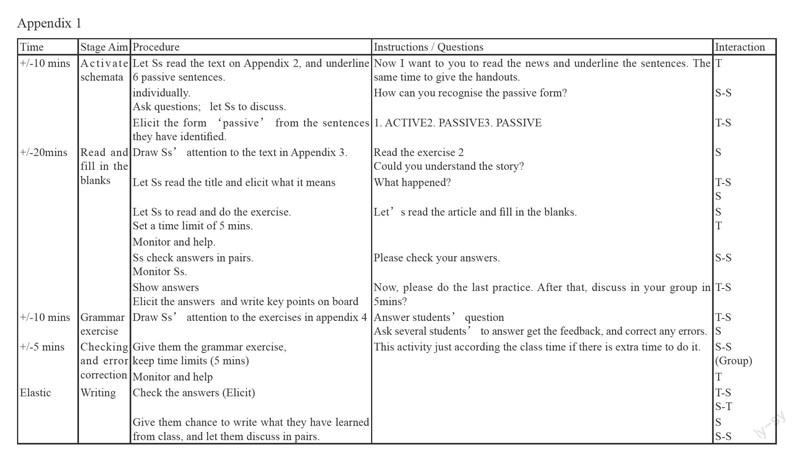
Also, there are three major uses of passive: to say what has happened, to avoid mentioning the agent, to conform to normal English discourse (Penston, 2005). Some examples are presented below, respectively.
1. To say what has happened to something/someone
The society was founded in 1946 by Roland Berrill and Lancelot Ware.
2. To avoid mentioning the agent, who is not required to be or cannot be made know
It was originally known as the High IQ Society.
3. To conform to normal English discourse, keep the ‘topic at the front of the sentence and the new information in the predicate.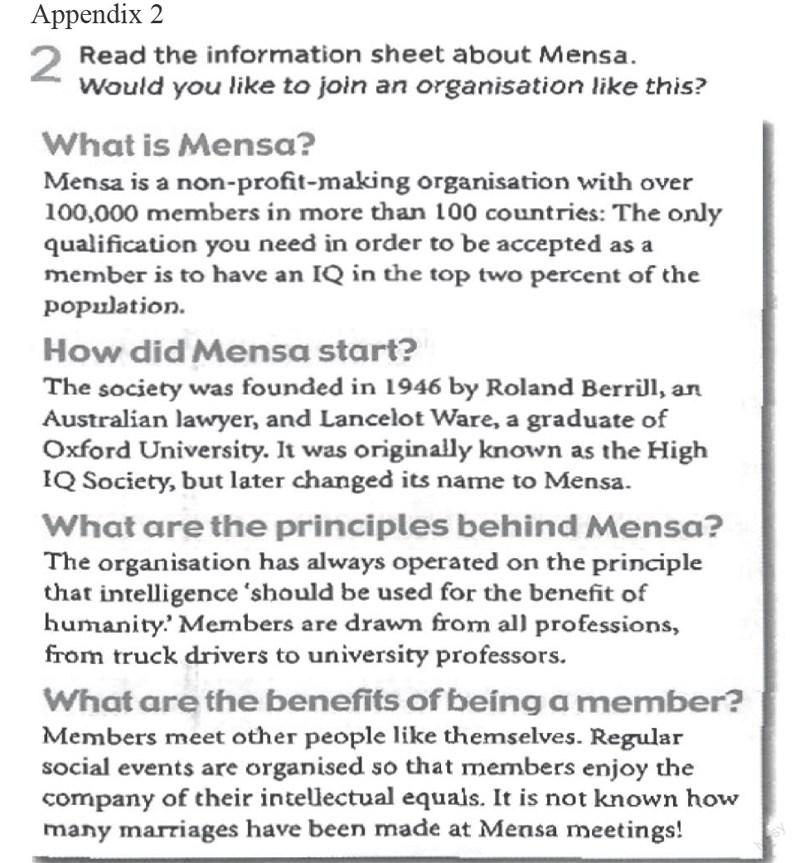
Roland Berrill played a lousy game…in the end they were crucified (by Lancelot Ware). (Compare: Lancelot Ware wanted revenge… in short, they crucified Roland Berrill.)
Aitken (2002) explains several errors in passive voice mainly about the form, spelling, punctuation, meaning and function problems. For Chinese students, the main reason of which is that Chinese and English belong to two different language systems. English Verbs have different forms in active voice and passive voice; unfortunately in Chinese verbs do not have any changes in different voices and tenses. While acquiring English passive voice, Chinese students will make errors because of the differences between the two kinds of languages. Although it seems to use passive voice better, while in Chinese still use the active voice instead of them. If you think about it, Chinese do not really have a ‘passive voice. This is shown by the following examples from Chinese:
1. fan zhu hao le (飯煮好了= ‘rice cook already instead of ‘rice had already been cooked )
2. xin xie hao le (信寫好了= ‘letter write already instead of ‘letter had already been written)
3. shu mai wan le (書賣完了= ‘book sell out already instead of ‘book had already been sold out)
On the surface, these Chinese sentences look just like ‘active sentences, because the verbs are in exactly the same form. But there are two major differences between English and Chinese that you should notice by comparing the above sentences with their English equivalents.
In fact, problems also arising from the formation of past participle or from the tenses of to be may be transferred to the passive (Swan & Smith, 2001). For instance, we were inviting to a party. The buildings are selling out. Moreover, Chinese learners are sometimes unwilling to use the past participle form for present meaning because some languages like Chinese do not have a special verb from like the past participle (invited, sold, written etc), which is associated with the passive voice in English.
Brief analysis of the learners and the learning context
The school is a private high school in Jiaxing, and it also has an entrance examination as the majority school in China, which is regarded as a main key to access a high-grade university. There are thirty students in each class with the ranges 15 to 16 years old. Their level seems to be intermediate to upper-intermediate. The English lessons are 4 classes per week and each class 45 minutes.
Although the new curriculum reform brings new changes of teaching ideas and teaching methods, some teachers still pay more attention to the grammar teaching. It can discourage the students formal language experience and can hinder their ability to learn and improve. Consequently, students may gradually lose interest in English and they perceive that classroom teaching is ineffective. Additionally, there is the notion that ‘Task-based teaching method can be used by teachers blindly. Teachers believe the new curriculum reform places too much emphasis on verbal ability. In fact, the teacher do not understand the true meaning of ‘play down the grammar, which leads to the neglect of grammar teaching. Students oral and written expressions are arbitrary, which hinders their ability to use the language.
Overview of the approach I would use in teaching this topic to these learners
My lesson plan (see Appendix 1) is based on the knowledge of passive voice that my learners had already learned in junior high school; therefore I have divided into three main parts. Firstly, I have chosen an inductive approach instead of the traditional way of grammar to teach the passive voice. Thornbury (1999) stats in the inductive method the teachers provide learners with authentic language data and induce the learners to realise grammar rules without any form of explicit explanation. It is believed that the rules will become evident if the students are given enough appropriate examples.
Therefore, I give a text to let student to read and discover the rules of passive voice (Appendix 2).This activity is just as a warming up in order to help students remember what they have already learned in middle school. Although the students know the rules and the formation of the tenses, it is still necessary to elicit in a systematic way. Nunan (2004) lists several things teachers can do to help learners notice target structures which include explicit instruction. Ellis (1994) claims that group work provides the kind of input and opportunities for output that promote rapid L2 acquisition, and he also points out that small-group work provides more opportunities for language production.
Secondly, I use the task-based activities to let learners finish gap filling. According to Willis (1996), a task is an activity ‘where the target language is used by the learner for communicative purpose (goal) in order to achieve an outcome. Undoubtedly it is a good way to stimulate students interest and an implicit way to consolidate the grammar and train their communicative ability. As evident from Nassaji & Fotos article, teachers may prefer different methods of focusing on form; however, the one thing that unites most of them today is their firm belief that in order for L2 learners to develop their communicative abilities, learners must be offered grammar courses that focus on both grammar and communication.
Thirdly, I will let students to do practice exercise in order to know exactly what they have learned, and find the errors in this activity.
Account of the types of errors
Depending on the task and the context I chosen, I planned correcting the errors after pair work. While students are involved in a passionate discussion, for keeping the conversational flow I would like to correct errors after discussing. Supporting opinions by Harmer (2007) showed that correction is often not appropriate since it can interfere with the flow of activity. During the activities, I monitored the whole process and found the most errors are corrected by themselves. Therefore, I took notes and analyzed the frequent errors then gave feedback to the students.
Conclusion
To sum up, it is generally accepted that a good lesson plan needs to rely on different good ideas and suitable materials with proper activities, even the smallest details need to be thought out well and clearly. Teaching grammar, we would try to provide learners with many opportunities to use the language for communicative purpose, and develop the learners integrated ability through the process of communicating rather than their perfect mastery of individual rules and structures.
References:
[1]AITKEN,R.,2003.Teaching tenses.Sussex:ELB Publishing.
[2]BIBER,D.,CONRAD,S.,andLEECH,G.,2002.Longman student grammar of spoken and written English.Harlow:Longman.
[3]ELLIS,R.,1994.The study of second language acquisition.Oxford:OUP.
[4]HARMER,J.,2007.How to teach English.Essex:Pearson Education.
[5]HEWINGS,M.,1999.Advanced grammar in use.Cambridge:CUP.
[6]NASSAJI,H.,and FOTOS,S.,2004.Current developments in research on the teaching of grammar.Annual review of applied linguistics 24.
[7]NUNAN,D.,2004.Task-based language teaching.Cambridge:CUP.
[8]PENSTON,T.,2005.A concise grammar for English language teachers.Dublin:Future Print.
Appendix 2
(From New Cutting Edge Upper-Intermediate Student Book, 2005)
Appendix 3
2. Complete the text in each gap, and then check with your group members.
(From New English File Upper-Intermediate Student Book, 1997)
Appendix 4
3. Complete following sentences, and check in pairs.
(Form New Cutting Edge Intermediate Student Book, 2005)
作者簡介:
徐曉菲(1987-),女,浙江嘉興人,嘉興學院南湖學院,助教,英語語言教學碩士,英語語言教學及課程開發和評估。
祁佳艷(1990-),女,浙江嘉興人,嘉興學院南湖學院,助教,語言學碩士,語言獲得及雙語研究方向。
猜你喜歡
非公有制企業黨建(2020年9期)2020-09-26 13:22:18
文苑(2020年4期)2020-05-30 12:35:30
小學生作文(中高年級適用)(2018年3期)2018-04-18 01:24:47
領導決策信息(2017年12期)2017-05-17 04:49:18
華北電力大學學報(社會科學版)(2016年4期)2016-12-01 03:59:30
中國衛生(2016年7期)2016-11-13 01:06:44
小學生導刊(低年級)(2016年2期)2016-02-24 23:02:11
少兒科學周刊·少年版(2015年4期)2015-07-07 21:11:17
中國衛生(2014年10期)2014-11-12 13:10:10
小天使·五年級語數英綜合(2014年5期)2014-06-25 05:22:42

- 校園英語·上旬的其它文章
- 《簡愛》中的“火”意象
- On the Tragedy of Miss Brill in Katherine Mansfield’s Miss Brill From the Perspective of Contrast
- The Disillusion of American Dream in Sister Carrie
- 《玫瑰園中的影子》的“玫瑰”意象及對話分析
- 言說者文本視角下看內勒的《戴媽媽》
- Discussing the Application of Amplification andOmissionin Company Profiles Translation from Chinese to English