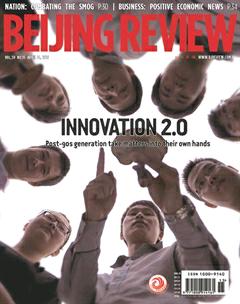
NEXT GEN INNOVATORS
2016-04-26 22:41:40ByWangHairong
Beijing Review 2016年15期
By+Wang+Hairong


On a sunny afternoon earlier this month, an employee from leading Chinese telecommunication company Huawei Technologies traveled to Tsinghua University to meet with students and potential partners at the iCenter, a hatchery for innovative projects and entrepreneurs.
In a spacious room on the first floor of the newly built Lee Shau Kee Science and Technology Building, which houses the center, two students demonstrated their virtual reality equipment and programs to Huawei and other prospective investors. The duo are from OwlReality, a Tsinghua-based startup founded by third-year doctoral computer science candidate Wen Ziyu that develops virtual reality software.
“With help from Chuang-plus, we completed the registration process for our company in one day,” Wen told Beijing Review. Chuang-plus is a platform set up by Tsinghua University to assist student-founded startups.
The center buzzed with other activities from engineering students learning how to make gadgets using different machinery to others setting up equipment for interactive meetings between entrepreneurs and investors on different floors of the building.
Spread over 16,500 square meters, iCenter is the largest on-campus innovation center in the world, according to Sun Hongbin, Chairman of Innovation and Entrepreneurship Education Committee of Tsinghua University and Secretary General of the Innovation and Entrepreneurship Education Alliance of China, a platform for universities to share relevant resources, exchange ideas and establish standards. The alliance was launched in Beijing in June 2015 and is comprised of members from more than 150 universities and 50 companies.
“The center is student-oriented. Every year, 5,000 to 6,000 students take part in activities here,” Sun said. Students are encouraged to “be a maker and make everything, and turn their dreams into reality.”
Fostering innovation
ICenter, which offers tools such as 3D printers to the students to use for free, is one of many cropping up across the country in response to the governments call for more student entrepreneurs. The State Council released further guidelines in May 2015 for higher education institutions to develop additional innovation and entrepreneurship education measures.
“College students are a fresh and dynamic force in pursuing Chinas strategy of innovation-driven development, and their practical abilities should be improved, while those wanting to start their own businesses must be supported,” Premier Li Keqiang wrote in a letter to college students participating in the first Internet Plus Innovation and Entrepreneurship Competition for College Students held in Changchun, capital city in Jilin Province, on October 19-20, 2015. Internet Plus refers to the Chinese Governments policy of integrating information technology with conventional industries.
Campuses across the country have launched various initiatives to implement the Central Governments guidelines. So far, 82 percent of universities and colleges have created innovation and entrepreneurship courses, 68 percent have set aside venues for relevant activities and 6.13 million people have participated in such activities, China Education Daily recently reported.
“Tsinghua University seeks to boost high-level innovation and entrepreneurship by shaping students value system, nurturing their abilities and disseminating knowledge,”Sun told Beijing Review. “We would like to integrate imagination, innovation and entrepreneurship,” he said. The university has built several platforms to encourage students to improve their creativity, execution and leadership ability.
More than 20 interest groups, each with 40-50 members, are active on campus, including groups focusing on future automobile and robots, Sun said.
Other platforms include the iCenter, Chuang-plus and X-lab. The X-lab, established in 2013 and based in the School of Economics and Management, mainly offers innovation and business consulting services to students, such as improving products, meeting with investors, drafting business plans and marketing products and services.
Tsinghua has adjusted its curriculum to encourage innovation and entrepreneurship. More than 30 undergraduate courses have been created so far. The university also revised its rules to allow students aspiring to create their own companies a grace-period of up to three years.
One course on how to start businesses opened to all students in the university in the spring of 2015. Famous entrepreneurs, such as New Oriental Education and Technology founder Yu Minhong, are invited to the classroom to address students. The university has also opened several cross-disciplinary minors, such as future robotics, smart hardware and smart transportation. Students began enrolling in these programs this spring, and their grades will be reflected on their diplomas.
The university is extending beyond its own walls to reach its students online and with other universities overseas. It launched about 20 courses on Massive Open Online Course websites and has set up a variety of outside partnerships to boost innovation, including one with Washington University.
The two universities launched a masters degree program in technology innovation at the Seattle-based Global Innovation Exchange (GIX), a research facility funded by Microsoft.
Tsinghuas student innovators received attention from Chinese leaders. On May 4, 2015, Premier Li wrote back to Tsinghuas creative students who told him about their innovative efforts. The premier said he hopes college students will think outside of the box, and continue to engage in innovative and entrepreneurial activities. He also said the government will unveil more policies and build a larger stage for entrepreneurs in China.
Tsinghuas innovators have been making waves on and off campus in recent years. Students from Tsinghua walked away with a gold medal and a silver medal in the first Internet Plus Innovation and Entrepreneurship Competition for College Students. Around 200,000 students from more than 1,800 colleges took part in the competition, according to Xinhua News Agency.
Uncertain horizons
The winning team headed by Huang Boyuan, a masters student majoring in automobile design uses virtual reality technology to give homeowners a “real” view of how their homes will look like after its interior is decorated.
Some students have reached broader success, such as Wang Hao, founder and CEO of Phantom, a smart home company. He studied at Tsinghuas Department of Precision Instrument from 2006 to 2010, where he was a member of a student in- novation group. In 2013, he founded Phantom, which currently has more than 30 employees. It has launched smart light bulbs and portable switches that enable users to control the lights with a remote. Consumers can use their smart magnet sensors to see if their home doors and windows are open using an application on their cell phone.
This year, more than 100 newly graduated Tsinghua University students are expected to launch their own businesses, Lin Chengtao, Director of the Career Development Center at Tsinghua University, recently told Guangming Daily. Lin said that last year the figure was 60.
Nearly 7,000 students will graduate from Tsinghua this summer and enter the labor force, Lin said.
But Sun warns that merely looking at the number of graduates starting their own companies upon graduation is not a healthy way to measure the overall impact of encouraging innovation and entrepreneurship in higher education. The effect of their education needs be measured in the long term, as it takes some companies 20-30 years to grow, he said. Also, not all innovators are cut out for creating their own companies, he said.
Tsinghua aims to nurture high-level businesses to cope with the challenges confronting humankind in such areas as renewable energy, smart hardware and environmental protection, he said.
“Starting businesses and making money are the natural outcome of education rather than the goal,” he cautioned. Innovation should be geared toward meeting social needs, and good products and services that meet those needs will bring in money, he added.