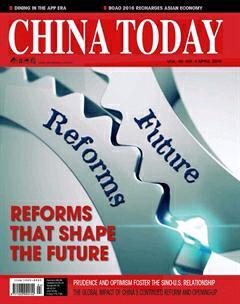
Kenneth Pomeranz: A Non-Western Perspective on China
2016-04-15 02:18:56BystaffreporterZHANGHONG
CHINA TODAY 2016年4期
By staff reporter ZHANG HONG
FOR decades, American aca- demic Kenneth Pomeranz has been studying the history of Chinas economy and environment. In a recent interview with China Today the prominent sinologist shared with us his thoughts on Chinas economic development and role in globalization.
“Just a Different Mode”
In the 1980s, Pomeranz was working on his masters degree. He could read historical materials written in Chinese, but was not too familiar with Chinese historians. Today, his students in the U.S. are keenly aware of what is happening on the other side of the Pacific and what Chinese historians are studying. He is pleased that communication between the American and Chinese sides now also involves more face-toface discussions.
“Its not unusual for them to have a drink together after an academic symposium,” said Pomeranz, a professor at the University of Chicago specializing in late imperial and 20th-century China. He is also happy to see that Americas younger generation of Chinese history experts have developed more integrative views on important academic issues in China.
Pomeranz traces his devotion to Chinese history to “a lucky coincidence.”When he randomly took several Chinese history courses in college, he never expected to be inspired by the lectures of sinologist Sherman Cochran. This led to a doctorate from Yale University, where he studied under China historian Jonathan Spence.
Today, Pomeranz is a world-renowned economic and environmental historian and a fellow of the American Academy of Arts and Sciences. He is also one of the most prominent members of the California School, a group composed of scholars teaching in California and beyond. As specialists in the comparative research of the economic history of China and Europe, these historians criticize Western-centric ideological trends, and seek to bring fresh insights into the conversation.
Pomeranzs research has been greatly influenced by American historian Paul A. Cohen. It is believed that a huge gap existed in Chinas history of economic development. China and the U.K. shared a similar economy in the 18th century, but their economic paths diverged in the following century. The phenomenon is often conventionally explained by asking what mistakes China made during this time.
But Pomeranz would like to think of the answer from a different perspective. When comparing China and Europes roads to economic progress, he tends to emphasize the functions and influences of the ecological environment.
“Before the industrial revolution, the coastal areas south of Shanghai were probably some of the most affluent areas in the world,” he said. “The standard of living in the Yangtze River Delta, where the population exceeded 31 million in 1770, was comparable to that in Britain in the mid-18th century.”
In his book The Great Divergence: China, Europe, and the Making of the Modern World Economy, he compared Britain and the southern part of the Yangtze Rivers lower reaches to explain how Europes growth surpassed that of Asia in the 19th century.
He argued that Europes divergence from Asia owes much to the discovery of the New World and the huge supply of coal in Britain. Colonial exploitations and easy access to Britains coal helped Western Europe solve its problems of finding the natural resources needed to transform into an industrialized society.
As a result of this “great divergence,”Pomeranz said, the Wests development began overtaking that of the East. The book won the John K. Fairbank Prize in 2000 and shared in the World History Association Bentley Book Prize in 2001.
Pomeranz is eager to explain the significance of China to colleagues specializing in Western history. “Historical development could be compared to a speeding truck,” he said, “Researchers in the West tend to think that China fell off the truck but have now caught up to it. But I believe that China is taking another vehicle to move ahead – a different mode from that of the West.”
Globalization ≠ One-way Westernization
To counter Western-centrism in history, the California School advocates that China not be evaluated according to the Wests development model. Pomeranz has particularly reacted to John K. Fairbanks “impact-response” concept, which studies the East from a Western perspective.
Fairbank held that Confucianism, the dominant ideology in China and which largely contributed to ancient Chinas social stability, led to a sluggish reaction when the empire was challenged by the arrival of Westerners in search of business opportunities in coastal areas. The country closed its doors and rejected every single outsider. Fairbank noted that challenges from the West eventually provided China with opportunities for progress.
In Pomeranzs view, China was indeed impacted by the West. Still, he said, the two sides have always mutually influenced each other, and it is inaccurate to say that not a single meaningful change took place in China before it was modernized.
When talking about Chinas status against the backdrop of globalization, Pomeranz raised the example of the Chinese stock market. Last summer, share prices in China plunged and affected stock markets in other countries, including Australia and Chile.
He also talked about his perceptions of Eurocentrism. Some believe that modernization originated in Europe and often highlight Europes influences on other parts of the world. But Pomeranz thinks “the effects are mutual.” For instance, silver mines discovered in America led to the rise of imperialism in Europe. In his eyes, globalization can take place in other forms besides integration, and people need to rethink how far and how long they should allow the “fusion”to continue.
Pomeranz, meanwhile, is worried that economists sometimes only pay attention to the simplest solutions – the so-called rational schemes under globalization – rather than taking regional limitations into consideration. He gave as an example the water supply shortage in northern China. The countrys large south-to-north water diversion project is designed to take water from the Yangtze River to feed dry areas in the north, including major cities like Beijing and Tianjin. He said that in economistsview, reducing farming in the north may solve the water shortage, and the accompanying food problem can be solved by importing food or leasing agricultural land abroad.
But solutions of this kind will face considerable challenges in this era of globalization, Pomeranz explained. Once China begins to import grain, concerns may grow over a potential rise in international food prices; and renting farmland overseas is likely to result in suspicions of Chinas motives. In a sense, the water diversion project provides a rational and ideal solution to this problem, the professor said.
In his book The World That Trade Created, Pomeranz wrote that the study of regional economies must be done visa-vis globalization, since differences in regional economies and mechanisms constitute the global context. He agrees that the world is interrelated, but believes that the term “globalization” portrays the world as assimilated, which would make meaningless the study of distinct entities.
Pomeranz holds that globalization is not a one-way path toward Westernization or Americanization. Over the past three decades, East Asia and Southeast Asia have scored outstanding economic growth, he said, but it is barely known that these achievements come not only from trade development between Asia and the West but also from trade growth within Asia itself.