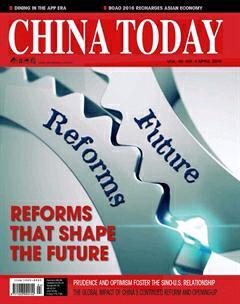
Boao 2016 Recharges Asian Economy
2016-04-15 01:50:19ByLINMINWANG
CHINA TODAY 2016年4期
By LIN MINWANG
THE 15th Boao Forum for Asia, convened in late March, was one of the first major diplomatic events China hosted this year. After years of development the event has built on its global reputation and is now more widely observed than ever before. The 2016 session is also deemed a run-up to the G20 Summit to be held in Chinas Hangzhou City in September.
Determine Direction
China values the Boao Forum as an opportunity to express its standpoint and make recommendations. Chinese President Xi Jinping delivered at the 2015 session a keynote speech titled “Towards a Community of Common Destiny and A New Future for Asia,” in which he called on Asian countries to foster a community of shared destiny, and elaborated on its guiding principles and Chinas role in this mission.
The theme of the 2016 forum, Asias New Future: New Dynamics, New Vision, reprised the key phrase – New Future – of the previous two sessions. In continuing to explore paths to Asias future development, the 2016 forum focused specifically on economic restructuring, regional economic interconnectivity and collaboration, more investment in infrastructures, and improving sci & tech innovation capacities.
China, the largest economy in Asia and the biggest trade partner of most countries in the region, shapes the future of the Asian economy. The trend and policies of Chinese economy at the “new normal” (lower growth rate, higher quality) stage are therefore of broad concern in Asia and beyond. Meanwhile, the regions geopolitical situation becomes trickier, as several disputes within it involve China. The Boao Forum offers China a much needed channel to speak out and explain itself to the rest of the continent and the world at large.
Fuel the Economy
The 2016 Boao Forum took place at a time when the outlook for Asian, including the Chinese, economy, appeared uncertain. This lent more weight to the event. China took this opportunity to address the concerns of its Asian peers and guide their expectations.
The two top economic issues Asia needed to address were:
First, where is the Chinese economy heading? The countrys 2015 GDP growth, at 6.9 percent, met its“around seven percent” target, but was undeniably the lowest since 1990. Inevitably there has been anxiety in the international community about prospects for the Chinese economy, as reflected in the outflow of a large quantity of foreign capital from the country, steep losses on the Chinese stock market, and fluctuation of the RMB exchange rate. All this bodes great uncertainty for the Chinese economy in the coming months, which in turn generates pessimism in the market.
Certain economists are convinced that the decline of Chinese growth is due to its shrinking labor force and rising labor costs as a consequence of an aging population. George Soros predicted in Davos last January that Asian currencies would weaken and that 2016 would be a difficult year for the market. The famed financiers explicit placing of the blame for this on China exacerbated world consternation about the countrys economic stability and raised the questions: Is Chinas real economy in trouble? And are Chinas policymakers capable of gradually slowing down the countrys economic growth without sparking an economic crisis or social unrest?
The second issue concerns the world economic out-look, and whether or not it will go from bad to worse and have adverse impact on Asia. The recent turmoil on global financial markets took its toll on the stock markets of developed economies like Japan, South Korea, France, and Germany, the economic development of emerging economies having already begun to flag. For years Europe has grappled with low growth and deflation, and the Abenomics phenomenon is far from reassuring. These factors compound world anxiety about the outlook for global growth. U.S. Federal Reserve Chair Janet L. Yellen told the Senate at a hearing on February 11 that she would not rule out the possibility of a global recession.
The Feds rounds of quantitative easing (QE) coupled with Chinas infrastructure spree, and the strong sales of bulk commodities by emerging markets and leading resource exporters, generated the drive towards global recovery. It, however, came with a downside that grew more pronounced with the passing of time, and its impetus is now tapering off. How can a new bout of global downturn be prevented? The world has pinned its hopes on economic restructuring.
The Boao Forum is convened against the backdrop of such fluxes in world economy, and emphasizes Asias significance. As Premier Li Keqiang remarked in his speech at the 2014 Boao Forum, Asia is one of the most dynamic regions in the world. “It boasts one third of the global GDP, over four billion people, and an ample supply of labor force. It enjoys distinct advantages as a latecomer and has tremendous untapped development potential.”
Meanwhile, most Asian countries are developing nations, with low per capita GDP and uneven regional development. Over 700 million people on the continent still live below the international poverty line. Asia hence faces the huge challenge of expanding the economy and improving peoples livelihood. Ultimately, the key to solving its problems lies in development, which to sustain Asia must explore new dynamic sources that build on its economic vigor and create a new outlook. This is vital both to the continent and the rest of the world.
Chinas Role and Responsibility
At the Boao Forum, China injected a “cardiotonic” to Asian, and even global, economic development.
Domestically, the country has steadfastly advanced reforms that will recalibrate its economy. Despite downward pressure, the Chinese economy remains a leading engine of world growth. Its growth goal for the 13th FiveYear Plan period (2016-2020), moreover, is well above that of other major world economies. Even at the “new normal” level, Chinas GDP gains have outstripped those of other countries and regions. The countrys around seven percent growth of last year contributed to one third of world growth. No country has yet shown itself capable of superseding China in this regard.
The Central Economic Work Conference held at the end of 2015 clarified the overarching economic policy of 2016 – promoting supply-side structural reform while paying due attention to the demand side. This entails fulfillment of five prioritized tasks, namely, reducing overcapacity, destocking the real estate sector, lessening leverage, lowering costs, and strengthening points of weaknesses.
These pledged reforms will boost market confidence globally and arrest the slumps in emerging economies and resource-dependent countries, so pushing the world economy onto the track of a new round of recovery.
Internationally, China is prominent in global efforts to find a solution to the current world economy doldrums. In September Hangzhou will host the G20 Summit, another major world economic event whose aim is to work out a new plan for and chart a new path to better global financial governance.
The theme of the summit is “Building an innovative, invigorated, interconnected and inclusive world economy.” To be innovative, the world must advocate innovation-driven development and structural reform that encourages innovation on all fronts, including science and technology, development concepts, mechanisms and institutions, as well as business models. The goal is to allow factors of production and resources to flow more efficiently throughout the world, generating new sources of growth.
To be reinvigorated, the world must bring growth potential into play. This requires advancing global economic governance towards more justice, equity and higher efficiency, enhancing individual countries internal growth impetus and growth quality, and beefing up the world economys resistance to risk.
Interconnectivity means close and wholesome communications and interactions. Inclusiveness means sharing development bonuses with other peoples.
In short, the 2016 Boao Forum proved yet again Chinas role and responsibility in Asian economic development. In addition to the aforementioned endeavors, China will continue to carry on with Japan and South Korea negotiations on the free trade area and the Regional Comprehensive Economic Partnership (RCEP), press ahead with the Belt and Road Initiative, and advance international cooperation on production capacity and regional collaboration in the financial sector. All of these actions will help to make East Asia a stable leading contributor to world economic growth.