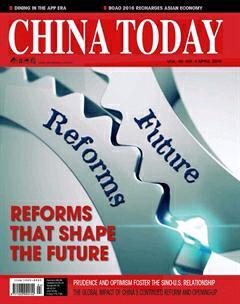
On Chinese Media
2016-04-15 01:26:56
CHINA TODAY 2016年4期
End of Oil?
Life Week Issue No.9, 2016
In former years, oil crisis theory was all about depleting oil reserves. As major emerging economies like China and India fueled growing consumption, the world geared up for a new round of energy crises.
Oil prices, however, began to nosedive in 2014, and have dropped 70 percent over the past 18 months. Last January, the oil price fell below US $30 per barrel, back to the 2003 level. Unlike previous slumps, this time the worlds oil producers didnt rush in to team up and bolster it. Instead they are preoccupied with preserving market share.
OPEC members have long felt the pinch. The old Middle Eastern and Soviet monopoly has been superseded by two broader supply sources – Middle East-Central Asia-Russia and America. The latter is the region of fastest oil and gas growth from unconventional sources and maritime oil and gas. There is indeed an increasingly pronounced trend of oil and gas extracted from the land being replaced by that from the ocean and unconventional sources, in addition to new energies.
Previously high oil prices and the geopolitical clashes related to oil demand and supply have prompted countries to develop new technologies and sources. For instance, technological breakthroughs in the U.S. have enabled commercial production and large-scale supply of shale oil and gas. With the growth of natural gas and nuclear power, and new energies like wind, solar, hydropower and biofuel, the share of petroleum had fallen to make up only one-third of global primary energy consumption by last year.
The development of coal-based chemicals, oil sands, rechargeable batteries, and advances in other fields all act as dampers on high oil prices. Once oil prices climb above the level where these sectors can stay in the black, they will strongly surge and snap up the oil industrys old market turf. Mohammed Al Sabban, a senior economic advisor to the Saudi Ministry of Petroleum and Mineral Resources, once said that nobody believes that the world will need petroleum forever.
The shift in energy supply from sparse to superfluous is triggering a revolution in our thinking. At this historical watershed, we observe how the oil industry is changing from a sellers to a buyers market as a new energy tableau unfurls before our eyes.
Internet+Automakers: Dreamers or Car-Makers?
CBN Weekly
Issue No. 7, 2016
When talking about future cars, the first names that come to mind are Apple, Google and Tesla. Now the list is getting more crowded, with new entries from China including Nextev, Harmony Futeng and Letv – all with connections to the countrys Internet giants – and they are scooping up executives from top Western brands.
In February, Hyundai announced the abandonment of its plan for independent development of vehicle software and mobile apps, and the adoption of its potential rivals Apple and Google software into its cars mobile apps. It is now the dream of every IT company to foray into the fortified industrial chain of automakers. A survey by U.S.-based Autotrader.com found that 44 percent of respondents are willing to pay US $1,499 more for a model with CarPlay or Android Auto apps.
Every new automaker can present visions of cars even cooler than those in Back to the Future, prompting the public to pose the question: Are they dreamers or car-makers?
Towards a New Balance
Capital Week
Issue No. 6, 2016
At the beginning of this year the Chinese stock market “caught a cold,”and markets elsewhere immediately began to “sneeze.” In an interview Zhou Xiaochuan, governor of the Peoples Bank of China, remarked that the Chinese economy and financial market indeed have “spillover” effect, although its influence should not be “over-sensationalized.”
An emerging but slowing Chinese economy and shifts in global liquidity all point to the faltering of the old fragile equilibrium in the global market and the prospects of a new one emerging to supersede it.
In 2016 and a long period beyond, macro factors will prove decisive in Chinas financial markets. As the countrys potential growth rate dips, its economic cycle becomes shorter, and investors have adjusted their tactics accordingly. Over-valued assets are now the most dangerous in their eyes, but they are unwilling to take on even certain under-valued assets until systemic risks ease, though some long-depressed assets may expect a turnaround within the year.
The “Rice Bowl”Challenge
South Reviews Issue No. 5, 2016
Over the past three decades Chinas biggest boast has not been its attainment of the worlds No. 2 GDP, but putting the worlds largest monolinguistic labor force to work.
Employment is the thermometer of a nations economic health. If it plummets, this could catalyze political upheavals. For China, ample jobs and a stable labor market serve as the safety valve for its reforms.
Worries about this issue have however resurfaced this year, in the wake of news that Chinas 2015 GDP growth had dipped below seven percent – for the first time since the 1990s – and in anticipation of continued reforms to weed out overcapacity and zombie enterprises.
After years of expanded college admission, China now faces a swelling white-collar reserve, while its blue-collar workers and engineers have limited access to training and career development. College students are more of an intellectual factor in economic restructuring than a tool of growth creation, and migrant workers should be viewed as a promising labor force, rather than a buffer for social stability – to be sent home when jobs evaporate in the city. The time has come to change the old mindset.
A Shot at RMB 5 Billion?
Blog Weekly
Issue No. 4, 2016
A survey by EntGroup Inc. put the 2015 box office revenues of Chinas film industry at RMB 44.069 billion,17.8 percent of the global total, and up 48.7 percent over 2014. This is the first time the industry has breached the RMB 40 billion mark. Since 2011, Chinese box office figures have been soaring by above 30 percent annually.
Domestic productions took up 61.58 percent of last years lot in terms of ticket sales and 58 percent in terms of numbers, sustaining the growing trend. Since joining the WTO, China has increased its import quota for foreign films from 10 to 20. Meanwhile domestic film makers are racing to infuse capital and deploy new technologies to create grandiloquent productions, in a bid to lure more viewers and win a ticket to international awards. This has led to feverish investment in the sector, with consequently rapid expansion.
Despite its recent advances, Chinese films nevertheless remain lackluster in the North American, European, Japanese, and Australian markets. Reaching the RMB 5 billion mark any time soon thus appears as a long shot.