BREAKING THE BOTTLENECK
2016-04-08 01:33:18ByDengYaqing
Beijing Review 2016年13期
By+Deng+Yaqing


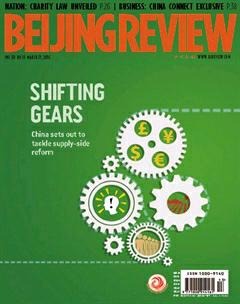
China shattered economic growth records over the past few decades, yet in 2015 it recorded its slowest growth figures in 25 years. China now turns to its supply side in search of new growth sources throughout its 13th Five-Year Plan period, lasting from 2016-20.
“At present, structural contradictions are conspicuous in economic development. Whats most glaring is the supply sides failure to respond to changes in demand, which has affected the manufacturing, service and even agricultural sectors,” Xu Shaoshi, Minister of the National Development and Reform Commission, said at a press conference held on March 6.
“Therefore, the current priority should be given to correct the misallocation of production factors, expand effective supply and enhance the adaptability and flexibility of supply structure,” Xu added.
In the past, Chinese policymakers tended to concentrate their efforts on the demand side and pushed for growth from investment, export and consumption.
But now that era is over, and the supplyside reform creates more consumption opportunities than traditional methods, according to Huang Yanming, Chairman of the Jilin Provincial Committee of the Chinese Peoples Political Consultative Conference(CPPCC). Huang said that emphasis will be placed on boosting growth quality and efficiency, rather than expanding the economic aggregate during the 13th Five-Year Plan period.
Moving forward, structural reforms to the supply side will be implemented in five ways: cutting overcapacity and excess inventory, de-leveraging, reducing costs and shoring up weak growth areas.
Growth sources
On one hand, efforts will be made to improve weak economic links in order to increase effective supply, expand the supply of production factors to stoke the development of emerging industries, and enhance the quality and efficiency of economic growth.
On the other hand, companies should take the initiative to cut excessive industrial capacity and reduce their costs of operation with the support of the government. Actions should also be taken to destock the burgeoning housing inventories, which have given rise to a housing bubble.
Case in point, at the end of 2015, Chinas commercial housing inventories stood at 719 million square meters, a historic high. Xu suggested that the stockpiles be digested via three methods.
First, efforts should be made to accelerate urbanization, which would multiply housing demand, foster the construction of affordable housing and help deflate housing inventories.
Second, the government should reinforce housing system reforms by attaching equal importance to both purchasing and renting operations.
Third, authorities should set regulations based on conditions present in different localities, since the housing market varies throughout cities.
In addition to housing inventories, overcapacity is also prominent on the minds of policymakers. “The excessive industrial capacity that will be eliminated is not necessarily outdated and backward,” said Wang Chang, Director of the State-owned Assets Supervision and Administration Commission of Hebei Province.
“For example,” Wang said, “the produc- tion capacity of common rolled steel should be reduced to release additional resources, which can then be allocated to the manufacturing of high-end rolled steel products—which can satisfy market demands better.”Wang also stressed that the core of the supply-side structural reform consists of producing high-end and high-efficiency products.
By carrying out the supply-side structural reform, resource factors such as labor forces, capital and technology will be freed up from sectors weighed down by overcapacity and will thereby flow to emerging industries, said Gu Shengzu, Vice President of the China Democratic Construction Association.
“Domestic consumers demand hasnt been met adequately,” said Li Zhantong, President of Tianjin Datong Investment Group Co. Ltd., who said that China still has market potential it has yet to tap into. Companies should therefore seek more information regarding market demand and pursue specialization, he noted.
As the role of traditional elements used for development—including labor, resources and capital—is waning, scientific and technological progress, as well as institutional reform, should be taken as new engines for growth to drive Chinas economy, said Jia Kang, President of the China Academy of New Supply-side Economics.
“To reduce production costs, manufacturers have to expand the sales of their products, and the most effective way to win favor from consumers is to elevate the quality and functions of products through scientific and technological innovation,” said Bian Zhiliang, President of the Taishan Sports Industry Group.
Importance should also be attached to innovation in terms of development concepts, the exploration of new growth points and market spaces, as well as the creation of new industries.
Li Jiaming, head of the Key Lab for Atomic, Molecular and Nanoscience in the Department of Physics at Tsinghua University, claimed that in the next five years, innovation in science, technical capacity and management will become a major source of growth for the national economy.
Another key factor in promoting the supply-side structural reform is allowing the market to play a decisive role in shaping decisions. “To improve the quality and efficiency of the supply side, the government should simplify administrative procedures, delegate power to lower levels of government and create an equal and transparent environment, so that companies can find a direction for development amidst fierce competition,” said Bai Chongen, a professor at Tsinghua University.
Many academics suggest that the Central Government should take everything into consideration and adopt a rational point of view in deciding what should be delegated to lower levels.
Local governments should also actively seek to take over decentralized power, said Ding Rongyu, an official with the Intellectual Property Office of Jiangsu Province. “Rules and regulations should be further completed to prevent inaction,” he said.
Difficult terrain ahead
In the 2016 Report on the Work of the Government, Premier Li Keqiang said China will increase its deficit-to-GDP ratio to 3 percent this year, up from 2.3 percent last year, and made it clear that the moderate increase in government deficit is projected to mainly cover tax and fee reductions for enterprises, a step that will further reduce their burden.
Tax and fee cuts are essential if the supply-side structural reform is to succeed, stated Zhu Guangyao, Vice Minister of Finance, who argued that although it would add to the fiscal imbalance and temporarily increase deficits, it is conducive to fostering new growth engines and business patterns, and promotes fiscal revenue in the long run.
According to the Maastricht Treaty that binds eurozone countries together, no member country should have its annual government deficit exceed 3 percent. However, some major countries, such as France and Germany, have seen their deficits breaking the limit.
“Chinas deficit-to-GDP and government debt ratios are lower than those of other major economies,” said Premier Li, adding that tax and fee cuts are necessary, feasible and safe.
As the reform continues, some companies will be reorganized or even shut down, and therefore, some employees may be laid off. To cushion the effects of the job losses on society, as well as the families involved, the Central Government has allocated 100 billion yuan ($15.4 billion) to help those made redundant find new jobs over the next two years. “The fund can be increased if necessary, and local governments do their own job accordingly,” said Premier Li.
Supply-side structural problems are especially serious in state-owned enterprises, such as those engaged in steel and iron, construction material and energy, said Chang Zhenming, President of the China International Trust and Investment Corp. Group.
Concerns remain over whether this round of capacity reduction measures may cause a huge wave of unemployment similar to what happened in the 1990s. That, however, seems unlikely.
In addition to the support policy launched by the government, the current reform will have a smaller influence because state-owned enterprises facing pressure from overcapacity or bankruptcy and reorganization are much fewer in number than those in the 1990s.
The current environment is more favorable now since the non-public sector currently contributes over 60 percent to the GDP, over 50 percent to tax revenues and over 80 percent to employment, said Ge Feng, a financial commentator.
The problems that the structural reforms to the supply side are handling are based on a lack of competition in the market. The government therefore needs to guide structural optimization and take hold of growth potential through policy and institutional supply, said Jia.
“In a mature market economy, selfadjusting mechanisms can solve these problems. But in China, such a mechanism based on the survival of the fittest has not yet taken shape,” said Hou Yunchun, President of China Society for Public Economics.
“Government plays an indispensable role in promoting the supply-side reform. It can create a favorable environment which allows the market to play a decisive role and encourages companies to compete on an equal basis. They can also weed out administrative barriers for companies,”said Hou.