
Metamaterial-Based Electromagnetic Tunneling Effect for Wireless Energy Transfer
2016-04-07 00:34:44LiYunhuiChenYongqiangFengTuanhuiFangKaiZhangYewenChenHongKeyLaboratoryofAdvancedMicrostructureMaterialsMinistryofEducationSchoolofPhysicsScienceandEngineeringTongjiUniversityShanghai200092China
電工技術學報 2016年4期
Li Yunhui Chen Yongqiang Feng Tuanhui Fang Kai Zhang Yewen Chen Hong(Key Laboratory of Advanced Micro-structure Materials Ministry of Education School of Physics Science and Engineering Tongji University Shanghai 200092 China)
?
Metamaterial-Based Electromagnetic Tunneling Effect for Wireless Energy Transfer
Li Yunhui Chen Yongqiang Feng Tuanhui Fang Kai Zhang Yewen Chen Hong
(Key Laboratory of Advanced Micro-structure Materials Ministry of Education School of Physics Science and Engineering Tongji University Shanghai 200092 China)
Abstract In this paper, a sandwich structure composed of two different single negative metamaterial layers separated by air is proposed to improve the efficiency of wireless energy transfer. Numerical analysis reveals that by tuning the metamaterials, electromagnetic tunneling phenomena can occur even through a long distance over several hundred times of device length, which is far beyond mid-range. To verify the above analysis, mesh-like and double-sheet metal structures that play the roles of two different single negative metamaterials are fabricated and measured at microwave range. The experimental results show that the energy transfer efficiency, as well as the transfer distance may be superior to some conventional methods proposed previously. These features will be beneficial to the realistic application of wireless energy transfer.
Keywords:Metamaterial, electromagnetic tunneling, wireless energy transfer
This work is supported by the national basic research program of China (grant 2011cb922001) and the National Natural Science Foundation of China (grants 51377003, 51007064, 11234010, 61137003).
Received 2013-09-04, received in revised form 2014-07-03.
0 Introduction
In the last few years, a new type of wireless energy transfer technology, called “Witricity” technology, is under the spot-light due to its special ability to transfer electric power through a relatively long distance of about 1 or 2 meters[1]. Unlike traditional wireless system hiring two emitting/receiving antennas linked by plane waves propagating between them, a non-radiative electromagnetic transfer system mainly consisting of two magnetic resonators is established. When the two magnetic coils resonate at the same frequency, they tend to exchange energy efficiently through evanescent wave coupling. If any one of them is taken away, the electromagnetic energy transfer procedure will stop immediately. Hence, electromagnetic (EM) energy will be highly localized around one resonator almost without any power losses. These properties are promising to be applied in the quickly developing wireless technologies—WIFI, Bluetooth, ID tags, and so on. Compared to the traditional power transfer system, Witricity has some obvious advantages. As emitter and the receiver in Witricity system is linked as point-to-point, massive unnecessary power losses dissipated in the wide and empty space under the traditional way can be avoided. More important, only magnetic fields of two resonators take a part in the whole energy transfer procedure, which is quite safe to people’s health. However, there are still some difficulties hindering the way for Witricity to be applied more conveniently in our daily life. As the Q-factor of magnetic resonator is always restricted by the intrinsic losses of metal coils, the transfer distance is also awkward. For example, for a Witricity designed at about 10MHz, the energy transfer rate decreases to about 30% at a distance of 2 meters. The device size is relatively large (the diameter of the coil is about 50 cm at 10MHz), making it not convenient to be used in the daily application. In order to pave away these problems, some exotic concepts or functional materials should be introduced.
Metamaterials refer to a sort of artificial metal structures with elementary units much smaller than the vacuum wavelength. Recently, people’s interestsabout metamaterials have been increased steadily over the last decade due to their intriguing effects such as negative refraction[2-5], sub-wavelength lensing[6,7]and electromagnetic cloaking[8-10]. Metamaterials include double negative (DNG) materials and single negative (SNG) materials. For DNG materials, both the permittivity and the permeability are negative and for SNG materials, only one of the permittivity and the permeability is negative. In metamaterials, the propagation of EM waves exhibits lots of unique properties[6-9]. Specifically, the phenomenon of light tunneling in opaque SNG metamaterials has attracted many people’s interests recently[10-12]. Although an isolated SNG metamaterial is opaque, for the reason that the wave propagating in it is evanescent, a conjugate matched pair made of epsilonnegative (ENG) and mu-negative (MNG) metamaterials will be transparent. .
In this paper, the special EM tunneling effect occuring in a MNG-Air-ENG sandwich structure is investigated intensively, which provides a possible long range and highly efficient way of wireless energy transfer. Numerical analysis based on transfer-matrix method and experiments in microwave range are both performed. The results demonstrate that by properly chosen parameters, EM waves can efficiently tunnel through a long distance in air that is over several hundred times of the length of the SNG slabs. Moreover, by tuning the single negative metamaterials, the space distribution of electric and magnetic field can be modified easily. Unlike in the ENG-MNG slabs, the electric and the magnetic field of the tunneling mode is interestingly separated and localized at the interface of MNG-Air and ENG-Air respectively. Therefore, this structure may be important for potential applications in wireless information and energy transfer, due to its high efficiency, security and health.
1 Numerical Analysis
Firstly, the tunneling phenomenon in a MNGAir-ENG structure is investigated by means of the transfer-matrix method[13]. EM waves are normally incident from vacuum onto the MNG-Air-ENG structure (along z direction), as shown in Fig.1. For each layer, a 2× 2 transfer matrix is considered, given as


Fig.1 Schematic of the sandwich structure consisting of MNG material, air and ENG material
If there is no absorption, the perfect transmission conditioncan be satisfied when the reflection coefficient satisfies, given as
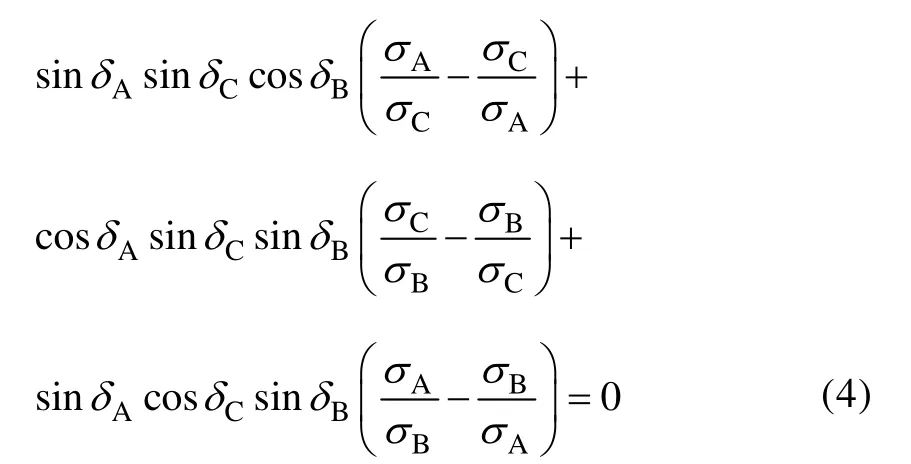

By utilizing the two equations above, one can exactly determine the tunneling frequency of the MNG-Air-ENG structure. In peculiar, given dC=0, e.g. δC= kCdC=0, the above equations can be rewritten in a simple form as

Which is a familiar with result that determines the tunneling frequency of two pairing of single negative slabs, for instance, the ENG-MNG pair. The above analysis also shows that, if any one layer of the composite structure is removed or its parameters are changed, the tunneling phenomenon will no longer exist, leading to a flexible control of the wireless transfer devices. This property also implies that the inefficient energy loss in traditional wireless antenna systems may be avoided. In addition, the distance in air layer that the EM waves tunnel through can be exactly determined by the resonant condition. Therefore, it is optimistic to achieve a wireless information transfer system with high security.
Secondly, EM tunneling phenomenon in MNGAir-ENG sandwich structure is also investigated to demonstrate the working principle of wireless energy transfer. A drude model is used to describe the isotropic single-negative materials, given as

in MNG materials and

in ENG materials. These kinds of dispersion for μAand εBmay be realized in some special metamaterials. The unit of angular frequency ω/(2π) is GHz. In the following calculation, a set of parameters of εa=μb=1, μa=εb=1 and α=β =400 are chosen. The thicknesses of the MNG and the ENG slab are assumed to be dA=2mm and dB=2mm, respectively. dC=400mm, corresponds to a considerable length of the air layer between two SNG wireless devices. Transverse electric wave case is considered, namely, the electric field E˙ lies in the y direction. The treatment for the transverse magnetic wave is similar. By depicting the calculated transmittance of the MNG-Air-ENG structure in Fig.2, it is clear that the EM wave completely tunnels through the composite structure at f0=124MHz, shown as the solid line. In this case, the ratio of the distance that EM waves pass through the air to that through the SNG slab (regarded as an emitting or receiving device in wireless transfer systems) isLtrans/Ldev=dC/dA=400/2=200, much larger than the ratio obtained in Ref.[1]. This means that by employing the SNG medium, it is possible to obtain a highly efficient wireless device with its functional region beyond mid-range. Furthermore, the calculated results in the case of dA=dB=4mm, dA=dB=6mm and dA=dB=8mm are also given in Fig.2, shown as the dash line, the dots line and the dash dots line respectively. It is found that when the length of the SNG slab is shortened to a quarter of its original value, the frequency shift of the tunneling mode is only about 5%. In the mean time, Ltrans/Ldev=dC/dA= 400/2=200. This result reveals that the tunneling phenomena will still occur through a long distance over several hundred times of the length of the device, which is far beyond mid-range.

Fig.2 The transmittance of the MNG-Air-ENG structure with different thickness of SNG materials (the length of the air is 400 mm)
Moreover, the electromagnetic field distribution of the tunneling modes with its frequency at 319.7MHz corresponding to the parameters of dA=20mm, dB=20mm and dC=200mm is shown in Fig.3. Incontrast to the traditional resonance or tunneling phenomena, amazing results are obtained that the electric field and the magnetic field are localized at different locations: the electric field is localized at the interface of MNG layer and air, but the magnetic field is localized at the interface between air and ENG slab. By applying the ENG medium in a wireless receiving device, it will help people to carry it for the reason that the magnetic field localizing at the interface between air and ENG slab will not interact with common environment objects.
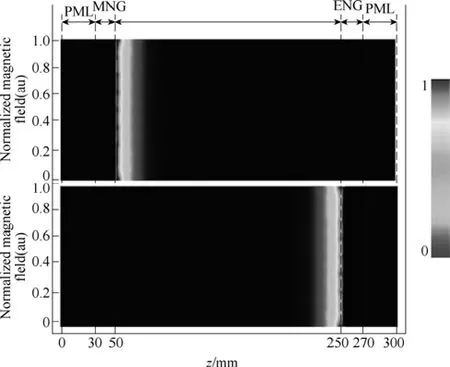
Fig.3 The electromagnetic field distribution corresponding to the tunneling mode in MNG-Air-ENG structure (the origin is at the starting side of MNG material): dA=20mm, dB=20mm, dC=20mm
2 Microwave Experiments
To validate the above long range EM tunneling effect, microwave experiments for the MNG-Air-ENG sandwich structure were carried out in a shielded chamber. A network analyzer (Agilent 8722ES) is utilized to measure the energy transfer rate in the EM tunneling system. Both the ENG and MNG metamaterials are fabricated on a 1.6mm thick F4B substrate (εr=2.2) with copper layer whose thickness is 0.017 5mm. By applying a traditional printed circuit board (PCB) etching technology, ENG and MNG metamaterials are fabricated on the substrate (shown in Fig.4) as the mesh-like and double-sheet metal structures, respectively.

Fig.4 The schematics and photographs of mesh-like and double-sheet metal structures
For ENG metamaterials, mesh-like structures are fabricated on only one side of the substrate. The width of metal line in this case is w=2mm. For each unit the periodical length is p=16mm. The MNG metamaterial is composed of two square metal sheets on both top and bottom of the substrate. The side length of the square metal sheet is d=13.5mm. The periodical length for each unit is also p=16mm.
The ENG and MNG metamaterials are separated at a distance of 10mm (about 1/4 wavelength in vacuum), with EM waves normally incident from the MNG side. From the measured results shown in Fig.5, it is shown clearly a tunneling mode at about 7.0GHz with a high energy transfer rate of about 75% for simulation and 56% for measurement. It should be noticed that, for Witricity technology, the energy transfer rate is about 50% at a transfer length of 1/20 wavelength in vacuum. The experimental results are found agreeing well with the simulations carried out by a commercial full wave EM solver CST Microwave studio, despite some undesired energy losses due to intrinsic losses of materials and also some fluctuations from boundary-caused standing waves. Of course, for the structure the transfer distance can be further optimized by a well trade-off procedure between transfer distance and the geometry size of metamaterials. Thus, by utilizing the EM tunneling effect in MNG-Air-ENG sandwich structure, the energy transfer rate as well as the transfer distance is promising to be optimized, leading to the realistic application of wireless energy transfer.

Fig.5 The simulated (top) and measured energy transfer rate of EM waves tunneling through the MNG-Air-ENG structure as shown in Fig.4
3 Conclusion
To sum up, EM tunneling effect occurring in a MNG-Air-ENG structure is proposed to improve the wireless energy transfer rate or distance. Numerical analysis reveals that, by tuning the metamaterials tunneling phenomena can occur even through a long distance over several hundreds times of device length, which is far beyond mid-range. To verify the above analysis, mesh-like and double-sheet metal structures that play the roles of ENG and MNG metamaterials are also fabricated and measured at microwave range. The experimental results show that the energy transfer efficiency, as well as the transfer distance may be superior to some conventional methods proposed previously. These features will be beneficial to the realistic application of wireless energy transfer.
Reference
[1] Kurs A, Karalis A, Moffatt R, et al. Wireless power transfer via strongly coupled magnetic resonances[J]. Science, 2007, 317(6): 83-86.
[2] Liu R, Zhao B, Lin X Q, et al. Experimental observation of evanescent-wave amplification and propagation in microwave regime[J]. Applied Physics Letter, 2006, 89(22): 221919(1-3).
[3] Baena J D, Jelinek L, Marques R, et al. Near-perfect tunneling and amplification of evanescent electromagnetic waves in a waveguide filled by a metamaterial: theory and experiments[J]. Physical Review B, 2005, 72(7): 075116(1-8).
[4] Kim K Y, Lee B. Complete tunneling of light through impedance-mismatched barrier layers[J]. Physical Review A, 2008, 77(2): 023822(1-7).
[5] Ahmadi A, Mosallaei H. Physical configuration and performance modeling of all-dielectric metamaterials[J]. Physical Review B, 2008, 77(4): 045104(1-11).
[6] Pendry J B. Negative refraction makes a perfect lens[J]. Physical Review Letters, 2000, 85(18): 3966-3969.
[7] Grbic A, Eleftheriades G V. Overcoming the diffraction limit with a planar left-handed transmissionline lens[J]. Physical Review Letters, 2004, 92(11): 11703(1-4).
[8] Garcia de Abajo F J, Gomez-Santos G, Blanco L A, et al. Tunneling mechanism of light transmission through metallic films[J]. Physical Review Letters, 2005, 95(6): 067403(1-4).
[9] Cai W, Chettiar U K, Kildishev A V, et al. Optical cloaking with metamaterials[J]. Nature Photonics, 2007, 1(4): 224-227.
[10] Alu A, Engheta N. Pairing an epsilon-negative slab with a mu-negative slab: resonance, tunneling and transparency[J]. IEEE Transactions on Antennas and Propagation, 2003, 51(10): 2558-2571.
[11] Guan G S, Jiang H T, Li H Q, et al. Tunneling modes of photonic heterostructures consisting of single-negative materials[J]. Applied Physics Letter, 2006, 88(21): 211112(1-3).
[12] Zhou L, Wen W J, Chan C T, et al. Electromagneticwave tunneling through negative-permittivity media with high magnetic fields[J]. Physical Review Letters, 2005, 94(24): 243905(1-4).
[13] Jiang H T, Chen H, Li H Q, et al. Omnidirectional gap and defect mode of one-dimensional photonic crystals containing negative-index materials[J]. Applied Physics Letter, 2003, 83(26): 5386(1-3).
Brief notes
Li Yunhui male, born in 1978, Professor, Ph.D, research directions include metamaterials and wireless energy transfer.
E-mail: liyunhui@tongji.edu.cn
Chen Yongqiang male, born in 1987, Ph.D student, research directions are metamaterials and wireless energy transfer.
