HISTORY AND REALITY
2016-03-28 01:53:36ByJosefGregoryMah
Beijing Review 2016年11期
By+Josef+Gregory+Mahoney
No other country in the world has more foreign neighbors on its borders or within striking distance than China. It is a curious fact and one that presents China with both danger and opportunities. Why does such a large and by various definitions—ancient civilization if not state—have so many neighbors on its periphery?
There are many possible answers, with some arguing that Chinas political philosophy over the long course of history has generally eschewed conquest and dominion over others. There are historical exceptions, of course, long ago when some of Chinas near neighbors in the east and southeast were more or less under Chinese control, and there have been degrees of association under varying tribute-state forms. But the argument that China, during both modern and pre-modern times, has avoided the sort of imperialism and hegemony common to Western powers cannot be easily dismissed.
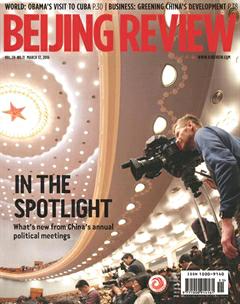
This fact has been cited in one form or another by Chinese officials in recent times and it was, in effect, repeated thematically during Foreign Minister Wang Yis press conference held in Beijing on March 8 during the two most important annual political sessions in China, known as “the two sessions.” There Wang again clarified Chinas foreign policy in response to questions about issues related to its activities in the South China Sea, the Belt and Road Initiative(the Silk Road Economic Belt and the 21st-Cen- tury Maritime Silk Road), the Asian Infrastructure Investment Bank, and investment in Africa, among others.
Millenniums of memory
Counterarguments stipulate that a modern China is not necessarily consigned to traditional practices and indeed, much of modern China can be viewed as a negation of traditional Chinese values. Why then, should one put much stock in traditional Chinese values as a guarantor against the possibility of an aggressive and potentially hegemonic “rising China,” when the contemporary Chinese state is substantially the result of ideas and practices that run contrary to traditions?
One possible answer can be offered as follows. To begin, there are those who believe that ideas that in turn develop as theories or stipulated values, or even, as fundamental principles, are more likely to emerge initially as descriptions of historical or ongoing practices than the other way around. In fact, many believe this to be true, including a great number of senior scholars, policymakers and leaders in Beijing today: real politics, the real political economy, and so on, come first—theory comes second. It often leads to the tragic consequences when idealism outpaces reality, when theory takes command in a way that neglects actual material conditions and situations.
Such a lesson is not unique to China and further, Wang alluded to such in his tacit criticism of foreign powers that have engaged in and perhaps even continue to engage in hegemonic activities while stoking fears that China may seek to do the same in the future. The irony, of course, is that some of these powers fail to practice what they preach, and further, have failed to learn their own lessons despite experiencing disastrous adventurism and a great number of foreign policy blunders.
Historically, China has learned and relearned a great number of things, but two of the greatest perhaps include the knowledge of how to build and run a large state and in turn, the limits of that state.
In ancient times, the Qin Dynasty (221-206 B.C.) innovated an early form of the Chinese state and the Han Dynasty (206 B.C.-A.D. 220) developed it further, producing an achievement that was so remarkable, so capacious and ahead of its time, that it was cherished, institutionalized and protected to such an extent that it survived for millennia in various guises.
One way it was protected stemmed from the recognition that this state and its institutions, however remarkable, were nevertheless faced with limits in material terms—that such a state at such a time, with such technology, with such neighbors, was therefore finite in its ability to grow and extend its political control. To extend beyond its capacity would threaten the remarkable achievement at the center of it all. It is reasonable to suggest that various traditional Chinese political philosophies that emerged subsequently did so as theories buttressing this basic political insight.
It is also reasonable to suggest that a similar lesson has been reaffirmed among Chinese leaders in modern times, and likely more strongly so than in the past. On the one hand, the“century of humiliation” taught China terrible lessons that have not been lost during rejuvenation. These lessons include the understanding that there is no “manifest destiny” or “son of heaven” metaphysics that can guarantee the survival of the state or even the civilization.
On the other hand, given the fact that a single party leads the state, there is an immediate institutional memory of these difficult lessons. Foremost among them, that overstepping oneself creates opportunities for catastrophic failure. Instead, one must “cross the river by feeling the stones,” as Deng Xiaoping (1904-97), a renowned Chinese statesman, reiterated, not only to solve problems, but also to effectively recognize the limits of a stable but advancing state. Such a lesson carries an important corollary, namely, that while multi-party states have a number of positive qualities, one of their key weaknesses is a tendency for their political parties to avoid taking effective responsibility for solving deep-seated and difficult problems.
In Beijing, one can easily find pride in Chinas achievements, but one rarely finds hubris among key leaders. The lessons of history, both recent and ancient, are too fresh, and the ongoing challenges and risks are all too clear.
One lesson we learn from philosophy in general is that it is sometimes easier to talk about ideas in relatively abstract terms than it is to talk about politics in real terms. Nevertheless, it can be terribly difficult to communicate at all when neither philosophical nor political lessons mutually resonate, for example, when certain lessons have not yet been learned or appreciated by one or the other.
Window to his thinking
Despite his diplomatic language, a careful review of Wangs remarks to the press reveals an underlying frustration, the sort provoked when mutual understanding simultaneously appears to be so reasonable and possible and yet incredibly distant. This frustration appeared to surface in both his critical comments as well as in those points that he took great pains to emphasize. He repeated again and again that China was looking for win-win scenarios and was determined to avoid zero-sum games.
That said, as Wang himself essentially admitted, it is certainly the case that China is involving itself actively in international affairs like never before, such as the pursuit of mutually beneficial economic opportunities and substantial contributions to global peacekeeping efforts.
At the same time, the foreign minister pointed to a number of issues that are complicating Chinese efforts. Perhaps most directly, Wang singled out Japan with surprising candor, starkly asserting, “On the one hand, the Japanese Government and leaders say nice things about wanting to improve relations. On the other hand, they are making trouble for China at every turn. This is a typical case of double-dealing.”
Elsewhere, Wang did not hesitate to lecture Americans who harbor negative views of Chinas rise, stating that, “I want to emphasize once again that China is not the United States, and China will not and cannot become another United States. We have no intention to displace anybody or dominate anybody. My advice to American friends: Perhaps you may want to spend more time learning about Chinas cultural tradition distilled from its 5,000-year history, and dont always judge China with the American mindset.”
As expected, Wang also discussed Chinas recent support for new sanctions on North Koreas continuing efforts to develop nuclear weapons and their possible delivery systems. On one hand, Wang emphasized Chinas support for the sanctions as a continuing commitment to denuclearizing the Korean Peninsula. On the other hand, Wang highlighted the longstanding, close relationship between China and North Korea, and argued that negotiating a peace treaty to replace the armistice should go handin-hand with negotiations aimed at halting and dismantling their nuclear weapons programs. Consequently, Wangs tone on North Korea was somewhat more conciliatory than comments made by other leading figures in Beijing in recent days.
Further, while some view the sanctions as having a punitive aspect, Wang suggested instead that their fundamental purpose was to provide a positive incentive for North Korea to return to talks aimed at resolving differences peacefully.