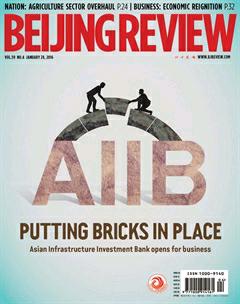
REFORMING THE FINANCIAL MOLD
2016-03-22 01:32:26ByZhangMonan
Beijing Review 2016年4期
By+Zhang+Monan
The inauguration of the AIIB on January 16 marks a breakthrough for global financial governance, which has had its structure overhauled since the worlds financial crisis of 2008. Nonetheless, in order to improve, the global economic and financial order is now facing a new set of challenges including additional changes and readjustments.
The AIIBs goal is to build an inclusive, open and transparent financial institution. Its purpose, functions, membership composition, allocation of capital stock, organizational structure and governance framework are all in conformity with operational standards of current multilateral development banks.
For a long time, the G7 has been at the center of the global governance, which features a leadership role of developed countries and an economic system spearheaded by the U.S. dollars hegemony. In the fields of international trade, finance and development, the United States is the only super power.
In addition, major existing institutions for global governance, including the World Trade Organization, the International Monetary Fund and the World Bank, are led by developed countries. In comparison, developing countries have diminished influence over those institutions, leading to an unequal distribution of interests in the global governance structure.
Taking that into consideration, those conventional organizations are increasingly becoming obsolete, and soon will no longer be capable of assuming all the responsibilities of global administration. Therefore, a new structure that can reflect the contemporary trends and concepts of fairness, mutual benefit, and sharing of interests and risks is needed.
Faced with the pressing need to address the economic turmoil after the global financial crisis, the essential scheme for global economic governance was shored up by changing the group of leading economies from seven to 20. With the aim to build a community of shared interests, shared destiny and shared responsibilities, in addition to common development as well as prosperity, the AIIB seeks to open a new chapter in the history of the international finance structure.
Solving the imbalanced distribution of financial interests between developed and developing countries is the central issue at hand. In recent years, Asia has accumulated a large amount of financial assets. For example, two thirds of the worlds total foreign exchange reserves are held by Asian economies. However, most of those assets are dollar-denominated ones whose returns are very low. From 1952 to 2014, the average rate of return on overseas assets held by U.S. investors stood at 5.72 percent, while that on U.S. assets held by foreign investors was only 3.61 percent. The gap in the rates is surely due to the low risk that dollar assets constitute. Nevertheless, the United States still earns from the valuation effects produced by the depreciation of the greenback against other currencies in a dollar-dominated international monetary system.
In Asia, the demand for infrastructure investment throughout 2010-20 is estimated at $8 trillion, leaving a huge funding void. Therefore, the establishment of the AIIB will provide efficient and reliable long-term financial support for the Asian economy and serve as an important platform for the transformation of savings into investment within Asia, which will enhance infrastructure construction as an important engine for regional economic growth. Moreover, the bank will improve the efficiency of capital utilization in Asia, as well as promote interconnectivity within the region.
The AIIB can also play an important role in the creation of a multilateral financing system to serve the building of the Silk Road Economic Belt and 21st-Century Maritime Silk Road. Multilateral financing should not just rely on the contribution of a few countries. Consequently, more governments, financial institutions and private investors shall take part in investment, discuss financing plans and make use of the advantages of different capital providers.
In the meantime, the AIIB must cooperate with other funds, such as the China-ASEAN Investment Cooperation Fund and the ChinaCentral and Eastern Europe Investment Cooperation Fund, as well as the newly established Silk Road Fund.
In the long term, the establishment of the AIIB will have a far-reaching effect on the dollardominated international monetary system.
In recent years, there has been an upsurge of currency swaps in the world. In particular, following the global financial crisis, various central banks have been signing currency swap agreements more frequently. It is foreseeable that with the establishment of the AIIB, a yuanbased financing mechanism and network will be formed, therefore promoting the yuans transition to an international reserve currency.