炎癥性腸病結腸隆起型異型增生影響因素的回顧性研究
2016-03-02 01:35:57李俊霞劉冠伊王化虹劉新光
中國全科醫學 2016年6期
田 雨,李俊霞,田 原,劉冠伊,王化虹,劉新光
作者單位:100034 北京市,北京大學第一醫院消化內科
?
·論著·
炎癥性腸病結腸隆起型異型增生影響因素的回顧性研究
田 雨,李俊霞,田 原,劉冠伊,王化虹,劉新光
作者單位:100034 北京市,北京大學第一醫院消化內科
【摘要】背景隨著我國炎癥性腸病發病率的上升,炎癥性腸病相關結直腸癌及癌前病變的發病情況值得關注。目的探討炎癥性腸病結腸隆起型異型增生發生的相關影響因素。方法選取2007年1月—2014年1月在北京大學第一醫院進行內鏡隨訪的393例炎癥性腸病患者為研究對象,收集患者臨床資料和病理學檢查結果。以發生結腸隆起型異型增生為結局事件,以患者的病程為時間變量,采用Cox比例風險回歸分析炎癥性腸病患者結腸隆起型異型增生發生的影響因素。結果393例炎癥性腸病患者中13例發生結腸隆起型異型增生,其中潰瘍性結腸炎12例、克羅恩病1例;腺瘤樣病變或腫物(ALM)10例、異型增生相關病變或腫物(DALM)3例。Cox比例風險回歸模型結果顯示,炎癥性腸病家族史、疾病活動程度和疾病復發情況與結腸隆起型異型增生有回歸關系(P<0.05);性別、起病年齡、結腸癌家族史、吸煙、病變范圍和接受至少2年以上的5-氨基水楊酸(5-ASA)/柳氮磺胺吡啶(SASP)維持治療與結腸隆起型異型增生無回歸關系(P>0.05)。Log-rank檢驗結果顯示,無炎癥性腸病家族史者、中度活動者及疾病偶發患者的累計生存率高于有炎癥性腸病家族史者、重度活動者及疾病頻發/持續活動患者(χ2值分別為4.631、7.382、13.438,P值分別為0.031、0.007、<0.001)。10例ALM患者中9例行內鏡下黏膜切除、1例多發ALM患者行全結腸切除;3例DALM患者1例行全結腸切除,2例因病情較重或全身情況差未行手術治療。結論炎癥性腸病患者結腸隆起型異型增生的發生率隨著病程的延長而增加;影響其發生的高危因素有炎癥性腸病家族史、疾病活動程度和疾病復發情況。
炎癥性腸病包括潰瘍性結腸炎和克羅恩病,兩者有著較正常人群更高的罹患結腸惡性腫瘤的風險[1],這些患者結腸鏡隨訪的目的之一是發現癌前病變或早期可治愈的結腸癌[2]。目前通常認為,炎癥性腸病患者結腸癌的發生經歷了從反復炎癥到異型增生再到癌變的過程[3]。炎癥性腸病患者結腸的異型增生是炎癥性腸病相關結直腸癌(colorectal cancer,CRC)的重要預測因素。炎癥性腸病患者結腸的異型增生根據內鏡下表現可分為平坦型異型增生和隆起型異型增生,前者的發現是通過結腸鏡隨機活檢病理檢查發現的,而后者可以通過內鏡肉眼發現可疑病變,活檢病理加以證實。其中隆起型異型增生又可分為腺瘤樣病變或腫物(adenoma-like lesion or mass,ALM)和異型增生相關病變或腫物(dysplasia associated lesion or mass,DALM)[4]。本研究回顧性分析北京大學第一醫院進行了完整隨訪的炎癥性腸病患者的臨床資料和內鏡資料,探討炎癥性腸病患者結腸隆起型異型增生發生的影響因素。
1資料與方法
1.1臨床資料選取2007年1月—2014年1月在北京大學第一醫院進行至少一次完整隨訪(包括結腸鏡、病理學檢查)的炎癥性腸病患者393例為研究對象,炎癥性腸病的診斷符合《炎癥性腸病診斷與治療的共識意見(2012年·廣州)》[5]的診斷依據。其中男208例,女185例,男女比1∶1.1;起病年齡1~75歲,平均起病年齡(38.4±15.1)歲;病程1~65年,平均病程(8.9±7.8)年;潰瘍性結腸炎306例,克羅恩病87例;具有炎癥性腸病家族史22例(5.6%);具有結腸癌家族史7例(1.8%);吸煙88例(22.4%);潰瘍性結腸炎廣泛受累(E3)和克羅恩病結腸受累(L2)174例(44.3%);疾病活動程度為重度活動140例(35.6%);疾病復發情況為疾病頻發/持續活動54例(13.7%);接受至少2年以上的5-氨基水楊酸(5-ASA)/柳氮磺胺吡啶(SASP)維持治療224例(57.0%);無合并原發性硬化性膽管炎(primary sclerosing cholangitis,PSC)患者。
1.2資料收集收集患者的性別、起病年齡、病程、本研究背景和創新點:
國外研究已證實,炎癥性腸病是結腸癌的高危因素。近年來,炎癥性腸病在我國的發病率有逐年遞增的趨勢,隨著患者數量的增加和病程的增長,此類患者腸道腫瘤發生的情況已經日益顯現。目前我國炎癥性腸病相關結腸癌的研究數據有限,我國炎癥性腸病發生結腸癌及癌前病變的概率是多少?與何因素相關?藥物治療是否能起到預防作用?等問題均需用循證醫學的數據來解答。本研究采取回顧性的研究方法,分析了炎癥性腸病結腸隆起型異型增生的發生情況,尋找炎癥性腸病患者發生結腸癌及癌前病變的相關因素。雖然受到病例數量、研究方法和僅探討了結腸隆起型異型增生等限制,此項研究仍然為臨床醫生篩選高危患者、指導治療和隨訪提供了重要依據。
炎癥性腸病類型、家族史(炎癥性腸病、結腸癌)、吸煙情況(吸煙指連續或累計吸煙6個月或以上者,無論是否已經戒煙)、病變范圍(根據蒙特利爾分類/型確定E3和L2)、疾病活動程度〔潰瘍性結腸炎和克羅恩病分別采用改良Mayo評分和簡化克羅恩病疾病活動指數(CDAI)評分,以改良Mayo評分≥6分和簡化CDAI評分≥9分為重度活動〕、疾病復發情況(潰瘍性結腸炎和克羅恩病患者癥狀再次出現,且改良Mayo評分>2分和簡化CDAI評分>4分為疾病復發;當復發頻率≥2次/年時為疾病頻發,當患者癥狀持續不緩解時為持續活動)[5]、接受至少2年以上的5-ASA/SASP維持治療情況、合并PSC情況等臨床資料,同時收集其結腸鏡、病理學檢查結果。
1.3結腸隆起型異型增生的確定炎癥性腸病患者結腸鏡檢查發現隆起病變處后,活檢1塊或多塊,其中9例患者采用內鏡下黏膜切除(endoscopic mucosal resection,EMR),2例經結腸鏡活檢病理診斷為異型增生者行全結腸切除,手術切除標本進行病理診斷。
結腸隆起型異型增生的病理學改變由病理科醫師和消化科醫師會診,參考文獻[6]加以判定,分為ALM和DALM,主要根據病變受累腸段,異型增生的程度,黏膜層中性粒細胞、淋巴細胞的浸潤程度,腺體形態改變以及有無絨毛成分等綜合考慮判定。異型增生根據維也納標準[7]分為輕度異型增生(light grade dysplasia,LGD)和重度異型增生(high grade dysplasia,HGD)。
1.4結腸隆起型異型增生患者的隨訪對判斷為結腸隆起型異型增生的患者,繼續對其進行隨訪,包括異型增生的處理以及其復發情況。對接受內鏡下治療的患者3個月內復查結腸鏡并做病理學檢查。

2結果
2.1患者的一般情況393例炎癥性腸病患者中13例發生結腸隆起型異型增生,其中男8例,女5例,男女比1∶1.6;起病年齡17~53歲,平均起病年齡(46.5±16.5)歲;病程8~40年,病程中位數為11年;潰瘍性結腸炎 12例,克羅恩病1例;具有炎癥性腸病家族史2例(15.4%);具有結腸癌家族史1例(7.7%);吸煙6例(46.2%);E3和L2 10例(76.9%);疾病活動程度為重度活動10例(76.9%);疾病復發情況為疾病頻發/持續活動10例(76.9%);接受至少2年以上的5-ASA/SASP維持治療10例(76.9%);無合并PSC患者;ALM 10例,DALM 3例;LGD 10例,HGD 3例。結腸隆起型異型增生的內鏡下表現為,在病變腸段生長,大小0.5~3.0 cm,扁平或亞蒂的隆起病變,部分隆起型異型增生呈結節狀,多數表面有充血,少數腫物表面有糜爛(見圖1~4,本文圖1~8等彩圖見本刊官網www.chinagp.net電子期刊相應文章附件)。
2.2結腸隆起型異型增生的處理和隨訪結果10例ALM患者中9例行EMR,病理學檢查分別為管狀腺瘤Ⅰ~Ⅱ級,LGD;鋸齒狀腺瘤Ⅰ~Ⅱ級,LGD;增生性息肉合并管狀腺瘤,LGD。3個月后隨訪結腸鏡檢查和病理學檢查患者病變部位均未發現復發。1例多發ALM患者行全結腸切除,術后病理學檢查為結腸多發絨毛-管狀腺瘤、LGD。3例DALM患者1例行全結腸切除,術后病理學檢查為管狀腺瘤Ⅲ級、HGD;2例因病情較重或全身情況差未行手術治療(見表1、圖5~8)。

表1 13例炎癥性腸病結腸隆起型異型增生患者的臨床資料和病理改變
注:E3=潰瘍性結腸炎廣泛受累,E2=潰瘍性結腸炎左半結腸型,L2=克羅恩病結腸受累,5-ASA=5-氨基水楊酸,SASP=柳氮磺胺吡啶,ALM=腺瘤樣病變或腫物,DALM=異型增生相關病變或腫物,LGD=輕度異型增生,HGD=重度異型增生;EMR=內鏡下黏膜切除
2.3結腸隆起型異型增生發生的影響因素以發生結腸隆起型異型增生為結局事件,以患者的病程為時間變量,代入Cox比例風險回歸模型,結果顯示,炎癥性腸病家族史、疾病活動程度和疾病復發情況與結腸隆起型異型增生有回歸關系(P<0.05);性別、起病年齡、結腸癌家族史、吸煙、病變范圍和接受至少2年以上的5-ASA/SASP維持治療與結腸隆起型異型增生無回歸關系(P>0.05,見表2)。采用Kaplan-Meier法對炎癥性腸病家族史、疾病活動程度和疾病復發情況3個影響因素繪制生存曲線,Log-rank檢驗結果顯示,無炎癥性腸病家族史者、中度活動者及疾病偶發患者的累計生存率高于有炎癥性腸病家族史者、重度活動者及疾病頻發/持續活動患者,差異有統計學意義(χ2值分別為4.631、7.382、13.438,P值分別為0.031、0.007、<0.001,見圖9~11)。
3討論
炎癥性腸病相關CRC的發生只占全部結直腸癌的1%~2%,但是炎癥性腸病患者最為嚴重的并發癥[8],最近的研究表明,有近15%的炎癥性腸病患者死于炎癥性腸病相關CRC[9]。很多研究表明,隨著炎癥性腸病病程的延長結直腸癌的發病率逐漸遞增,從8~10年的2.0%~2.9%,到15~20年的5.6%~8.0%,再到30年的8.3%~18.0%[8,10-11]。炎癥性腸病患者出現的異型增生被認為是炎癥性腸病相關CRC發生的最可靠的癌前標志[12]。本研究觀察了炎癥性腸病相關CRC的癌前病變中的重要部分——結腸隆起型異型增生,發現該病變也有著隨病程延長逐漸增高的趨勢,而且與炎癥性腸病相關CRC有著近似的數值。本研究發現,DALM伴HGD僅3例,占全部病例的比例不足1.0%,與國內一些研究接近,提示國人炎癥性腸病相關CRC的發生率較低[13-14]。
表2炎癥性腸病患者結腸隆起型異型增生發生影響因素的Cox比例風險回歸分析
Table 2Cox proportional hazards regression analysis of the influencing factors for the occurrence of IBD colon uplift type dysplasia
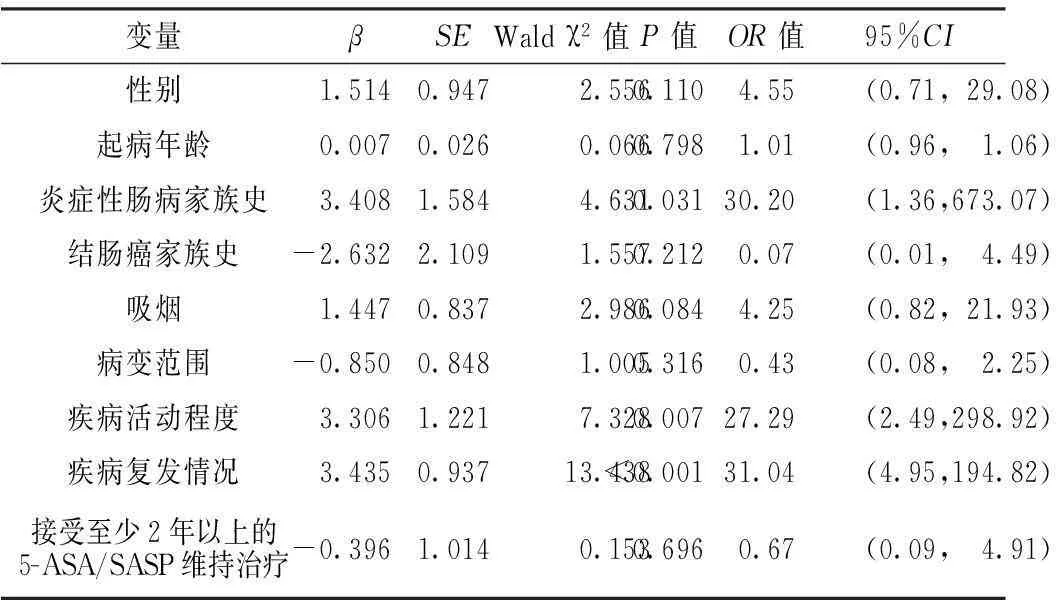
變量βSEWaldχ2值P值OR值95%CI性別1.5140.9472.5560.1104.55(0.71,29.08)起病年齡0.0070.0260.0660.7981.01(0.96, 1.06)炎癥性腸病家族史3.4081.5844.6310.03130.20(1.36,673.07)結腸癌家族史-2.6322.1091.5570.2120.07(0.01, 4.49)吸煙1.4470.8372.9860.0844.25(0.82,21.93)病變范圍-0.8500.8481.0050.3160.43(0.08, 2.25)疾病活動程度3.3061.2217.3280.00727.29(2.49,298.92)疾病復發情況3.4350.93713.438<0.00131.04(4.95,194.82)接受至少2年以上的5-ASA/SASP維持治療-0.3961.0140.1530.6960.67(0.09, 4.91)
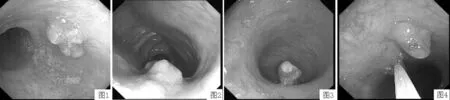
圖1直腸不規則隆起病變:DALM圖2降結腸隆起病變:ALM
Figure 1Rectum irregular uplift lesions:DALMFigure 2Descending colon uplift lesions:ALM
圖3乙狀結腸隆起病變:ALM圖4乙狀結腸多發隆起病變:ALM
Figure 3Sigmoid colon uplift lesions:ALMFigure 4Sigmoid colon multiple uplift lesions:ALM

圖5直腸管狀腺瘤Ⅲ級,HGD(×4)圖6直腸管狀腺瘤Ⅲ級,HGD(×20)
Figure 5Rectum tubular adenoma grade Ⅲ,HGD Figure 6Rectum tubular adenoma grade Ⅲ,HGD
圖7橫結腸鋸齒狀腺瘤,LGD(×4)圖8降結腸絨毛-管狀腺瘤,LGD(×4)
Figure 7Transverse colon serrated adenoma,LGDFigure 8Descending colon villous-tubular adenoma,LGD
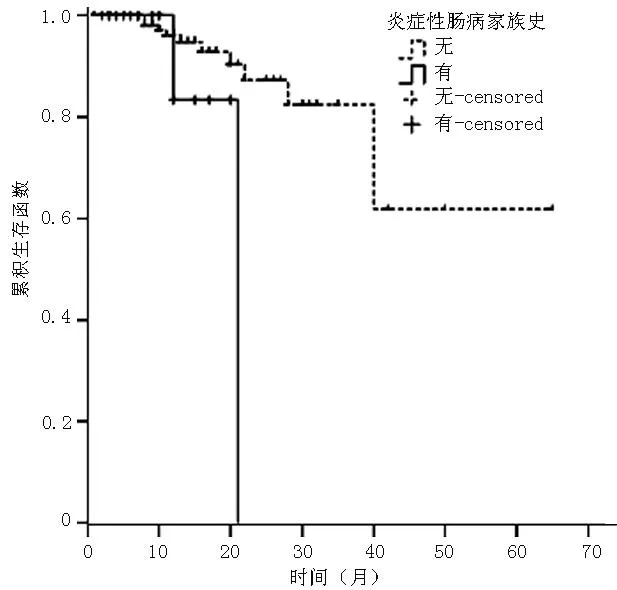
圖9有無炎癥性腸病家族史患者結腸隆起型異型增生發生生存曲線
Figure 9Survival curves of the occurrence of colon uplift type dysplasia of patients with or without IBD family history
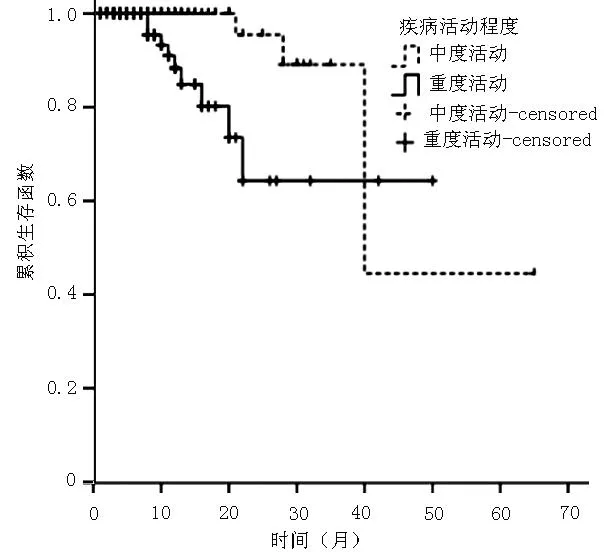
圖10不同疾病活動程度患者結腸隆起型異型增生發生生存曲線
Figure 10Survival curves of the occurrence of colon uplift type dysplasia of patients with different disease activity degrees
炎癥性腸病相關CRC的高危因素主要包括發病年齡、病程、病變范圍、結腸癌家族史、病程遷延和伴發PSC等[15-17]。本研究以病程作為時間變量,通過Cox比例風險回歸分析得出,炎癥性腸病家族史、疾病活動程度和疾病復發情況3項是炎癥性腸病結腸隆起型異型增生發生的高危因素,與既往國內研究結論相似[18],提示炎癥性腸病患者遵循著“慢性炎癥-異型增生-惡性腫瘤”[3]這一病理改變途徑。提示對炎癥性腸病的治療不但要臨床緩解,更要以達到黏膜愈合,以減少復發,可以有效地預防炎癥性腸病患者異型增生乃至炎癥性腸病相關CRC的發生。本研究發現,炎癥性腸病家族史也是結腸隆起型異型增生發生的高危因素,提示炎癥性腸病結腸隆起型異型增生的發生有一定的家族遺傳傾向,對具有炎癥性腸病家族史的患者更要注意結腸鏡的隨訪工作。疾病活動程度也是結腸隆起型異型增生的高危因素。
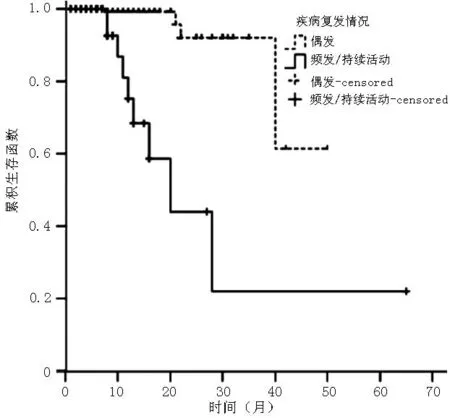
圖11不同疾病復發情況患者結腸隆起型異型增生發生生存曲線
Figure 11Survival curves of the occurrence of colon uplift type dysplasia of patients with different conditions of relapse
起病年齡是炎癥性腸病相關CRC的另一項高危因素,本研究中并未得出此結果。推測因為從異型增生到炎癥性腸病相關CRC還需要一段時間,這樣在是否發生結腸隆起型異型增生的兩組患者之間的起病年齡差異可能被縮小。雖然沒有得出起病年齡是高危因素這一結果,但是從發生結腸隆起型異型增生的平均年齡僅為38.4歲上也可以觀察出有這樣的趨勢。以往研究提示,結腸腫瘤家族史也是炎癥性腸病相關CRC的高危因素[18],本研究中具有結腸癌家族史的患者僅有7例,無法達到統計學分析的需要,所以沒有得出相關結論。病變范圍是炎癥性腸病相關CRC的另一個高危因素,本研究并未得出此結果,可能與病例數量少有關系。分析13例結腸隆起型異型增生患者,仍可以看出有10例為E3和L2。
早期研究表明,SASP對炎癥性腸病相關CRC有一定的化學預防作用[19]。隨后國內外的一些學者通過Meta分析得出,5-ASA對炎癥性腸病相關CRC具有化學預防作用[20-22]。本研究未發現接受至少2年以上的5-ASA/SASP維持治療對炎癥性腸病結腸隆起型異型增生的發生具有保護作用。可能的原因是,一方面并非所有的研究對5-ASA的化學預防作用有一致的結論[23],另一方面本研究中接受至少2年以上的5-ASA/SASP維持治療的患者只有224例,占全部患者的比例不足60.0%,可能與樣本量有關。
對于結腸隆起型異型增生的處理,美國胃腸病學會于2010年提出了證據等級為A級的強烈推薦方案[24],即伴有DALM的炎癥性腸病患者行全結腸切除;對有ALM而結腸其他部位無扁平型異型增生的炎癥性腸病患者可行息肉切除術并繼續監測。本研究中的結腸隆起型異型增生的處理正是遵照上述處理意見進行的,ALM患者在EMR后3個月內隨訪結腸鏡并病理學檢查均未發現復發。而對于DALM和多發難以判斷其他部位異型增生情況的患者選擇了全結腸切除。
本研究針對的是炎癥性腸病相關CRC的癌前病變的發生,這一階段是炎癥性腸病患者隨訪中可控可治的良機。了解炎癥性腸病患者結腸隆起型異型增生的發生情況和高危因素可以更早地做出恰當的處理,從而預防炎癥性腸病相關CRC的發生。本研究不足為:首先,受病例數所限,部分高危因素的探究并不深入;其次,本研究是回顧性分析,數據完整沒有失訪,但病程中位數為11年,沒有觀察到更長病程的結局,且有一定的選擇偏倚;最后,受到實際臨床工作的限制,結腸鏡隨訪沒有嚴格按照每10 cm進行4象限隨機活檢的標準進行,這直接導致本研究只能局限在探討結腸隆起型異型增生的發生這一局限的方面。這些不足之處更激發今后對炎癥性腸病相關CRC以及其癌前病變的臨床研究的興趣。通過設計前瞻性的研究,利用目前先進的共聚焦顯微內鏡等技術,組成多中心的研究團隊,找到針對國人炎癥性腸病相關CRC的高危因素和預防措施。
作者貢獻:田雨、李俊霞進行試驗設計與實施、資料收集整理、撰寫論文、成文并對文章負責;田原、劉冠伊進行試驗實施、評估、資料收集;王化虹、劉新光進行質量控制及審校。
本文無利益沖突。
參考文獻
[1]Jess T,Horváth-Puhó E,Fallingborg J,et al.Cancer risk in inflammatory bowel disease according to patient phenotype and treatment:a Danish population-based cohort study[J].Am J Gastroenterol,2013,108(12):1869-1876.
[2]Pellisé M.Overcoming challenges in IBD management:management of colonic dysplastic lesions[J].Dig Dis,2013,31(2):244-247.
[3]Matkowskyj KA,Chen ZE,Rao SR,et al.Dysplastic lesions in inflammatory bowel disease molecular pathogenesis to morphology[J].Arch Pathol Lab Med,2013,137(3):338-350.
[4]Vu M,Chang JY,Chen J,et al.Inflammatory bowel disease associated colorectal neoplasia[J].J Gastrointest Dig Syst,2012,23(Suppl 8):2.
[5]Chinese Society of Gastroenterology Committee of Inflammatory bowel disease.Consensus of the diagnosis and treatment for inflammatory bowel disease (2012 Guangzhou)[J].Chin J Intern Med,2012,51(10):818-831.(in Chinese)
中華醫學會消化病學分會炎癥性腸病學組.炎癥性腸病診斷與治療的共識意見(2012年·廣州)[J].中華內科雜志,2012,51(10):818-831.
[6]Odze RD.Adenomas and adenoma-like DALMs in chronic ulcerative colitis:a clinical pathological,and molecular review[J].Am J Gastroenterol,1999,94(7):1746-1750.
[7]Schlemper RJ,Riddell RH,Kato Y,et al.The Vienna classification of gastrointestinal epithelial neoplasia[J].Gut,2000,47(2):251-252.
[8]Mattar MC,Lough D,Pishvaian MJ,et al.Current management of inflammatory bowel disease and colorectal cancer[J].Gastrointest Cancer Res,2011,4(2):53-61.
[9]Herrinton LJ,Liu L,Levin TR,et al.Incidence and mortality of colorectal adenocarcinoma in persons with inflammatory bowel disease from 1998 to 2010[J].Gastroenterology,2012,143(2):382-389.
[10]Rutter MD,Saunders BP,Wikinson KH,et al.Thirty-year analysis of a colonoscopic surveillance program for neoplasis on ulcerative colits[J].Gastroenterology,2006,130(4):1030-1038.
[11]Canavan C,Abrams KR,Mayberry J.Meta-analysis:colorectal and small bowel cancer risk in patients with Crohn′s disease[J].Aliment Pharmacol Ther,2006,23(8):1097-1104.
[12]Farraye FA,Odze RD,Eaden J,et al.AGA technical review on the diagnosis and management of colorectal neoplasia in inflammatory bowel disease[J].Gastroenterology,2010,138(2):746-774.
[13]Li JN,Zheng WY,Qian JM,et al.Clinical characters of ulcerative colitis associated colorectal cancer and carcinogenesis related protein expression[J].Chin J Dig,2010,30(11):808-810.(in Chinese)
李景南,鄭威揚,錢家鳴,等.潰瘍性結腸炎相關結直腸癌臨床特點及癌變相關蛋白的表達[J].中華消化雜志,2010,30(11):808-810.
[14]Gong W,Lv N,Wang B,et al.Risk of ulcerative colitis associated colorectal cancer in China:a multi-center retrospective study[J].Dig Dis Sci,2012,57(2):503-507.
[15]Andersen NN,Jess T.Has the risk of coloroctal cancer in inflammatory bowel disease decreased?[J].World J Gastroenterol,2013,19(43):7561-7568.
[16]Xie JL,Itzkowitz SH.Cancer in inflammatory bowel disease[J].World J Gastroenterol,2008,14(3):378-389.
[17]Ekbom A,Helmick C,Zack M,et a1.Ulcerative colitis and colorectal cancer.A population-based study[J].N Engl J Med,1990,323(18):1228-1233.
[18]Zhao YJ,Yuan YZ.A clinical study on relationship between inflammatory bowel disease and colocrectal cancer[J].Chin J Dig,2008,28(12):827-830.(in Chinese)
趙玉潔,袁耀宗.炎癥性腸病與結直腸癌關系的臨床初步探討[J].中華消化雜志,2008,28(12):827-830.
[19]Pinczowski D,Ekbom A,Baron J,et al.Risk factors for colorectal cancer in patients with ulcerative colitis:a case-control study[J].Gastroenterology,1994,107(1):117-120.
[20]Velayos FS,Terdiman JP,Walsh JM.Effect of 5-aminosalicylate use on colorectal cancer and dysplasia risk: a systematic review and metaanalysis of observational studies[J].Am J Gastroenterol,2005,100(6):1345-1353.
[21]van Staa TP,Card T,Logan RF,et al.5-Aminosalicylate use and colorectal cancer risk in inflammatory bowel disease:a large epidemiological study[J].Gut,2005,54(11):1573-1578.
[22]Wang CD,Yu CM.The chemopreventive effect of 5-aminosalicylic acid on inflammatory bowel disease associated colonic cancer and dysplasia:a meta-ayalysis[J].Chin J Gastroenterol Hepatol,2013,22(4):348-353.(in Chinese)
王乘黨,喻春梅.5-氨基水楊酸對炎癥性腸病相關結腸癌和上皮內瘤變化學預防:Meta分析[J].胃腸病學和肝病學雜志,2013,22(4):348-353.
[23]Nguyen GC,Gulamhusein A,Bernstein CN.5-aminosalicylic acid is not protective against colorectal cancer in inflammatory bowel disease:a meta-analysis of nonreferral populations[J].Am J Gastroenterol,2012,107(9):1298-1304.
[24]Farraye FA,Odze RD,Eaden J,et al.AGA medical position statement on the diagnosis and management of colorectal neoplasia in inflammatory bowel disease[J].Gastroenterology,2010,138(2):738-745.
(本文編輯:陳素芳)
【關鍵詞】腸炎;結腸炎,潰瘍性;克羅恩病;增生;影響因素分析
田雨,李俊霞,田原,等.炎癥性腸病結腸隆起型異型增生影響因素的回顧性研究[J].中國全科醫學,2016,19(6):652-657,665.[www.chinagp.net]
Tian Y,Li JX,Tian Y,et al.Retrospective analysis of relevant influencing factors for the occurrence of uplift type dysplasia in the colons of patients with inflammatory bowel disease[J].Chinese General Practice,2016,19(6):652-657,665.
Retrospective Analysis of Relevant Influencing Factors for the Occurrence of Uplift Type Dysplasia in the Colons of Patients With Inflammatory Bowel DiseaseTIANYu,LIJun-xia,TIANYuan,etal.DepartmentofGastroenterology,PekingUniversityFirstHospital,Beijing100034,China
【Abstract】BackgroundAs the prevalence of inflammatory bowel disease(IBD)in China is increasing,the morbidity of IBD associated colorectal cancer and precancerous lesions are worth noticing.ObjectiveTo investigate relevant influencing factors for the occurrence of IBD colon uplift type dysplasia.MethodsA total of 393 IBD patients who were followed up by endoscope in Peking University First Hospital from January 2007 to January 2014 were enrolled in the study.Clinical data and pathological results of the patients were collected.With uplift type dysplasia as outcome event and disease duration as time variable,the influencing factors for the occurrence of IBD colon uplift type dysplasia were analyzed and screened by Cox proportional hazards regression.ResultsA total of 13 cases had colon uplift type dysplasia among the 393 IBD cases.Among the 13 cases,12 cases were ulcerative colitis and 1 case was Crohn′s disease;10 cases had adenoma-like lesion or mass(ALM) and 3 cases had dysplasia associated lesion or mass(DALM).The result of Cox proportional hazards regression model showed that regression correlation existed between colon uplift type dysplasia and IBD family history,disease activity degree and disease relapse (P<0.05);regression correlation did not exist between colon uplift type dysplasia and gender,onset age,family history of colon cancer,smoking,scope of lesions and receiving maintenance treatment of 5-aminosalicylic acid (5-ASA)/Salazosulfapyridine (SASP)for at least two years (P>0.05).Log-rank test result showed that cumulative survival rate of patients who had no IBD family history and had moderate activity and accidental symptoms was higher than that of patients who had IBD family history,severe activities and frequent symptoms/persistent activity (χ2= 4.631,7.382,13.438;P=0.031,0.007,<0.001).Among 10 cases of ALM,9 cases were given tumor resection by endoscope and 1 case with multiple ALM was given total colectomy.Among 3 cases of DALM,1 case was given total colectomy and 2 cases were not given operative treatment because of serious disease or poor general physical condition.ConclusionThe incidence of IBD colon uplift type dysplasia increases with prolonged disease duration.High risk factors include IBD family history,disease activity degree and disease relapse.
【Key words】Enteritis;Colitis,ulcerative;Crohn disease;Hyperplasia;Root cause analysis
(收稿日期:2015-05-12;修回日期:2015-12-13)
【中圖分類號】R 574.621
【文獻標識碼】A
doi:10.3969/j.issn.1007-9572.2016.06.007
通信作者:李俊霞,100034 北京市,北京大學第一醫院消化內科;E-mail:lijxtom@foxmail.com