Symbiotic Relationship
2016-02-24 05:35:31ByBobWekesa
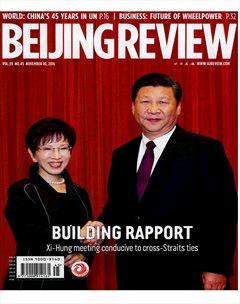
Beijing Review 2016年45期
By Bob Wekesa
Looking back in history, it was in 1971 that, with the firm support of African nations, the Peoples Republic of China (PRC) was able to garner the two-thirds majority vote needed to reclaim its lawful seat in the UN.
In a 1974 speech at the UN General Assembly, then Chinese Vice Premier Deng Xiaoping enunciated Chinas view of the world under the “three worlds theory” that called for solidarity among developing countries. This view was not only welcomed by African countries at the time, but has remained a point of convergence between China and Africa. This is for instance clearly stated in declarations and action plans under the Forum on China-Africa Cooperation(FOCAC). The documents call for the reform of the UN system to ensure that African countries are properly represented in the UN system, a call seen to be resisted by developed nations.
Quite symbolically, Chinese and African leaders have since 2009 held high-level discussions on the sidelines of the annual UN General Assembly in New York. The affirmation of China-Africa cooperation in the UN system can be seen in the voting patterns over crucial issues in specialized UN sessions and at the General Assembly.
Support for Africa
While calls for enhanced inclusion of African representation in the UN system remain unfinished business, China has found many means of assisting Africa through specialized UN agencies. A major turning point for Chinas involvement in the UN system was in the early 1980s when the country started making contributions to agencies such as the UN Development Program(UNDP), UN Capital Development Fund, UN High Commissioner for Refugees, UN Population Fund, UN Industrial Development Organization, and World Food Program. These contributions have benefited African countries as these agencies are targeted at developing nations where Africa constitutes the largest number of states.
A shining example of Chinas support for African countries is in the UN peace and security arena where China has received accolades from not just African leaders but the UN system in its entirety. Although civil wars have considerably subsided on the continent, some regions and countries remain trouble spots. Chinas active involvement in UNled peace and security efforts can be traced to its 1989 deployment of military observers in Namibia during a transition in the southern African nation.
Throughout the 1990s and 2000s, Chinese peacekeeping forces were sent to UN missions in Mozambique, Liberia, Sierra Leone, Ethiopia, Eritrea, Burundi, Cote dIvoire and the Western Sahara. Today, China has the highest number of bootson-the-ground engaged in UN peacekeeping operations in Africa of any other permanent member of the UN Security Council. For instance, when the UN voted to support Liberias peacekeeping efforts in 2003, China heeded the call, deploying forces to not only secure peace, but also help with reconstruction in sectors that had been ravaged by the civil war such as the energy, infrastructure, agriculture and manufacturing sectors. This model of blending traditional peacekeeping with reconstruction is on display in virtually all African countries in which China is involved.
In 2006, China supported Chads UN-based push for the deployment of peacekeeping forces after the country was inundated by refugees from the neighboring Sudanese region of Darfur. With regards to the Darfur conflict itself, China not only deployed a peacekeeping force there but used its diplomatic leverage over Khartoum to ensure the acceptance of a combined African Union (AU) and UN peacekeeping mission. Indeed, peacekeeping has become a centerpiece of Chinas relations with Africa in the UN system as articulated in numerous policy documents and captured in FOCAC action plans.
In the UN system
While China directly supported African countries across various economic sectors as part of establishment of diplomatic relations from the 1960s, this support has over the past decade been undertaken trilaterally under the UN mechanism. Beginning 2006, China has established agricultural demonstration centers in various African countries under the aegis of the UN Food and Agricultural Organization aimed at bolstering the continents food security. This has involved China sending agricultural experts to train African farmers in crop, livestock and fish farming by leveraging the agricultural technology capacities that have made China food selfsufficient.
Working with the AU and the World Health Organization, China played an important part in helping stem the Ebola epidemic that threatened Liberia, Sierra Leone, Nigeria and Guinea. The assistance came with innovations as the WHO eventually listed the China-made Ebola virus real-time kit—which gives results in two hours flat—as a means of screening patients. This is one example how China has worked with the WHO in helping stem African tropical diseases.
Chinas prowess in the UN system is to the benefit of African countries. At the World Bank and International Monetary Fund where China has a huge sway due to its appreciable shareholding and voting power, it has voted in support of inclusion of Africa in numerous projects. Indeed some of the infrastructure projects that dot the continent today were implemented in trilateral fashion by the World Bank, China and African countries. For instance, a Chinese firm, the China Road and Bridge Corp., was involved in World Bank road infrastructure projects in Rwanda, Kenya and Uganda.
Since 2010, the World Banks private sector lending firm, the International Finance Corp., has been giving loans to Chinese firms looking to do social capital projects in Africa. The cooperation is set to continue in future as China and the World Bank signed an agreement in September for cooperation in the African infrastructure sector.
The current phase of China-Africa relations in the UN system are underlined by the alignment of the three broad plans: the AUs Agenda 2063, the FOCAC action plans for the period 2015-18 and the UNs 2030 Agenda for Sustainable Development. A range of projects and programs are already underway, notably led by the UNDP China office which works closely with the Chinese Government, the AU and individual African countries.