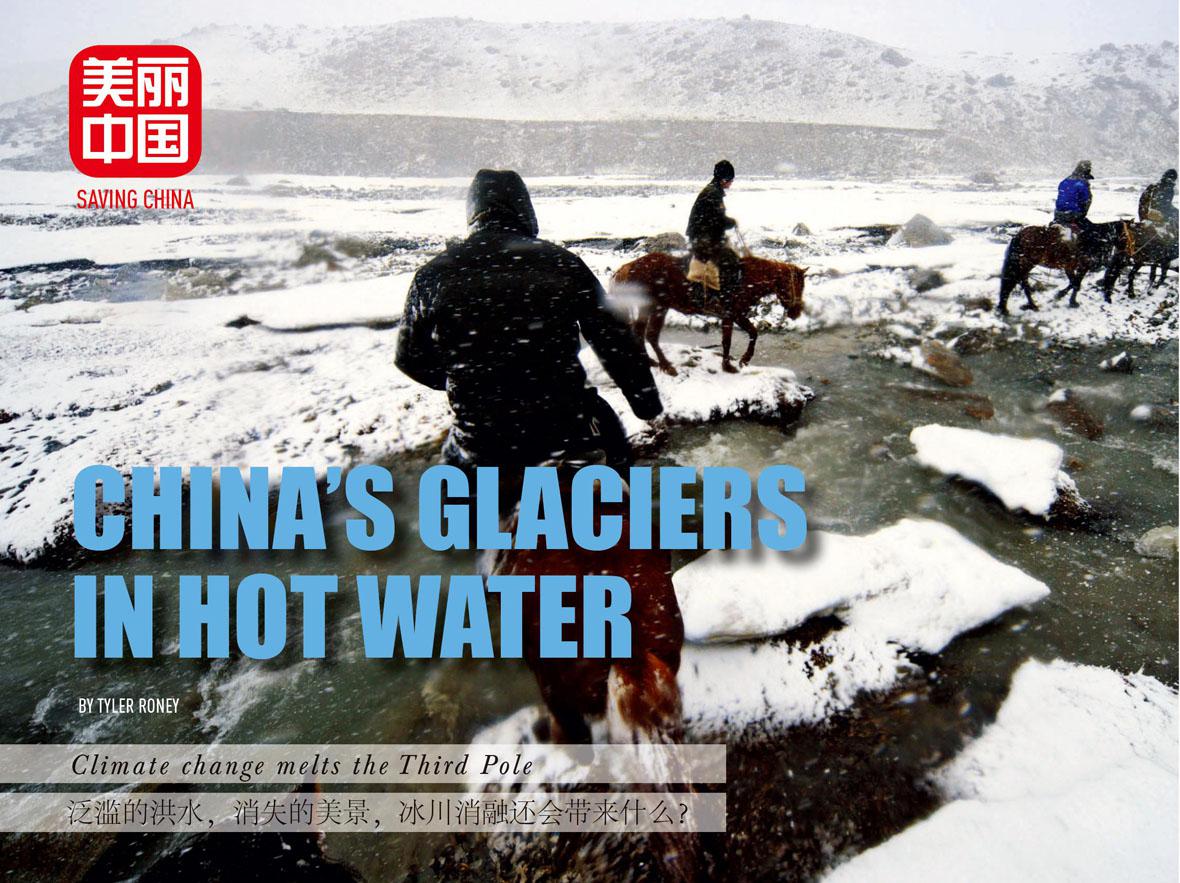
China’s Glaciers in Hot Water
2016-01-10 10:54:52
漢語世界(The World of Chinese) 2016年4期
By Tyler Roney
Climate change melts the Third Pole
泛濫的洪水,消失的美景,冰川消融還會帶來什么?
China isnt the first country that comes to mind when one thinks of glaciers—and it might never be. From the Tomur glacier in Xinjiang and the Meili Snow Mountain in Yunnan to the Hailuogou glacier in Sichuan and the Rongbuk glacier in Tibet, there are more than 51,000 square kilometers of glaciers left in China, and they are retreating at alarming rates.
In June, Xinhua confirmed that Qinghai Provinces Jianggudiru Glacier on Geladaindong Mountain had shrunk by more than 34 meters in just the past six years. “This is direct evidence of global climate change,” Yang Xin, president of the Green River Environmental Protection Association, told Xinhua.
But Qinghai isnt the only one with problems; Xinjiang has more than 22,000 square kilometers of glaciers and all of them are being worn away by impending climate change disaster. In fact, since 1950, more than 18 percent of Chinas glaciers have disappeared according to a 2014 report by the Chinese Academy of Sciences—more than 244 square kilometers worth every year.
However, the problems arent just the disappearance of these beautiful natural wonders; glacial water is a key component for reliable drinking water in many parts of rural China. That Jianggudiru glacier found to have retreated 34 meters isnt just a pretty sheet of ice; its a large source of water for the Yangtze River. As it happens, most of Chinas important rivers begin with the waters of glaciers in the west and their retreat is having incalculable effects on both the biodiversity of the region and rural populations.
Indeed, this area of Central Asia is often considered the “Third Pole”, bringing water to more than 1.5 billion people throughout Asia. Waters from these glaciers water the fields and run in the rivers of Vietnam and Myanmar so it is not just a Chinese problem; however, the immediate flooding effects are definitely a worry for the Middle Kingdom. An official report from Chinese authorities in 2015 stated that, from 2008 to 2010, 173 Chinese cities experienced more than three incidents of flooding.
On Chinas northern border, there is the Altai, and it has experienced perhaps the worst degradation of any Chinese glacier, with Chinese reports claiming that it has receded by 37.2 percent. The effects to the landscape have been catastrophic. According to a World Wildlife Federation report, nearly 11 percent of mudflows in the region are the direct result of Glacial Lake Outburst Flood (GLOF) events and that “the number of glacial lakes within one study area had jumped from 66 to 132.”
Luckily for China, most of the problems associated with the Altai are hitting Kazakhstan, but there are a few glaciers closer to home that are having nasty effects. In 2015, the Atka glacier shifted. The heavy weight of melting water on top collapsed the bottom and the end result was 1,000 hectares of farming land ruined and 70 homes destroyed. The trouble of Chinas glaciers is becoming harder and harder to ignore.
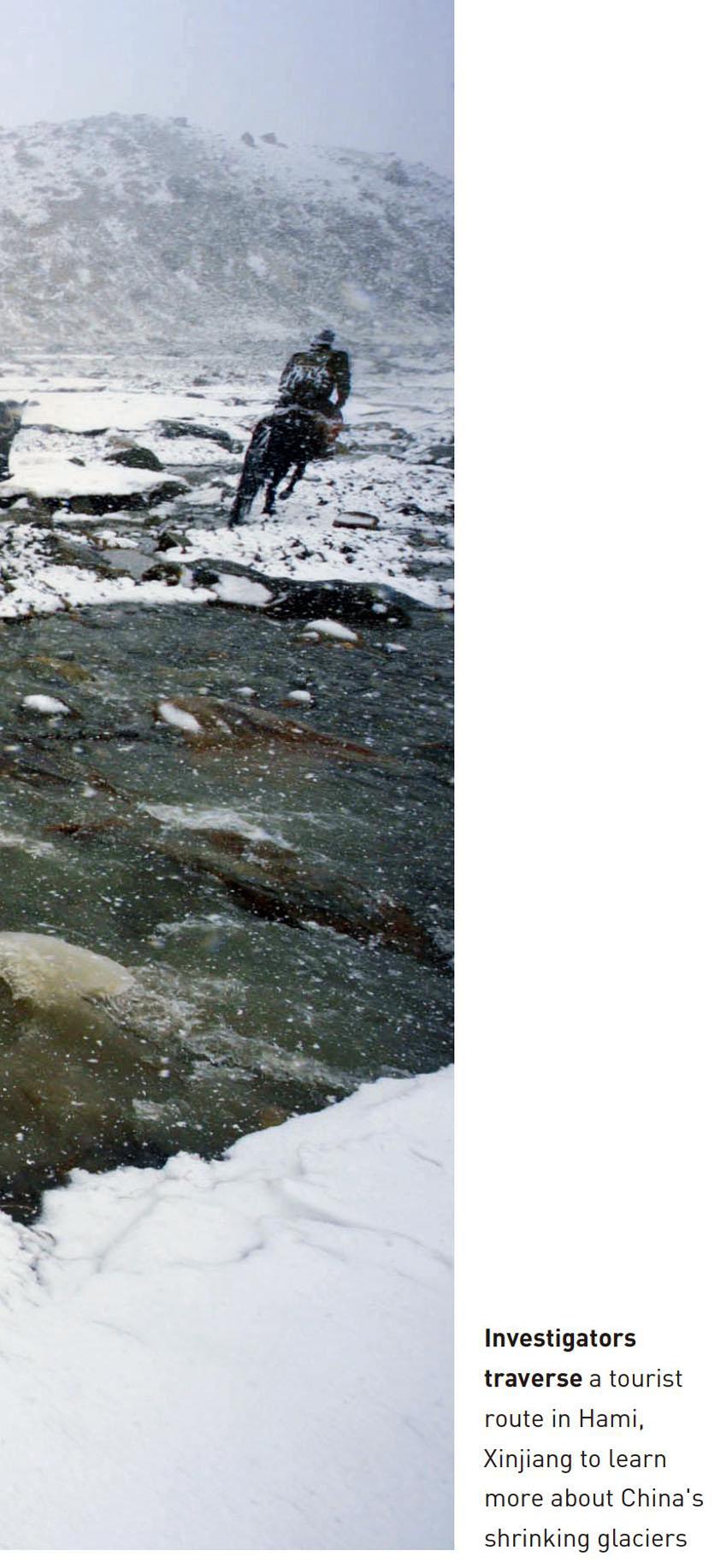
And, while curbing climate change may be the duty of our global generation, greenhouse gases arent the only cause of glacial recession. In Xinjiang, theyre a tourist attraction. While the effects of receding glaciers are hard enough to measure already, one billion RMBs worth of tourists have visited the shrinking Xinjiang glaciers over the past 10 years. This, at least, is an area where the government can take direct action.
Li Jidong, the Communist Party secretary of the Tourism Administration in Xinjiang, said in February that, “We will ban glacier tourism by 2020 and propose replacing the existing facilities with holiday resorts.” Li also commented that others in the Tianshan Mountain region should, “Say no to glacier tourism.”
This is, however, just one solution to the myriad problems Chinese glaciers face. Theres also mining, urbanization, and new transport routes, all serving the secondary purpose of degrading Chinas glaciers. Compounding the problem is a lack of knowledge. Chinese scientists in the December 2015 issue of Advances in Climate Change Research stated, “Studies on glacier vulnerability to climate change have been seldom reported, and thus adaptive countermeasures formulated by Chinese government departments lack a scientific basis, and fail to achieve optimal results.”
And, whats worse than floods is when the water stops altogether. The Tarim Basin is one of the driest places in the world—a marvel of natural beauty but also a horror story along the ancient Silk Road. Near glaciers, people worry about flooding, but people who depend on water from annual glacial run off often have to do without entirely.
While some are concentrated on stopping global warming in its tracks, others are trying to figure out what to do with the areas already hit by the global menace of climate change. The Sustainable Management of River Oases along the Tarim River (SuMaRiO), a group of German and Chinese scientists, are looking at ways to keep the region afloat with innovative thinking. From irrigation to planting common reeds, they see that the Tarim Basins problems with glacial recession are only beginning.
On the political front, the areas most at risk of flooding and the fast effects of melting and shifting glaciers are part of to Chinas One Belt, One Road project. This, perhaps, is the most trying aspect of dealing with the most immediate effects of climate change: cooperation. Unlike the North and South Poles, the Third Pole involves India, Nepal, Kazakhstan, China, and others that cant exactly communicate important changes in climate quickly or effectively—an upsetting state of affairs considering WWF found that glacial events in China can have effects in Nepal in just six minutes. Data is measured irregularly, events go underreported, and important information is not relayed fast enough.
For now, Chinas disappearing glaciers are a microcosm for the hand climate change is ready to deal all life on earth. Perhaps, then, it might be a perfect place to figure out how to fix it altogether.