
Module 4 Fine Arts—Western, Chinese and Pop Arts
2016-01-04 18:12:41
時代英語·高一 2015年6期
(滿分120分;時間90分鐘)
第一部分 ?聽力(共兩節(jié),滿分20分)
第一節(jié)(共5小題;每小題1分,滿分5分)
聽下面5段對話。每段對話后有一個小題,從題中所給的A、B、C三個選項中選出最佳選項,并標在試卷的相應位置。聽完每段對話后,你將有10秒鐘的時間來回答有關小題和閱讀下一小題。每段對話僅讀一遍。
1. What is the weather like now?
A. Rainy. B. Cold. C. Hot.
2. What is the time now?
A. 7:10. B. 7:30. C. 7:00.
3. What does the man probably want to do?
A. Talk with the woman. B. Do some shopping in the store. C. Eat at the McDonalds.
4. Where does the conversation probably take place?
A. In a hospital. B. At school. C. At home.
5. What will the woman do?
A. Buy a new radio. B. Borrow the mans radio. C. Ask the man to repair her radio.
第二節(jié)(共15小題;每小題1分,滿分15分)
聽下面5段對話或獨白。每段對話或獨白后有幾個小題。從題中所給的A、B、C三個選項中選出最佳選項,并標在試卷的相應位置。聽每段對話或獨白前,你將有時間閱讀各個小題,每小題5秒鐘;聽完后,各小題將給出5秒鐘的作答時間。每段對話或獨白讀兩遍。
聽第6段材料,回答第6至8題。
6. When can you have your letter posted at the post office?
A. At 7:30 am on Monday. B. At 4 pm on Friday. C. At 10 am on Saturday.
7. Which service is the dearest if one wants to post a parcel?
A. First-class mail. B. Second-class mail. C. Parcel post.
8. How many hours is second-class mail delivered later than first-class?
A. 12 hours. B. 20 hours. C. 24 hours.
聽第7段材料,回答第9至11題。
9. How would the man spend the money if he won ten million dollars?
A. He would spend it buying what he liked. B. He would save it in the bank.
C. He had no idea about that.
10. What does the woman like best?
A. Travelling. B. Holding parties. C. Shopping.
11. What is the man like?
A. He is warm-hearted. B. He is selfish. C. He is careful with money.
聽第8段材料,回答第12至14題。
12. Who is Rich?
A. Hes the mans cousin. B. Hes the mans friend. C. Hes the womans friend.
13. What sport is Alice good at?
A. Bicycling. B. Tennis. C. Basketball.
14. How does Alice look?
A. She has brown hair. B. Shes tall. C. She has black eyes.
聽第9段材料,回答第15至17題。
15. How does Susan usually go to school?
A. By bus. B. On foot. C. By bike.
16. What happened to Susan yesterday?
A. She was seriously ill. B. She was almost hit by a drunken car driver.
C. She was hit by a truck.
17. What can we learn from the conversation?
A. The car driver isnt allowed to drive for three months.
B. The man thought Susan was very unlucky.
C. The truck driver was seriously injured.
聽第10段材料,回答第18至20題。
18. What does the speaker mainly talk about?
A. That there should be no homework. B. Why too much homework is not a good thing.
C. How to get rid of the boring homework.
19. What do we learn about the speaker from the text?
A. He is often late for school. B. He often tells his friends not to do homework.
C. He is in Grade One in senior middle school now.
20. What does the speaker want his teachers to know?
A. That homework doesnt help with their studies.
B. That good learning methods are very important.
C. That too much homework often makes him fall asleep in class.
第二部分 ?完形填空(共20小題;每小題1.5分,滿分30分)
Many adults see teens as energetic. Many of us see ourselves as proud. This thinking ? 21 ? many adults and us, too, to have the idea that if we cant handle school or ? 22 ? life well, were just not trying.
But in my opinion that may not be true.
Earlier this school year, I was leaving my class one Friday, when suddenly it ? 23 ? like I had pulled a muscle in my back. I knew I was ? 24 ? .
After a few days I stopped eating. This meant I lost ? 25 ? . The clothes that I bought two weeks earlier began ? 26 ? loose. This time my parents got scared. ? ?27 ? , I started sleeping less. My eyelids were constantly(時常地) ? 28 ? .
I refused to ? 29 ? that I was ill. I kept my job working 25 hours a week in a shop; I didnt ? 30 ? any classes. When I was hurting, I didnt mind and kept on going. ? ?31 ? it kills you, it makes you stronger, right?
But now I find myself ? ?32 ? . Is it worth it? Im taking the classes and writing for the newspaper because it looks ? 33 ? on college applications. And I m working 25 hours a week so that, once I get into my dream school, I can ? 34 ? it.
Here I am, already sick from the ? 35 ? of work Im doing in and out of school. So, what good is a(n) ? 36 ? application if Im badly ill? What is the ? 37 ? of doing this work if I cant enjoy the results?
In fact, by writing my ? 38 ? Im telling all the people who ? 39 ? much about the future to worry about it now. This is my warning: ?Dont climb the ? 40 ? dive if you dont like the deep end.
21. A. proves B. forces C. permits D. causes
22. A. still B. even C. just D. yet
23. A. looked B. seemed C. appeared D. felt
24. A. foolish B. heated C. wrong D. ill
25. A. weight B. hope C. face D. direction
26. A. hanging B. holding C. changing D. dressing
27. A. In fact B. In addition C. In turn D. In general
28. A. red B. shut C. open D. heavy
29. A. understand B. determine C. accept D. consider
30. A. lose B. drop C. give D. take
31. A. Unless B. If C. Though D. As
32. A. studying B. working C. resting D. thinking
33. A. curious B. funny C. good D. cool
34. A. control B. manage C. support D. afford
35. A. amount B. set C. enjoyment D. stage
36. A. suitable B. believable C. impressive D. unusual
37. A. reason B. idea C. point D. aim
38. A. time B. labor C. article D. story
39. A. know B. care C. miss D. realize
40. A. far B. deep C. hard D. high
第三部分 ?閱讀理解(共兩節(jié),滿分40分)
第一節(jié)(共10小題;每小題3分,滿分30分)
A
Most people only tap(發(fā)掘)a small part of their potential. You do what you CAN do, but are you doing what you COULD do? Most people do what they CAN do, but not what they COULD do. But there is a whole other world of possibilities out there that most of us dont even let ourselves think about them.
The larger question we need to ask ourselves is: Can we reach a greater potential than we have ever imagined? In fact, if you stop and think about it, what could you do? I mean if you werent afraid of failing, or if you decided to stop coming up with reasons for not doing something, what COULD you actually accomplish?
As a psychotherapist(心理咨詢師)I was always interested in the stories that people told about themselves.
Joey Boring, a stockbroker worked in Edward Jones, was an average performer until he got a vision of what he COULD do. Within two years Joey became one of the top performers. In fact, during the global financial crisis, his performance was up by 43%. Why? Joey decided not to limit himself. He said, “I realized that I could do more than I had ever thought I could do”, and he did! During a time that could have easily been the worst financial period in his career, he chose to view it as an opportunity and began to focus his efforts on ways to better serve his existing customers.
A young friend of mine, Ashtyn Van, sprained(扭)her knee pretty badly. As a 14-year-old girl, she decided that she could tell herself that she was strong enough and good enough to do it. That day, she received the highest score at the state level competition. She could do more than she was doing.
I wonder what limits you are putting on yourself today. Perhaps we are only held back by our own limited thinking.
41. According to the author, “to do what you could do” means to do the things that ___ .
A. you have the ability to do B. you are not allowed to do
C. you have managed to do D. you may do successfully but not sure
42. Why do many people cant realize a greater potential?
A. They are realistic. B. They are not good enough to succeed.
C. They tend to find themselves excuses. D. They havent drawn lessons from past failures.
43. But for his idea of what he COULD do, Joey, during the crisis, might have ___ .
A. been more successful B. lost his job
C. suffered losses D. made Edward Jones closed
44. Why does the author give the two examples?
A. To sing the praises of the two.
B. To say the two are really lucky dogs.
C. To advise people to follow the two examples.
D. To prove ones potential is far bigger than he or she can imagine.
45. Which would be the best title for the text?
A. Are you going to take a risk? B. Are you brave enough?
C. God helps those who help themselves. D. Stop putting limits on yourself.
B
Hello, everyone. Because of the high rate of school violence(暴力)in some areas, teenagers safety becomes a serious problem. We are planning to set up an organization named School Watch to make sure that students have a safe school environment. Please be part of our plan!
What is School Watch?
School Watch is a volunteer project in our school. It helps us stop violence and improve the quality of school life. It will keep yourself and your schoolmates safe. The other members of School Watch care for you and your classroom and you do the same for them.
Is it for everyone?
Anybody can become a member of School Watch because everyone has something to offer.
What else can it do?
School Watch makes it possible for us not only to help each other but also to make friends with each other. Some members may offer to help schoolmates who have problems with their homework.
Who is the Best School Watcher?
Our school will look for the Best School Watcher and give him or her lots of prizes. You could be the one!
How do you start?
To be part of this plan, the only thing you need to do is to talk to the director of the plan in your grade. If you want to get more information, check the official website at www.schoolwatch. com.
46. The members of School Watch are probably ___ .
A. teenagers B. parents C. policemen D. teachers
47. School Watch can help its members ___ .
A. save the environment B. organize sports activities
C. improve studentsmarks D. improve the quality of school life
48. Anyone can become a member of School Watch because ___ .
A. everyone may have problems B. everyone can give help to others
C. everyone wants to have good marks D. everyone needs to make some friends
49. If you want to be a member of School Watch, you should ___ .
A. check the websites B. be good at your schoolwork
C. talk to the director of the plan D. get good marks
50. Every year the Best School Watcher will get a lot of prizes from ___ .
A. the school B. the website C. the organization D. the society
第二節(jié) ?閱讀填空(共10小題;每小題1分,滿分10分)
閱讀下面材料,在空白處填入適當的內容(1個單詞)或括號內單詞的正確形式。
Started in 1636, Harvard(哈佛)University is the ? ?51 ? ?(old) of all the colleges and universities in the United States. Yale, Princeton, Columbia and Dartmouth ? ?52 ? ?(open) soon after Harvard.
In the early years, these schools were ? ?53 ? ?(near) early the same. Only young men went to college. All the students studied the same subjects, ? ?54 ? ?everyone learned Latin and Greek. Little was known about science. And few people knew that one kind of school could teach everything that was known about the world. When the students graduated, most of ? ?55 ? ?(they) became ministers or teachers.
In 1782, Harvard started a medical school ? ?56 ? ?young men who wanted to become doctors. Later, lawyers could study in Harvards law school. In 1825, besides Latin and Greek, Harvard began to teach modern ? ?57 ? ?(language), such as French and German. Soon it began to teach American history.
As knowledge increased, Harvard and other colleges began to teach many new subjects. Students were allowed to choose the subjects that ? ?58 ? ?(interest) them.
Today, there are many different kinds of colleges and universities. Most of them ? ?59 ? ?(be) made up of smaller schools that deal with special fields of learning. Theres so much to learn ? ?60 ? ?one kind of school cant offer all.
51.______52.__________53._________54.________55.__________56.________57. _______58._______59. ______60. ____________
第四部分 ?寫作(共兩節(jié),滿分30分)
第一節(jié) ?短文改錯(滿分10分)
假定英語課上老師要求同桌之間交換修改作文,請你修改你同桌寫的以下作文。文中共有10處錯誤,每句中最多有兩處。錯誤涉及一個單詞的增加、刪除或修改。
增加:在缺詞處加一個漏字符號(∧),并在其下面寫出該加的詞。
刪除:把多余的詞用斜線(\)畫掉。
修改:在錯的詞下畫一橫線,并在該詞下面寫出修改后的詞。
注意:1. 每處錯誤及其修改均僅限一詞;2. 只允許修改10處,多者(從第11處起)不計分。
Jimmy started painting in four. When he was six, he was already good at it. He painted many beautiful pictures, that were different from the others because he just painted on half of the paper. “That was very clever,” everyone said, “Nobody else do that!” And people paid a lot money for them, saying “This boy is going to be famous when he is a little old, and then were going to sell it for a lot more money. Then we will get rich.” One day somebody asked him, “How do you only paint on the bottom half of your paper?” “Because Im small, and my brushes cant reach very highly,” Jimmy said.
第二節(jié) ?書面表達(滿分20分)
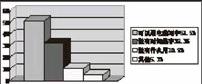
常言道“字如其人”。隨著電腦的普及,部分老師、家長和學生對書寫的重視程度也降低了。據一項調查顯示,有85.8%的中學生表示自己寫的字不好看。對于中學生而言,能寫一手美觀大方的字還是頗有益處的,而中學生不想改善書法的理由也有很大差別,如圖所示。請寫一篇英文短文,反映一下中學生不想改善書法的理由以及你是如何看待這個問題的。
注意:詞數100左右。
Middle School Students Attitudes Towards Handwriting
Nowadays, with the growing popularity of computers, teachers, students and their parents are paying less and less attention to handwriting.
__________________________________
___________________________________
猜你喜歡
閱讀(快樂英語中年級)(2024年9期)2024-10-23 00:00:00
時代英語·高三(2024年3期)2024-09-03 00:00:00
中學生數理化(高中版.高考理化)(2022年1期)2022-04-26 13:53:48
中學生數理化(高中版.高考理化)(2021年10期)2021-12-06 03:26:12
中學生數理化(高中版.高考理化)(2021年9期)2021-11-05 08:14:14
發(fā)明與創(chuàng)新(2021年10期)2021-03-26 03:14:26
閱讀(快樂英語高年級)(2020年8期)2020-01-08 02:21:16
智慧少年·故事叮當(2018年11期)2018-05-14 11:48:18
意林(繪英語)(2017年5期)2017-05-15 02:17:23
中學生(2015年34期)2015-03-01 03:44:42
