
75歲及以上老年患者經皮冠狀動脈介入治療術后遠期預后的性別差異
2015-12-16 01:22:02王玉玨高展楊進剛袁晉青徐波楊躍進陳玨陳紀林喬樹賓吳永健顏紅兵高潤霖
中國循環雜志 2015年5期
王玉玨,高展,楊進剛,袁晉青,徐波,楊躍進,陳玨,陳紀林,喬樹賓,吳永健,顏紅兵,高潤霖
臨床研究
75歲及以上老年患者經皮冠狀動脈介入治療術后遠期預后的性別差異
王玉玨,高展,楊進剛,袁晉青,徐波,楊躍進,陳玨,陳紀林,喬樹賓,吳永健,顏紅兵,高潤霖
目的:評價75歲及以上老年患者在經皮冠狀動脈介入治療(PCI)術后遠期預后是否存在性別差異。
方法:連續入選2004-04至2010-11期間在我院行PCI的29 211例冠心病患者,分為:≥75歲女性組(521例)、<75歲女性組(5 666例)、≥75歲男性組(1 098例)和<75歲男性組(21 926例)。比較各組患者PCI術后住院期和遠期預后。
結果:住院期間,≥75歲女性組心原性死亡發生率明顯高于其他三組。COX比例風險模型分析顯示:與<75歲女性及<75歲男性比,≥75歲女性是心原性死亡(HR=2.53,95% CI:1.15~5.59;HR=2.22,95% CI:1.26~3.91)和心原性死亡/心肌梗死(HR=2.26,95% CI:1.27~4.03;HR=2.25,95% CI:1.44~3.51)的獨立危險因素。但與≥75歲男性相比,≥75歲女性不是心原性死亡(HR=1.30)和心原性死亡/心肌梗死(HR=1.21)的獨立危險因素。
結論:與其他人群相比,75歲及以上老年女性PCI術后住院期和遠期預后較差,但其不是PCI術后預后不佳的獨立危險因素。
經皮冠狀動脈介入治療;老年女性;隨訪
(Chinese Circulation Journal, 2015,30:438.)
與男性冠心病患者相比,導致女性患者預后不良的危險因素更多,例如:體型小、動脈內徑小、激素水平不同、冠狀動脈(冠脈)反應異常(內皮功能障礙)[1]、微血管障礙[2]、斑塊形態不同[3,4],這些因素在理論上可導致女性患者預后較差,但既往大量關于女性是否為經皮冠狀動脈介入治療(PCI)后獨立危險因素的研究未得出一致的結論[5-16],而有研究證實年齡為一個獨立危險因素[17]。因此,或許是老年女性,而非女性作為一個整體,是PCI預后不良的獨立危險因素。本研究旨在通過比較75歲及以上老年女性與其他人群PCI后住院期和遠期預后,分析75歲及以上老年患者PCI術后遠期預后是否存在性別差異。
1 資料和方法
研究對象:連續入選2004-04至2010-11在我院行PCI的29 211例冠心病患者。≥75歲女性組521例、<75歲女性組5 666例、≥75歲男性組1 098例和<75歲男性組21 926例。
PCI及術后用藥:PCI治療策略和支架類型選用由術者決定。≥75歲女性組患者共848個病變, <75歲女性組患者共9 476個病變, ≥75歲男性組患者共1 892個病變,<75歲男性組共38 442個病變。對于沒有禁忌的患者,術前至少24 h口服阿司匹林 300 mg/d,同時服用氯吡格雷300 mg負荷量。術中經動脈鞘管根據體重給予肝素100 U/kg,由術者決定是否使用血小板糖蛋白Ⅱb/Ⅲa受體拮抗劑。術后繼續口服阿司匹林100 mg/d,氯吡格雷75 mg/d:置入裸金屬支架患者至少口服3個月、藥物洗脫支架患者至少服用1年。
隨訪:住院期間及出院1、3、6個月和1、2、3年進行門診和電話隨訪,記錄心原性死亡、非致死性心肌梗死、靶血管血運重建(TVR)和主要不良心血管事件(MACE)。如患者有心肌缺血癥狀或臨床證據,建議其復查冠狀動脈造影,用定量冠狀動脈造影(QCA)進行評價。
相關定義:(1)介入成功:手術結束時,血管內殘余狹窄小于30%,前向血流心肌梗死溶栓治療臨床試驗(TIMI)3級。(2)心肌梗死:缺血性癥狀合并心電圖變化和(或)肌酸激酶同工酶(CK-MB)的動態演變(CK-MB升高大于正常高限的3倍及以上)。(3)TVR:對曾行支架治療的血管再次行PCI或冠狀動脈旁路移植術治療。(4)心原性死亡:不能找到非心原性病因的死亡。(5)MACE:包括心原性死亡、心肌梗死和TVR。(6)參照血管:病變近端或遠端的正常血管。
2 結果
患者基線特點(表1、2):基線臨床特點方面,與其他三組患者相比,≥75歲女性組糖尿病、高血壓患者的比例較高,吸煙者的比例較低。在病變特點方面,≥75歲女性組多支血管病變、鈣化和閉塞病變的比例較高,而參照血管直徑小于其他三組。在介入操作特點上,≥75歲女性組急診PCI的比例較高,而經橈動脈路徑雙球囊對吻技術、分叉病變雙支架技術的比例較低。
隨訪期間臨床療效:本研究平均隨訪時間15個月,失訪共4 323例,失訪率14.8%,其中3 308例多次打電話未通,981例拒絕或無法提供患者情況,34例死亡,但家屬拒絕說明死亡原因。
住院期間,≥75歲女性組的MACE發生率明顯高于<75歲女性組和<75歲男性組(P<0.05),差異有統計學意義;而與≥75歲男性組相比差異無統計學意義。其中≥75歲女性組的心原性死亡發生率明顯高于其他三組患者(P<0.05)。≥75歲女性組的心肌梗死發生率明顯高于<75歲女性組和<75歲男性組(P<0.05),差異均有統計學意義,而與≥75歲男性組相比差異無統計學意義。≥75歲女性組的TVR與其他三組相比差異無統計學意義(表3)。
COX比例風險模型分析在調整潛在的混雜因素(包括陳舊性心肌梗死、既往PCI、既往冠狀動脈旁路移植術、糖尿病、高血壓、不穩定性心絞痛、左主干病變、支架數量、病變數量、藥物洗脫支架比例、支架直徑、支架長度、后擴張和血管內超聲)后顯示:與<75歲女性和<75歲男性比,≥75歲女性是心原性死亡(HR=2.53,95% CI:1.15~5.59;HR=2.22,95% CI:1.26~3.91)和心原性死亡/心肌梗死(HR=2.26,95% CI:1.27~4.03;HR=2.25,95% CI:1.44~3.51)的獨立危險因素。但與≥75歲男性相比,≥75歲女性不是心原性死亡(HR=1.30,95%CI:0.97~1.71)和心原性死亡/心肌梗死(HR=1.21,95%CI:0.94~1.55)的獨立危險因素。
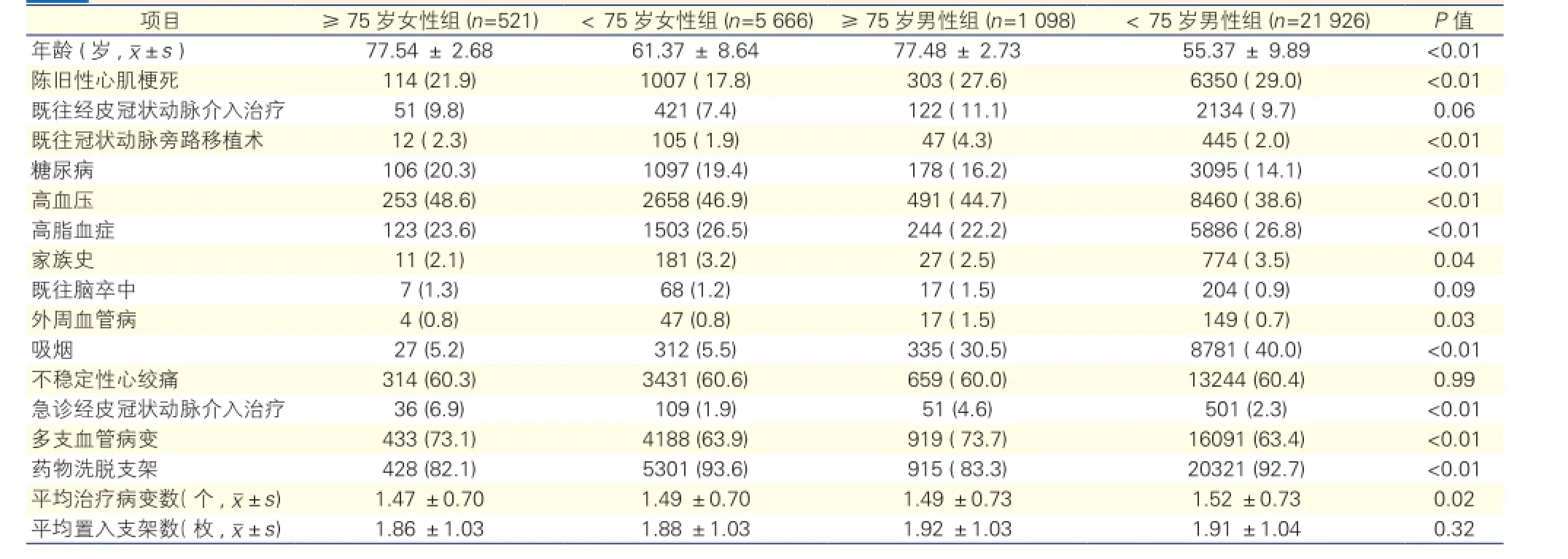
表1 4組患者基線資料比較[例(%)]
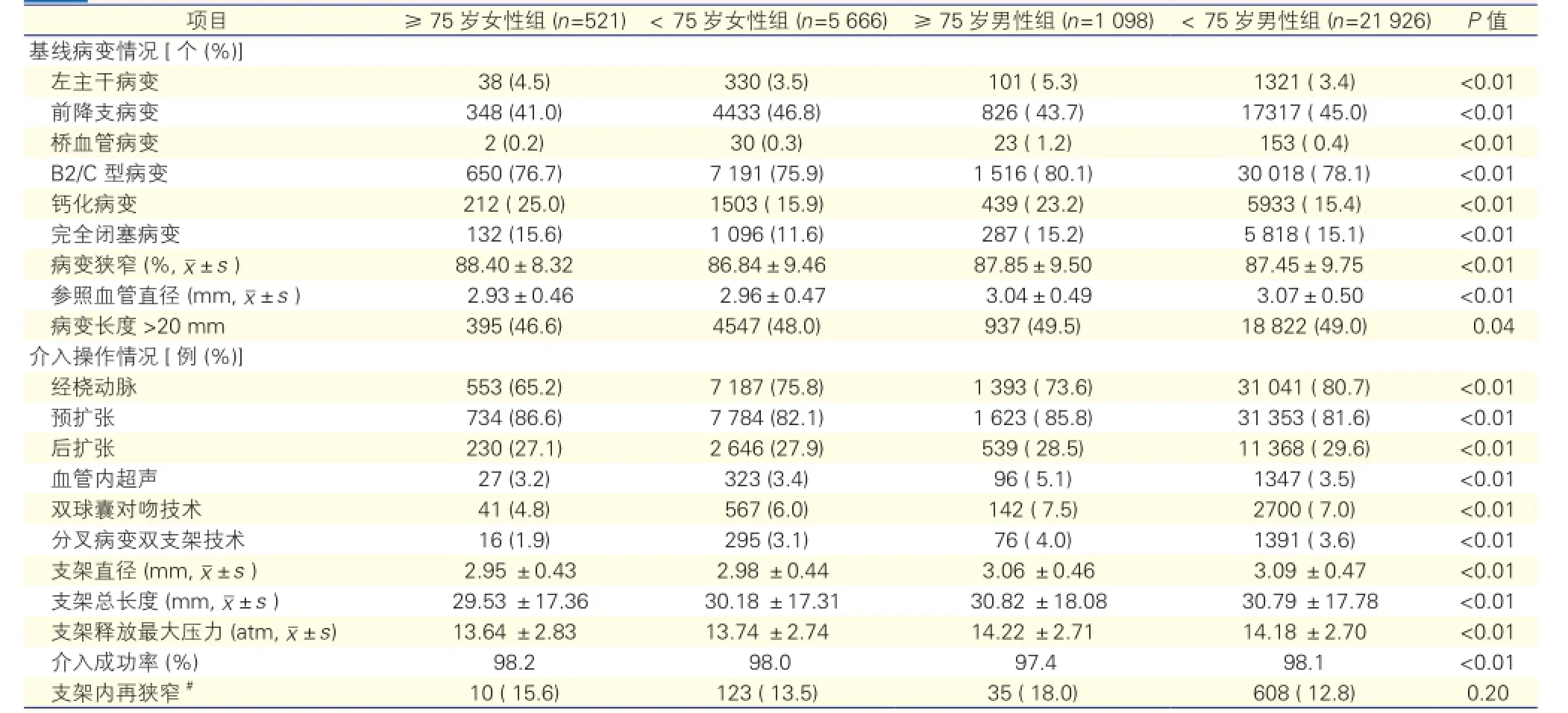
表2 4組患者基線病變特點和介入操作參數
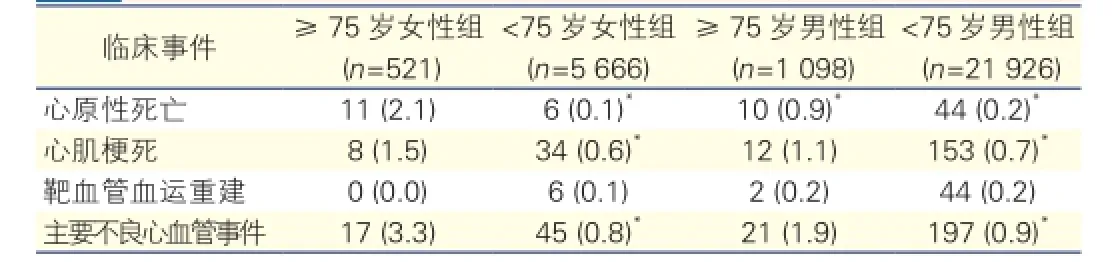
表3 住院期間4組臨床事件的發生情況[例(%)]
3 討論
與男性冠心病患者相比,引起女性冠心病患者預后不良的危險因素更多,且這些危險因素隨著年齡增長變得更加明顯。與既往有關女性患者的報道一致[5-16],本研究中≥75歲女性組糖尿病、高血壓的比例更高,一些研究顯示糖尿病患者更易發生三支病變[18],高血壓患者更易發生分叉病變[19],這些均可導致預后不良。此外,本研究中≥75歲女性組急診PCI 、多支血管病變、鈣化病變和完全閉塞病變的比例較高,參照血管直徑較小,這些因素均可導致預后不良。
本研究中≥75歲女性組MACE發生率高于<75歲男性組和<75歲女性組,其中心原性死亡發生率明顯高于其他三組,心肌梗死發生率高于<75歲男性組和<75歲女性組,TVR發生率與其他三組相比無明顯差異。但調整混雜因素后,雖然≥75歲女性的心原性死亡和心肌梗死的發生風險仍明顯高于<75歲男性和<75歲女性,卻與≥75歲男性相比無明顯差異。因此,≥75歲女性不是PCI術后預后不良的獨立危險因素。
研究顯示,女性患者預后不良只是暫時的,女性PCI術后30天內MACE的發生率比男性高,但1年時臨床結局卻與男性相當或優于男性[20-25]。而本研究中,老年女性不良事件的發生情況并未隨時間推移而有所好轉,長期隨訪及住院期的結局均較差。
本研究發現75歲及以上老年女性PCI術后住院期和長期結局較差,但75歲及以上老年女性不是預后不良的獨立危險因素。由于本研究樣本量大、隨訪時間長且來源于臨床“真實世界”,也許能為臨床選擇治療策略和預測此類患者預后提供一定的指導作用。本研究的不足之處在于為單中心、非隨機對照研究,存在一定的選擇偏倚和混雜性偏倚,需要開展進一步的研究來證實。另外,本研究失訪率較高,且對失訪中出現的34例原因不明的死亡事件未能進行進一步分析,這些因素可能對研究結果造成一定的影響。
[1] von Mering GO, Arant CB, Wessel TR, et al. Abnormal coronary vasomotion as a prognostic indicator of cardiovascular events in women: results from the national heart, lung, and blood institute-sponsored women’s ischemia syndrome evaluation (WISE). Circulation, 2004, 109: 722-725.
[2] Wong TY, Klein R, Sharrett AR, et al. Retinal arteriolar narrowing and risk of coronary heart disease in men and women. The atherosclerosis risk in communities study. J Am Med Assoc, 2002, 287: 1153-1159.
[3] Burke AP, Farb A, Malcom GT, et al. Effect of risk factors on the mechanism of acute thrombosis and sudden coronary death in women. Circulation, 1998, 97: 2110-2116.
[4] Burke AP, Virmani R, Galis Z, et al. 34th Bethesda conference: task force #2-what is the pathologic basis for new atherosclerosis imaging techniques? J Am Coll Cardiol, 2003, 41: 1874-1886.
[5] Cowley MJ, Mullin SM, Kelsey SF, et al. Sex differences in early and long term results of coronary angioplasty in the NHLBI PTCA Registry. Circulation, 1985, 71: 90-97.
[6] Peterson ED, Lansky AJ, Kramer J, et al. Effect of gender on the outcomes of contemporary percutaneous coronary intervention. Am J Cardiol, 2001, 88: 359-364.
[7] Bell MR, Holmes DR Jr, Berger PB, et al. The changing in-hospital mortality of women undergoing percutaneous transluminal coronary angioplasty. J Am Med Assoc, 1993, 269: 2091-2095.
[8] Ellis SG, Myler RK, King SB, et al. Causes and correlates of death after unsupported coronary angioplasty: Implications for use of angioplasty and advanced support techniques in high-risk settings. Am J Cardiol, 1991, 68: 1447-1451.
[9] Ellis SG, Roubin GS, King SB, et al. Angiographic and clinical predictors of acute closure after native vessel coronary angioplasty. Circulation, 1988, 77: 372-379.
[10] Lansky AJ, Ng VG, Mutlu H, et al. Gender-based evaluation of the XIENCE V everolimus-eluting coronary stent system: Clinical and angiographic results from the SPIRITⅢ randomized trial. Catheter Cardiovasc Interv, 2009, 74: 719-727.
[11] Watanabe CT, Maynard C, Ritchie JL. Comparison of short term outcomes following coronary artery stenting in men versus women. Am J Cardiol, 2001, 88: 848-852.
[12] Peterson ED, Dai D, DeLong ER, et al. Contemporary mortality risk prediction for percutaneous coronary intervention: Results from 588,398 procedures in the National Cardiovascular Data Registry. J Am Coll Cardiol, 2010, 55: 1923-1932.
[13] Singh M, Rihal CS, Gersh BJ, et al. Mortality differences between men and women after percutaneous coronary interventions . a 25-year, single-center experience. J Am Coll Cardiol, 2008, 51: 2313-2320.
[14] Woo JS, Kim W, Ha SJ, et al. Impactof gender differences on longterm outcomes after successful percutaneous coronary intervention in patients with acute myocardial infarction. Int J Cardiol, 2010, 145: 516-518.
[15] Berger JS, Sanborn TA, Sherman W, et al. Influence of sex on in-hospital outcomes and long-term survival after contemporary percutaneous coronary intervention. Am Heart J, 2006, 151: 1026-1031.
[16] Kovacic JC, Mehran R, Karajgikar R, et al. Female gender and mortality after percutaneous coronary intervention: results from a large registry. Catheter Cardiovasc Interv, 2012, 80: 514-521.
[17] Farooq V, Brugaletta S, Serruys PW. Contemporary and evolving risk scoring algorithms for percutaneous coronary intervention. Heart, 2011, 97: 1902-1913.
[18] 安辰鴻. 冠心病并發2型糖尿病患者冠狀動脈病變特點及護理對策. 中國循環雜志, 2013, 29(z1): 233.
[19] 梅佳杰, 曲鵬. 合并高血壓的冠心病患者冠狀動脈病變特點的分析. 中國循環雜志, 2013, 29(z1): 128.
[20] Arnold AM, Mick MJ, Piedmonte MR, et al. Gender differences for coronary angioplasty. Am J Cardiol, 1994, 74: 18-21.
[21] Robertson T, Kennard ED, Mehta S, et al. Influence of gender on inhospital clinical and angiographic outcomes and on one year follow-up in the new approaches to coronary intervention(NACI) registry. Am J Cardiol, 1997, 80: 26K-39K.
[22] Mehilli J, Kastrati A, Bollwein H, et al. Gender and restenosis after coronary artery stenting. Eur Heart J, 2003, 24: 1523-1530.
[23] Heidland UE, Heintzen MP, Klimek WJ, et al. Acute complications and restenosis in women undergoing percutaneous transluminal coronary angioplasty. Is it possible to define sex differences and to determine risk factors? J Cardiovasc Risk, 1998, 5: 297-302.
[24] Kelsey SF, James M, Holubkov AL, et al. Results of percutaneous transluminal coronary angioplasty in women:1985-1986 national heart, lung, and blood institute’s coronary angioplasty registry. Circulation, 1993, 87: 720-727.
[25] Lansky AJ. Outcomes of percutaneous and surgical revascularization in women. Prog Cardiovasc Dis, 2004, 46: 305-319.
Gender Difference of Long-term Clinical Outcomes in Patients at 75 Years or Elder After Percutaneous Coronary Intervention Treatment
WANG Yu-jue, GAO Zhan, YANG Jin-gang, YUAN Jin-qing, XU Bo, YANG Yue-jin, CHEN Jue, CHEN Ji-lin, QIAO Shu-bin, WU Yong-jian, YAN Hong-bing, GAO Run-lin.
Department of Cardiology, Cardiovascular Institute and Fu Wai Hospital, CAMS and PUMC, Beijing (100037), China
Objective: To explore the gender differences of long term outcomes in patients at 75 years or elder after percutaneous coronary intervention (PCI) treatment.Methods: A total of 29211 consecutive patients who received PCI in our hospital from 2004-04 to 2010-11 were retrospectively studied. The patients were divided into 4 group: Group① Female ≥ 75 years of age, n=521, Group②Female < 7 5 years, n=5666 and Group③ Male ≥75 years, n=1098, Group④ Male < 75 years group, n= 21926. The inhospital and long-term clinical outcomes after PCI treatment were compared among different groups.Results: The in-hospital cardiac death in Group① was higher than the other 3 groups, P<0.05. Cox proportional hazard model analysis indicated that compared with Group② and Group④, the female ≥ 75 years was the independent risk factor for cardiac death (HR=2.53, 95% CI 1.15-5.59; HR=2.22, 95% CI 1.26-3.91) and cardiac death/MI (HR=2.26, 95% CI 1.27-4.03; HR=2.25, 95% CI 1.44-3.51). While compared with the male ≥75 years, the female ≥ 75 years was not an independent risk factor for cardiac death (HR=1.30) and cardiac death/MI (HR=1.21).Conclusion: Compared with other age groups, female patients at the age ≥ 75 years could have worse in-hospital and long-term outcomes after PCI, while it was not the independent risk factor for cardiac death and cardiac death/MI in patients after PCI treatment.
Percutaneous coronary intervention ; Elder female; Follow-up
2014-12-12)
(編輯:許 菁)
國家衛生和計劃生育委員會公益性行業專項(201402001)
100037 北京市,北京協和醫學院 中國醫學科學院 國家心血管病中心 阜外心血管病醫院 冠心病診治中心
王玉玨 碩士研究生 研究方向:冠心病學研究 Email:805573802@qq.com 通訊作者:高展 Emai1:gaowangjia@163.com
R54
A
1000-3614(2015)05-0438-04
10.3969/j.issn.1000-3614.2015.05.007
猜你喜歡
體育科技文獻通報(2022年3期)2022-05-23 13:46:54
天津醫科大學學報(2021年4期)2021-08-21 02:14:32
天津外國語大學學報(2021年3期)2021-08-13 08:32:18
遼金歷史與考古(2021年0期)2021-07-29 01:06:54
基層中醫藥(2020年10期)2020-11-27 01:58:58
智慧健康(2019年36期)2020-01-14 15:22:58
科技傳播(2019年22期)2020-01-14 03:06:54
民用飛機設計與研究(2019年4期)2019-05-21 07:21:24
汽車工程學報(2017年2期)2017-07-05 08:13:02
中國衛生標準管理(2015年3期)2016-01-14 03:41:45
