不同文化之間的建筑
2015-11-29 06:08:07WolfGuenterThiel文化研究員
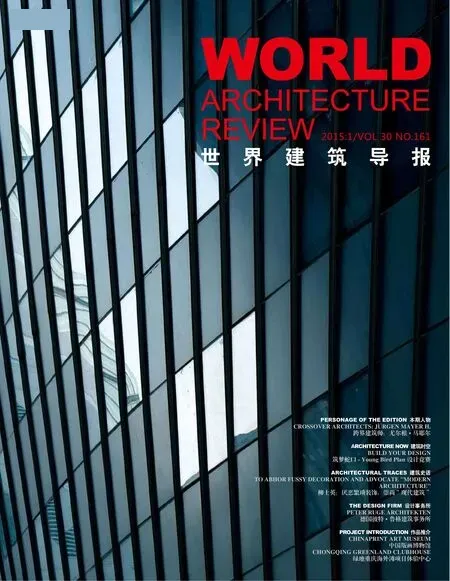
世界建筑導報 2015年1期
Wolf Guenter Thiel,文化研究員
Wolf guenter Thiel, Researcher, cultural studies
不同文化之間的建筑
ARCHITECTURE IN BETWEEN CULTURES
Wolf Guenter Thiel,文化研究員
Wolf guenter Thiel, Researcher, cultural studies
鄰近河流,我們才能看到魚,鄰近山脈,我們才能聽到鳥的歌聲。
世界上三分之一的二氧化碳大氣污染是由建筑物所產生的。為了減少這種排放,以滿足全球氣候變暖的挑戰,建筑師們正在為解決可持續發展和生態保護問題而努力。他們在高效節能建筑方面和科學家,研究人員,工業企業以及客戶等合作。由此,他們必須采用新現代主義的態度,利用高效率的技術解決方案,還有使用因地制宜的戰略。
Peter Ruge是一位德國建筑師,其事務所總部設在柏林。他也在德國德紹建筑研究院教學可持續設計課程。他在可持續建筑領域有著豐富的專業知識,體現在其多個建筑作品獲得了德國國家可持續建筑認證。他的建筑尊重當地人文條件,體現出他的核心價值觀就是人類發展和個人福祉。現代化是一個跨文化,跨宗教,跨政治的理念,這就需要去適應當地的傳統和行為。這意味著現代的建筑技術都是為了服務于不斷更新的文化傳統和態度。通過這個,他的建筑可以稱為他對文化的理解,對文化的一種表達。
建筑師要理解當地文化是一個復雜的過程,從城市發展,社會分層,語言溝通,支配形式以及自然環境等方面。對他來說,一棟大樓不是一個孤立的個體,而是一個可以與周圍環境適應并共享資源的機制。這樣一來,建筑不僅可以更智能,也可以和自然構成一種和諧的關系。
2010年杭州會議中心的外立面設計就是一個很好的例子,杭州是浙江省的省會。“浙江省以盛產茶葉而著稱,為了表達該地域特性,建筑的外觀設計主要是疊加了茶的種植路徑和種植網的輪廓。(Peter Ruge)“建筑看起來像多層的編織物所覆蓋,并賦予它以一種真實的建筑形態。從遠處看,建筑外觀就像一個剛性體,但是當走近時就會發現水平的和豎直的結構網格。該建筑就是與杭州的整體環境融合一體,成為杭州的人文景觀的一部分。
Ruge認為他的工作是將兩種文化的結合。文化的差異不是要點,而在兩者之間,或與解構主義理論所說的那樣:“延異”。雅克·德里達用這個詞來表達多種特點主宰產品的文本意義。我們的話語文字和標志及其含義是根據他們所在的背景而改變。他用的是解構主義的工具,來建立一個新的現代式建筑。在此,我們理解新現代主義作為一個可持續發展的概念,是健康,環境,社會和經濟的有機結合。
即將在2015年竣工的杭州新天地工廠,是曾經的工業遺跡成為當代建筑的一個有力的例子。Ruge重組了整個建筑群,并保留了工業時代留下的建筑上的亮點。它顯示了當今先進的生產行業是多么的不同于其歷史的建筑。鋼鐵生產爐就像一個時間見證者,將遙遠的過去鏈接到高科技的今天。他們不像是工業歷史的終結,而是一個不久前的遺留。他們看起來就像從一個蒸汽時代的小說或電影詩意的隱喻。在今天超速發展的中國,現代工業時期已經看起來古老,但比起實際的時間跨度,他們并沒有離的像看起來那么久遠。
另一個2013年中國海南博鰲樂城總體規劃項目,也就是一富有遠見的想法。這是一個將新現代主義和超現代主兩方面完美結合的典范。生態,健康和福祉是共生共存的關系。今天建筑的要求是要有預見未來的能力。該設計以五個環為基礎,體現的是人的五官和五種感知。主要解決的問題是健康,交流,休憩和交通。因此,這樣的五環設計就是為了平衡這些系統,創造一個和諧的環境,在每個島嶼區之間和整個城市里推動能量流動。建筑師的可持續城市設計想法起到了顯著減少能源消耗和建筑占有量的目的。整個城市是二氧化碳零排放,有利于80%的可再生能源的生產,且提供了一個完全集成的交通系統。所有私人化石燃料車輛將留在城市外。可持續能源的使用和健康的核心理念的想法是共生共存。
Peter Ruge 是過去20年建筑和城市規劃的發展理念和態度轉變的見證者。在這些巨大的發展里,建筑和城市規劃的的愿景發生了改變。今天,生態和可持續的解決方案才是建筑設計和城市規劃的重點。節約能源和減少碳排放,同時通過建筑和景觀的融合達到健康和福祉才是建筑的目的。將環保理念延伸到設計的各個方面。他們對于創造可持續城市環境是至關重要的。
生態民居建筑是通過理解當地傳統區域,保護棲息地的一種建筑類型。它鼓勵利用當地的食品,水,建材和清潔能源資源。它要求建筑與自然環境相結合。它通過保護和發展所有資源和生活空間,建立起自然和建筑環境之間的和諧關系,同時也滿足了人們的生理和心理需求。這樣的,以可持續發展為目標,著力實現人與自然之間的和諧。民居建筑是一種與區域融合的建筑,是當地居民傳統文化的反映。民居建筑也是基于對生態的理解,具有某些特性,如在形式和在建筑物的結構上,經濟的使用天然有機材料,融合和適應自然。每一種文化都有其前現代的解決方案。能將那些文化的復興和高科技解決方案結合一起嗎?可以滿足全球氣候變化和不斷增長的需求嗎?
近十年,Ruge 已經在中國實現了數個建筑設計和城市規劃,實現和促進了可持續發展的愿景。中國文化是他的建筑設計的重要驅動力。可持續發展不僅是建立在效率和節約自然資源。它還是建立在地方和區域特點上的。這些原則需要尊重當地氣候或構造的特殊性和他們的建設者,居民及本地需求。
2014年的“被動屋布魯克”就是一個絕佳的例子。Ruge 作為一個建筑師與客戶合作,并鼓勵他們要了解設計和開發,將其作為一個對話的過程;一個建筑師,客戶和工業或技術解決合作伙伴之間的對話。他這樣做的目的是為了使自己的作品更融合當地的文化和生活。在這個項目中,建筑師的目的是將被動式房屋作為一個在溫暖,潮濕的氣候下的節能試點項目。他的建筑師們在詳細設計階段,優化了項目很多的節能部分。而這些想法都體現在了外立面設計中。此外立面指的是中國園林護欄的典型防護結構即用于保護草叢的細竹元素。這還是一個典型的高科技建筑,它更是因地制宜的范例。該建筑清楚的展現其適應當地的能力,同時也展現了建筑為人為建的哲學理念。因此,可持續發展不是一個單獨的術語,而是在最終設計中適應了當地文化和哲學的態度,結合當地居民背景的新設計理念,使用高新科技,節約自然資源,融合當地自然,氣候和健康的最佳途徑之一。“被動式房屋布魯克”是一個非常好的例子。
當然,該方法不能僅依靠技術支持單獨作為解決方案,還必須尊重當地和地區的文化特性。其中包括已經歷了數千年的精神和哲學態度,他們依然是文化,是建筑的最可持續的動力。“作為建筑師,我們不是只關心建筑。以我們的理解,一個好的建筑,應該是可以應對人類不斷變化的需求,文化和生活方式的建筑。(Peter Ruge)”
near to rivers, we recognize fish, near to mountains we recognize the songs of birds.
One third of the world‘s CO2 pollution of the atmosphere is produced by the operation of buildings. Toreduce this production, and to meet the challenges of global climate change objectives, architects workon contemporary sustainable and ecological solutions. They cooperate with scientists, researchers, industrial concerns, and last but not least their clients in terms of new highly energy-efficient building. Therefore they combine a neo-modern attitude with highly efficient hightechnology based solutions, as well as vernacular strategies.
Peter Ruge is a german architect, based in berlin, who teaches sustainable design at the dessau Institute of Architecture (dIA). He has extensive expertise in the field of sustainable construction, reflected in his portfolio of already certified sustainable buildings. The core of his interest is the human being and its personal wellbeing. His architecture respects the human condition in all demands. Modernity is a trans-cultural, trans-religious and trans-political mind set, which is adjusted to the local traditions and convictions. This means the possibilities of modern building technologies are made to serve the ongoing processing of cultural traditions and attitudes. Through this his architecture becomes an expression of cultural understanding through general respect.
This architect understands civilization as a complex state society characterized by urban development, social stratification, symbolic communication forms and a perceived separation from, and domination over, the natural environment. For him a building has never been an isolated entity that consumes, but an integrated mechanism that can also produce and share its resources amongst built environments. In this way architecture can move further toward a harmonious and intelligent partnership with nature.
An example of this spirit is the fa?ade of the congress centre in Hangzhou, China from 2010. Hangzhou is the capital of Zheijing Province. “The Zheijang Province is known for its tea producing region. To express the building's regional characteristics,the design of the fa?ade is based on the superimposed configurations of the tea cultivation pathways and the planting nets.” (Peter Ruge) The building seems to be enveloped by a multi-layered fabric. This fabric evokes the remarkable architectural plasticity of the building. seen from a distance, the fa?ade appears like a rigid volume, but dissolves into a network of structures and levels on approach. The building is perfectly adjusted to the landscape and becomes a natural part of the cultural landscape of Hangzhou.
Ruge regards his work as a work in-between both cultures. The difference of cultures is not the main focus, but the in-between, or as deconstructivist theory puts it: the “différance”. Jacques derrida coins the term to describe heterogeneous features that govern the production of textual meaning. What we like to add to our discourse is the notion of words and signs and their meaning in relation to other words from which they differ. He uses a deconstructivist toolset to build a new modern or neo-modern type of architecture. Hereby we understand neo-modernism as a full notion of the aspects of sustainability towards health,and environmental,social and economic ecology.
The Xintiandi Factory in Hangzhou, which will be finished in 2015, shows a convincing case of incorporating the relicts of an industrial past into a contemporary building. Ruge's architecture restructures the whole building complex, and conserves at the same time the historical architectonic highlights of the industrial era. It shows how today's advanced production industry differs from its historical predecessors. The relicts of the steel producing furnaces are like testimonials of a time too far away to link to the hyper-modern and high-tech of today's surroundings. different from industrial monuments in Europe, they do not seem to testify to the closing of industrial history, but rather seem to be an archaic relict of a time long ago. They appear like poetic metaphors from a steam-punk novel or movie. Through the hyperdevelopments in China today, the modern industrial period already looks ancient,and seems to be further away from today's society than it really is.
The masterplan of the boao lecheng green Health City in Hainan, China (2013),gives an idea of this visionary presence. It is a perfect example of a combination of neo-modern and hyper-modern aspects. These aspects are symbiotically linked to ecology, health and well-being. Today the requirements for architecture involve the ability to foresee future conditions. The design is based on five rings related to organs and senses, using the islands and rings as metaphors. The main issues are health, communication, relaxation and individual transport. The idea is to balance these cycles and systems and create a harmonious planning arrangement,promoting positive energy flow within each of the island districts and throughout the whole city. The architect's idea of sustainable urban design involves a remarkable

杭州會議中心細部 Hangzhou Congress Center

被動房屋布魯克 Passive House Bruck
reduction of energy consumption and the building footprint. The city is CO2 neutral and facilitates 80% renewable energy production. A fully integrated transportation system is provided. All private and fossil-fuelled vehicles will remain outside the development complex. The idea of sustainable energy ecological building and the core idea of health are symbiotically linked.
Peter Ruge has been a witness of the developing ideas and attitudes towards building and city planning in the last 20 years. during these immense developments,the vision of cities and the ideas of building and city planning have been adjusted. Today there is an essential interest in ecological and sustainable solutions. saving energy and reducing the footprint, as well as health and the idea of well-being through a fusion of landscape and architecture, are highly requested. Environmental strategies extend to all aspects of design. They are vital to the creation of sustainable urban environments.
Ecological vernacular architecture is a structure that protects habitants by understanding and interpreting the regional traditions of building and constructing. It encourages the use of local foods, water, building materials and clean energy resources. It requires buildings to be integrated into the natural environment. It works to establish a relationship between the natural and built environment by contributing to the conservation and development of all resources and biotope (living space),while it meets the physiological and psychological needs of people. In this way ecology, aimed at sustainability, tries to attain a harmony between man and nature. The term vernacular architecture expresses an architecture which employs the products of its region, which are themselves a result of traditionally grown cultural traditions. Vernacular architecture also corresponds to an understanding of ecological architecture, with some characteristics such as the use of natural-organic material,integration and adaptation with nature in terms of form and structure of the building,economic and practical application. Every culture has its pre-modern solutions. Would a renaissance of those go together with high-tech solutions? Could a joint venture answer questions of the global climate change and the growing need to save energy?
For almost a decade Ruge has implemented plans, buildings and town planning in China, promoting and realizing sustainable design visions. This Chinese cultural impact is an essential driving force in his architectural approach. sustainability is not only founded in efficiency and the saving of natural resources. It is founded much more in local and regional vernacular building principles. These principles respect climatic or tectonic particularities and the local demands of their builders, inhabitants and users. In fact we find sources of inspiration as well in the spiritual and philosophical attitude of the very same people. This is where both worlds meet in a vernacular and high-tech venture against a background of Chinese philosophical attitudes and paradigms.
The Passive House bruck from 2014 is the most recent achievement, and a very good example for the joint venture process sketched here. As an architect Ruge collaborates with the client and encourages him to understand the process of designing and developing as a dialogue; a dialogue between the architect, the client and the industrial or technological solution partner. He does this especially in the context of the Chinese cultural traditions and habits. The aim of the architect here was to position the house as a pilot project for an energy-efficient residential building in a warm,humid climate. The architect has planned the project in meticulousness and numerous energy-efficient optimization steps in detailed design stages. The architect hints at this context at the fa?ade. The fa?ade refers to typical patterns and structure of a Chinese garden fence, and to the delicate bamboo elements used to protect the bushes. This is a vernacular additive to a high-tech building. It is a result of research in vernacular solutions and techniques established in and for the region. The building shows clearly not only local and regional solution techniques and fertilities in construction, but also the spiritual and philosophical idea of building and constructing as such in the region.
sustainability is therefore not alone a terminology, but also a mature cultural and philosophical attitude incorporated in the final product. The idea of vernacular backgrounds for new architecture, in combination with insights into new and highend technologies, may be one of the best ways to save natural resources as well as nature, climate and health of the inhabitants. Passive House bruck is a very good example of this.
The approach can never reduce its tools for problem solution to technology alone,but must respect local and regional cultural identities. These include spiritual and philosophical attitudes which have endured over thousands of years, and which remain the most sustainable driving forces of culture and its architecture. “As architects not only interested in building. good architecture we understand it is the static response (we ) to (are ) the changing conditions of human needs, to the rhythm of (as )culture and subsequently, lifestyle.” (Peter Ruge)
猜你喜歡
湖北教育·綜合資訊(2022年4期)2022-05-06 22:54:06
金橋(2022年2期)2022-03-02 05:42:50
北方建筑(2021年6期)2021-12-31 03:03:54
文苑(2020年10期)2020-11-07 03:15:36
現代裝飾(2020年6期)2020-06-22 08:43:12
小天使·一年級語數英綜合(2018年9期)2018-10-16 06:30:16
藝術啟蒙(2018年7期)2018-08-23 09:14:18
海峽姐妹(2017年7期)2017-07-31 19:08:17
Coco薇(2017年5期)2017-06-05 08:53:16
少兒科學周刊·兒童版(2015年6期)2015-11-24 03:49:38