
ON SOLVABILITY OF A BOUNDARY VALUE PROBLEM FOR THE POISSON EQUATION WITH A NONLOCAL BOUNDARY OPERATOR?
2015-11-21 07:11:43KADIRKULOV
B.J.KADIRKULOV
Tashkent State Institute for Oriental Studies,Tashkent,Uzbekistan
M.KIRANE
Laboratoire de Math′ematiques,Image et Applications,Universit′e de La Rochelle,Avenue M.Cr′epeau,17042 La Rochelle Cedex,France NAAM Research Group,Department of Mathematics,Faculty of Science,King Abdulaziz University,P.O.Box 80203,Jeddah 21589,Saudi Arabia
ON SOLVABILITY OF A BOUNDARY VALUE PROBLEM FOR THE POISSON EQUATION WITH A NONLOCAL BOUNDARY OPERATOR?
B.J.KADIRKULOV
Tashkent State Institute for Oriental Studies,Tashkent,Uzbekistan
E-mail:kadirkulovbj@gmail.com
M.KIRANE
Laboratoire de Math′ematiques,Image et Applications,Universit′e de La Rochelle,Avenue M.Cr′epeau,17042 La Rochelle Cedex,France NAAM Research Group,Department of Mathematics,Faculty of Science,King Abdulaziz University,P.O.Box 80203,Jeddah 21589,Saudi Arabia
E-mail:moktar.kirane@univ-lr.fr
In this work,we investigate the solvability of the boundary value problem for the Poisson equation,involving a generalized Riemann-Liouville and the Caputo derivative of fractional order in the class of smooth functions.The considered problems are generalization of the known Dirichlet and Neumann problems with operators of a fractional order.
operator of fractional integration and differentiation;solvability;boundary value problem;Riemann-Liouville operator;Caputo fractional derivative;Poisson equation;Dirichlet and Neumann problems
2010 MR Subject Classification 35J05;35J25;26A33
1 Introduction and Preliminaries
There were many works devoted to the investigation the solvability of boundary value problems for the fractional differential equations with the Riemann-Liouville,Caputo,Hadamard,Hadamard-Marchaud and other general fractional operators[12].More information on these works can be found in[2,3,12,13,19-23].
Despite the appearance of the theory of fractional calculus immediately after the creation of the theory of differential calculus,their application in practical problems began to be relatively recent.We note the papers of Jesus and Tenreiro Machado[9]on the fractional electric impedance of biological elements[18],on the fractional control of diffusion systems.Applications of the theory of fractional integration and differentiation in the motion control,to the signal analysis used in robotics,dynamical systems and control of mechanical manipulators and so on can be found in[6,8,15,16,18],respectively.
First we introduce some fact,related with fractional integral and differential operators.
The following operators were introduced by Erdelyi(see,for example,[2,12]).
Definition 1.1 For a function f(t),defined in an interval(0,l),l<∞,the fractional integral in the sense of the Riemann-Liouville with respect to the function tmis defined by the formula

where α∈(0,1],m∈N,Γ(α)is Euler's gamma-function.
Definition 1.2 Let α∈(0,1].The operators

are called the generalized derivative of order α in the sense of Riemann-Liouville for(1.2)and Caputo derivative for(1.3),respectively[2,12].
Note,in the case m=1,operator(1.2)and(1.3)coincides with the well-known Riemann-Liouville or Caputo derivative(see[12]),i.e.,

2 Statement of Problems and Formulation of Main Results

In the domain ? for the equation

we consider the following problems:
Problem 1 Find the solution u(x)of equation(2.1)in the domain ?,satisfying the boundary condition

Problem 2 Find the solution u(x)of equation(2.1)in the domain ?,satisfying the boundary condition


Definition 2.1 A solution of Problem 1(resp.Problem 2)a function u(x)∈C2(?)∩,such that,which satisfies conditions(2.2)(2.3)in the classical sense.
Let v(x)be a solution of the Dirichlet problem

The main results of the present work are:
Theorem 2.2 Let 0<α≤1,m∈N,f(x)∈Cλ+2(??),g(x)∈Cλ+1(?),0<λ<1. Then a solution of Problem 1 exists,is unique,belongs to the class Cλ+2(?)and is represented in the form

where v(x)is the solution of problem(2.6)with

Theorem 2.3 Let the conditions of Theorem 2.2 be satisfied.Then Problem 2 admits a solution,if and only if,the condition

is satisfied.If a solution of the problem exists,then it is unique up to a constant summand,belongs to the class Cλ+2???and is represented in form(2.7),where v(x)is the solution of problem(2.6)with

satisfying the condition v(0)=0.
Problems 1 and 2 in the case m=1 were studied in[19].These problems generalize the classical well-known Dirichlet and Neumann problems for the Poisson equation[1,4].
3 Properties of the Operatorsand
It should be noted that properties and applications of the operatorsandin the class of harmonic functions in the ball ? are studied in[2].Now we study some properties and applications of these operators in the class of smooth functions.Later on,we assume that u(x)is a smooth function in the domain ?.
Lemma 3.1 For 0<α<1,m∈N,the equality

holds for any x∈?.
Proof Using the definition of the operatorand formula(1.3),we obtain

Further,integrating the right part of this equality by parts,we obtain
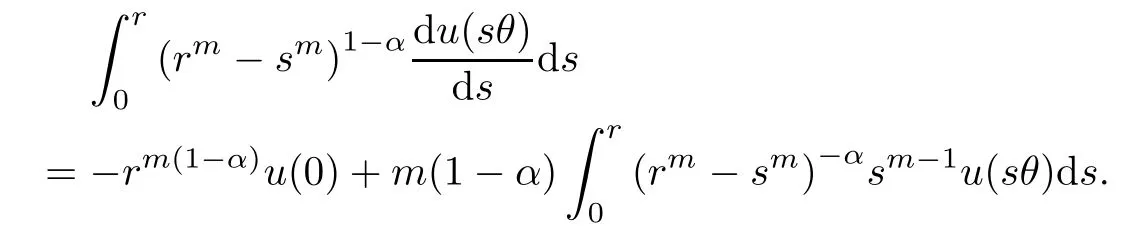
Then

Lemma 3.1 is proved.
Lemma 3.2 For 0<α<1,m∈N,the equality Bα?u(0)=0 holds true.
Proof Taking into account formula(1.2),the function Bαu(x)can be represented in the form
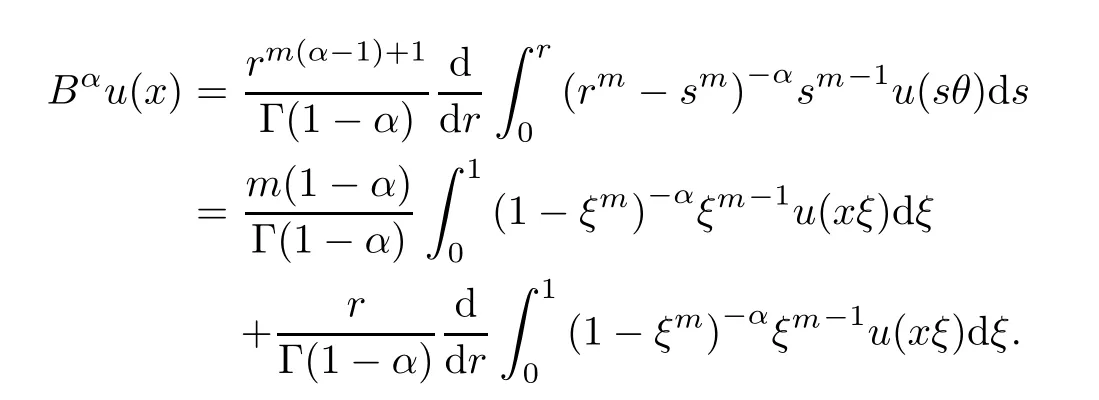
Since u(x)is a smooth function,the second integral converges to zero at x→0[19].Hence,taking Lemma 3.1 into account,we obtain
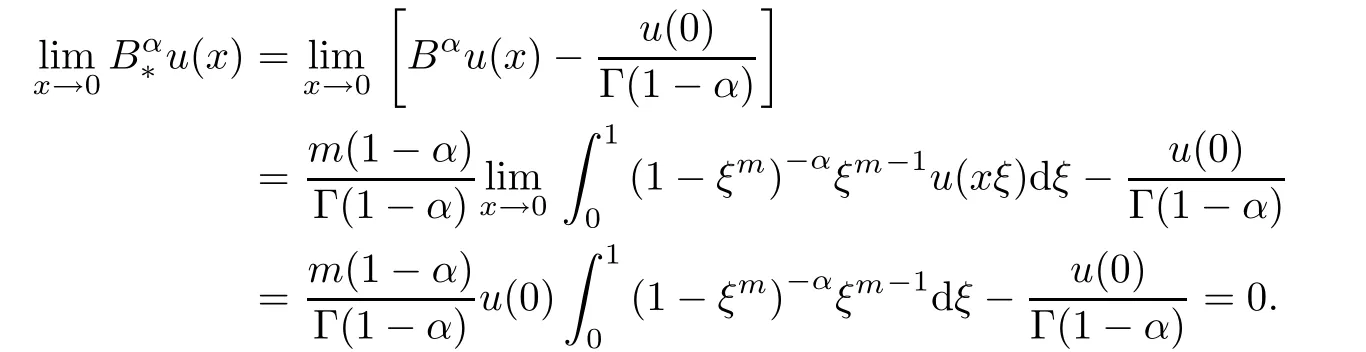
Lemma 3.2 is proved.
Lemma 3.3 For 0<α<1,m∈N,the equalityholds true.

Proof Let x be any point of the domain.It is clear that tx∈? for any 0≤t≤1. Consider the function

and represent it as

Integrating the right part of this equality by parts,we obtain

It is easy to show that(B is the Beta function of Euler)

Then

If now we suppose t=1,then

Lemma 3.3 is proved.
Lemma 3.4 For 0<α<1 and m∈N,the equalityholds for any x∈?.

Proof Using connection between operators Bαand,we have
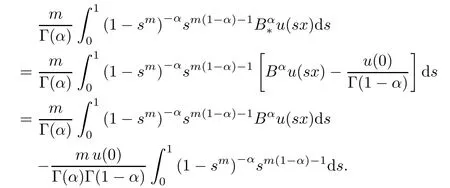
Hence,using Lemma 3.3 and integrating the right part of this equality,we obtain the result of Lemma 3.4.
Lemma 3.5 For 0<α<1 and m∈N,the equalityholds for any x∈?.

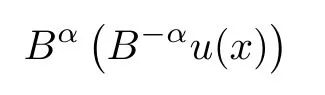
Proof Let us prove the first equality B-α(Bαu(x))=u(x).By definition of B-α,we have

But by virtue of Lemma 3.3,the last integral is equal to u(x),i.e.,

Now let us prove the second equality.We have
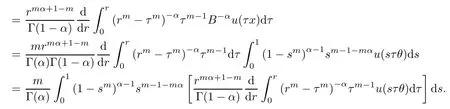
Further,it is not difficult to verify that
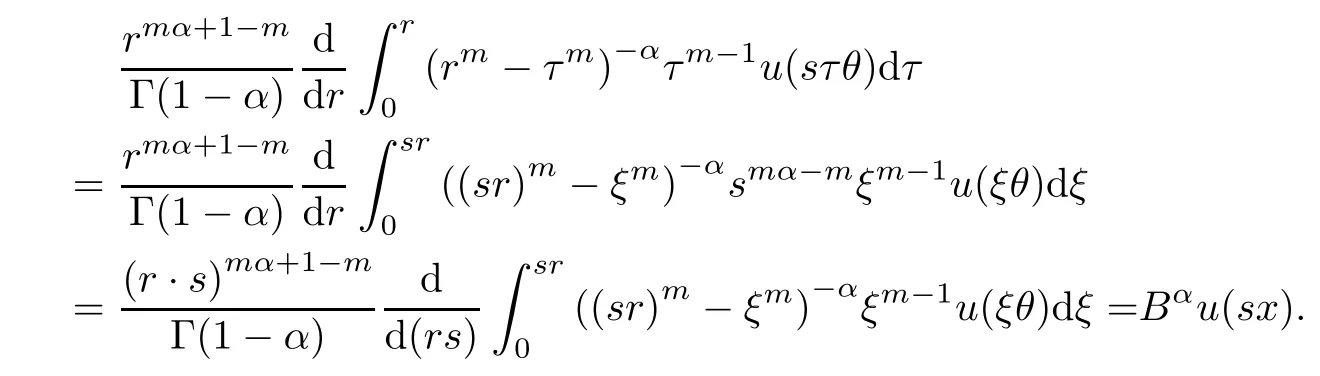
Then

Hence,using Lemma 3.3 we obtain
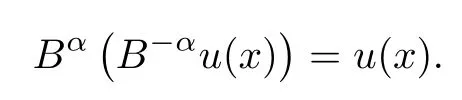
Lemma 3.5 is proved.
Lemma 3.6 For 0<α<1 and m∈N,the equalityholds for any x∈?.

Proof Since

we have

Hence,taking into account the equality

we have

Let us prove the second equality.Using Lemma 3.3,the operator Bα?(B-α)can be represented in the form of

Since

we have
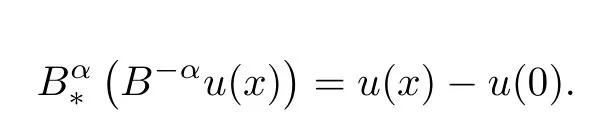
Lemma 3.6 is proved.
Let us consider the case α=1.Due to(1.2)and(1.3)we deduce

We consider the following operator
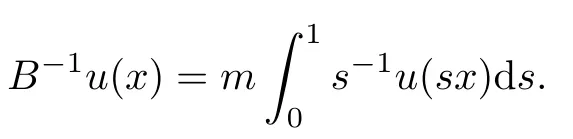
Note that if u(0)/=0,then the operator B-1is not defined in such functions.In[19],the following is proved:
Lemma 3.7 For any x∈?,the following equalities are valid:
1)B-1?B1u(x)?=u(x)-u(0),
2)if u(0)=0,then B1?B-1u(x)?=u(x).
Lemma 3.8 Let u(x)be a solution of equation(2.1)in the domain ?,0<α<1.Then for any x∈?,the following equalities are valid
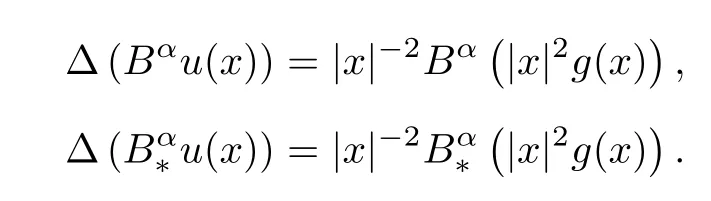
Proof Using Lemma 3.2,Bαu(x)can be reduced to the form:
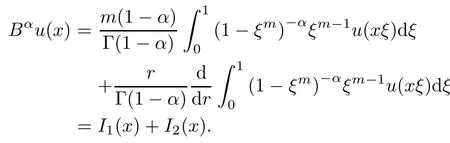
Then
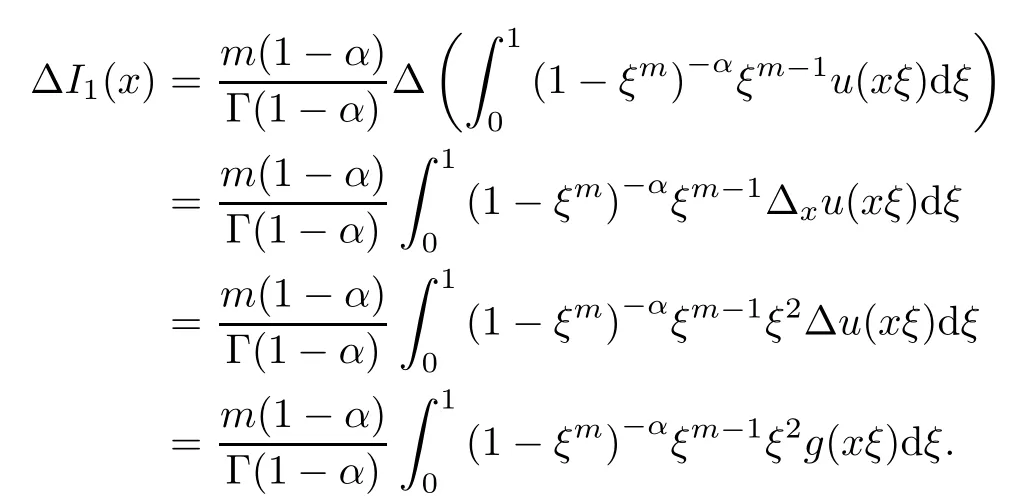

Then?I1(x)can be represented in the form

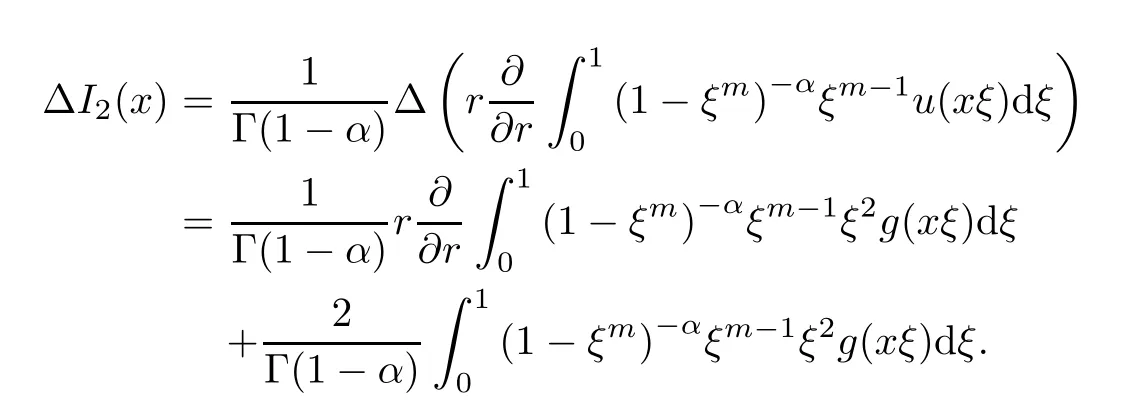
Consider the integral?I2(x).It is clair that[19]

Then
Here,taking formula(3.1)into account,we have
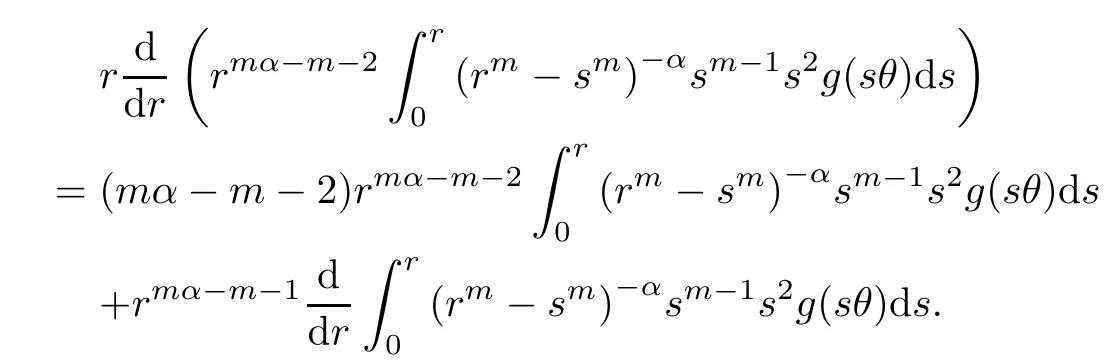
Hence
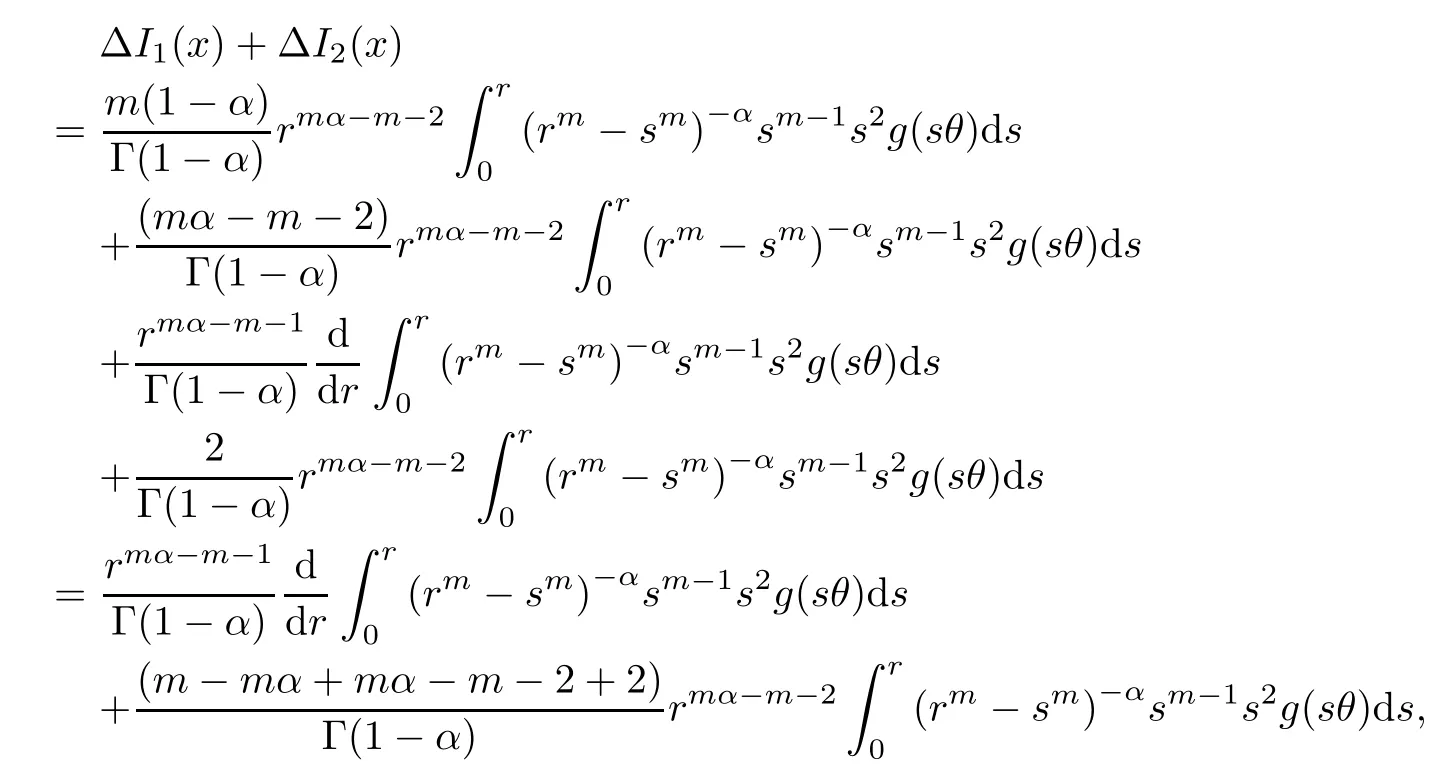
from here we get
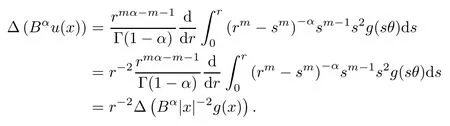
Fulfillment of the second formula can be checked similarly as in the first case.
Lemma 3.8 is proved.
Let v(x)be a solution of problem(2.6).It is known(see[4]),if functions f(x)and g1(x)are sufficiently smooth,then a solution of problem(2.6)exists and can be represented in theform

here ωnis the area of the unit sphere,G(x,y)is the Green function of the Dirichlet problem for the Laplace equation,and P(x,y)is the Poisson kernel:

Lemma 3.9[19]Let v(x)be a solution of problem(2.6).
1)If v(0)=0,then

2)If equality(3.3)is valid,then the condition v(0)=0 is fulfilled for a solution of problem(2.6).
4 The Proof of the Main Propositions
Proof of Theorem 2.2 Let 0<α<1,m∈N,and u(x)be a solution of Problem 1. Apply to the function u(x)the operator Bα,and denote

Then,using Lemma 3.8,we obtain

It is clear that

Thus,if u(x)is a solution of Problem 1,then we obtain for function(4.1)problem(2.6)with

Further,since

for g(x)∈Cλ+1(?),we have g1(x)=Cλ(?)[19].Then for g1(x)∈Cλ(?)and f(x)∈Cλ+2(??),a solution of Problem 1 exists and belongs to the class Cλ+2(?)[7].
Let v(x)be a solution of problem(2.6),with

Apply to function(4.1)the operator B-α,by virtue of Lemma 3.1,we obtain u(x)= B-αv(x).The last function satisfies all the conditions of Problem 1.Indeed

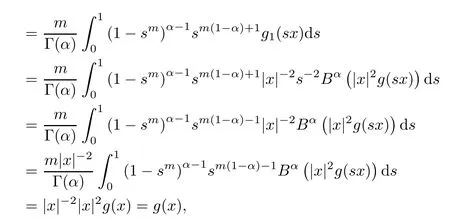
and

Hence,the function u(x)=B-αv(x)satisfies equation(2.1)and the boundary condition(2.2).
Theorem 2.2 is proved. □
Proof of Theorem 2.3 Let 0<α<1,m∈N,u(x)be a solution of Problem 2.Apply to the function u(x)the operator Bα?,and denote

Then,as in the case of Problem 1,we obtain that v(x)is a solution of problem(2.6)with the right-hand side

From Bα?u(0)=0,follows v should satisfy the condition v(0)=0.
Since v(x)is a solution of problem(2.6),it can be represented in the form of(3.2).Then,according to Lemma 3.9,the condition v(0)=0 is equivalent to condition(3.3)which in our case takes the form

Thus,the necessity of(2.8)is proved.This condition is also sufficient for the existence of a solution for Problem 2.
Indeed,if condition(2.8)holds,then v(0)=0,and the function
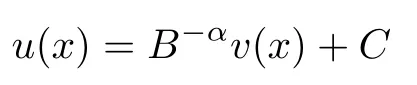
satisfies to all conditions of Problem 2.Let us check these conditions.The fulfillment of the condition?u(x)=g(x)can be checked similarly as in the case of Problem 1.
Now,using the equality

we obtain

Case α=1 can be studied similarly as in[19].
Theorem 2.3 is proved.
[1]Bavrin I I.Operators for harmonic functions and their applications.Differential Equations,1985,21(1): 6-10
[2]Berdyshev A S,Nieto J J,Kadirkulov B J.Solvability of an elliptic partial differential equation with boundary condition involving fractional derivatives.Complex Variables and Elliptic Equations,2014,59(5): 680-692
[3]Berdyshev A S,Turmetov B Kh,Kadirkulov B J.Some properties and applications of the integrodifferential operators of Hadamard-Marchaud type in the class of harmonic function.Siberian Mathematical J,2012,53(4):600-610
[4]Bitsadze A V.Equations of Mathematical Physics.Moscow:Mir Publishers,1980
[5]Erdely A.On fractional integration and its applications to the theory of Hankel transforms.Quart J Math Oxford,1940,11(1):293-303
[6]Ferreira N M F,Duarte F B,Lima M F M,Marcos M G,Tenreiro Machado J A.Application of fractional calculus in the dynamical analysis and control of mechanical manipulations.Frac Calc Appl Anal,2008,11(1):91-113
[7]Gilbarg D,Trudinger N.Elliptical Partial Differential Equations of the Second Order.Berlin:Springer-Verlag,1998
[8]Hilfer R.Fractional calculus and regular variation in thermodynamics//Hilfer R,ed.Applications of Fractional Calculus in Physics.Singapore:World Scientific,2000
[9]Jesus I S,Tenreiro Machado J A,Cunha J B.Fractional impedance in botanical elements.J Vibration and Control,2008,14(9/10):1389-1402
[10]Jesus I S,Tenreiro Machado J A.Fractional control of heat diffusion systems.Nonlinear Dyn,2008,54: 263-282
[11]Karachik V V,Turmetov B Kh,Torebek B T.On some integro-differential operators in the class of harmonic functions and their applications.Siberian Adv Math,2012,22(2):115-134
[12]Kilbas A A,Srivastava H M,Trujillo J J.Theory and Applications of Fractional Differential Equations. Amsterdam:Elsevier,2006
[13]Kirane M,Tatar N E.Nonexistence for the Laplace equation with a dynamical boundary condition of fractional type.Siberian Math J,2007,48(5):849-856
[14]Kober H.On a fractional integral and derivative.Quart J Math Oxford,1940,11(1):193-211
[15]Koeller R C.Application of fractional calculus to the theory of viscoelasticity.J Appl Mech,1984,51: 299-307
[16]Serbina L I.A model of substance transfer in fractal media.J Math Model,2003,15:17-28
[17]Sneddon I N.The use in mathematical analysis of the Erdelyi-Kober operators and some of their applications//Lect Notes Math 457.New York:SpringerVerlag,1975:3779
[18]Tenreiro Machado J A.Theory of fractional integrals and derivatives:application to motion control// Proceedings of International Conference on recent advances in Mechatronics(ICRAM 95).Istanbul,Turkey,14-16 August 1995
[19]Torebek B T,Turmetov B Kh.On Solvability of a Boundary Value Problem for the Poisson Equation with the Boundary operator of a fractional order.Boundary Value Problems,2013,93:1-18
[20]Umarov S R,Luchko Yu F,Gorenflo R.On boundary value problems for elliptic equations with boundary operators of fractional order.Frac Calc Appl Anal,2000,3(4):454-468
[21]Umarov S R.On certain boundary-value-problems for elliptic-equations with boundary operator of fractional order.Doklady Akademii Nauk,1993,333(6):708-710
[22]Turmetov B Kh.A boundary value problem for the harmonic equation.Differential Equations,1996,32(8): 1093-1096
[23]Berdyshev A S,Cabada A,Turmetov B Kh.On solvability of a boundary value problem for a nonhomogeneous biharmonic equation with a boundary operator of a fractional order.Acta Mathematica Scientia,2014,34B(6):1695-1706
?Received October 10,2014;revised March 8,2015.
 Acta Mathematica Scientia(English Series)2015年5期
- Acta Mathematica Scientia(English Series)的其它文章
- ALL MEROMORPHIC SOLUTIONS OF AN AUXILIARY ORDINARY DIFFERENTIAL EQUATION AND ITS APPLICATIONS?
- APPROXIMATION OF COMMON FIXED POINT OF FAMILIES OF NONLINEAR MAPPINGS WITH APPLICATIONS?
- SOME COMPLETELY MONOTONIC FUNCTIONS ASSOCIATED WITH THE q-GAMMA AND THE q-POLYGAMMA FUNCTIONS?
- SUB-ADDITIVE PRESSURE ON A BOREL SET?
- AN APPLICABLE APPROXIMATION METHOD AND ITS APPLICATION?
- ORBITAL INSTABILITY OF STANDING WAVES FOR THE GENERALIZED 3D NONLOCAL NONLINEAR SCHR¨ODINGER EQUATIONS?