
Two-Dimensional Modal Curvature for Damage Detection in Plates
2015-11-21 07:56:23CaoMaosen曹茂森PanLixia潘麗霞HanYi韓奕
Cao Maosen(曹茂森),Pan Lixia(潘麗霞),Han Yi(韓奕)
Department of Engineering Mechanics,Hohai University,Nanjing 210098,P.R.China
Adding Eqs.(8,9),we find
Two-Dimensional Modal Curvature for Damage Detection in Plates
Cao Maosen(曹茂森)*,Pan Lixia(潘麗霞),Han Yi(韓奕)
Department of Engineering Mechanics,Hohai University,Nanjing 210098,P.R.China
Mode shape has become a hotspot of vibration-based damage detection in plates.Two-dimensional(2D)modal curvature(MC2D),derived from mode shapes,is a prevailing physical quantity used to indicate damage. Unfortunately,the physical mechanism of MC2Dfor characterizing damage in plates has not been clarified to date. In contrast,one-dimensional(1D)modal curvature(MC1D)has explicit physical mechanism to portray damage in beams.Unresolved physical mechanism of MC2Dseverely hampers its applications for damage identification in plates.To address this deficiency,the clarification mechanism of MC2Dis investigated to identify damage.With the clarified mechanism,numerical and experimental cases are used to demonstrate the effectiveness of MC2Din detecting damage in plates.
damage detection;mode shape;2D modal curvature;crack;scanning laser vibrometer(SLV)
0 Introduction
Damage detection in beams,plates and shells have been widely investigated in fields including civil aviation,mechanics,aerospace,and military[1-9].In particular,2D modal curvature(MC2D)-based methods have become a research focus over the last decade.The abrupt singularity of a MC2Dhelps to determine the damage in plates.The methods simply imitate the algorithm of 1D modal curvature(MC1D)-based damage detection in beams:An abrupt change of MC1Din the vicinity of damage can lead to the occurrence and location of damage.Unfortunately,unlike MC1Dfor beam damage identification,the mechanism of MC2Dfor plate identification damage is not well understood yet,and some theoretical issues are still unresolved.
Representative studies of MC2D-based damage identification in plates are as follows.Yam et al.[10]created a damage index using the difference between a pair of MCs2Dfor intact and damaged plates.The capability of this index was demonstrated on cracked aluminum plates.Qiao et al.[11]employed a MC2Dto detect delamination in a composite laminate.The presence,the location,and the size of the delamination were effectively detected.Li et al.[12]developed two damage indices using MCs2D,namely a bending moment index and a residual strain mode shape index,and utilized them to identify damage in a free-boundary plate.The results showed that damage indices could locate the damage accurately.Hu et al.[13]evaluated the x and y directional MCs2Dof a plate by individually differentiating a mode shape in the x and y directions,and utilized these MCs2Dto locate delamination in plates.Numerical results showed that sudden changes of MCs2Dcorrectly designated the region of the delamination.Wu et al.[14]used the curvature of a uniform load surface resembling a MC2Dto indicate damage in plates,with the location of the damage accurately identified.Yoon et al.[15]improved MC2Dby a gapped smoothing method and used it to inspect plates for damage.The numerical and experimental results indicated that the method was capable of detecting damaged regions in plates.
Despite increasing applications for damage detection,MC2Dhas a noticeable deficiency:Unlike MC1Dwith its clearly understood mechanism for portraying damage in beams,MC2D′s corresponding mechanism in plates has not been well studied,which hampers the integrity of the MC2D
methods for damage detection in plates.
1 MC2Dfor Damage Detection
1.1 Physical imPlication of MC2D
When applied to damage detection in plates,MC2Dis commonly evaluated by the second-order differentiation of the displacement mode shape W(x,y)of a plate
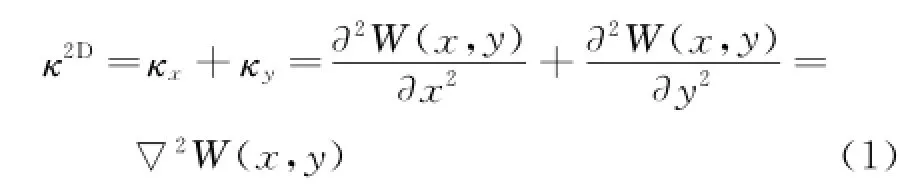


where EI(x)and M(x)are the bending stiffness and the bending moment at the location x,respectively.Eq.(2)implies the mechanism of MC1Dfor describing damage:Damage causes alteration of EI(x),and consequently results in a change inκ1D.Therefore,the change ofκ1Dmanifests the occurrence of damage.This mechanism relies on the explicit correlation betweenκ1Dand the physical properties M(x)and EI(x)of a beam.
Unfortunately,no explicit relationship betweenκ2Dand certain physical properties of a plate is available as yet,because plate has more complex vibrational behavior.Thus,using MC2Dto detect damage lacks a solid physical explanation,which calls for a study on it.
Eor a vibrating thin plate,the bending moments Mx(x,y)and My(x,y)in the x and y directions can be expressed as


Erom Eqs.(3(c),3(d)),we can obtain
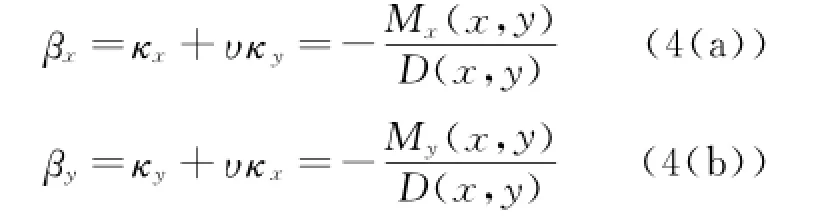
Damage changes the elasticity modulus E and/or the inertia moment I,naturally altering the bending stiffness D(x,y).The alteration of D(x,y)causes modifications inβxandβyby virtue of Eqs.(4(a,b)),and consequently induces the change in the sum ofβxandβy
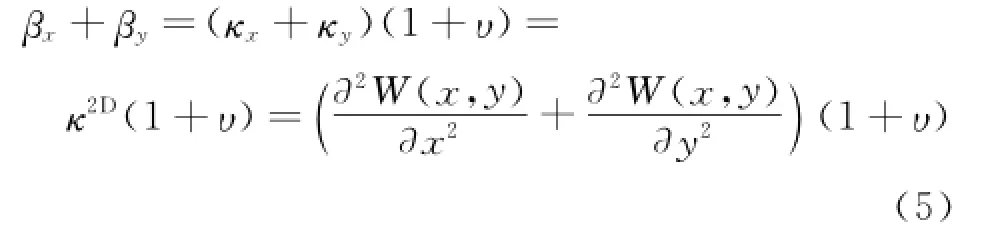
Erom Eq.(5),MC2Dcan be represented by
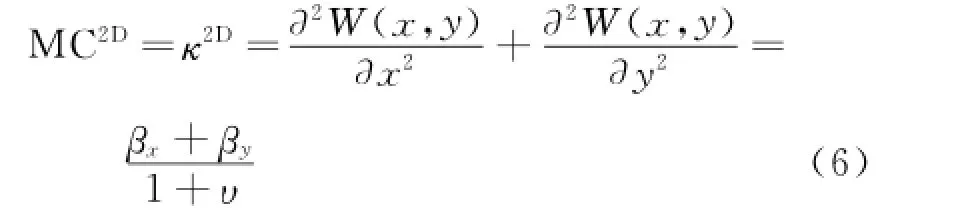
1.2 IsotroPy of MC2D


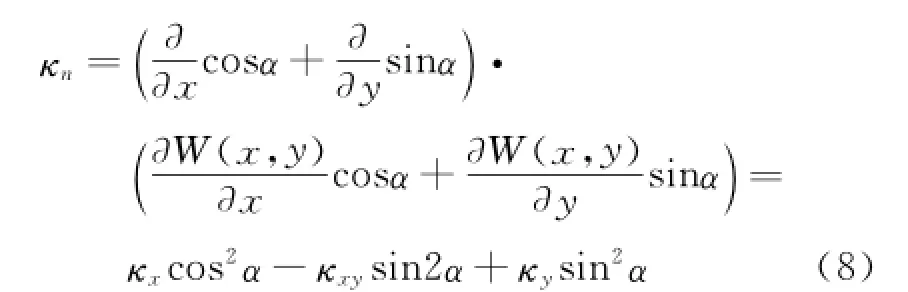
Instead of the direction an,we take the direction tn perpendicular to an,Eq.(9)can be written by substitutingα+π/2 forα.Thus we obtain

Adding Eqs.(8,9),we find

which indicatesκ2Dis independent from the angle α,i.e.,MC2Dcharacterizes damage in a way independent from the principle direction of the adopted coordinate system.
2 Numerical Validation
2.1 Case descriPtion
A free-boundary-condition aluminum plate is seleted as a test specimen with 1 000 mm length,1 000 mm width,and 4 mm thickness in x,y and z directions,respectively.The Young′s modulus,the Poisson′s ratio,and the mass density of the plate are taken as 70.5 GPa,0.33,and 2 680 kg/m3,respectively.The numerical model of the plate is built with 8-node 3D solid structural elements(SOLID 45)using a commercial software ANSYS?.A crack is introduced 2 mm deep,50 mm long parallel to the y-axis,centered at x=400 mm and y=225 mm,lying on the damaged(rear)surface of the plate.The crack is created using a null-thickness interface,on which the coincident nodes in the part of the adjacent but separated structural elements are distributed. The intact(front)surface of the plate is covered by 100×100 elements containing 101×101 nodes,of which the mode shape is achieved by finite element(EE)modal analysis.Eig.1 shows the layout of the crack in the mesh of the EE model.
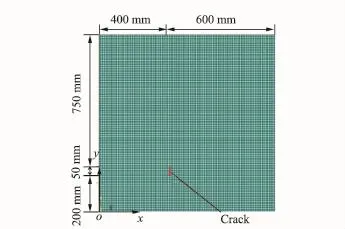
Eig 1 Layout of crack in mesh of EE model of plate
2.2 Results
Eig.2 shows the first three mode shapes of the damaged plate W1,W2and W3,where crackintroduced singularity can hardly be identified. According to Eq.(1),the second-order differentiation of W1,W2and W3gives▽2W1,▽2W2and▽2W3(Eigs.3(a,b,c),respectively),and bears a sharply rising singular peak,unambiguously signifying the presence of the crack;moreover,the singular peak-induced strip of higher intensity in each planform(Eigs.3(d,e,f),respectively)of▽2W1,▽2W2and▽2W3clearly delineates the crack.The identified crack is located at x= 400 mm and spanning from y=200 mm to y= 250 mm,in good agreement with the actual crack location.This case demonstrates that MC2Dis capable of detecting crack in a plate.
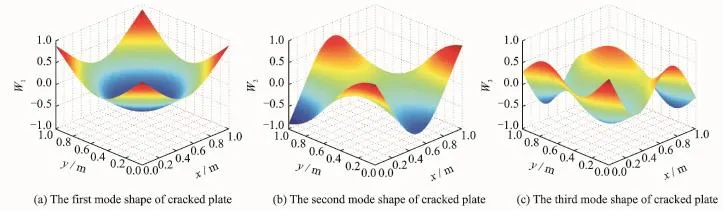
Eig.2 The first three mode shapes of cracked plate
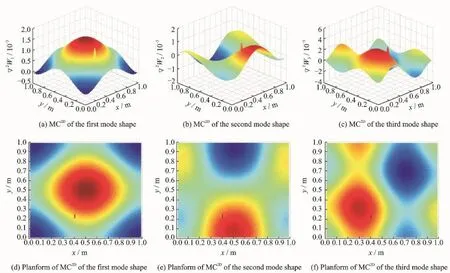
Eig.3 MCs2Dand corresponding planforms for W1,W2,W3of cracked plate
3 ExPerimental Validation
Using MC2Dto detect damage in plates is experimentally validated on an aluminum plate containing an X-shaped notch,with mode shapes of the plate acquired via non-contact measurement with a scanning laser vibrometer(SLV).
3.1 ExPerimental setuP
A free-boundary-condition aluminum plate of 1 000 mm long,1 000 mm wide,and 4 mm thick is selected for a test specimen(Eig.4(a)).The opposite surface of the plate contains an X-shaped notch,whose center is located at 400 mm away from both the upper and the left edges and each inclined branch is 40 mm long,1 mm wide and 1.2 mm deep.The steady-state vibration of the plate is produced by a harmonic excitation at a natural frequency of 830 Hz exerted by a piezoelectric lead-zirconate-titanate(PZT)actuator located on the rear surface beyond the measurement zone(Eig.4(b)).While the plate vibrates stably,the measurement zone is scanned by a SLV to generate the operational deflection shapes(ODSs)covering 451×449 measurement points.When the excitation is at a natural frequency,the ODS can be referred to as a mode shape.
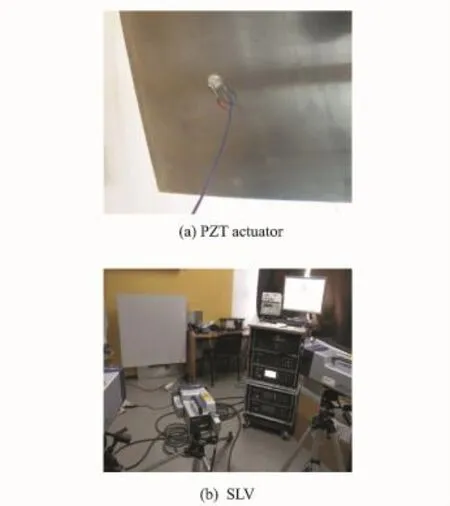
Eig.4 Experimental setup

Eig.5 Mode shapes of cracked plate at 830 Hz
3.2 Results
After modal test,the mode shape at natural frequency of 830 Hz is selected for use.Eig.5 presents the mode shape W acquired by SLV,after which the associated de-noised MC2D▽2W together with its planform are shown in Eig.6.It can be clearly seen in the Eig.6(a)that a singularity peak arising in MC2Didentifies the presence of the damage;and in its planform,the location and the shape agree well with those of the actual X-notch damage.Hence,it is experimentally validated that MC2Dis capable of locating and depicting damage in plates.
4 Conclusions

Eig.6 MC2Dof cracked plate and its planform
Although the use of MC1Dto detect damage in beams has been thoroughly studied,the use of MC2Dto identify damage in plates has not been investigated in depth,with not-clarified physical implication.As a fundamental research,this study clarifies the mechanism of MC2Din describing damage in light of thin plate vibration theory.MC2Dis proved to possess an isotropic form in mathematics,which enables MC2Dto depict damage in any direction.The feasibility of the use of MC2Dto detect damage is investigated using numerically simulated cases and validated by experiment.MC2Dholds promise for developing practical technologies for damage detection in plates.
Acknowledgements
This work was supported by the Key Program of the National Natural Science Eoundation of China(No. 11132003),the Qing Lan Project,and the Eundamental Research Eunds for the Central Universities(Nos. 2012B05814,2014B03914).
[1] Worden K,Manson G,Den?ux T.An evidencebased approach to damage location on an aircraft structure[J].Mechanical Systems and Signal Processing,2009,23(6):1792-1804.
[2] Ou J P,Li H.Structural health monitoring in mainland China:Review and future trends[J].Structural Health Monitoring,2010,9(3):219-231.
[3] Cheng L,Tian G Y.Surface crack detection for carbon fiber reinforced plastic(CERP)materials using pulsed eddy current thermography[J].IEEE Sensors Journal,2011,11(12):3261-3268.
[4] Xu H,Su Z,Cheng L,et al.Reconstructing interfacial force distribution for identification of multidebonding in steel-reinforced concrete structures using noncontact laser vibrometry[J].Structural Health Monitoring,2013,12(5/6):507-521.
[5] An Y H,Ou J P.Experimental and numerical studies on model updating method of damage severity identification utilizing four cost functions[J].Structural Control and Health Monitoring,2013,20(1):107-120.
[6] Wang S S,Ren Q W,Qiao P Z.Structural damage detection using local damage factor[J].Journal of Vibration and Control,2006,12(9):955-973.
[7] Staszewski W J,Mahzan S,Traynor R.Health monitoring of aerospace composite structures—Active and passive approach[J].Composites Science and Technology,2009,69(11/12):1678-1685.
[8] Boller C,Chang E K,Eujino Y.Encyclopedia of structural health monitoring[M].New York:John Wiley and Sons,Hoboken,2009.
[9] Qiu L,Yuan S E,Chang E K,et al.On-line updating Gaussian mixture model for aircraft wing spar damage evaluation under time-varying boundary condition[J].Smart Materials and Structures,2014,23(12):125001.
[10]Yam L H,Li Y Y,Wong W O.Sensitivity studies of parameters for damage detection of plate-like structures using static and dynamic approaches[J].Engineering Structures,2002,24(11):1465-1475.
[11]Qiao P Z,Lu K,Lestari W,et al.Curvature mode shape-based damage detection in composite laminated plates[J].Composite Structures,2007,80(3):409-428.
[12]Li Y Y,Cheng L L,Yam H,et al.Identification of damage locations for plate-like structures using damage sensitive indices:Strain modal approach[J]. Computers and Structures,2002,80(25):1881-1894.
[13]Hu N,Eukunaga H,Kameyama M,et al.Vibration analysis of a delaminated composite beams and plates using a high-order finite element[J].International Journal of Mechanical Sciences,2002,44(7):1479-1503.
[14]Wu D,Law S S.Damage localization in plate structures from uniform load surface curvature[J].Journal of Sound and Vibration,2004,276(1/2):227-244.
[15]Yoon M K,Heider D,Gillespie Jr.J W,et al.Local damage detection using the two-dimensional gapped smoothing method[J].Journal of Sound and Vibration,2005,279:119-139.
[16]Timoshenko S,Woinowsky-Krieger S.Theory of plates and shells[M].New York:Mc Graw-Hill,1999.
(Executive editor:Zhang Bei)
TU312 Document code:A Article ID:1005-1120(2015)03-0255-06
*CorresPonding author:Cao Maosen,Professor,E-mail:cmszhy@hhu.edu.cn.
How to cite this article:Cao Maosen,Pan Lixia,Han Yi.Two-dimensional modal curvature for damage detection in plates[J].Trans.Nanjing U.Aero.Astro.,2015,32(3):255-260.
http://dx.doi.org/10.16356/j.1005-1120.2015.03.255
(Received 18 March 2015;revised 14 April 2015;accepted 1 May 2015)
 Transactions of Nanjing University of Aeronautics and Astronautics2015年3期
- Transactions of Nanjing University of Aeronautics and Astronautics的其它文章
- Mechanical Behavior of Plastic PiPe Reinforced by Cross-Winding Steel Wire Subject to Foundation Settlement
- Ultrasonic ComPuted TomograPhy Imaging Method of Concrete Materials Based on Simulated Annealing Genetic Algorithm
- OPtimized Fuzzy Clustering Method for Health Monitoring of Shield Tunnels
- Low-Cost Wireless Sensor Network Node Design for Multi-Point Bolt Loosening Detection
- Modeling and Simulation of PiPeline Security Monitoring System Based on Line-Structure Sagnac Interferometer with 3×3 CouPler
- Data Fusion of MultiPle Curvature Mode ShaPes for Structural Damage Diagnosis