Abstracts
2015-11-17 05:44:10
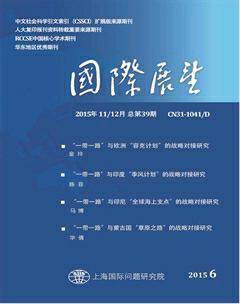
國(guó)際展望 2015年6期
On Strategic Connectivity between the OBOR Initiative and Europes Juncker Plan
JIN Ling
To overcome the negative impacts of the Euro debt crisis on European growth and job creation, the European Union launched a mega-investment plan, namely Juncker Plan. The Juncker Plan prioritizes three pillars: increasing investment without impose greater public debt burdens; supporting projects and investment in key areas such as infrastructure, education, and innovation; and removing investment barriers in both financial and non-financial areas. The priorities of the Juncker Plan, to a large extent, are in line with Chinas “One Belt, One Road” (OBOR) initiative. Besides, it also mirrors the future direction of chinas industrial and economic transformation. Promoting the connectivity between Chinas OBOR initiative and the Juncker Plan will not only benefit China-EU all-round cooperation but also expand areas of cooperation between China and the European Union in other parts of the world. Enhanced cooperation between the two markets in all areas will lay a solid foundation for forging the connectivity between the Junker Plan and Chinas OBOR initiative. Moreover, the 16+1 cooperation between China and the 16 Central and Eastern European countries could also provide valuable experiences for the connectivity. However, there are still some structural challenges, such as the strategic mistrust and the U.S. factor, that have to be addressed before the connectivity between the OBOR initiative and the Juncker Plan can be achieved.
On Strategic Connectivity between the OBOR Initiative and Indias Mausam Project
CHEN Fei
In the process of constructing the “One Belt, One Road” (OBOR) initiative, China has been trying to align its national development strategy, Asian regional cooperation, and other countries development strategies. But in the geographical regions encompassed by the OBOR initiative, India was the only big country expressed hesitation for the invitation from China. Meanwhile, India is also planning a Mausam Project, which promotes the cooperation around the Indian Ocean region. Therefore, the Mausam Project was interpreted as a countermeasure to the OBOR initiative. Actually, the OBOR initiative and Mausam Project are not a pair of conflicting concepts structurally and naturally. Instead, they can achieve strategic connection and fusion. Through conceptual connectivity, functional connectivity, and cultural connectivity, China and India can avoid conflict, build consensus, and expand cooperation. The connectivity between strategies from China and India is a new type of strategic cooperation mode, which can be fostered in a non-zero sum fashion. The establishment of the cooperation mode is not only beneficial to the progress the OBOR initiative, but will also promote regional economic cooperation.
On Strategic Connectivity between the OBOR Initiative and Indonesias Global Maritime Fulcrum Strategy
MA Bo
Indonesias new president Joko Widodo has made the Global Maritime Fulcrum (GMF) strategy a centerpiece of his administration; meanwhile, the Chinese government proposes the “One Belt, One Road” (OBOR) initiatives. Once implemented, these two strategies will profoundly affect the future of the China -Indonesia bilateral relationship. This article intends to understand the GMF strategy first, and then, discusses the necessities, conditions, and paths for the connectivity of these two strategies, as well as the opportunities and challenges both countries face. On the one hand, China and Indonesias good bilateral relations, along with common interests in safeguarding regional security and stability guarantee the successful connectivity of the two strategies. China and Indonesia, through promoting bilateral trade, increasing investment, developing energy resources, can make a breakthrough to promote strategic connectivity. On the other hand, bilateral relations between China and Indonesia face a number of potential challenges, such as Indonesia hardened maritime law enforcement, its attitude toward ethnic Chinese, as well as external factors such as the United States and Japans potential interference. In the end, an analysis of the strategic connectivity between the two countries may establish a new model for cooperation between China and other nations along the OBOR initiative regions in the future.
On Strategic Connectivity between the OBOR Initiative and Mongolian Pasture Road Strategy
HUA Qian
The introduction of the “One Belt, One Road” (OBOR) Initiative has attracted worldwide attention, especially that of countries along the Silk Road. Mongolia, a key member along this route through the ancient prairie, also actively responds to this strategy by putting forward its own Pasture Road strategy. From the perspective of the comprehensive strategic partnership between China and Mongolia, Chinese and Mongolian history and realities demonstrate the necessity of closer cooperation. At a time when the Chinese economy enters a period of new normal and the Mongolian economy is facing growing downturn pressure, strategic alignment of the two neighbors development strategies seems all the more important and imperative. Yet despite strategic common interests and economic and trade complementarities in the two strategies, both countries still face numerous problems and challenges. The successful alignment of the two grand strategies requires a somber assessment of existing and potential challenges, effective approaches, and the reconciliation between commercial interests and moral principles.
New Developments in Arctic Governance and Chinas Deepening Involvement Strategy
SUN Kai and WU Junhuan
The Arctic is transforming as a result of impacts from climate change, economic globalization, and geopolitical power shift. Actors in Arctic governance have increased to include not only the Arctic states but also outside major powers, international none-state actors, and other stakeholders. The fields of governance have expanded to encompass important thematic issues, such as resource exploration, shipping regulation, and economic exploitation. The governance model in the Arctic has also changed from soft law governance to hard law governance. In this context, the adjustment of Arctic governance mechanism falls short of expectations, which highlights several conflicts, namely inclusive governance vs. exclusive governance, protection vs. exploration, and new challenges like absent mechanisms of contract performing, roles of external actors, among others. China acquired the Arctic Councils observer status in May 2013 and has since been increasingly engaged in Arctic governance. Under new circumstances, the Arctic is becoming strategic new frontiers for China. China should strengthen its capacity, deepen the level of engagement, enhance its discourse power in Arctic affairs, in order to serve and expand its legitimate Arctic interests, and thus ensure Chinas goal of building a strong maritime power.
On the Legal Framework of Governance in the Arctic and Chinas Role
ZHANG Cheng
Discords have resurfaced and tensions grown since a Russian flag was planted on the Arctic seabed in 2007. The conventional wisdom believes that improvements on the United Nations Convention on the Law of the Sea and the adoption of an Arctic Treaty would constitute a practical legal framework for governance in the Arctic. But there still remain serious challenges. The Arctic states try to confine the issues on the delimitation of outer limits of continental shelves within their own jurisdiction by constructing a closed Arctic legal framework and partially borrowing self-interested provisions in Article 76 of UNCLOS to carve up the Arctic to the largest extent. Non-Arctic countries, on the other hand, expect the Arctic issues to be an international issue. They strive to amend the UNCLOS, adjust related competences of CLCS, and establish specific conventions for the Arctic area and polar region to restrict Arctic countries from making use of UNCLOS to claim large interests intentionally. Therefore, China should actively engage in Arctic legal framework construction and integrate its own Arctic interests with those of other Arctic stakeholders to obtain a greater say in Arctic affairs.
Institutional Dilemma in Cyberspace Governance and Path Breaking of Emerging Countries
WANG Mingguo
Cyberspace governance constitute an essential part of global governance. The current institutional frameworks for cyber governance prove inadequate in addressing pressing cyber challenges. The legitimacy and representativeness issue concerning these frameworks remains the biggest predicament to effective and fully operationalized cyber governance. More fundamental conflicts regarding cyber governance concerns concepts and assumptions about cybersecurity between developed countries and emerging ones. With the collective rise of emerging powers on the world stage, cyber power shift is also discernible in cyberspace. Emerging powers are demanding greater representation and say in cyber issues by taking the initiative to reform traditional international institutions and erect new frameworks for cyber governance. Emerging powers engagement in cyberspace governance has been countered by the U.S.-led Western bloc and constrained by internal discords among themselves. As the biggest developing country, China should uphold the United Nations leadership role in cyber governance to promote effective reforms in the current governance frameworks and joins hands with emerging powers to build up new institutional frameworks for cyber governance.
EU-China Bilateral Investment Treaty Negotiation and Its Potential Effects
YE Bin
The current EU-China bilateral investment treaty negotiation is an important instrument to implement Chinas Comprehensively Deepening Reforms Strategy and promote its transformation of development. Since the existing China BITs couldnt fully match China's booming outbound investment, it is necessary to upgrade them into the new generation of BIT to provide high investment protection and seek more market access. By reference to the investment chapter of the EU-Canada Comprehensive Economic and Trade Agreement, this article explores major clauses and subjects in the EU-China investment treaty talks. In terms of competition neutrality, labor protection, environment protection, and intellectual property protection, the new rules will have positive functions to eliminate the excessive monopoly of SOEs, enhance the protection of workers rights, strengthen environmental protection, and guarantee innovation capabilities given that flexible and transitional clauses might be introduced to confront potential challenges.
The Pragmatic Transformation of EU's Global Governance Concept
REN Lin, CHENG Ranran
The EU has taken a more pragmatic outlook on global governance since the beginning of the twenty-first century, especially after the 2008 financial crisis. Its members have embraced Chinas “One Belt, One Road” initiative, made concessions on reforms of IMF quotas, enhanced coordination with the United States on issues ranging from TTIP negotiations to regional security. The turn to a more pragmatic outlook does not necessarily mean that the Union has relinquished its normative power. Instead, the Union has taken a middle-ground and more flexible approach. As three major forces in the world, the EU, China, and the U.S. should put aside their discords, increase dialogues, and strengthen cooperation regarding preventing and managing global economic risk and promoting sustainable development with a view to building a new pattern of international order.