
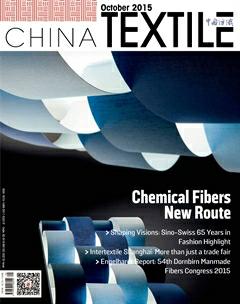
Chemical fibers:Seeking a new route for development
2015-11-03 18:34:57ByZhaoZihan
China Textile 2015年10期
By+Zhao+Zihan
The 21st China International Man-made Fiber Conference (CIMFC), themed on “innovationdriven, integrative development — the main theme of the development of chemical fiber industry in the‘New normal ” and focused on new strategies for the transformation and new initiatives for integrative development of global chemical fiber industry, was convened in Shengze Jiangsu province from September 7th to 9th, 2015. China Textile gave a brief introduction to the conference in the last issue and is sharing the detailed reports to our readers in this issue, including the interpretation of the “Belt and Road Initiative”, prior analysis of the 13th Five-Year Program for the whole textile industry as well as the chemical fiber industry, and the manmade fibers in Japan, the U.S., and the Europe.
New industrial pattern based on the“Belt and Road Initiative”
During the 21st China International Man-made Fiber Conference, Prof. Zhang Jianping from Dept. of International Cooperation Institute of International Economical Research, NDRC, made a speech themed on “Open Economic System and the Belt and Road Initiative Strategy”, noting that currently China is gradually losing its advantage in labor cost which has already been five times of the ASEAN countries. Moreover, in the future there will be an annual reduction of about 2 million to 3 million new labor forces, and as a result, irresistibly China labor costs will rise at an annual average of 10%.
Meanwhile, the increased land costs as well as the to-be-launched environmental tax during the 13th Five-Year Program period are also driving the industrial development of China to shift from the export-oriented to the innovationdriven, which must rely on reform of structure and mechanism. “A crucial driving force for the reform is opening up.” Mr. Zhang stated that the reform in China is still facing new challenges and needs great courage for practice. Trans-Pacific Partnership Agreement (TPP) represents the economic integration of the United States and Japan, meaning that the economic integration process in the developed countries has been launched. In this context, China, Russia and other countries need to create a new platform for international economic cooperation regionally. To this end, the“Belt and Road Initiative” can meet the economic development needs of developing countries and is conducive to the balanced development of regional economy and the global economic rebalanced development.
As an emerging cooperation platform proposed by China, the “Belt and Road Initiative” is actually an economic network formed by various “roads” and plentiful “belts”. Among two-thirds countries under the Initiative, the GDP per capita is below 5,000 USD, together with a relatively backward industrialization process. Therefore, in order to drive the prosperity of the “Belt and Road Initiative” countries through trade and investment, investment into the infrastructure comes the first, in which China can take advantages of its strengths. In such an era of opening and globalization, any economic belt and city are required to keep highly correlated with the outside world, which is also one important reason that so many provinces in China are included into the “Belt and Road Initiative”.
Duan Xiaoping, President of China Chemical Fibers Association, pointed out that such national strategies as the “Belt and Road Initiative”and the building of free trade area have provided the chemical fiber industry a strong support for international distribution and development. The textile industrial chain, including chemical fibers, should respond positively and fully seize this favorable opportunity to actively study overseas investment strategies in order to make good preparation for the industrial regional distribution and resources allocation when going out.
Advance interpretation of the 13th FiveYear Program for the man-made fibers and the textile industry in China
Key tasks
To enhance the level of technological innovation
Improve the technological innovation system to strengthen the basic capacity building.
Exploit the new materials to develop high-quality functional products.
Promote the intelligent manufacturing step by step to integrate in depth the information technology.
To comprehensively promote the brand building
Accelerate the innovation capacity building to enhance the enterprise brand value.
Create the virtuous brand ecology to strengthen the corporate social responsibility.
Strengthen the main role of the enterprise to promote the growth of well-known brands.
To strengthen the ecological civilization building
Strengthen the institutional mechanism building to improve the clean production system.
Develop the green manufacturing technology to produce the green textile products.
Strengthen the resource recycling and reuse to implement the green consumption patterns.
To optimize the industrial area layout
Strengthen the interaction and upgrading of the coastal area and mainland to optimize the industrial area layout.
Expand and open up the border region to form specialty industrial system.
Carry out international and domestic development coordination to improve the efficiency of cross-border layout.
Optimize and upgrade the industrial clusters to build up the innovative development platform.
To accelerate the corporate restructuring
Make the advantageous enterprise bigger and stronger to form a multinational enterprise group.
Promote service-oriented textile enterprise to develop the productive services.
Strengthen the enterprise management innovation to enhance the core competitiveness.
To build up the multi-level personnel system
Optimize the education and training system to expand the scale of textile talents.
Improve the personnel management mechanism to strengthen the corporate culture building.
Key projects
Intelligent manufacturing, focusing on the development of a number of digital, networked, intelligent equipment and production lines.
New textile materials, focusing on the development of a number of new fiber materials and industrial fiber textiles.
Quality and brand, focusing on quality improvement, creative design, brand fosterage and brand internationalization.
Ecological civilization building, focusing on promotion of green technologies and establishment of fiber recycling and reuse system.
Development Objectives
Industry growth objective
By 2020, the chemical fiber production will reach 55 million tons by 2020 with an annual average growth rate of 3.6%; the chemical fiber processing volume will increase to 51 million tons from 43.4 million tons with an annual average growth rate of 3.4%, accounting for the 85% of the total textile fiber processing volume.
Structural optimization objective
The chemical fiber differentiation rate will be increased to 65% by 2020; the effective capacity of high-performance fibers will reach 260,000 tons; the proportion of industrial chemical fibers will be increased to 33%.
Technological innovation objective
By 2020, the proportion of new product output value will be increased to 28% from 20%.
Green development objective
The total emission of major pollutants will be decreased by 10% by 2020, where: the total COD emission will be declined by 10%, the total SO2 emission will be decreased by 10%. The regenerated fiber recycling rate will be increased to 30%, and the bio-based raw material substitution rate will be increased to more than 2%.
Major tasks
Control the new production capacity to improve the utilization of capacity with a total amount target that the chemical fiber production will reach 55 million tons by 2020, with an annual average growth rate adjusted to 3.6% from the previous 9.2%.
The industrial development shall be trans- formed from expansion of production capacity to structural adjustment, industrial upgrading and new product development.
Encourage the advantageous enterprises to use the new operating mode of “Internet+” thinking and innovation. The innovative results of the Internet are deeply integrated in the process of production, operation and development, and integrate the different enterprise resources to build a management service model of full-range supply chain
Promote international distribution and global resource allocation with the countrys “The Belt and Road Initiative”. To adapt to the international division and readjustment trends in the textile industry, strengthen the interconnection and intercommunication with the countries along the road, optimize the allocation of resources to form a new pattern of chemical fiber industry to “Go Global”and the upgrading version of opening to outside world, and form the pooling-of-interest cooperation system to enhance the international level and international competitiveness of chemical fiber industry
Technological innovation and technological progress
Development of Hi-Tech Fibers
Recycling economy, green manufacturing
Promote brand and standardization building
Lead the competitive enterprises to be bigger and stronger
Major projects include new fiber materials, green manufacturing, intelligent manufacturing, brand building, as well as quality and standard upgrade.
Man-made fibers in Japan, the U.S., and the Europe
Japan
Hideshi UEDA, Executive Vice President Japan Chemical Fibers Association
Key focus: High value-added products
According to FAO/ICAC, the recent growth of global fiber demand comes mainly from increased demand in developing countries. Per capita fiber consumption in developing countries has continually increased, even during the global financial crisis in 2008.
World fiber consumption in 2030 is estimated to reach 137.3 million tons with 2.95% annual growth, of which synthetic fibers will reach 103.4 million tons with 3.9% annual growth. Total demands for all fibers will increase at an annual rate of 2.9% from 83.7 million tons in 2013 to 104.1 million tons in 2020. Global synthetic fiber demand in 2020 is estimated to reach 71.7 million tons with 4.1% annual growth. Global synthetic fiber production capacity is forecast to expand from 73.3 million tons in 2013 to 93.4 million tons in 2020. As a result, the gap between production capacity and consumption is expected to reach 21.7 million tons.
When economic development reaches a certain level in a country, there is little need to increase the quantity further. However, consumption continues to increase on a value basis, as people have higher motivation to buy better quality products. Therefore, a transition to high value-added products such as“technical textiles” becomes important once the economy reaches a certain level of development.
As a result of the shift to value-added application areas, for the USA and Japan, nonapparel applications account for more than 80%. The global textile industry is still growing and total fiber demand, especially for high value-added products, is expected to keep increasing in the future. On the other hand, there are growing concerns about the serious over-supply situation regarding standard products. The global fiber industry will need to promote a shift from quantity to quality.
“In order to solve the predicted over-supply situation, China will play the most important role. We should pay attention to the direction of Chinas 13th Five-Year Program.” Hidesh stated. “Under the progress of trade liberalization in Asia, we believe that we can build a future strategic complementary relationship between Japan and China, through the strengthening of close information exchange and cooperation for our mutual benefit.”
He also put forward that the common tasks that every country is facing in the chemical fiber industry are:
? To cope with environmental issues and product safety issues
? To improve both countries business environment and trade facilitation such as and the harmonization of standards and other regulations and the elimination of non-tariff barriers
? To expand into emerging Asian markets, taking advantage of each countrys strengths
? To joint cooperation for promotion of fashion/brands in Asia
The United States Paul T. ODay, President & Counsel of American Fiber Manufacturers Association
Key focus: Shale Gas Benefits for Manufactured Fiber
According to EIA, ICE, and NYMEX, oilto-gas ratio is a proxy for US energy competitiveness. Paul introduced that the shale gas benefits for manufactured fiber include lower-cost feedstock for fiber petrochemicals, and improved energy efficiency for feedstock production & supply chain, fiber manufacturing, distribution systems, and downstream processing.
In the speech, Paul pointed out that in terms of unconventional oil and gas wells, success depends on such factors as attractive geology & enabling data, technology for horizontal drilling & fracking, ample water supply, established, efficient infra- structure, skilled workforce (professional & field hand), supportive regulation, and competition to spur innovation.
The Europe Frédéric VAN HOUTE, Director General of CIRFS
Key focus: European Production is More Balanced
According to CIRFS YEARBOOK, as for the world man-made fibers production, China is the main producer, followed by Europe. Globally, polyesters dominance is increasing from 39.3 million tonnes in 2004 to 66 million tonnes in 2014. European production is more balanced.
Frédéric analyzed the market background for fibers and textiles as follows:
The economic growth is still fragile and this is impacting the textile sector
Good growth is being seen in automotive end-uses
Apparel end-uses see more difficulties and face strong import competition
Construction is recovering but not in all markets and only slowly overall
Exports are benefiting from the exchange rate with the dollar and are supporting the industry
The declining oil price has brought some relief in EU/US cost differentials
According to Frédéric, man-made fibers production volume in Europe stagnated in 2014 at 3.5 million tones, while in 2015, the economy should only slowly improve – meaning continued chal- lenging times for fiber markets; capacity has been adjusted to the market but some restructuring may be possible; specialization is developing, with new fibers, new applications, also linked to the green economy; growth should be more balanced in 2016.
He stated that excess capacity squeezes margins and profitability and creates environmental concerns, and world polyester fibre capacity in 2015 will reach 69 million tones. Overcapacities lead to massively selling in export markets, causing harm in these markets. WTO rules allow antidumping actions. Producers, in Europe but also outside have to defend themselves. With additional capacities anti-dumping actions may further develop. In addition, subsidized exports create injury and more anti-subsidy actions may take place.
Frédéric believed that facing the global overcapacity challenge – that can only be solved by responsible behavior. In future, innovation will remain the major source of development supported by quality, flexibility, specialization and efficient structures. And sustainability as a driving factor is further growing in importance. Globalization will bring additional opportunities, while cooperation in and outside the value chain will be key factors for success.
- China Textile的其它文章
- Potential boon from the shoppable side of social media
- Importance of truly connecting with“Need to Know”millennials
- Everyday business casual actually means comfort
- Consumers call for better linens
- Apparel Sourcing Paris welcomed more than 100 Newcomers
- Largest Yarn Expo Autumn jumps 70% in scale