
Chengde City: Chinese Summer Resort
2015-08-02 12:00:20
中國-東盟博覽(政經版) 2015年2期
Chengde City: Chinese Summer Resort
Chengde, a charming little town lying in Hebei Province of China, is an important historical town just a few kilometers away from Beijing. Being part of a mountainous region of northern China, Chengde enjoys a lush landscape made of beautiful natural sceneries and rivers.
Primarily called “Jehol” or “Rehe”, the city is renowned for its historical importance as a summer resort capital of the Qing Dynasty (1644-1911 AD): a role that can still be seen through the historical masterpieces present here. Divided in 3 districts, 5 counties and 3 autonomous counties of Manchu and Mongol natures, Chengde offers to travelers the opportunity to enter in another China, the life there being definitely smoother. Owing to its surrounding mountains, Chengde constitutes today the largest city in Hebei Province, but has the lowest level of population. For years now, this delightful city has been a peaceful retreat away from the turmoil of its neighbor metropolis.
Famous Scenic Spots
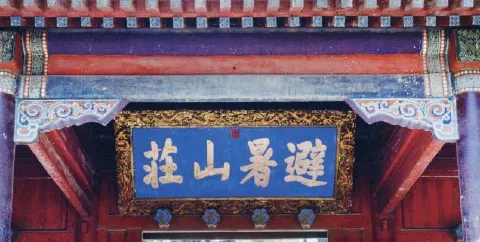
Chengde gmperial Summer Resort
The Imperial Summer Resort in Chengde is the resort of Qing emperors. Situated in the northern part of Chengde city, it is about 200 kilometers from Beijing.
The magnificent resort was built during the Qing Dynasty, the last feudal Chinese dynasty. It served as the second political center of the Qing imperial court and the emperors of the early Qing Dynasty often spent their summers there, conducting state affairs and engaging in important political activities.
The resort and its temples and palaces have made Chengde a famous historical and cultural city, and one of China's leading scenic spots. The imperial resort was listed in the directory of the world's cultural heritages in 1994.
The construction of the Mountain Resort took place over a period of 90 years --starting from the 42nd year of Emperor Kangxi’s reign (1703 AD), rebuilt and expanded during the reign of Emperor Qianlong, and completed in the 57th year of Emperor Qianlong’s reign (1792 AD).
Ticket:
RMB120 (Apr.16 - Oct.15);
RMB90 (Oct.16 - Apr.15)
Opening time: 08:00 to 17:30
How to get there:
Take Bus No.5, 7, 11, or 15 from Chengde Railway Station to the Mountain Resort. Or take a taxi at a cost within RMB20 from anywhere of the city of downtown area.
Best time to visit: all year round
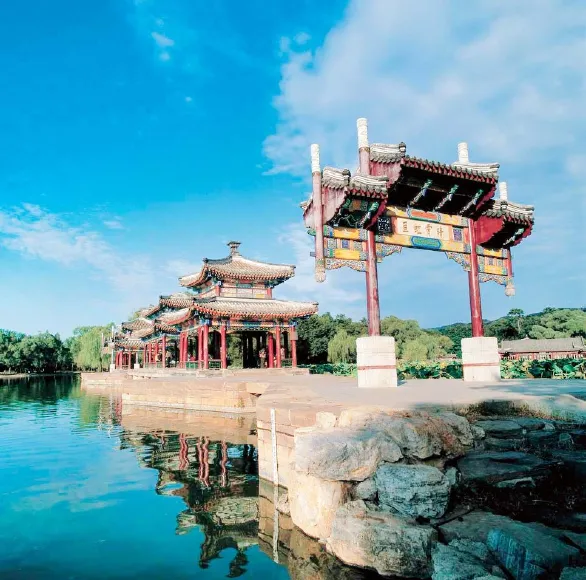
It is China’s largest existing imperial garden, covering an area of 5.64 million square meters, double that of the Summer Palace, and eight times that of Beihai Park in Beijing. The 10-km-long wall around it winds its way through plains and high mountains like the Great Wall.
The Mountain Resort is divided into four parts: the palace area, lake area, plain area and mountain area. The palace area lies in the south part of the resort and is a concentration of palaces where the Qing emperors handled the political affairs and where the royal families lived. It covers an area of 100,000 square meters (25 acres), consisting of four main complexes: the main palace, the Pine-Crane Hall, the East Palace and the Pine Soughing Valley. The main palace was the place where important ceremonies and events were observed, but today it is used as the Mountain Resort Museum. The Pine-crane Hall was the residence built by Emperor Qianlong for his mother -- the empress while the East Palace was damaged in a fire in 1945 with only the groundwork still visible today. The Pine Soughing Valley was the reading room of the emperors and the office where the emperors handled the political mandates.
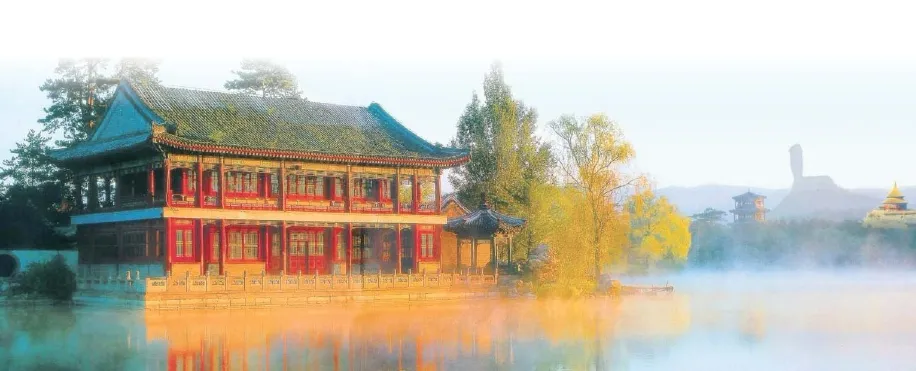
The lake area lies in north of the palace area. Eight islets dotted the lake, dividing the lake area into several fields of different sizes. In total, there are eight lakes in the lake area, respectively called Cheng Lake, Mirror Lake, Ruyi Lake, Upper Lake, Lower Lake, Silver Lake, Half-moon Lake and Inner Lake.
The plain area is located at the foot of the mountain, north of the lake area. The plain is a vast area, and is covered with thick grass and trees. The plain area is broken into three areas: a garden populated by various trees in the east, a vast grassland for riding horses in the west and a group of temples in the north. Riding a horse over this broad plain leaves visitors feeling refreshed and relaxed.
The mountain area, located in the northwest of the resort, accounts for 80% of the total area. The mountain area is formed by four valleys: Filbert Valley, Pine Valley, Pear Valley and Pine-cloud Valley, which run south to north. The mountain peaks surrounding the area form a natural curtain which impedes the cold winds blowing in from Northwest China. Various pavilions, temples and other structures dot the mountain slopes and valleys.
Eight Outer Temples
To the north-east of the Imperial Summer Resort of Chengde, lies the Eight Outer Temples. Originally there were 12 temples, but now there are only seven temples and one relic left, which are collectively called the Eight Outer Temples. The 12 temples were built in succession. Construction began in 1713 in the Qing Dynasty and completed in 1780. Eight Outer Temples is eight Tibetan Buddhist monasteries in this area, including the Boren Temple, Puning Temple, An'yuan Temple, Putuozongcheng Temple, Guang'an Temple, Suxiang Temple, Guangyuan Temple, Xumifushou Temple(the temple for praying happiness and longevity). The architecture was mainly built in 3 styles: Tibetan style, Han style and the combination of the two styles. Its architecture, gardens and a large number of inscriptions, sculptures, murals, statues and other artifacts play an important role in the study of history, culture, religion art, and garden culture of Qing Dynasty as art treasures.
Mulan Paddock
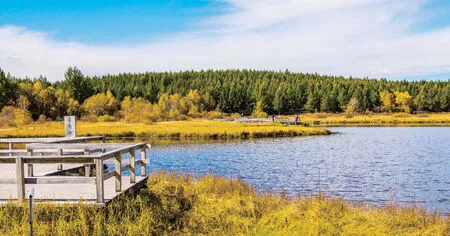
Located in Weichang Manchu and Mongolian Autonomous County of Chengde, Mulan Paddock is regarded as Beijing’s backyard garden. It used to be a royal hunting place and a summer retreat in the Qing Dynasty. As an imperial hunting place in the Qing Dynasty, Mulan Paddock was built during the period under the reign of Emperor Kangxi (1661-1722 AD). The Emperor Kangxi, Qianlong (1735-1796 AD) and Jiaqing (1796-1820 AD) had ever held hunting activities here in autumn, which gradually became a rule for the imperial family. By holding military maneuver, emperors aimed at enhancing the military quality of the imperial kinsmen and the Eight Banner nationalities as well as carrying out the conciliation policy to ethnic minorities. From Emperor Kangxi to Emperor Jiaqing, the imperial families went hunting there more than100 times.
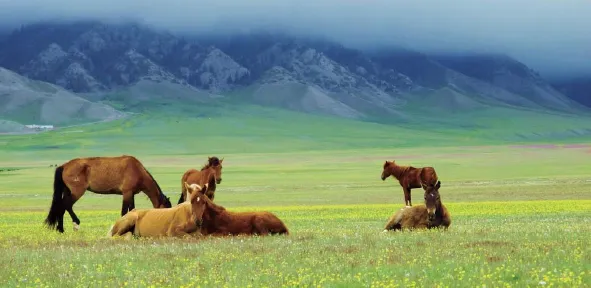
It consists of mainly 3 sections: the Saihanba National Forest Park, the Yudaokou Grassland and Forest Scenic Zone, and the Hongsongwa National Nature Reserve. Mulan Paddock enjoys really gorgeous scenery. With vast forest and a wide expanse of grassland, it owns herds of cows and flocks of sheep haunting and grazing. During summer days, all kinds of flowers are in full blossom and birds giggling in the sky while in winter, the snow-covered ground can give you a much fresh experience and everywhere is a white world. Due to the cool weather and picturesque scenery in summer, tourists can come here to escape the heat while it becomes an ideal place for skiing and hunting with rare animals and birds haunting in the forest during the winter days. The famous Mulan Paddock Forest Grassland Festival is held here from the late June to the next February and draws a lot of visitors annually.
gnvestment Opportunities
Being a close neighbor of Beijing and Tianjin, two international metropolises of China, Chengde enjoys profound cultures, pleasant ecological environment, and regional advantages. It has numerous historical culture heritages, as well as natural landscape like forests, mountains, grassland, snowpack and hot springs. It abounds in scarce resources like vanadium and titanium, as well as godgiven ecological environment. Its unique advantages offer colossal potentials, displaying great vitality for development.
With its “tourism, resource and regional”advantages, Chengde puts forth efforts on building the “5+2” modern industrial system, namely, giving priority to the five leading industries including cultural tourism industry, advanced equipment manufacturing, new energy industry, vanadium-titanium new material industry, and food & medicine processing while actively developing its two emerging industries -- modern logistics and innovative & high technology.
Cultural Tourism as the Leading gndustry
Aiming at building itself into an international tourism city, Chengde takes cultural tourism as its leading industry. The city has greatly promoted the integration of culture, tourism and service industry by innovating ideas. It combines its multiple cultures, unique landscape and precious historical heritage with modern recreation projects. Relying on the royal culture resources, the city is now building the “21st Century Summer Resort”. Also, it tries to build itself as the largest Buddhist culture center by utilizing its Buddhist culture resources.
Building gndustrial Bases for Vanadium, Titanium and Molybdenum
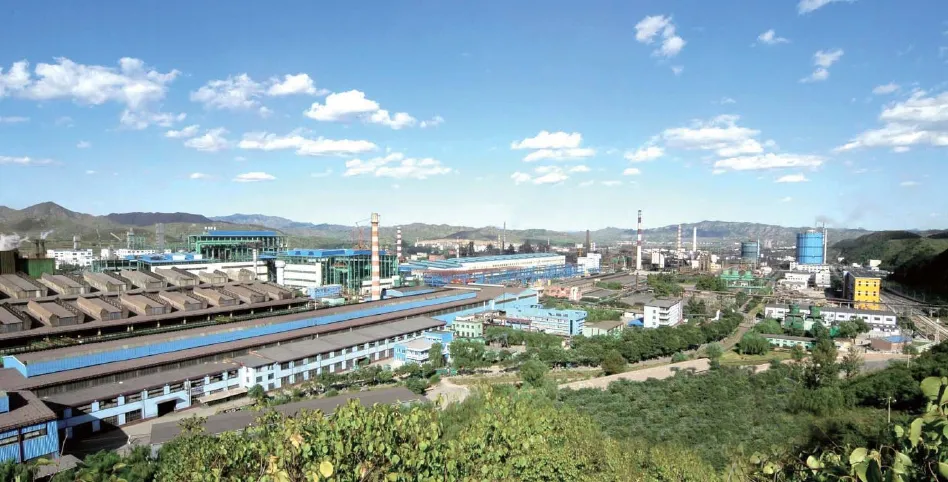
As a country's scarce and important strategic materials, vanadium, titanium and molybdenum are main raw materials for high strength steel. Chengde ranks second in China for its proven reserves of vanadiumtitanium magnetite resources. Its unique resource conditions and solid industrial base produce strong comparative advantages. Metallurgy and mineral become the leading industries and make great contributions to the economic development of Chengde.
The Rising of New Energies
The region is rich in solar energy, next only to Xinjiang and Tibet in China. Its geothermal resources are abundant as well. By covering an area of 4,250 square kilometers, Chengde also abounds in wind energy. It has 3.62 million kilowatt long-term installment capacity. The four rivers like Luanhe River and Chaohe River contribute a lot to the development of hydropower resources. The reserves for water resources are up to 780,000 kilowatt with a hydropower exploitation volume of 570,000 kilowatt, accounting for 37% of water resources of Hebei Province. The dense forest coverage here brings huge biomass energy resources, such as, straws and fuel wood, making itself as the“Green Lung in North China”.
