
Non-Supervised Learning for Spread Spectrum Signal Pseudo-Noise Sequence Acquisition
2015-07-14 01:20:34HaoChengNaYuandTaiJunWang
Hao Cheng, Na Yu, and Tai-Jun Wang
1. Introduction
Spread spectrum signals are used widely in the field of communication. For certain applications, their antijamming capabilities[1]and low probability of intercept justify the price to be paid in increased bandwidth. In direct-sequence spread spectrum (DSSS) systems, the signal is modulated by a pseudo-noise (PN) sequence[2]and the wideband signal can resist narrowband jamming or multi-path.
In the cooperation condition[3], the receiver knows the PN spreading sequence, which is used to perform the matched filtering operation and recover the transmitted data.However, there are cases where the receiver may have no knowledge of the transmitter’s PN sequence (e.g., when intercepting an unfriendly transmission in non-cooperation communications). Then, all the related issues of synchronization, multi-path equalization, and data detection become more challenging. There is an abundance of references in the literature on the problem of “code acquisition” under various interference environments when the PN sequence is known to the receiver. However, the literature is not equally rich for the case where the PN sequence is unknown.
The self-organizing feature map (SOFM)[4]network dose not require a target signal to define correct network behaviors. The non-supervised learning character just suits the aim of the blind PN sequence estimation. In this paper,we utilize the characteristic and focus on the interception/user acquisition problem, that is, on the recovery of the transmitted information data stream. The performance is analyzed and compared with the matched filter-based solutions.
The rest of the paper is organized as follows. In the next section, the DSSS signal estimation problem is stated in a discrete-time framework, whereas in Section 3, the proposed algorithms are delineated, and identifiably issues are addressed. In Section 4, the performances of the proposed method are evaluated and issues related to timing and bit rate estimation are discussed in the section. Finally,some illustrative simulation results and conclusions are presented in Sections 5.
2. DSSS Signal Model
In most studies of DSSS systems, the continuous-time transmitted signal is modeled as[5]

where A is amplitude of signal,f0is the carrier frequency,φ0is the initial phase,n( t)denotes noise with the variance σ2, and PN sequence pj∈{+1, -1}.d( t)is the information bearing signal before spreading:

The probability density function is
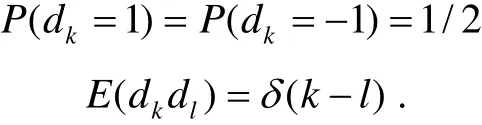
The goal of this paper is to recover the pseudo-noise sequencePN(t ). The following assumptions will be in effect throughout the rest of the paper.
Assumption 1. The carrier frequency f0and the chip period Tchave been estimated[6].
Assumption 2. The symbol duration Tshas been estimation[7].
In Assumption 1, the method based on the “spectral correlations” analysis can estimate the chip periodTcand carrier frequency f0even in a low SNR. If the estimation of Tcand f0are available, we can process the signals in the base band and the sampling period can be set to Tc.
The spectral correlations density of DS signal at f=0 section is
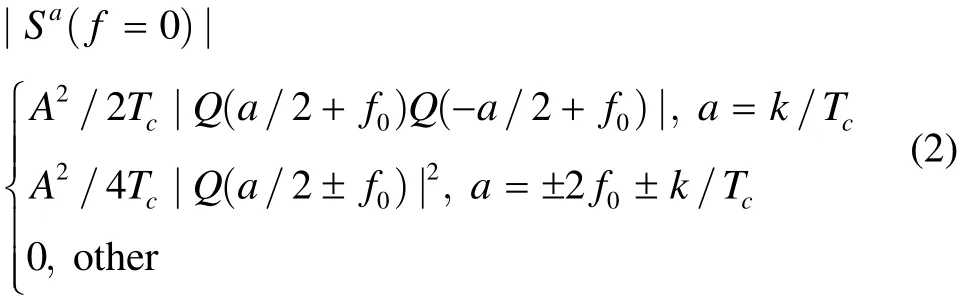
where a is the cycle frequency,fis the spectrum frequency, andQ(?)is the sinc function. From (2), the main peak of the spectral correlations densitySaappears ata =±2f, then we search the max value of the Saat0the f=0 section, by which we can obtain the carrier frequency. Furthermore, the second peak’s position will appear at thea =±2 f0±1/Tc, and the distance of between main peak and second peak is just the chip period Tc. We can measure the distance between the main peak and the side peak, and estimates the chip periodTc.
Based on the Assumption 1, we need do a pretreatment[8]to the original signals( t), as shown in Fig.1.s( t )is multiplied by a coefficient cos(2π f0t)by using a multiplier and the output:
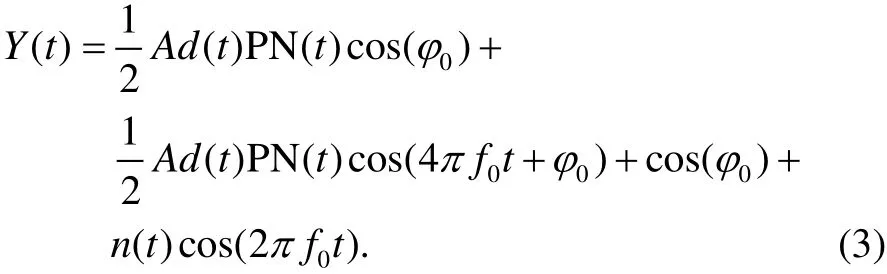
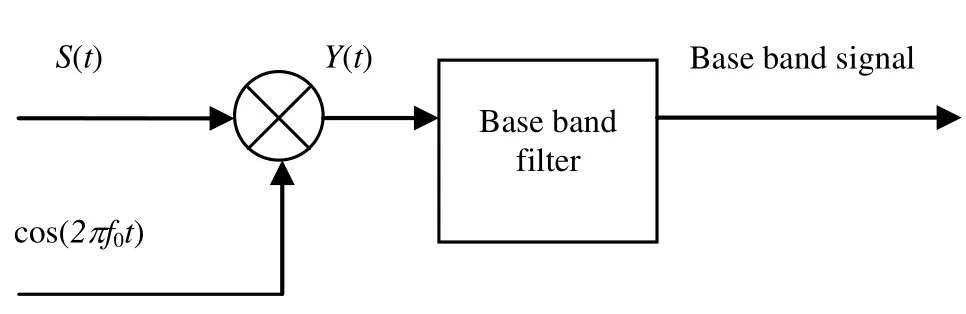
Fig. 1. DSSS signal pretreatment.
Then we design a band-pass filter of which the center frequency is f0and can get the base band signal as the first item of (3). As cos(φ0)is a constant, it dose not work on the PN sequence estimation. In Section 4, we will demonstrate that it is available.
In Assumption 2, the symbol durationTscan be estimated by using fluctuations of correlation even in –10 dB (that is enough low to our method in the paper). Based on Assumption 2, we can adopt the DS/CDMA data model as follows.
3. Signal Estimation Algorithm
Based on the assumptions of Section 2, the symbol duration Tsand the chip duration Tchave been known.The sampling duration Teis set to Tcand the sampling window (analysis window) duration is set to Ts. So, each sampling window will include L sampling points. L is the length of PN code. All data will be divided in different time windows. We propose and modify the algorithm based on the Kohonen rule[9]in the SOFM theory:

where w is the iterative weights matrix which is S×L dimensional matrix, n is the times of iterative, α is the length of step, and P(n) is an L×1 dimensional input vector and also stands for the data of in an analysis window in the nth time. So, P(n) also stands for the PN sequence with noise. The output matrix A is a S×1 dimensional matrix and A=w×P. Our aim is to calculate the iterative weights matrix w and obtain the right output A. In this paper, the output vector A is the value of estimated PN sequence, so L=S.
When a sampling window’s data (vector P) is presented,the weights of the winning neuron and its neighbors will move toward P(n) according to the rule of (4). The result is that, after many presentations, neighboring neurons[10]will have learned vectors similar to each other. The output result will near the real PN sequence.
We should mention that the neurons in the algorithm do not have to be arranged in a two-dimensional pattern. It is possible to use a one-dimensional arrangement, or even three of more dimensions. The estimation structure is demonstrated as Fig. 2.
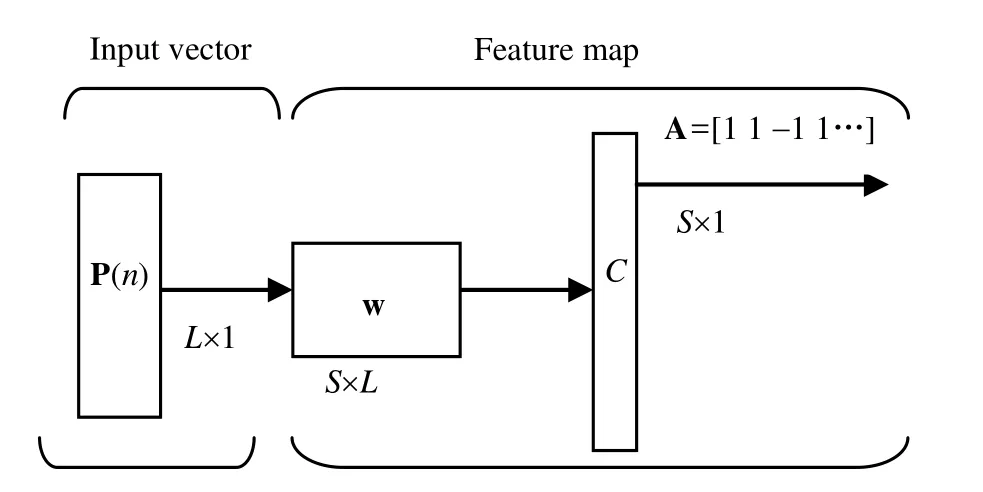
Fig. 2. Estimation model.
4. Simulation and Performance
The blind algorithm is demonstrated here via computer simulation, for a DSSS signal received in the presence of various levels of white Gaussian background noise. The source signal is generated by the computer and signal’s parameters are set as follows:
Carrier frequency: f0=5000 Hz;
Chip period: Tc=1/1000 s;
Symbol period:Ts=31/1000 s (PN code length L=31);
SNR=-5 dB (the signal-to-noise ratio (SNR) satisfies the condition of Assumption 1 and Assumption 2);
Input vector P and output vector A dimensions are

In evaluating the algorithms, a Gaussian vector noise process is added to the observation with noise variance σ2I,where I is the unit matrix. The SNR is then defined as

Considering the DSSS signal exhibits cyclic-stationary,we utilize the “spectral correlation” method to get the carrier frequency f0and the chip period Tc. Fig. 3 shows the measured spectrum correlation function magnitude for the DSSS system at the f=0 section.
Form Fig. 3, the first peak value coordinate appears at α=±1× 10⁴, according the definition of cyclic-correlation,we can get the carrier frequency at thef0=α/2, that is the carrier frequency f0has been estimated. The second peak value appears at the both sides of each main peak, and the coordinates is ±9000 (that is not distinct in the figure)and ±11000, so we can obtain the chip period Tc=1/1000 s.Above all, we have solved the problem of Assumption 1.We can design the filter and multipliers to transform the original signals to the base-band signals and set the sampling period to Tc.
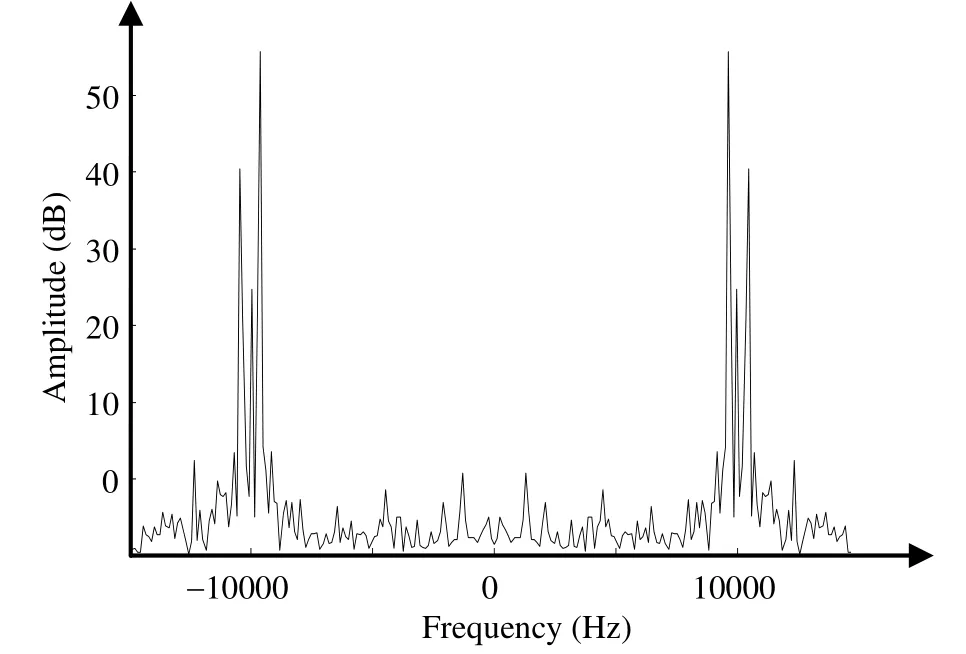
Fig. 3. Spectrum correlation function magnitude in DSSS system at the f=0 section.
Using the fluctuations of correlation method, we obtain the Ts=0.0311 s (aberrancy near upon 0.3%). So the PN code length can be known asL = Ts/Tc=31.The Assumption 2 is also solved.
We sample the base-band signal (with noise) in 5 dB and –5 dB. Fig. 4 shows the signal distributions in 5 dB and–5 dB. Each point ‘+’ in the figure represents a 31 dimension vector and the circle ‘ο’ in the center of the figure is the output result of A (the estimation value of PN sequence). We set the initial value of A to zero [0 0 0 …].When SNR=5 dB (Fig. 4 (a)), the base-band signal can be classified but when the SNR=-5 dB (Fig. 4 (b)), all of the signals cannot be identified.
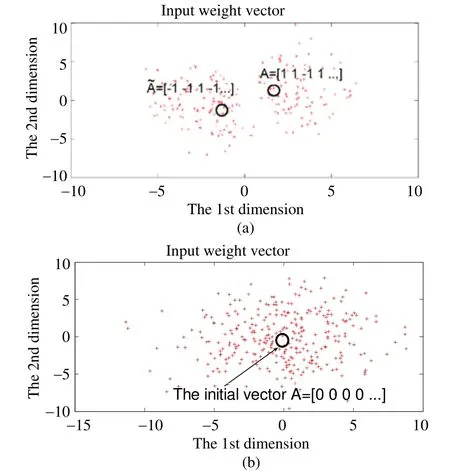
Fig. 4. Signal distributions in different SNR: (a) SNR=5 dB and (b)SNR=-5 dB.
Then the w (refer to (4)) is trained during 200-step, and output result A is shown in Fig. 4 under the –5dB. The position of circle ‘ο’ in the Fig. 5 is moved and the result is that, after 200 vectors p were presented, the weights of winning neuron is more and more near the real PN sequence. We can get the right value of the PN sequence even under the strong effect of noise.
In Fig. 4 and Fig. 5, “A? ” is the complement of “A”,namely: if A = [10… 01], then A?= [ 01… 10]. Because of above figures can not display a 31-dimension vector, only the first two dimensions of all 31 dimensions are shown in the graph.
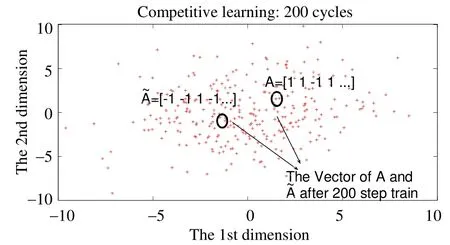
Fig. 5. Vector A after 200-step training in the –5 dB.
Fig. 6 shows the comparison of SNR-BER (bit error rate) by using the proposed method and the traditional correlation function method. From Fig. 6, the BER based on SOFM is lower than that of the traditional correlation method under the same SNR.
However, since the implementation complication of the proposed method is lower than that of the correlation function method, we only need to input the vector of s(t) to the neural network. The weights are adjusted automatically according (4) and the output of the weight of w is the PN sequence justly. The whole process needs not manual work.Comparing the correlation function method, the data need to be calculated by the correlation function first, and then the correlation function is arranged again according the value. After the arrangement, the data is classified. Finally,the statistic average is executed, and the real PN sequence is obtained.
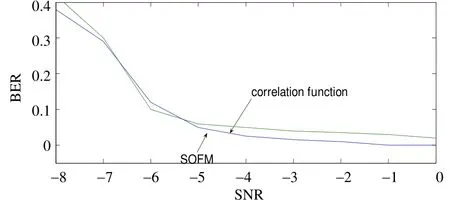
Fig. 6. SNR-BER comparison between the proposed algorithm and the correlation algorithm.
5. Conclusions
A DSSS signal PN parameter detection or PN sequence estimation algorithm is introduced in this paper. In the low SNR (-5 dB), it is demonstrated the method is feasible. The algorithm utilizes the characteristic of non-supervised learning to achieve the aim of blind PN sequence estimation. Comparing the correlation function method, the algorithm has lower implementation complication and lower BER.
We only discuss the single user’ DSSS system in this paper, actually, in the multi-users DS/CDMA system, the algorithm is also applicable. Because the multi-users DS/CDMA system is a self-interference[11]system, the BER is higher than the single user DSSS system.
[1] T.-Q. Zhang, X.-M. Zhang, and M.-Q. Lu, “Effect of frequency domain anti-jamming filter on satellite navigation signal tracking performance,” in Proc. of the CSNC2013 Electronic Conf., Chengdu, 2013, pp. 557–561.
[2] L. Wang and H. Chang, “A timing synchronization and frequency offset estimation for OFDM systems based on PN(pseudo-noise) sequence,” in Proc. of the 8th Int. Conf. on Electronic Measurement & Instruments, Xi’an, 2007, pp.117–124.
[3] N. Jindal, A. J. Goldsmith, and U. Mitra, “Capacity gain from two-transmitter and two-receiver cooperation,” IEEE Trans. on Information Theory, vol. 53, pp. 3822–3827, Jul.2007.
[4] L.-S. Xie, C.-J. Zhu, and P.-F. Ding, “Can defects classification based on improved SOFM neural network,” in Proc. of the 2012 Int. Conf. on Anti-Counterfeiting, Security and Identification, Taipei, 2012, pp. 1–4.
[5] H.-G. Zhang, L. Gan, and H.-S. Liao, “Estimating spreading waveform of long-code direct sequence spread spectrum signals at a low signal-to-noise ratio,” Signal Processing,vol. 6, pp. 358–363, Jun. 2012.
[6] M. Salem, S. Jarboui, and A. Bouallegue, “True cramer-rao lower bound for NDA carrier frequency estimation from general M-QAM modulated signals over flat rayleigh fading channel,” in Proc. of Communications and Information Technology Int. Conf., Hammamet, 2012, pp. 357–362.
[7] Z.-M. Deng and Y. Liu, “Phase-domain blind estimation of symbol duration based on Haar wavelet transform,” Systems Engineering and Electronics, vol. 21, pp. 375–381, May 2010.
[8] G.-L. Sun, “A fast acquisition method of DSSS signal Based on double FFT layers,” in Proc. of the 2009 Computer Science and Information Engineering, 2009, pp. 452–456.
[9] S.-Q. Qian and A.-H. Dong, “Application of Kohonen self-organizing map in fashion parts classification,” in Proc.of 2010 WASE Int. Conf. Information Engineering, 2010, pp.226–229.
[10] M. Di Marco, M. Forti, and M. Grazzini, “Convergence of a class of cooperative standard cellular neural network arrays,” IEEE Trans. on Circuits and Systems, vol. 59, pp.772–783, May 2012.
[11] J. Elsner and R. Tanbourgi, “Multiple access interference mitigation through multi-level locally orthogonal FH-CDMA,” in Proc. of Military Communication Conf.2011, pp. 378–383.Hao Cheng was born in Jiangsu, China in 1976.He received the B.S. degree in applied instrument technology and the M.S. degree in physical electronics in 1999 and 2002,respectively, both from South East University of China, Nanjing, China, and the Ph.D. degree in communication engineering from University of Electronic Science and Technology of China (UESTC), Chengdu,China in 2007. He is currently working with the Electronic Information Engineering College, Chengdu University, Sichuan,China. His current research interests include wireless signal processing, spectral estimation, and array theory.
登錄APP查看全文
 Journal of Electronic Science and Technology
2015年1期
Journal of Electronic Science and Technology
2015年1期
- Journal of Electronic Science and Technology的其它文章
- Face Detection under Complex Background and Illumination
- Transformation of Voltage Mode Filter Circuit Based on Op-Amp to Circuit Based on CCII
- An Evolution, Present, and Future Changes of Cloud Computing Services
- Backlit Keyboard Inspection Using Machine Vision
- Efficient Slew-Rate Enhanced Operational Transconductance Amplifier
- Polarization-Dependent Optimization of Fiber-Coupled Terahertz Time-Domain Spectroscopy System