海表水溫變動對東、黃海鮐魚棲息地分布的影響
2015-06-24 14:11:13蘇杭陳新軍汪金濤
海洋學報 2015年6期
關鍵詞:研究
蘇杭,陳新軍,汪金濤
(1. 上海海洋大學 海洋科學學院,上海 201306;2. 國家遠洋漁業工程技術研究中心,上海 201306;3. 大洋漁業資源可持續開發省部共建教育部重點實驗室,上海 201306;4. 遠洋漁業協同創新中心,上海 201306 )
海表水溫變動對東、黃海鮐魚棲息地分布的影響
蘇杭1,4,陳新軍1,2,3,4*,汪金濤1,2,3,4
(1. 上海海洋大學 海洋科學學院,上海 201306;2. 國家遠洋漁業工程技術研究中心,上海 201306;3. 大洋漁業資源可持續開發省部共建教育部重點實驗室,上海 201306;4. 遠洋漁業協同創新中心,上海 201306 )
海表水溫(SST)通常是表征魚類棲息地分布的主要指標。本文根據1999—2007年我國大型燈光圍網的鮐魚生產統計數據,結合海洋遙感獲得的SST,分析了漁汛期間鮐魚棲息地的適宜SST范圍,探討了SST變動情況下鮐魚棲息地的變化趨勢。研究結果表明,東、黃海鮐魚7—12月的適宜SST范圍為15~30℃。根據政府氣候變化專門委員會(IPCC)第四份評估報告,本文擬定4種SST上升的情況,即(1)每月平均SST+0.5℃;(2)每月平均SST+1℃;(3)每月平均SST+2℃;(4)每月平均SST+4℃。結果顯示,東、黃海鮐魚的潛在棲息有明顯向北移動的趨勢,并且棲息地面積逐漸減小。研究認為,全球氣候變化引起的SST上升,可能會對近海鮐魚棲息地造成嚴重的影響。
鮐魚;氣候變化;海表水溫升高;棲息地
1 引言
鮐魚(Scomberjaponicus)屬于近海浮游性魚類,廣泛分布于西太平洋以及沿岸區域。其資源主要由韓國、日本和中國(包括臺灣省)的燈光圍網漁船所捕獲。已有的研究認為,鮐魚資源出現了下降趨勢[1—3],東、黃海大型燈光圍網(不含群眾燈光圍網作業)鮐魚產量在1.8萬~2.3 萬噸間波動[4]。國內外學者[5—9]對鮐魚漁業生物學、漁場分布及其與海洋環境如表溫、水團、厄爾尼諾等的關系[10—11]進行了比較系統的研究。魚類棲息地是漁業資源與漁場學的重要研究內容[12—14],棲息地范圍的變化直接受到各種環境因子的影響,進而也影響到魚類的資源量及其空間分布。海表水溫(SST)是影響魚類棲息地的重要環境因子之一,水溫上升是當前全球氣候變化中的一個重要特征。為此,本研究擬通過我國近海鮐魚燈光圍網的生產統計數據,結合海洋遙感的SST因子,確定其適宜的棲息地分布范圍,同時在不同SST升高情況下預測鮐魚棲息地的變化趨勢,為今后鮐魚資源管理和棲息地分布研究提供基礎。
2 材料與方法
2.1 數據
(1)漁獲數據。本文的漁獲生產統計數據來自中國遠洋漁業協會上海海洋大學魷釣技術組。時間為1999—2007年7—12月,數據包括作業日期、作業位置、漁區總產量(t)、放網次數,研究區域為東海25°~38°N、121°~128°E。時間分辨率是按月,空間分辨率為0.25°×0.25°表示一個漁區。
(2)海表水溫數據。海表水溫(SST)來源于OceanWatch網站(http://oceandata.sci.gsfc.nasa.gov/MODISA/Mapped/Monthly/4km/SST/),空間分辨率為0.05°×0.05°。由于漁獲量、SST數據的空間分辨率不同,因此必須對其空間尺度進行轉化并統一。利用Matlab編程軟件將空間分辨率數據轉化為0.25°×0.25°。
2.2 方法
(1)資源豐度計算。單位捕撈努力量的漁獲量(catch per fishing effort,CPUE)通常被用來衡量漁業資源豐度[15]。分別統計每一個漁區(0.25°×0.25°)內1999—2007年7—12月漁獲產量和作業次數,并計算獲得單船平均月產量,即CPUE。其計算公式如下:
(1)
式中,CPUEi為漁區i的鮐魚資源豐度(t/網次);CATCHi為漁區i的產量(單位:t);NETi為漁區i的作業次數(單位:網次)。
(2)鮐魚棲息地分布。利用統計獲得的CPUE繪制空間分布圖,以此探討其7—12月棲息地空間分布規律。
(3)鮐魚棲息地的適宜SST分析。利用頻度分析法,分析7—12月CPUE與SST的關系,獲得7—12月最適的SST范圍。
(4)SST升高對鮐魚棲息地分布的影響預測。專家預測[16],預計到2100年全球表溫會上升1.8~4.0℃,海平面升高幅度為18 ~59 cm,為此本文擬定4種SST升高的情況:① 每月平均SST+0.5℃;② 每月平均SST+1℃;③ 每月平均SST+2℃;④ 每月平均SST+4℃。
(5)棲息地面積計算:利用Marine explore 4.0軟件中Area Calculation功能計算,分析SST引起東、黃海鮐魚棲息地面積變化的趨勢。
3 研究結果
3.1 CPUE時空分布
由圖1可知,7月CPUE最低,不足15 t/網次;11月和12月的CPUE值為最高,均超過25 t/網次(圖1)。7—12月棲息地有明顯向北移動的趨勢。7—8月主要分布在26°~28°N、122°30′~124°30′E;9—10月主要分布在33°~37°30′N、123°~124°30′E;11—12月主要分布在32°30′~34°N、124°~125°30′E(見圖2)。
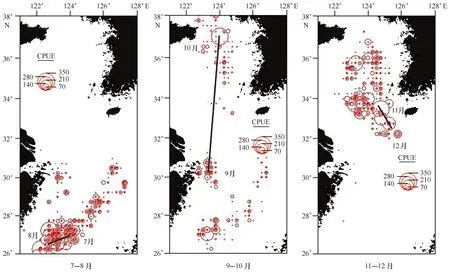
圖2 1999—2007年東、黃海鮐魚7—12月CPUE(t/網次)空間分布圖Fig.2 Monthly spatial distribution of average CPUE of Scomber japonicus during 1999—2007
3.2 7—12月東黃海鮐魚適宜SST分析
由圖3可知,7—9月適宜SST范圍與10—12月明顯不同。7月份CPUE主要分布在SST為24~30℃的海域,其中高CPUE分布在SST為27~30℃的海域;8月份CPUE趨向于SST為24~30℃的海域,其中高CPUE更趨向于SST為28~29℃的海域;9月份CPUE集中在SST為20~29℃的海域,其中高CPUE主要集中在SST為25~28℃的海域;10月CPUE基本在SST為15~27℃的海域,其中高CPUE基本在SST為17~25℃的海域;11月CPUE主要分布在SST為12~23℃的海域,其中高CPUE主要分布在SST為19~21℃的海域;12月CPUE適宜SST為8~20℃的海域,其中高CPUE更適合SST為10~17℃的海域。
3.3 東、黃海鮐魚潛在棲息地分布
以各月最適SST為依據,選擇CPUE值高的8—11月份,繪制了8—11月份潛在棲息地分布圖(見圖4)。8月份潛在棲息地主要分布在26°~31.5°N、122.5°~128°E;9月份主要分布在26°~33°N、121°~128°E;10月份主要分布在30°~38°N、121°~128°E;11月份主要分布在27.5°~37.5°N、121°~128°E。
在SST上升0.5℃、1℃、2℃、4℃情況下,其7—12月潛在棲息地的變化情況見圖5。隨著SST上升,鮐魚潛在棲息地逐漸向北移。8月份,SST上升0.5℃時,其潛在棲息地最南邊界從31.5°N北移到33°N;SST上升1℃時,向北移至33.5°N;SST上升2℃時,繼續向北移至36°N;SST上升4℃時,到達36.5°N附近。9月份,SST上升0.5℃時,其潛在棲息地最南邊界從30.5°N北移到31.5°N;SST上升1℃時,向北移至32.5°N;SST上升2℃時,繼續向北移至34.5°N;SST上升4℃時,到達36°N附近。10月份,SST上升0.5℃時,其潛在棲息地最南邊界從30°N北移至30.5°N;SST上升1℃時,向北移至31°N;SST上升2℃時,繼續向北移至32°N;SST上升4℃時,到達33.5°N附近;11月份,SST上升0.5℃時,其潛在棲息地最南邊界從27°N北移至28°N;SST上升1℃時,向北移至29°N;SST上升2℃時,繼續向北移至31°N;SST上升4℃時,到達34°N附近。
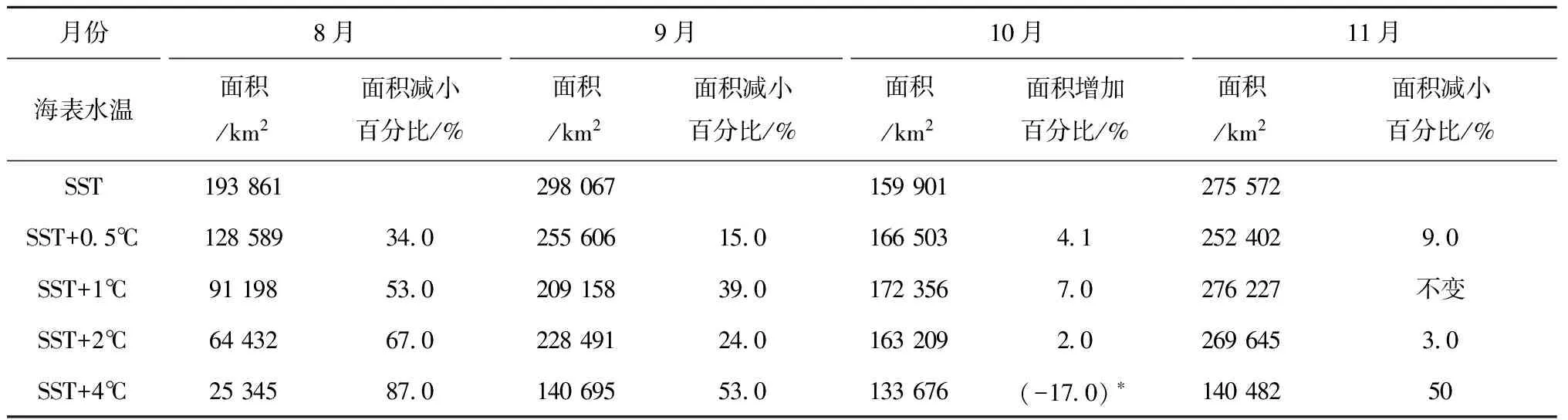
由表1可知,8—11月份東、黃海鮐魚的棲息地面積隨SST上升呈減小趨勢。其中在7—12月SST上升0.5℃、1℃、2℃、4℃時,8月份棲息地面積分別減小34%、53%、67%、87%;9月份的棲息地面積分別減小15%、39%、24%、53%;10月份則分別增加4%、7%、2%和減小17%;11月份分別減小9%、0%、3%、50%。
4 討論與分析
4.1 環境因子對東、黃海鮐魚CPUE的時空變動影響
分析發現,1999—2007年7—9月鮐魚較高CPUE主要集中在26°~28°N、122°~124°E海域;10—12月主要集中在33°~36°N、123°~125°E海域。
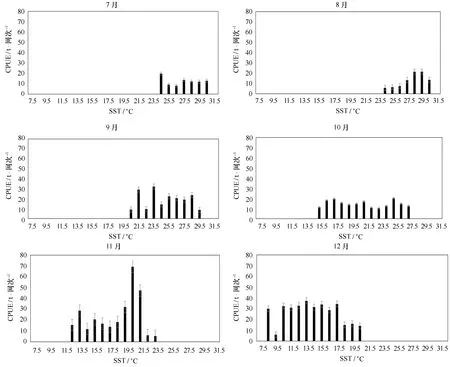
圖3 1999—2007年7—12月SST與CPUE關系Fig.3 Relationship between SST and CPUE of Scomber japonicus during 1999—2007

圖4 8—11月鮐魚CPUE(t/網次)與SST(℃)分布疊加圖Fig.4 CPUE distribution of Scomber japonicus combined with SST

圖5 SST上升0.5℃、1℃、2℃、4℃后8—11月鮐魚潛在棲息地預測分布圖Fig.5 Monthly potential habitats of the Scomber japonicus with increase of 0.5℃,1℃,2℃ and 4℃ during August to November
表1 8-11月鮐魚潛在棲息地面積隨海表水溫上升的變化情況
Tab.1 Monthly area of potential habitat ofScomberjaponicusunder the increase of SST
月份8月9月10月11月海表水溫面積/km2面積減小百分比/%面積/km2面積減小百分比/%面積/km2面積增加百分比/%面積/km2面積減小百分比/%SST193861298067159901275572SST+0 5℃12858934 025560615 01665034 12524029 0SST+1℃9119853 020915839 01723567 0276227不變SST+2℃6443267 022849124 01632092 02696453 0SST+4℃2534587 014069553 0133676(-17 0)?14048250
注:*表示減少百分比。
南部漁場CPUE為18.94 t/網次,北部漁場為25.19 t/網次,北部漁場的CPUE明顯比南部較高。前人研究認為,東、黃海鮐魚資源豐度會受經度、緯度、季節、海洋環境等條件影響[17—21]。崔科和陳新軍[15]、宋海棠等[22]、楊紅等[23]研究發現,鮐魚漁場重心變化主要受沿岸水團和外海高鹽水團的強弱變化影響。每年春季鮐魚自東海中南部越冬場開始生殖洄游,到達東海中部,性成熟的鮐魚即在此海域產卵,未成熟的鮐魚則繼續向北洄游進入黃海; 產卵后的鮐魚在東海中索餌,秋季向北洄游到達黃海; 冬季返回東海的越冬場[3,24],這與本文鮐魚漁場重心遷移方向及其棲息地分布基本一致。
4.2 海表水溫對東、黃海鮐魚潛在棲息地的影響
SST是影響許多中上層魚類資源量的重要因素,如沙丁魚[25—26]、竹筴魚和鳀魚[27]。張孝威[28]和李綱等[29]指出鮐魚的生殖、洄游對SST變化非常敏感。研究結果表明在17~19℃和28~30℃范圍內漁獲量較高,最適SST范圍隨季節變化而變化。7、8、9月最適SST為24~30℃,10、11、12月最適SST為15~19℃。因此,本文利用最適SST來預測東、黃海鮐魚棲息地分布(見圖4),方法是可行的。
SST上升是全球氣候變化的一個重要現象。本文通過模擬不同SST上升情況下來預測鮐魚棲息地遷移及其面積變化(以最適SST作為鮐魚棲息地分布海域)。研究表明,SST上升對鮐魚棲息地范圍影響是顯著的,且不同月份的影響情況明顯有差異,各月東、黃海鮐魚棲息地面積在SST升高情況下總體呈減小趨勢。因此,本研究認為SST升高將會對鮐魚時空分布產生重要影響。但是,海洋環境變化[30—31]以及厄爾尼諾[32]都會對魚類時空分布產生重要影響,也就是說影響魚類時空分布的因素是很多的,為此建議以后在研究鮐魚資源的棲息地位置時應該結合葉綠素、海流等更多的海洋環境因子[33],來預測分析其棲息地的變化。
[1] 程家驊,林龍山. 東海區鮐魚生物學特征及其漁業現狀的分析研究[J]. 海洋漁業,2004,26(2): 73-78.
Cheng Jiahua,Lin Longshan. Study on the biological characteristics and status of common mackerel (ScomberjaponicusHouttuyn) fishery in the East China Sea region[J]. Marine Fisheries,2004,26(2): 73-78.
[2] 王凱,嚴利平,程家驊,等. 東海鮐魚資源合理利用的研究[J]. 海洋漁業,2007,29(4): 337-343.
Wang Kai,Yan Liping,Cheng Jiahua,et al. Study on the reasonable utilization of Chub mackerel in the East China Sea[J]. Marine Fisheries,2007,29(4): 337-343.
[3] 張洪亮,周永東,姚光展. 浙江群眾傳統燈光圍網漁業利用資源狀況分析[J]. 海洋漁業,2007,29(2): 174-178.
Zhang Hongliang,Zhou Yongdong,Yao Guangzhan. Analysis on the utilization of resources in small scale traditional light seining fisheries of Zhejiang Province[J]. Marine Fisheries,2007,29(2): 174-178.
[4] 李綱,陳新軍. 東海鮐魚資源和漁場時空分布特征的研究[J]. 中國海洋大學學報,2007,37(6): 921-926.
Li Gang,Chen Xinjun. Tempo-spatial characteristic analysis of the mackerel resource and its fishing ground in the east China Sea[J]. Periodical of Ocean University of China,2007,37(6): 921-926.
[5] 李振太,許柳雄. 東海南部鮐魚生物學特征研究[J]. 福建水產,2005(1): 47-50.
Li Zhentai,Xu Liuxiong. Approach on biological characteristics ofscomberjaponicusin the southern east China Sea[J]. Journal of Fujian Fisheries,2005(1): 47-50.
[6] 劉勇,嚴利平,胡芬,等. 東海北部和黃海南部鮐魚年齡和生長的研究[J]. 海洋漁業,2005,27(2): 133-138.
Liu Yong,Yan Liping,Hu Fen,et al. Age and growth ofPneumatophorusjaponicusin the north of the east China Sea and the south of the Yellow Sea[J]. Marine Fisheries,2005,27(2): 133-138.
[7] 孫耀,于淼,劉勇,等. 現場胃含物法測定鮐的攝食與生態轉換效率[J]. 水產學報,2003,27(3): 245-250.
Sun Yao,Yu Miao,Liu Yong,et,al. Determination of food consumption and ecological conversion efficiency ofPneumatophorusjaponicusby stomach contents method[J]. Journal of Fisheries of China,2003,27(3): 245-250.
[8] Yamada T,Aokia I,Mitani I. Spawning time,spawning frequency and fecundity of Japanese chub mackerel,Scomberjaponicusin the waters around the Izu Islands,Japan[J]. Fisheries Research,1998,38(1): 83-89.
[9] 陳衛忠,李長松. 鮐魚幼魚耳石日輪的初步觀察與研究[J]. 水產學報,1996,20(2): 139-143.
Chen Weizhong,Li Changsong. A primary observation and study on the daily increment in otolith for juvenile Japanese mackerelPneumatophorusjapunicus[J]. Journal of Fisheries of China,1996,20(2): 139-143.
[10] 方水美,楊圣云,張澄茂. 臺灣海峽南部燈光圍網主要捕撈對象的水溫選擇及其季節變化[J]. 水產學報,2000,24(4): 370-375.
Fang Shuimei,Yang Shengyun,Zhang Chengmao. Selective water temperature and its seasonal variation for main species fished by light-seine from the southern Taiwan Straits[J]. Journal of Fisheries of China,2000,24(4): 370-375.
[11] 洪華生,何發祥,楊圣云. 厄爾尼諾現象和浙江近海鮐鲹魚漁獲量變化關系——長江口ENSO漁場學問題之二[J]. 海洋湖沼通報,1997(4): 8-16.
Hong Huasheng,He Faxiang,Yang Shengyun. El-Nio phenomenon and variation of catch ofScomberjaponicasandDecapterusmaruadsitrichiurus in offshare waters of Zhejiang province[J]. Transcations of Oceanology and Limnology,1997(4): 8-16.
[12] Laurs R M,Fiedler P C,Montgomery D R. Albacore tuna catch distributions relative to environmental features observed from satellites[J]. Deep-Sea Research Part A. Oceanographic Research Papers,1984,31(9): 1085-1099.
[13] Polovina J J,Howell E,Kobayashi D R,et al. The transition zone chlorophyll front,a dynamic global feature defining migration and forage habitat for marine resources[J]. Progress in Oceanography,2001,49(1/4): 469-483.
[14] Teo S L H,Boustany A M,Block B A. Oceanographic preferences of Atlantic Bluefin tuna,Thunnusthynnus,on their Gulf of Mexico breeding grounds[J]. Marine Biology,2007,152(5): 1105-1119.
[15] 崔科,陳新軍. 東、黃海圍網漁場鮐鲹魚產量的年際變動[J]. 海洋學研究,2005,23(2): 41-49.
Cui Ke,Chen Xinjun. Study on inter-annual change of the yields ofPnunmatophorusjaponicusandDecapterusmaruadsifor purse seine fishing grounds in the East China Sea and the Yellow Sea[J]. Journal of Marine Sciences,2005,23(2): 41-49.
[16] Solomon S D,Qin M,Manning Z,et al. IPCC Summary for policymakers[C]// Climate Change 2007: the Physical Science Basis. Contribution of Working Group I to the Fourth Assessment Report of the Intergovernmental Panel on Climate Change. Cambridge: Cambridge University Press,2007.
[17] Yatsuia A,Mitana T,Watanabe C,et al. Current stock status and management of chub mackerel,Scomberjaponicus,along the Pacific coast of Japan——an example of allowable biological catch determination[J]. Fisheries Science,2002,68: 93-96.
[18] Hiyama Y,Yoda M,Ohshimo S. Stock size fluctuations in Chub mackerel (Scomberjaponicus) in the East China Sea and the Japan/East Sea[J]. Fisheries Oceanography,2002,11(6): 347-353.
[19] Yatsu A,Watanabe T,Ishida M,et al. Environmental effects on recruitment and productivity of Japanese sardineSardinopsmelanostictusand chub mackerelScomberjaponicuswith recommendations for management[J]. Fisheries Oceanography,2005,14(4): 263-278.
[20] 由上龍嗣,檜山義明,依田真里,等. 平成 16 年マサバ對馬暖流系群の資源評価[R]. 西海區水產研究所,2005.
Yugami R, Hiyama Y, Yoda M, et al. Resources analysis of common mackerelScomberjaponicus, Tsushima Warm Current stock in 2004[R].Seikai Regional Fisheries Research Lab,2005
[21] 由上龍嗣,檜山義明,依田真里,等. 平成 17 年マサバ對馬暖流系群の資源評価[R]. 西海區水產研究所,2006.
Yugami R, Hiyama Y, Yoda M, et al. Resources analysis of common mackerelScomberjaponicus, Tsushima Warm Current stock in 2005[R].Seikai Regional Fisheries Research Lab,2006
[22] 宋海棠,陳阿毛,丁天明,等. 浙江漁場鮐鲹魚資源利用研究[J]. 浙江水產學院學報,1995,14(1): 2-12.
Song Haitang,Chen Amao,Ding Tianming,et al. A stock utilization survey of mackerel and scad in Zhejiang fishing area[J]. Journal of Zhenjiang College of Fisheries,1995,14(1): 2-12.
[23] 楊紅,章守宇,戴小杰,等. 夏季東海水團變動特征及對鮐鲹漁場的影響[J]. 水產學報,2001,25(3): 209-214.
Yang Hong,Zhang Shouyu,Dai Xiaojie,et al. Characteristics of water masses and its influence on mackerel scad fishery in the East China Sea in the summer[J]. Journal of Fisheries of China,2001,25(3): 209-214.
[24] Hwang S D. Population ecology of pacific mackerel,Scomberjaponicus,off Korea[D]. Daejeon: Chungnam National University,1999.
[25] Park J H,Choi K H. A study on the formation of fishing ground and the prediction of the fishing conditions of mackerel,ScomberjaponicusHouttuyn[J]. Bull Natl Fish Res Dev Agency Korea,1995,49: 25-35.
[26] Jacobson L D,MacCall A D. Stock-recruitment models for Pacific sardine (Sardinopssagax)[J]. Canadian Journal of Fisheries and Aquatic Sciences,1995,52(3): 566-577.
[28] 張孝威. 鮐魚[M]. 北京: 農業出版社,1983.
Zhang Xiaowei. Mackerel[M]. Beijing: China Agriculture Press,1983.
[29] 李綱,陳新軍,田思泉. 我國東、黃海鮐魚燈光圍網漁業CPUE標準化研究[J]. 水產學報,2009,33(6): 1050-1059.
Li Gang,Chen Xinjun,Tian Siquan. CPUE standardization of chub mackerel (Scomberjaponicus) for Chinese large lighting-purse seine fishery in the East China Sea and Yellow Sea[J]. Journal of Fisheries of China,2009,33(6): 1050-1059.
[30] 曹曉怡,周為峰,樊偉,等. 印度洋大眼金槍魚、黃鰭金槍魚延繩釣漁場重心變化分析[J]. 上海海洋大學學報,2009,18(4): 466-471.
Cao Xiaoyi,Zhou Weifeng,Fan Wei,et al. Analysis on barycenter of fishing ground for bigeye tuna and yellowfin tuna by lonelining in the Indian Ocean[J]. Journal of Shanghai Ocean University,2009,18(4): 466-471.
[31] 曹杰,陳新軍,劉必林,等. 魷魚類資源量變化與海洋環境關系的研究進展[J]. 上海海洋大學學報,2010,19(2): 232-239.
Cao Jie,Chen Xinjun,Liu Bilin,et al. Review on the relationship between stock recruitment of squid and oceanographic environment[J]. Journal of Shanghai Ocean University,2010,19(2): 232-239.
[32] 陳敏祥. 聖嬰現象對臺灣鯖圍網漁業影響評估[D]. 基隆: 國立臺灣海洋大學,2000.
Chen Minxiang. Impact assessment of the El Nio on the Mackerel Purse Seine Fishery in Taiwan[D]. Jilong: National Taiwan Ocean University,2000.
[33] 陳新軍. 漁業資源與漁場學[M]. 北京: 海洋出版社,2004: 202-203,252-253.
Chen Xinjun.Fisheries resources and fishery science[M]. Beijing: China Ocean Press,2004:202-203,252-253.
Influence of sea surface temperature changes onScomberjaponicashabitat in the Yellow Sea and East China Sea
Su Hang1,4,Chen Xinjun1,2,3,4,Wang Jintao1,2,3,4
(1.CollegeofMarineSciences,ShanghaiOceanUniversity,Shanghai201306,China; 2.NationalEngineeringResearchCenterforOceanicFisheries,ShanghaiOceanUniversity,Shanghai201306,China; 3.TheKeyLaboratoryofSustainableExploitationofOceanicFisheriesResources,MinistryofEducation,ShanghaiOceanUniversity,Shanghai201306,China; 4.CollaborativeInnovationCenterforDistant-waterFisheries,Shanghai201306,China)
Sea surface temperature (SST) is an important indicator representing fish habitat. According toScomberjaponicusfishery-dependent data of large lighting-purse seine,combining with SST by remote sensing,the suitable range of SST ofScomberjaponicasduring the fishing seasons are analyzed and the changing tendency of theScomberjaponicashabitat caused by variation of water temperature are also discussed. The results proved that suitable range of SST ofScomberjaponicasin the East China Sea and Yellow Sea is 15-30℃. This study based on global climate simulations under several emission scenarios (A1FI,A1B,A1T,A2,B1,and B2) from the AR4 of the IPCC to examine the impact on potential habitats ofScomberjaponicasfor the next 100 years. So we simulate four kinds of water temperatures rise by gradient : (1) monthly average SST increase of 0.5℃;(2) monthly average SST increase of 1℃; (3) monthly average SST increase of 2℃;(4) monthly average SST increase of 4℃. The results indicated that the habitat ofScomberjaponicashad a obvious northwards shifting tendency,and the area of habitat would decreased gradually. It is concluded that the rising SST caused by the global climate change would have a seriously effect on the habitat ofScomberjaponicas. These results can make us understand the spatial distribution ofScomberjaponicasinfluenced by SST in fishery management and fishery forecasting,which also provide the guide for the prediction of theScomberjaponicuspotential habitat in the East China Sea and Yellow Sea.
Scomberjaponicas; climatic change; SST increase; potential habitat
10.3969/j.issn.0253-4193.2015.06.009
2014-09-19;
2015-03-14。
國家863計劃(2012AA092303);國家發改委產業化專項(2159999);上海市研究生教育創新計劃;上海市科技創新行動計劃(12231203900);國家科技支撐計劃(2013BAD13B01)。
蘇杭(1992—),男,河南省商丘市人,主要從事漁業資源學研究。E-mail:615923118@qq.com
*通信作者:陳新軍(1967—),男,教授。E-mail:xjchen@shou.edu.cn
S931.1
A
0253-4193(2015)06-0088-09
蘇杭,陳新軍,汪金濤. 海表水溫變動對東、黃海鮐魚棲息地分布的影響[J].海洋學報,2015,37(6):88—96,
Su Hang,Chen Xinjun,Wang Jintao. Influence of sea surface temperature changes onScomberjaponicashabitat in the Yellow Sea and East China Sea[J]. Haiyang Xuebao,2015,37(6):88—96,doi:10.3969/j.issn.0253-4193.2015.06.009
猜你喜歡
體育科技文獻通報(2022年3期)2022-05-23 13:46:54
天津外國語大學學報(2021年3期)2021-08-13 08:32:18
遼金歷史與考古(2021年0期)2021-07-29 01:06:54
科技傳播(2019年22期)2020-01-14 03:06:54
遼金歷史與考古(2019年0期)2020-01-06 07:45:20
民用飛機設計與研究(2019年4期)2019-05-21 07:21:24
電子制作(2018年11期)2018-08-04 03:26:04
汽車工程學報(2017年2期)2017-07-05 08:13:02
國際商務財會(2017年8期)2017-06-21 06:14:14
電子制作(2017年23期)2017-02-02 07:17:19