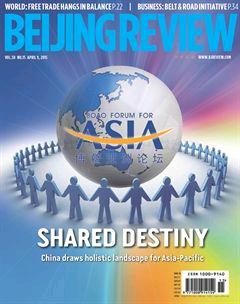
STRENGTHENED BONDS
2015-05-26 22:37:19ByJiJing
Beijing Review
2015年15期
By+Ji+Jing
Visiting the tiny tropical island of Boao in south Chinas Hainan Province, it would be hard to imagine a more picturesque or conducive venue for large-scale gatherings. The island boasts an abundance of coconut trees and sunny beaches cooled by the areas customary gentle ocean breeze. The overall atmosphere is one of tranquility.
Against this enviable backdrop, an array of elites drawn from a wide spectrum of society both in China and abroad gathered from March 26 to 29 to pool their wisdom and share their insights on a broad range of topics during the annual Boao Forum for Asia(BFA). Numbered among them were over 2,000 political leaders, business tycoons and globally renowned academics.
Held under the theme of Asias New Future: Towards a Community of Common Destiny, this years forum distinguished itself from previous gatherings through the broader participation of political heavyweights from almost every continent, as represented by the presence of Chinese President Xi Jinping and state leaders from Malaysia, Armenia, Australia, Indonesia, Nepal, Russia, the Netherlands, Thailand, Kazakhstan, Austria and Sweden, among other nations, at the opening ceremony on March 28.
“The original goal of the Boao Forum when it was founded was to build a community of common destiny. Im glad that we are coming to discussions surrounding this topic,” said Yasuo Fukuda, Chairman of the Board of Directors of the BFA and former Prime Minister of Japan, during the opening ceremony.
“Our friends in Southeast Asia say that the lotus flowers grow taller as the water rises. Our friends in Africa say that if you want to go fast, walk alone; and if you want to go far, walk together. Our friends in Europe say that a single tree cannot block the chilly wind. And Chinese people say that when big rivers have water, the small ones are filled; and when small rivers have water, the big ones are filled,” said Chinese President Xi in the opening speech addressing the importance of international cooperation in boosting common development and illustrating the idea of “a community of common destiny.”
The more specific framework for building such a community in Asia, which was underscored by Xi, included the China-ASEAN community of common destiny and an East Asia economic community for ASEAN, China, Japan and the Republic of Korea (ROK). The East Asia economic community is scheduled for completion by 2020.
Bringing Asia closer
Furthering cooperation between China and ASEAN countries was accorded high importance during the forum. Chinese Foreign Minister Wang Yi vowed to press ahead with the upgrading of the China-ASEAN Free Trade Area (CAFTA) and the negotiations of the Regional Comprehensive Economic Partnership(RCEP)—a multilateral free trade area that will include China, the ROK, Japan and 10 members of the ASEAN as well as India, Australia and New Zealand.
He also promised to improve the level of economic and trade cooperation between China and ASEAN and realize a bilateral trade volume of $500 billion this year and $1 trillion by 2020. Finally, he called for enhancing interconnectivity between infrastructures and various industries, as well as putting the Asian Infrastructure Investment Bank into operation by the end of 2015.
“At present, the Chinese economy has entered the ‘new normal. ASEAN countries will be the top choice for China to export its high-quality excess capacities. We will explore the possibility of building more industrial parks with ASEAN countries to help upgrade local industries,” Wang stated.
Over the past few decades, Chinas cooperation with ASEAN has strengthened. As one of the regional blocs 10 dialogue partners, China together with ASEAN in 2002 forged the CAFTA, at present the largest free trade area among those made up of developing countries. China has been ASEANs largest trading partner for five consecutive years and ASEAN has been Chinas third largest trading partner for four years. Over 1,000 flights fly back and forth between the two sides every week and personnel exchanges between the two are estimated to number 18 million every year.
The proposals put forward at this years BFA were not without precedence. President Xi had proposed creating a closer community of common destiny and co-building the 21st-Century Maritime Silk Road with ASEAN during a visit to Indonesia in October 2013. Premier Li Keqiang first proposed the 2+7 Cooperation Framework (referencing two political consensuses and seven areas of cooperation) while attending the 16th ChinaASEAN Leaders Meeting held in Brunei in 2013.
Aside from economic cooperation, Wang said the two parties will also up cooperation in the areas of education, culture, tourism, sports and medical care, as well as fostering and facilitating exchanges between young people, the media, think tanks and local governments.
ASEAN representatives also expressed willingness to further interact with China during the forum. “We are members of ASEAN.
It doesnt mean well forget China. China is with us, South Korea is with us, Japan is with us. So we have the ASEAN+3. This is one group and it is going to be a very important group,” said former Malaysian Prime Minister Datuk Abdullah Haji Ahmad Badawi.
“During the 1997 financial crisis, the IMF and other like organizations did not really pay attention to our crisis; by the way, China had taken very good actions and supported us. So next is to reduce the gap between us and second to have some common vision in terms of security, regional connectivity, cooperation with neighbors,” he added.
The economic growth of ASEAN countries has recorded remarkable progress in the past 10 years or so. Badawi said the association is expected to become the worlds fourth largest economy by 2050.
“The ASEAN community set to be established at the end of this year will provide a fresh impetus for the establishment of the ChinaASEAN community,” said Foreign Minister Wang.
In addition to the proposed “community of common destiny,” the broader framework of regional cooperation the East Asia Economic Caucus (EAEC) is also regarded as crucial for building this community in Asia.
The EAEC, a regional free trade area proposed in 1990 by former Malaysian Prime Minister Mahathir bin Mohamad, encompasses the 10 ASEAN member states, China, the ROK and Japan. However, the progress made with this initiative has been relatively slow and currently the level of economic cooperation between East Asian countries remains low.
“At present, there are three economic areas worth over $18 trillion globally, namely the EU, North America and East Asia. The total GDP of East Asia accounts for 24.5 percent of the global GDP, which surpasses that of the EU and is slightly lower than that of North America. Among the three areas, East Asia is considered the most advantageous in terms of market potential, room for development and potential growth rate,” said Zeng Peiyan, former Chinese Vice Premier and Vice Chairman of the Board of Directors of the BFA.
“However, for historical reasons, the level of economic cooperation between East Asian economies lags far behind the other two areas, which not only limits the regions growth potential but is also incompatible with its economic status in the world,” Zeng added.
Zeng said the vast number of bilateral and multilateral free trade agreements between East Asian countries, which often overlap with one another, has formed a “spaghetti bowl,”which has impeded the formation of a uniform market. Fortunately, according to Zeng, the negotiations on the RCEP are unfolding smoothly. The next step should be including more countries in the RCEP and establishing a uniform trade agreement in the end.
He also cited a convenient and smooth logistics system incorporating transportation, telecommunications and energy across East Asia, better coordination of market rules and regulations between different countries, and a regional financial stability facility as indispensable in fostering regional integration.
Fukuda said that in order to build the EAEC, first, ASEAN should play a significant role given its central position in the Asia-Pacific network. Therefore countries such as China, the ROK and Japan should help ASEAN to develop and boost its internal economic integration, because the prosperity and stability of ASEAN will in turn bring huge benefits to all Asian nations.
Second, as China is expected to be the driver for economic growth in Asia in the future, the country should further open up its economy to better contribute to the building of the EAEC.
He also suggested improving communication between young people of the region, strengthening cooperation with America and enhancing mutual trust between countries in the region.
In a bid to increase connectivity between different countries and realize the spirit of a community in Asia, China has put forward the Belt and Road Initiative (the Silk Road Economic Belt and the 21st-Century Maritime Silk Road), as well as the construction of the Asian Infrastructure Investment Bank (AIIB). These initiatives were the topic of much discussion at the forum.
“The Belt and Road and the AIIB are both open initiatives. We welcome all countries along the routes and in Asia, as well as our friends and partners around the world, to take an active part in these endeavors,” said President Xi.
Substantial progress has been made regarding these initiatives, exemplified by the rolling out of an action plan of the Road and Belt Initiative on March 28 by three Chinese ministries. Moreover, as of March 31, the deadline for application, 46 countries around the world had applied for the AIIB founding membership.
“As the center of gravity of the world shifts dramatically from the developed world to the developing world where 85 percent of the worlds population lives, we need a new international financing architecture where there are multinational institutions which can express the needs and interests of the developing world. The significance of the AIIB is that it has captured this moment,” said Martin Jacques, author of When China Rules the World, and a columnist for The Guardian and New Statesman.
“For us as a potential recipient, where we do have financing gaps or infrastructure needs, we welcome more possibilities to get Chinas financing for infrastructure under good governance structures,” said Mari Pangastu, former Minister of Trade of Indonesia.
Security issues
Aside from economic cooperation, security is seen as another prerequisite for building an Asian community with shared interests.
However, China and Japans disputes over historical and territorial issues and the overlapping claims of China and some ASEAN nations in parts of the South China Sea are posing threats to regional security.
“Economics and security are the two wings of the community of shared destiny, with the former being the foundation and the latter being the guarantee,” said Wang Yingfan, Chinese Foreign Ministry Special Envoy for Asian Affairs.
“Although Asia is regarded as the most dynamic and promising economic region in the world, security cooperation in the region has fallen behind. The Asian security architecture does not cover as many areas as its European counterpart,” Wang Yingfan added.
During the fourth summit of the Conference on Interaction and ConfidenceBuilding Measures in Asia held in Shanghai last May, President Xi envisioned a new security mechanism characterized by common, comprehensive, cooperative and sustainable security to cope with the rising security challenges in the region.
Xi reiterated this concept at the opening ceremony and pointed to its significant role in building a common Asian community.
“In order to safeguard regional security, we should build a new security architecture based on the existing ones such as the Shanghai Cooperation Organization and the six-party talks,” said Foreign Minister Wang Yi.
“In addition, it is important for China and the United States to form a major-power relationship to ensure security in the Asia-Pacific,” said Wang Yi.
Hugh White, a professor with Australian National University, agreed with Wang Yi, stating that a stable major-power relationship will provide the foundation for building an Asian community.
“We are moving into a very new era given the relationship between the major powers because the distribution of wealth and power between them has shifted so far. In the 1970s, Chinas economy was one 20th the size of Americas. Today its the second largest economy. Therefore, how the United States and Chinas roles can be reconciled and accommodated is a very important question and quite urgent,” White said.
However, despite major powers, small and medium-sized countries in the region should also play a role in promoting regional security.
“ASEAN considers itself as a very important component of the Asia-Pacific security architecture. We need engagement because the world is different. There needs to be dialogue, consultation and cooperation,” said Tan Sri Rastam Mohd Isa, Chairman of the Institute of Strategic and International Studies of Malaysia.
Paul Evans, a professor at the University of British Columbia, agreed to the importance of security to economic development but also pointed out the difficulty of implementing the new security concept proposed by Xi in practice.
“A security situation is going to limit economic opportunities now and in the future. That happened in the most extraordinary context when a year ago we were worrying about JapaneseChinese potential naval confrontations in and around disputed islands,” Evans said.
“The concepts of comprehensive, common, cooperative and sustainable securities are all important ideas, but they are not yet clearly defined. Its truly very difficult at this point to build a regional discussion around them. It takes some imagination,” Evans added.
登錄APP查看全文