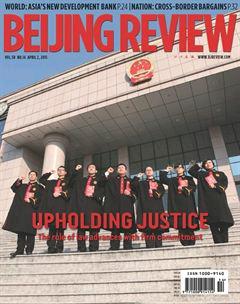
A LAW FOR THE LAW
2015-05-22 22:39:21ByYinPumin
Beijing Review
2015年14期
By+Yin+Pumin
Chinas top legislative body has adopted an amendment to the Legislation Law, the foundation of the nations legal system, to make the process of formulating and enacting laws more efficient while simultaneously reinforcing the rule of law.
Since coming into effect in July 2000, the Legislation Law has served as the cornerstone of Chinas legal system. It regulates how national laws, government regulations and local laws come into shape and which organizations hold the legislative power in the country.
The amendment, proposed at the beginning of last year, is intended to remove ambiguous language and legal definitions, streamline the lawmaking process, and further tighten the administration of the law.
The first priority in revising the law is to incorporate decisions and plans set by the Communist Party of China (CPC) Central Committee during its third and fourth plenary sessions, explained Li Jianguo, Vice Chairman of the National Peoples Congress Standing Committee, while elaborating the bill to deputies on March 8.
“The revisions are expected to improve the legislative system, raise the quality and ef-ficiency of legislation, maintain the unity of the legal system and the nation, establish a sound system of laws, modernize Chinas system and the capacity for governance, and improve the country under a socialist rule of law,” Li said.
Liang Ying, a member of staff with the Legislative Affairs Commission of the NPC Standing Committee, said that the bill indicated a changing role of legislation.
A decade ago a law was often an abstraction borne out of how things had been done before it was written but now they are expected to show the direction and guide the practice, Liang commented.
The legislature is also expected to accumulate consensus and help remove barriers for upcoming reform measures through making laws, which is why the Legislation Law needed to be amended, he noted.
Gu Shengzu, a member of the NPCs Financial and Economic Affairs Committee, said that only good laws can promote good governance, and that the Legislation Law was specifically formulated to produce“good laws.”
“The amendment underscores the fact that peoples congresses at all levels are authorized to enact legislation, and it also removes any confusion about the separation between the law and government policies, which are often regarded as one and the same,” he said.
Ma Huaide, Vice President of China University of Political Science and Law, explained that the amendment stipulates exactly which bodies are allowed to enact legislation, which he stressed are a major achievement and a giant stride toward strengthening the rule of law.
According to Ma, 75 percent of the draft laws initiated at NPC meetings in the past 10 years were written by government departments, rather than peoples congresses, but the new amendment clearly identifies the congresses as the only bodies authorized to make laws.
The amended law identifies the NPC as the only body authorized to draft national laws and emphasizes that the congress is in overall control of the legislative process. It also clarifies how national and local laws come into shape and carefully identifies the legislative power of each government department.
In one move, the Legislation Law expands legislative power from 49 cities in China to 282 nationwide, empowering their legislatures to make local laws.
Ma said the amended law would meet the rising clamor from cities to manage their own affairs, arguing that national laws fail to meet specific local needs.
Delegating legislative power
“Its more efficient to let locals decide their own affairs in matters like city management, environmental protection and public services,” he said, adding that the delegation of legislative power to the cities doesnt extend to regulatory matters, such as regional economic and political development.
Zheng Xuejun, an NPC deputy from east Chinas Zhejiang Province and a newspaper editor based in Wenzhou, is excited that her city finally has the power it had been lobbying to obtain for two decades.
Known for its vigorous private businesses and strong tradition of entrepreneurship, Wenzhou is often on the frontline of Chinas boldest economic policies.
A pilot project of legalized private lending in operation in Wenzhou had been refused endorsement from the State Council until a local credit crisis caused by underground lending in 2011. Provincial regulation only came out after two years of the trial.
“New businesses come up and so do new problems. National and provincial laws can be late to respond to our citys situation,”Zheng said.
“With the legislative power, our city can turn some of its pilot policies into more permanent arrangements and address new problems that other cities may not have,” she added.
Liang with the Legislative Affairs Commission of the NPC Standing Committee said that the provision indicates a changing perspective toward both national and local governance.
“It is not a simple change of a statute but shows that the central authority is delegating its power to those with a deeper understanding of the local dynamics,” he said.
However, the bill also stirred up worry among other lawmakers.
South Chinas Guangdong Province, also a test ground for reform, is likely to see 17 more city legislatures given the power to make local laws.
“It could be a very good thing, but it could also be messy,” said Wu Qing, an NPC deputy and veteran lawyer, at a panel discussion about the bill at the national legislative session this year.
Citing Dongguan in the province known for its booming export industry, Wu said local legislative power might help the city take a full advantage of a ministry-supervised pilot project on soil pollution treatment.
“If the city legislature can turn successful policies in the pilot project into a local law, these policies will become more permanent arrangements and benefit the city that has suffered serious soil pollution. Otherwise, it might take a very long time for a local pilot project to be incorporated into a national law,” she said.
However, she also worried that not all cities are prepared for the new power.
Zhang Guifang, an NPC deputy and a senior lawmaker from Guangzhou legislature, noted that city laws may cover a wide range of topics and it is hard to draw a line between what is within their power and what is not.
Responding to the concerns, Zheng Shuna, Deputy Director of the Legislative Affairs Commission of the NPC Standing Committee, told a press conference on March 9 that the bill set up “five lines of defense” against possible abuse.
The bill only allows cities to issue local laws about “rural or urban development and management, environmental protection, and preservation of historical heritage and cultural values.”
It also regulates that the power should be granted step by step and the provincial legislature will decide which city is suitable.
City laws, which should not contradict with national, provincial laws and Central Government regulations, must be approved by the provincial legislature.
As a last resort, the NPC Standing Committee will examine their legitimacy and make the necessary amendments.
Statutory taxation
Another provision that will affect every citizens life is statutory taxation. The revised Legislation Law underlines the principle of statutory taxation by singling it out in a provision.
The revised law makes it clear that a tax can only be levied or canceled through the law and the basic system of taxation can only be decided through the law.
It is considered an attempt by the national legislature to change the current taxation arrangement.
Of Chinas 18 existing taxes, only three—in- dividual income tax, corporate income tax, and vehicle and vessel tax—are levied through legislation, while the others are imposed through formal or provisional regulations issued by the State Council.
Such an arrangement was made because the NPC Standing Committee authorized the State Council to levy taxes about business activities in 1985. The decision was to give the cabinet more leeway in helping China shift from a planned economy to a market one. The cabinet has since instituted 15 taxes, consolidating the governments sources of revenue, as state investment plays a significant role in Chinas economic growth.
Fu Ying, spokeswoman for the Third Plenary Session of the 12th NPC, told a press conference on March 4 that China aims to realize full statutory taxation by 2020.
Fu explained that statutory taxation means that what taxes to be levied, to whom the taxes are collected and tax rates will all be decided by laws enacted by the top legislature.
“In the next few years, I believe we will have legislations on all 18 taxes. Any new tax, such as real estate tax and environment tax that are being mulled, should also be imposed by law,”Liang said.
Explaining why the country needs complete statutory taxation now, Liang said empowering the legislature to impose tax can ensure a more transparent process and an independent stance from any interest groups.
It also makes it more rigid to adjust the taxes, which will increase the sense of stability for citizens and businesses, he said.
Statutory taxation was listed in the overall reform blueprint adopted by the CPC Central Committee at its key session in November 2013.
Limiting administrative power Progress has also been made in the revised Legislation Law to rein in administrative power.
One provision bans ministries and local governments from issuing rules and policies that mitigate citizens rights or increase their obligations without legal foundations.
It is considered an attempt by the national legislatures attempt to prevent the executive branch from churning out inappropriate rules or policies.
In recent years, for the sake of economic development and social management, local governments enacted rules and policies that aroused concerns of abusing the administrative power.
In anticipation of easing traffic jams and reducing air pollution, the Beijing Municipal Government banned residents from buying cars without new car registration licenses given out during a bi-monthly lottery. Each private car in Beijing is required to stay off the roads during particular hours of one working day each week. The particular day is decided according to the cars license plate. Some other cities have followed suit.
Wang Lei, a professor with the Law School of Peking University, suggest buying cars is a basic civil right and an abrupt limit of this right without soliciting public opinion hurts peoples rights as well the governments credibility.
Meanwhile, a number of cities also adopted restrictive measures on residents purchasing real estate properties, hoping to squeeze out speculation in the housing market.
Liang said that he believes the executive branch would be more cautious of rules to be issued in the future.
“This provision will be a warning against undue administrative rules,” Liang said.
Ying with China University of Political Science and Law noted that it is an effort to stress the legitimacy of government rules and push the government to legally exercise their power.
In the revised law, a few provisions are about enhancing the top legislatures duty of examining whether all government regulatory documents are in line with the Constitution and law.
It clarifies that the NPC departments may review government regulations and local laws without being requested. If a citizen or organization requests the review, the top legislature may present the feedback and publicize the result.
“If the NPC plays a better role in carrying out the legitimacy review, the government will be under stricter scrutiny,” Ying said.
The law, nevertheless, allows local governments to issue temporary rules only if in emergency. Such temporary rules will turn invalid in two years unless local legislatures pass laws to support them.
登錄APP查看全文