
Scalp acupuncture combined with body acupuncture for 32 cancer cases with intractable hiccups after radiochemotherapy
2015-05-18 10:14:50GengTao耿濤
Geng Tao (耿濤)
Jiangsu Province Hospital of Traditional Chinese Medicine, Nanjing 210029, China
Clinical Study
Scalp acupuncture combined with body acupuncture for 32 cancer cases with intractable hiccups after radiochemotherapy
Geng Tao (耿濤)
Jiangsu Province Hospital of Traditional Chinese Medicine, Nanjing 210029, China
Objective:To observe the therapeutic effect of scalp acupuncture combined with body acupuncture in treating cancer patients with intractable hiccups after radiochemotherapy.
Acupuncture Therapy; Scalp Acupuncture; Scalp Stimulation Areas; Neoplasms; Chemoradiotherapy; Drug-related Side Effects and Adverse Reactions; Hiccup
Patients with advanced cancer generally need combination chemotherapy, which has strong killing effect on tumor cells, but the medications may produce a variety of adverse reactions. Intractable hiccup is one of them and can often lead to poor sleep and appetite, intolerable suffering, and aggravation of the gastrointestinal stimulus response[1], resulting in rapid deterioration of the patient's condition. Up to now, many studies have indicated that acupuncture, electrical acupuncture, transcutaneous electric nerve stimulation, acupoint stimulation and other alternative medicine therapy can achieve good therapeutic effect[2]. I have used scalp acupuncture combined with body acupuncture to treat 32 cancer patients with intractable hiccups after radiochemotherapy between July 2010 and July 2014, and now it is reported as follows.
1 Clinical Materials
1.1 Diagnostic criteria
They were referred to the diagnostic criteria of hiccups in theShanghai Diagnostic and Therapeutic Guidelines of Traditional Chinese Medicine: repeated hiccups with short and frequent sounds as the main symptom, and chest and abdominal discomfort may also be present[3].
1.2 Inclusion criteria
In conformity with the above diagnostic criteria; cancer patients under chemotherapy; hiccups could not be self-recovered in more than 3 d and could not be relieved by routine medication such as intramuscularinjection of Metoclopramide, Anisodamine and Chlorpromazine; clear consciousness and could follow the treatment procedure; stable vital signs; agreed with the treatment and signed the informed consent form.
1.3 Exclusion criteria
having unclear consciousness ; who had severe heart disease and hypotension (blood pressure<90 mmHg/60 mmHg); those who had other condition and were not suitable for this study.
1.4 General data
All the patients were from the Oncology Department and Gastroenterology Department of our hospital between July 2010 and July 2014. There were 21 males and 11 females. Their average age was (57.6±12.0), ranged between 45 and 75 years old. The shortest disease duration was 3 d, and the longest was one month. There were 30 cases with duration less than 2 weeks, 2 cases with duration of equal to or over 2 weeks. Among them, 10 cases with gastric cancer, 15 cases with liver cancer, 2 cases with pancreatic cancer, and 5 cases with esophageal carcinoma. And all the patients were treated by combination chemotherapy medications like Cisplatin and Paclitaxel during hospitalization, and they also got antiemetic medications like Ondansetron and Metoclopramide to prevent from gastrointestinal reactions.
2 Therapeutic Methods
2.1 Conventional therapy
All the patients were treated by conventional therapies including chemotherapy, antiemetic medications and nutrition support.
2.2 Acupuncture therapy
2.2.1 Scalp acupuncture
Scalp stimulation areas: Line 2 Lateral to Forehead [MS 3, from Toulinqi (GB 15) straight downward along the meridian (about 3 cm in length), (Figure 1).
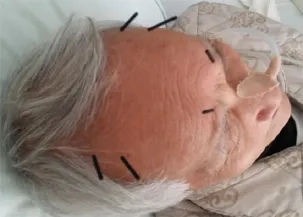
Figure 1. Scalp acupuncture
Method: The patient took a supine position. The scalp acupuncture was manipulated firstly. After routine disinfection of the acupoint area, filiform needles of 0.33 mm in diameter and 25 mm in length were inserted into Toulinqi (GB 15) for 1 cun, then twirled and rotated by the thumb and the index finger until the patient had soreness and distension sensation in the area. The patient should hold breath when the needle was inserted. The needles were manipulated once every 20 min and retained for 6 h[4]. And the patient could freely move during needle retaining.
2.2.2 Body acupuncture
Acupoints: Danzhong (CV 17), Zhongwan (CV 12), bilateral Cuanzhu (BL 2), Neiguan (PC 6), Zusanli (ST 36) and Taichong (LR 3).
Method: Filiform needles of 0.30 mm in diameter and 25-65 mm in length were selected for acupuncture and retained for 1 h after arrival of qi.
All the treatments above-mentioned were conducted once per day, and 5 d of treatment was a course. If the patients did not recover during the first course, they should continue to the second one. The therapeutic effect was evaluated after 2 courses of treatment.
3 Therapeutic Effect Observation
3.1 Therapeutic effect criteria
Referring to the therapeutic effect criteria of hiccups in theShanghai Diagnostic and Therapeutic Guidelines of Traditional Chinese Medicine[3].
Cured: Hiccups disappeared without recurrence during 1 week.
Improved: The frequency and degree of hiccups were decreased.
Invalid: Without any relief of hiccups and no change in attack frequency and degree.
3.2 Results
Among the 32 cases, 26 cases were cured, 4 cases were improved, and 2 cases were invalid. There were 18 cases cured and 2 cases improved after 1 course of treatment. The total effective rate was 93.8%.
4 Discussion
Hiccups usually occur accidentally; or however it can be continuous, intermittent or persistent. Because patients with advanced cancer generally have poor appetite and receive radiochemotherapy, intractable hiccups may be induced by chemotherapy or adjunctive medication. Modern medicine holds that hiccup is a neural reflex action, and the reflex arc passes by the third and fourth cervical spinal cord[5]. The afferent nerve is vagus nerve and the efferent nerve is phrenic nerve, and they are both controlled by the medullary respiratory center. Hiccups usually attack when phrenicnerve is stimulated and appears spasmodic contraction[6]. Scalp acupuncture can stimulate the cerebral cortex, and its action mechanism is to inhibit the increased vagus nerve excitability so as to stop hiccups. It also has an effect of restoring consciousness and regulating spirit, thus the effect of stopping hiccups is very noticeable. Acupuncture at Cuanzhu (BL 2) can inhibit the excitability of phrenic nerve and abdominal vagus nerve, and the combination of holding breath can relieve hiccups by preventing medullary respiratory center from transferring excitability to diaphragm[7].
According to traditional Chinese medicine, patients with advanced cancer are prone to intractable hiccups, because they are weak with exhaustion of stomach qi, deficiency of yin and yang and disorder of qi activity. Taichong (LR 3) is the Yuan-Primary acupoint of the Liver Meridian, and has the effect of dispersing liver qi; Zusanli (ST 36) is the lower He-Sea acupoint of the Stomach Meridian, and has an effect of regulating stomach and down-regulating the adverse qi, and it is usually combined with Taichong (LR 3) to treat disharmony of the liver and stomach. Danzhong (CV 17) can regulate spleen and stomach, and descend the adverse qi. It’s clarified in clinical study that stimulating Danzhong (CV 17) can inhibit excitability of sympathetic nerve and relive diaphragm spasm[8-10]. Neiguan (PC 6) is an important acupoint for relieving chest stuffiness and regulating diaphragm. Besides, many kinds of studies also indicate that acupuncture has definite therapeutic effect on hiccups related to abdominal surgery[11-14]. In this study, we specially prolonged the needle retaining time to increase stimulation and achieve better effects because all the patients were in middle or late phases of cancer[4].
In conclusion, scalp acupuncture combined with body acupuncture is effective in treating intractable hiccups induced by radiochemotherapy. It is easy to be manipulated with less adverse reaction and can effectively relieve patients’ suffering, thus it is suitable for further clinical application.
Conflict of Interest
The author declared that there was no conflict of interest in this article.
Statement of Informed Consent
Informed consent was obtained from all individual participants included in this study.
Received: 5 March 2015/Accepted: 13 April 2015
[1] Teng GZ, Song L, Li DQ. Correlation analysis between intractable hiccup and digestive tract hemorrhage of stroke patients with nasal feeding. Zhongguo Yiyao Daobao, 2008, 5(13): 43.
[2] Jiang DX. Rehabilitation therapy of intractable hiccup. Chin J Phys Ther, 2000, 23(1): 58-59.
[3] Shanghai Municipal Health Bureau. Shanghai Diagnostic and Therapeutic Guidelines of Traditional Chinese Medicine. 2nd Edition. Shanghai: Publishing House of Shanghai University of Traditional Chinese Medicine, 2003: 21-22.
[4] Bao F, Liang Z, Wang FQ. Clinical observation on treatment of stubborn hiccup by acupuncture with different needle-retaining time. Zhongguo Zhen Jiu, 2003, 23(1): 21-22.
[5] Wang YZ. Clinical observation of catgut implantation at acupoint in treating intractable therapy. China Prac Med, 2007, 2(18): 56-57.
[6] Han ZY, Cong ZQ, Tang SY. Neuropathic Therapy. Shanghai science and Technology Press, 1996: 14.
[7] Sun Y, Cao TM. Clinical observation of acupuncture treating stroke patients with intractable hiccup. Jiangsu Zhongyiyao, 2009, 41(7): 59.
[8] Shi B, Chu JF, Li L, Gao QL. Comparative study on strong acupuncture stimulation versus acupuncture point injection for the treatment of cancer-related refractory hiccups. Shanghai Zhenjiu Zazhi, 2013, 32(12): 1014-1015.
[9] Yang LZ, Liu JG, Zhang HX. Clinical observation of electoacupuncture combined with acupuncture in treating intractable hiccup. Hubei Zhongyi Zazhi, 2009, 31(8): 67.
[10] Dietzel J, Grundling M, Pavlovic D, Usichenko TI. Acupuncture for persistent postoperative hiccup. Anaesthesia, 2008, 63(9): 1021-1022.
[11] Zhao J, Wang JH. Studies on laws of choosing acupoints of acupuncture in treatment of intractable hiccups. Liaoning Zhongyiyao Daxue Xuebao, 2014, 16(9): 154-156.
[12] Chen YQ, Yin ZZ, Du YR, Liu YL. Clinical observation on intractable hiccup treated with soothing liver and invigorating spleen method of acupuncture and moxibustion therapy. Liaoning Zhongyi Zazhi, 2014, 41(7): 1503-1504.
[13] Zhu LL, Wang WX, Guo XG. Acupuncture for hiccups after stroke: a systematic review. Zhongguo Xunzheng Yixue Zazhi, 2011, 11(3): 325-328.
[14] Shi B, Chu JF, Li L, Gao QL. Comparative study of strong acupuncture stimulation versus acupuncture point injection for the treatment of cancer-related refractory hiccups. Shanghai Zhenjiu Zazhi, 2013, 32(12): 1014-1015.
Translator: Deng Ying (鄧櫻)
頭針結合體針治療惡性腫瘤放化療后頑固性呃逆32例
目的:觀察頭針結合體針治療惡性腫瘤患者放化療后頑固性呃逆的療效。方法:選擇符合納入標準的32例惡性腫瘤放化療后頑固性呃逆患者,予以針刺頭針額旁2線以及體針的膻中、中脘和雙側攢竹、內關、足三里、太沖治療。每日治療1次, 5次為1個療程, 治療2個療程后評價療效。結果:治療10次后, 32例患者中痊愈26例, 好轉4例, 無效2例, 總有效率93.8%。結論:頭針結合體針治療惡性腫瘤患者放化療后頑固性呃逆療效可靠, 且操作簡便, 不良反應小, 能夠有效減輕患者痛苦。
針刺療法; 頭針; 頭針刺激區; 腫瘤; 放化療; 藥物相關的副作用和不良反應; 呃逆
R246.1 【
】B
Author: Geng Tao, master of medicine, associate chief physician.
E-mail: xbbzw@aliyun.com
Methods:Thirty-two cancer patients with intractable hiccups after radiochemotherapy who met the inclusion criteria were selected. The Line 2 Lateral to Forehead (MS 3) of scalp stimulation areas as well as body acupoints including Danzhong (CV 17), Zhongwan (CV 12), bilateral Cuanzhu (BL 2), Neiguan (PC 6), Zusanli (ST 36) and Taichong (LR 3) were punctured. The treatment was given once a day, 5 treatments constituted a course, and the efficacy was evaluated after 2 treatment courses.
Results:After 10 treatments, 26 cases were cured, 4 cases were improved, and 2 cases were invalid, and the total effective rate was 93.8%.
Conclusion:Scalp acupuncture combined with body acupuncture in treating intractable hiccups in cancer patients after radiochemotherapy has reliable therapeutic effect, and it is easy-to-operate and can effectively alleviate the suffering of patients with less adverse reaction.
猜你喜歡
中國民間療法(2021年1期)2021-04-20 02:30:34
基層中醫藥(2021年7期)2021-03-26 18:00:27
中華養生保健(2020年1期)2020-11-16 00:47:38
中國中醫急癥(2019年10期)2019-05-21 07:20:30
中國醫藥指南(2017年3期)2017-11-13 02:57:31
中國康復理論與實踐(2015年10期)2015-12-24 05:42:46
中醫研究(2014年8期)2014-03-11 20:29:23
中醫研究(2014年6期)2014-03-11 20:29:02
中國醫學科學院學報(2014年6期)2014-03-11 20:26:14
中國中醫藥現代遠程教育(2014年17期)2014-03-01 04:29:28
 Journal of Acupuncture and Tuina Science2015年5期
- Journal of Acupuncture and Tuina Science的其它文章
- Electroacupuncture at Houxi (SI 3) for acute lumbar sprain: a meta-analysis of randomized controlled trials
- Clinical observation on warm needling therapy for scapulohumeral periarthritis: a randomized controlled trial
- Clinical observation on acupuncture plus chiropractic treatment for cervical spondylosis
- Observation on clinical effect of acupuncture for cervical spondylosis of vertebral artery type
- Clinical effect observation on acupuncture for chronic obstructive pulmonary disease
- Clinical observation on acupuncture combined with Chinese medicine and rehabilitation training for subacute stroke patients