
Investigation of human motion effects on 60GHz indoor office propagation①
2015-04-17 07:17:15ZhaoJunhui趙軍輝
High Technology Letters 2015年4期
Zhao Junhui(趙軍輝
(*School of Electronic and Information Engineering, Beijing Jiaotong University, Beijing 100044, P.R.China)(**National Mobile Communication Research Laboratory, Southeast University, Nanjing 210096, P.R.China)
?
Investigation of human motion effects on 60GHz indoor office propagation①
Zhao Junhui(趙軍輝②
(*School of Electronic and Information Engineering, Beijing Jiaotong University, Beijing 100044, P.R.China)(**National Mobile Communication Research Laboratory, Southeast University, Nanjing 210096, P.R.China)
A modified random walk model for human motion is proposed to investigate characteristics of 60 GHz indoor office propagation. Compared with the classic random walk model, the movement tendency in the walking process is taken into account in the modified model. Based on the proposed model, path gains of the propagation environment are simulated under a variety of settings by using a ray tracing method. Simulation results and analysis show that human motion is a major source of disturbance to the indoor office propagation and results in performance degradation in some areas.
60GHz, human motion, indoor propagation, modified random walk model, ray tracing
0 Introduction
Due to the rapid development of consumer electronic devices, such as smartphones, tablet computers, and HDTVs, the demand for a short-range and high-rate indoor wireless communication system is becoming more and more urgent[1]. Especially, networks that utilize millimeter-wave bands, typically 60GHz, have attracted lots of attentions for indoor wireless applications. The bandwidth of several gigahertzes around 60 GHz will be very beneficial to the design and implementation of the future advanced indoor wireless communication systems. Furthermore, the spectrum around 60GHz is license-free in many countries. In a word, 60GHz millimeter-wave radio technology is one of the most prospective communication technologies in the future 10 years.
There are mainly two approaches to get insight into the characteristics of wireless propagation in an indoor environment: measurement and simulation. Many researchers have reported measurement results around 60GHz in an indoor environment to assist the channel modeling[2,3]. However, the cost of channel measurement is extremely high and the collected data have very limited expansibility for general use. On the other hand, simulation techniques are free from the limitations of experiments. In principle, all details of the propagation can be obtained by solving the Maxwell’s equations with boundary conditions that make allowance for the physical properties of the walls and objects within the environment. But it needs sophisticated computational resources to carry out simulations and overspends too much time. Therefore, a ray tracing method based on geometrical optics is proposed for propagation predictions.
So far, a lot of efforts have been done concerning the ray tracing simulations in the 60GHz band. Ref.[4] examined the millimeter-wave propagation in a conference room and proved the validation of ray tracing results. Ref.[5] addressed the 60GHz propagation characteristics in an indoor office environment by using the ray tracing software of Wireless InSite. However, only little work concerning the human motion effects has been done and even the done work did not take account of the movement tendency or the furniture in the propagation environment, i.e., they assumed an empty room with random moving human bodies[4,5]. In this paper, it will explore the influences of human motion to the propagation in a relatively more realistic indoor office room based on the proposed modified random walk model and the conventional ray tracing algorithm.
The remainder of this paper is organized as follows. Section 1 presents a brief description of the ray tracing theory. Section 2 describes the propagation environment and the human motion model. Simulation results and analysis are discussed in detail in Section 3. Section 4 is devoted to conclusions summarizing this work.
1 Ray tracing theory
1.1 Ray tracing method
Ray tracing is a viable technique for predictions of propagation characteristics, such as impulse response, path gain, local mean power, and delay spread. The idea of this technique is to determine the propagation characteristics of a spatial environment from its geometrical and material properties assuming that radio waves follow the rules of geometrical optics. Every propagation path is modeled as a straight line and it is a good approximation providing that the radio wavelength is short enough compared to the environment dimensions. At a boundary between two adjacent media, i.e., the ray hits some obstacle, reflection as well as transmission occurs and the incident ray is split up into a reflected one and a transmitted one[6]. Diffraction can be also investigated by involving the uniform geometrical theory of diffraction (UTD). It plays an important role for coverage prediction when shadow regions are to be taken into account.
The basic concept of ray tracing based on image method[6]is illustrated in Fig.1. The image method is applied to simulate the effect of flat surfaces and it is not only useful when the number of objects or obstacles is relatively small, as in an indoor environment, but also easy to be implemented. The first step is to find virtual image S′ of source S and the next step is to link receiver R with virtual image S′ by a straight line, then the intersection point I can be determined as well as the whole ray trajectory. The construction that uses the virtual image and determines the point of reflection on the reflecting surface is valid for multiple reflections.
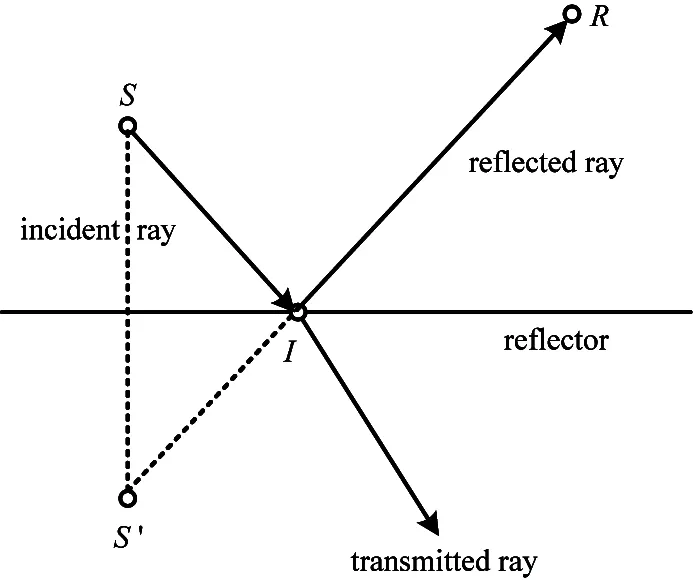
Fig.1 Illustration of image method
A simplified diffraction model is illustrated in Fig.2. When the ray hits the corner of an obstacle, no matter what incidence angle is, diffracted rays will be generated to all directions around the obstacle[7].
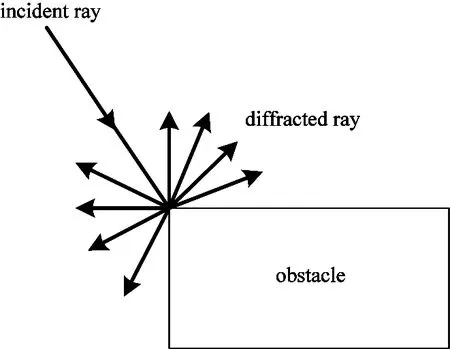
Fig.2 Illustration of diffraction model
Applying the above methods, all of the rays connecting the transmitter and the receiver can be constructed for an indoor environment. In order to find all valid propagation paths, rays are launched from the transmitter in all directions. For a quantitative analysis of the reception, propagation attenuation and delay of every ray are required.
1.2 Ray tracing algorithm
For investigations a simplified two-dimension (2D) ray tracing algorithm is used which is capable of simulating the wave propagation taking account of reflections, transmissions and diffractions. The ray tracing algorithm operates on a 2D model of the propagation environment described by numerous rectangles and each of them is related with its dimensions. By specifying the coordinates of the transmitter and the receiver, the sequence of computations begins with the direct path if it exists, followed by all paths with one propagation, two interactions, and so on, up to five reflections, one transmission and two diffractions. For every path, the distance dependent path loss is simply the free space propagation loss which is proportional to the total length squared. The total path loss is computed as the product of the free space propagation loss timing the reflection, transmission, and diffraction losses[8]. The antenna radiation patterns are not considered temporally.
The flow chart of the 2D ray tracing algorithm is shown in Fig.3. Two termination conditions are set: the maximum number of allowed reflections Nref, transmissions Ntrans, and diffractions Ndiff, the power threshold T.
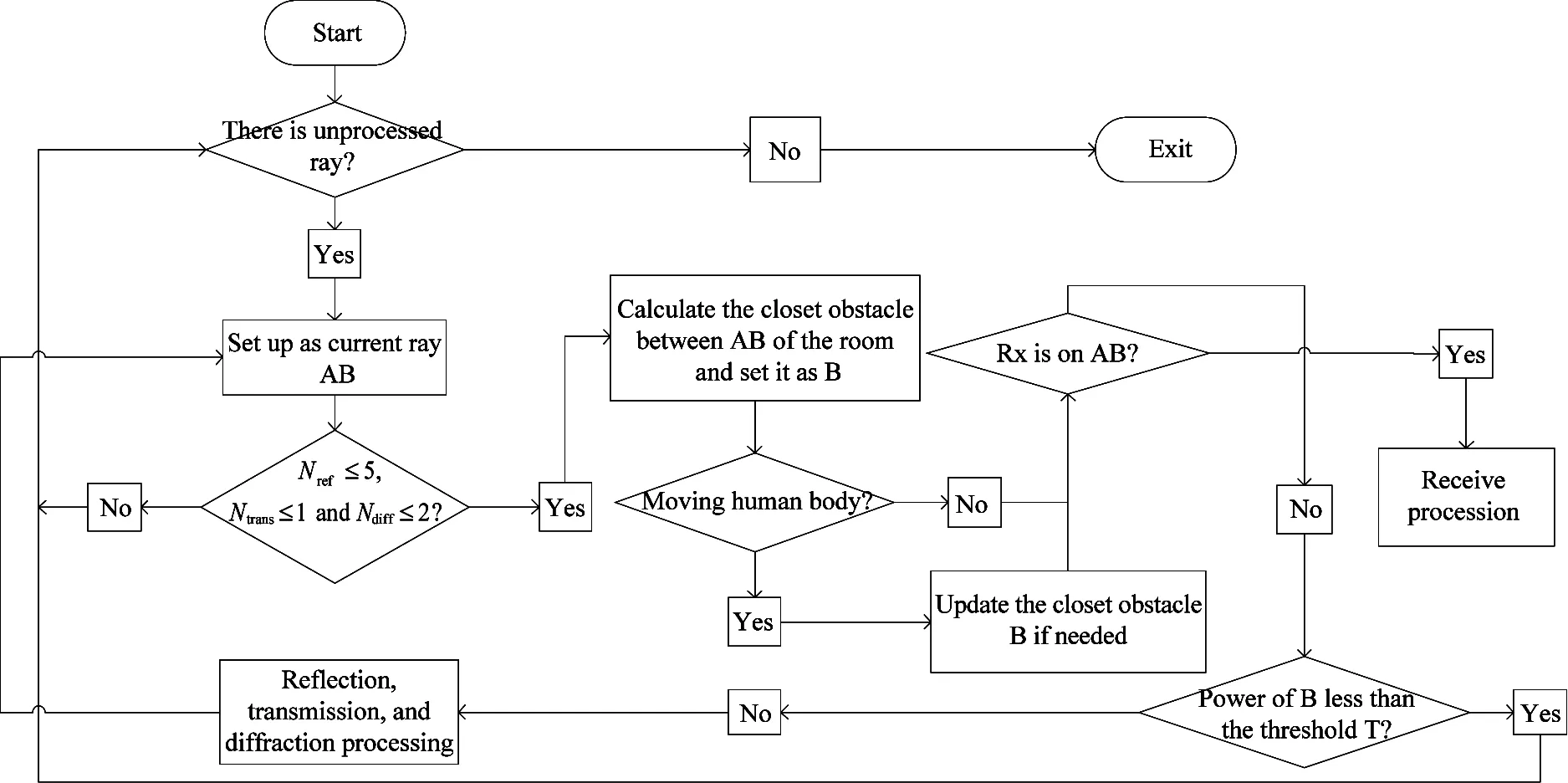
Fig.3 Simplified 2D ray tracing algorithm
2 Propagation environment and human motion model
2.1 Propagation environment
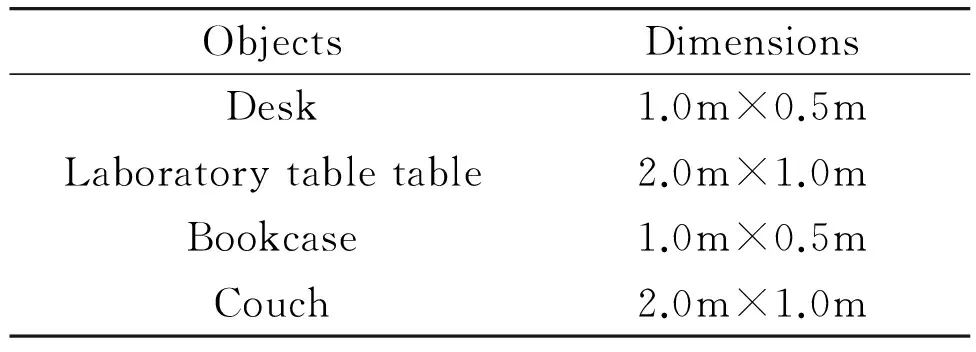
The floor plan of the propagation environment is depicted in Fig.4. It is an office room located on the fourth floor of our institute building. The dimensions of the office are 8.0m length and 4.0m width. The walls of the room are made of concrete. There are a glass window and a glass door between the outer room and the inner room. The outer room is provided with six desks, one laboratory table, and a wooden door towards the corridor, while the inner room is furnished with two desks, two bookcases, and one couch. The outer door as well as the inner door is 1.0m width and the glass window is 3.0m width. The dimensions of others objects are summarized in Table 1.
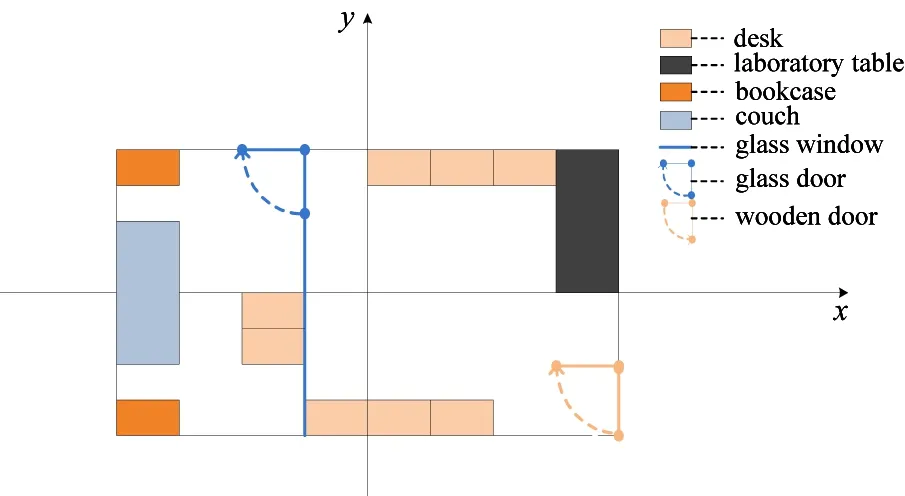
Fig.4 Floor plan of the office room
ObjectsDimensionsDesk1.0m×0.5mLaboratorytabletable2.0m×1.0mBookcase1.0m×0.5mCouch2.0m×1.0m

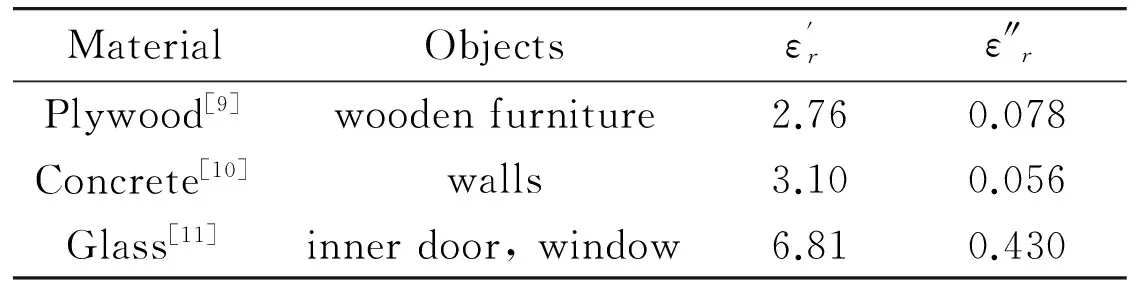
Table 2 Dielectric properties of objects
2.2 Human motion model
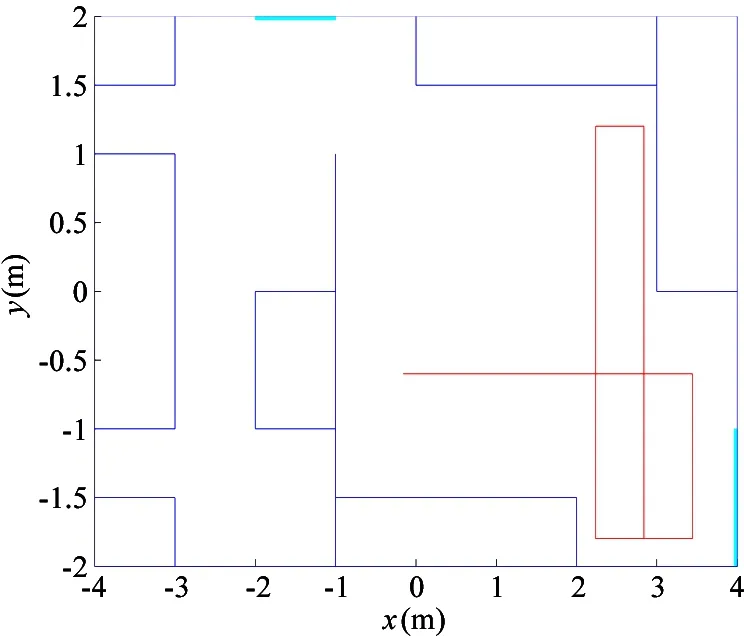
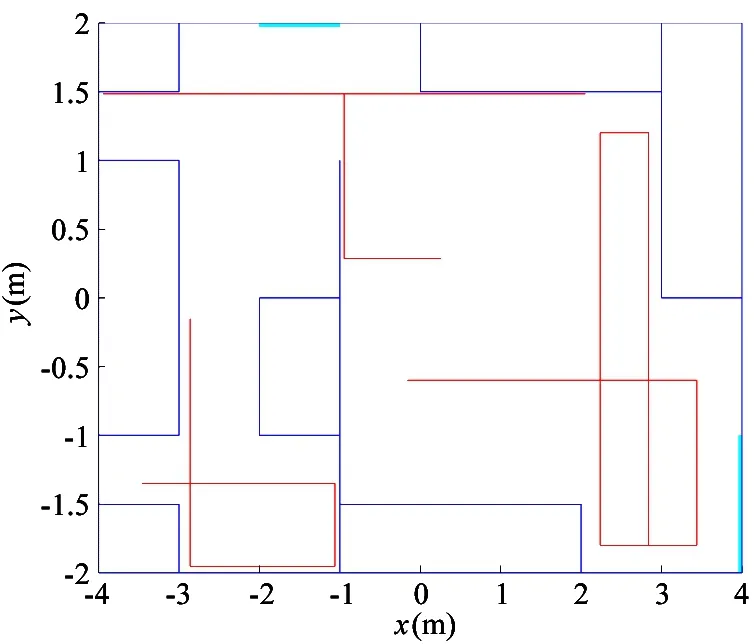
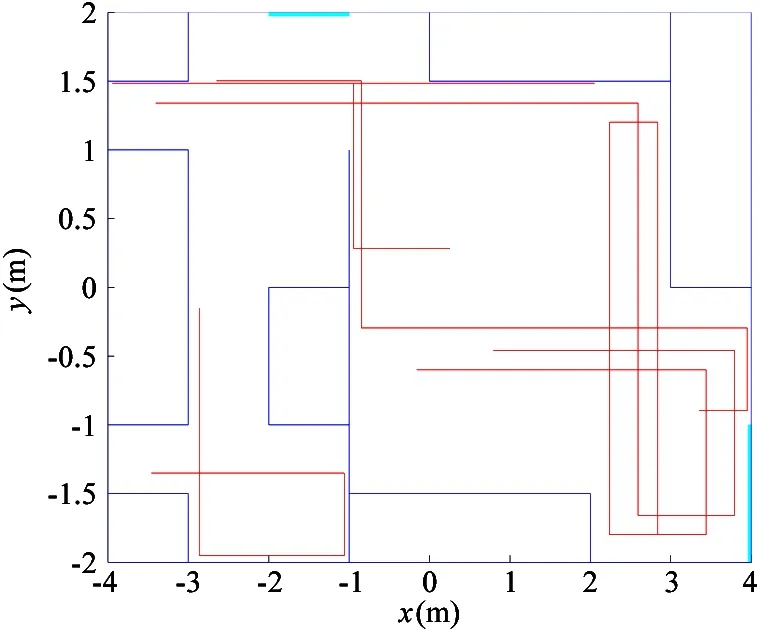
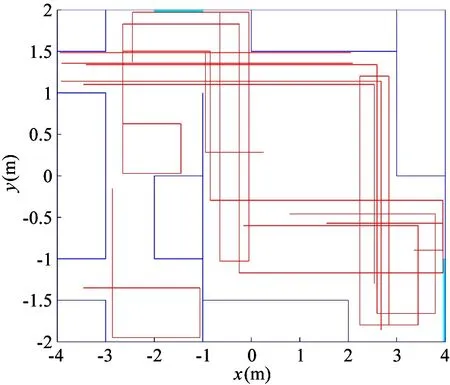
A 2D human body model is needed to be in accordance with the 2D ray tracing algorithm described in the above section. So a rectangle with the dimension of 0.3m×0.3m is used to represent the human body which can be considered as a common scatterer like other obstacles except that it is not static. Certainly, the modeling of human motion is the key to the validity and expansibility of the analysis on the human body movement effects to indoor propagations. In Ref.[12], the human motion is modeled as a random walk process which consists of a succession of random steps. It is modeled as a Markov chain that the next step is totally independent of the past trail. Unfortunately, the random walk model is not accurate enough because human body has a movement tendency, even time varying, in the walking process. In order to reproduce the movement of human body as realistic as possible, a modified random walk model is proposed as follows. Four simulation examples are presented in Fig.5, each corresponding to one, three, five, and ten moving bodies in the room.
(a) one moving body
(b) three moving bodies
(c) five moving bodies
(d) ten moving bodies
Step 1 Choose a valid point as the starting position randomly and set Count=0.
Step 2 Select a direction (forward, backward, left, or right) for the next step in random and set Count=Count+1.
Step 3 Determine whether the selected direction is valid for the next step. If so, go on to Step 4, otherwise, go back to Step 2 as long as Count 4.
Step 4 Try to keep the movement tendency based on
the last two positions. If fails, try to turn left or turn right with an equal probability. If it fails again, try the opposed direction (left or right). If it still doesn’t work, turn around and step backwards.
Step 5 Loop Step 4 until reaching the specified number of steps.
3 Simulation results and analysis
The reference system as indicated in Fig.4 is used for ray tracing. The outer door is kept to be closed, while the inner door is assumed to be open during the ray tracing process. As shown in Fig.3, the maximum number of transmissions is limited to one, which means that only the transmission through the glass window and glass door needs to be calculated. Based on the propagation environment model and the modified random walk model, parameters used for simulation are summarized below in Table 3. The simulation tools used are Microsoft Visual Studio 2008 and Matlab 7.10.0 (R2010a).
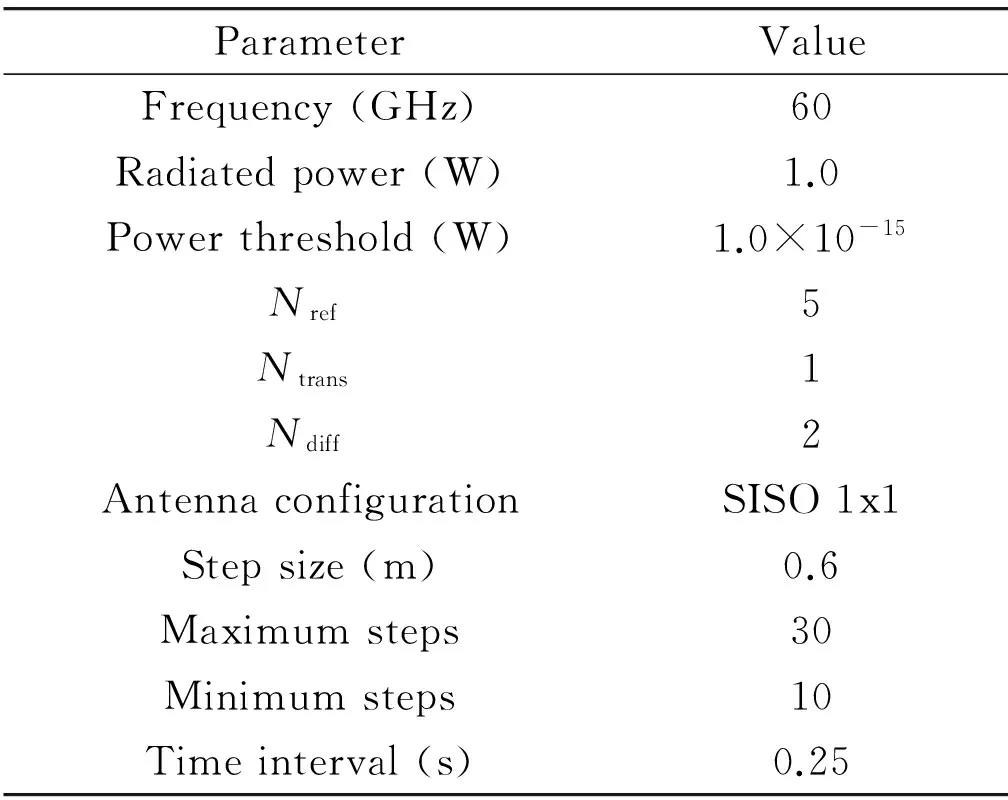
Table 3 Simulation parameters
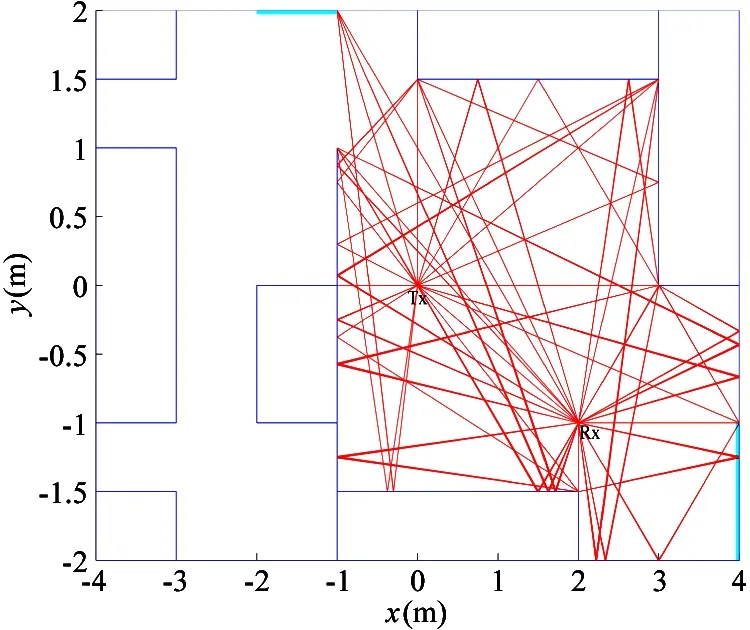
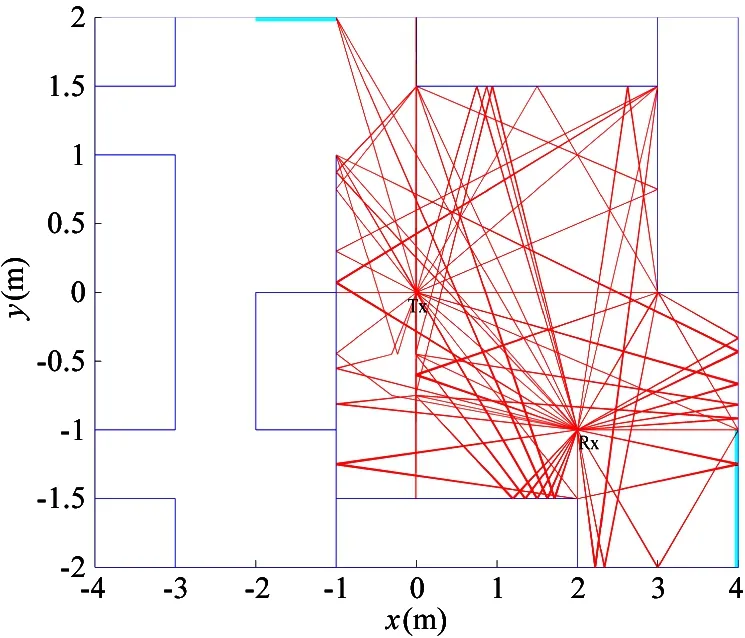
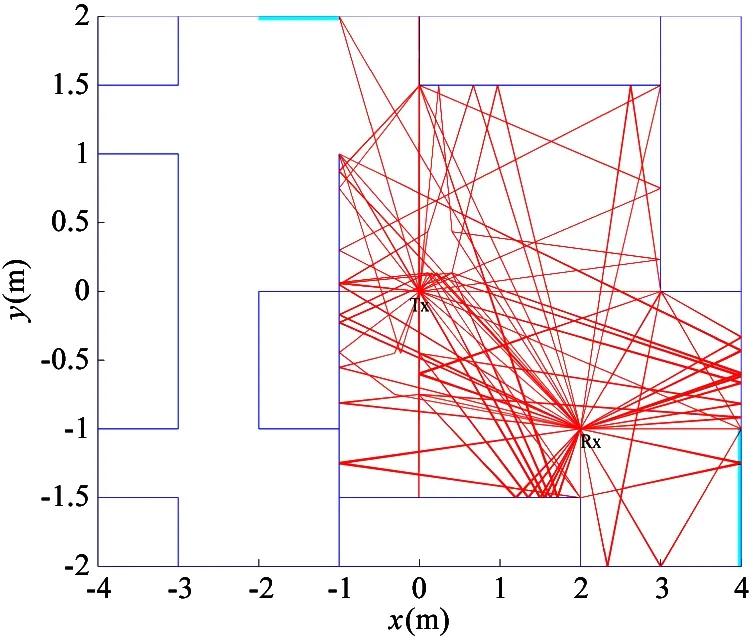
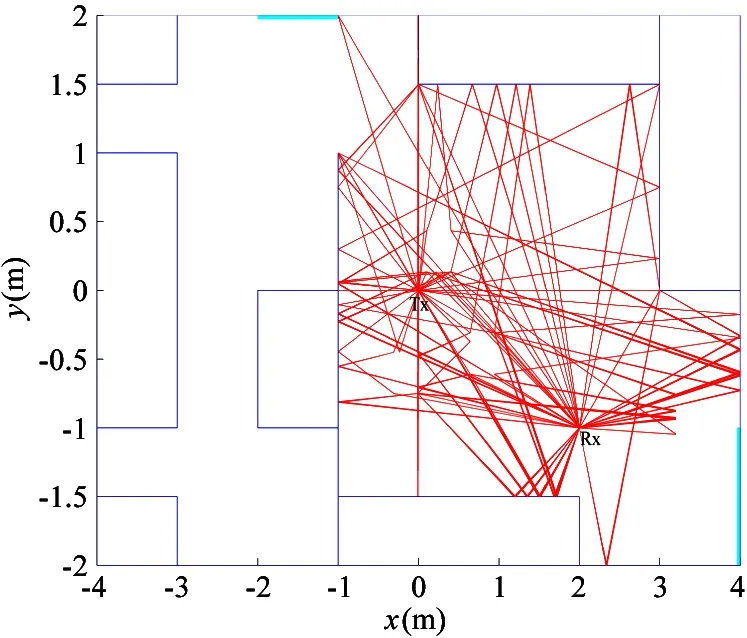
Transmitter Tx is located at the origin coordinate of the reference system, and the coordinate value of (2.0, -1.0) is chosen as the receiver. It is assumed that both of them are equipped with omnidirectional antennas. Fig.6 shows the ray tracing results between the transmitter and the receiver under the constraints of Nref≤1, Ntrans=0 and Ndiff≤1 at a certain time instant. The multipath disturbance due to the human body movement can be seen from these figures intuitively.
(a) no moving bodies
(b) one moving body
(c) three moving bodies
(d) five moving bodies
Simulation is taken with regular time intervals, which makes it possible to compute the positions of the human bodies again and make a new calculation of the parameters of the channel. To investigate the human motion effects on the path gains of different positions, the office room is gridded into a group of squares each with the dimension of 0.1m×0.1m. The path gain of the central point of the square can be used to approximately represent the transmission loss inside it. Especially, the power threshold 1.0×10⁻¹⁵W is used to represent the path gain inside the scatterer.
Fig.7 shows the simulation result when there is no human motion, i.e., in a static condition. It can be seen that the path gain varies from -40dB to -150dB. Most parts of the office go through a 100dB path loss, while the path gain around the transmitter is roughly -50dB. Furthermore, the path gain distributions under the human motion effects are presented in Figs8,9,10, and 11, each corresponding to the simulated walking trails in Fig.5. As shown in Fig.8, there
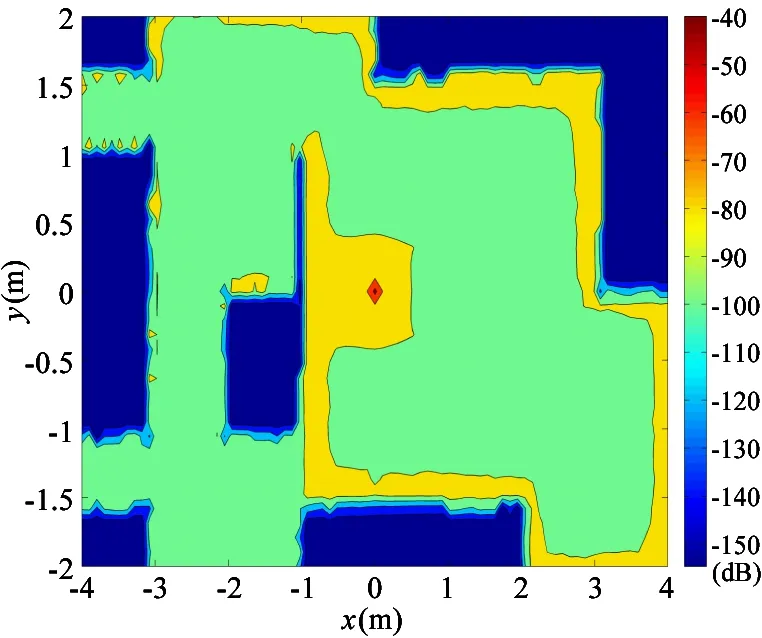
Fig.7 Path gain prediction without human motion
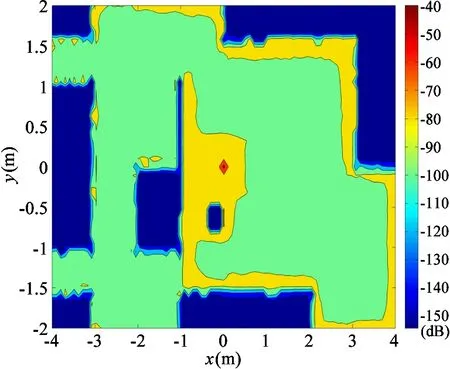
Fig.8 Path gain prediction with one moving body
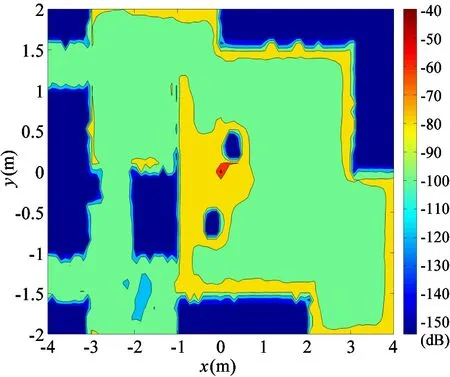
Fig.9 Path gain prediction with three moving bodies
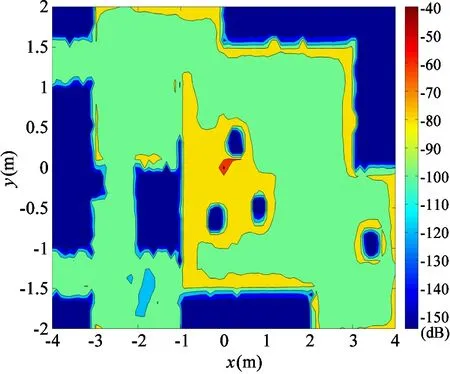
Fig.10 Path gain prediction with five moving bodies
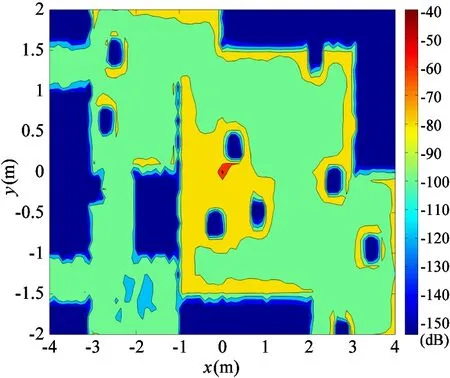
Fig.11 Path gain prediction with ten moving bodies
is just a little affection to the path loss when there is only one moving person. However, the path loss of the bottom right corner of the inner room degrades to 120dB more or less if there are three moving persons, which can be seen from Fig.9. It is mainly caused by the moving person in the inner room and the deep path loss area becomes larger as the number of moving persons increases in the inner room. Moreover, it is worth pointing that, in Fig.10 and Fig.11, a triangle area is formed by the three bodies around the transmitter and it increases the path gains inside the area.
4 Conclusions
In this work, it has investigated the human motion effects on the 60GHz indoor office propagation by adopting a modified random walk model which takes account of the movement tendency. Based on the modified random walk model and the 2D ray tracing algorithm, path gain distributions are simulated under the assumptions of different number of moving bodies. The simulation results and analysis show that the movement of human bodies results in multipath disturbances and causes deep path losses in some areas. It is one of the main factors that can significantly degrade the transmission quality in a realistic indoor environment and it may frequently occur because of people walking around from time to time.
[ 1] Park C, Rappaport T S. Short-range wireless communications for next-generation networks: UWB, 60GHz millimeter-wave WPAN, and ZigBee. IEEE Wireless Commun. Mag, 2007, 14(4): 70-78
[ 2] Cassioli D. 60GHz UWB channel measurement and model. In: Proceedings of the IEEE International Conference on Ultra-Wideband (ICUWB), Syracuse, NY, 2012. 145-149
[ 3] Moraitis N, Constantinou P. Indoor channel measurements and characterization at 60 GHz for wireless local area network applications. IEEE Trans Antennas Propag, 2004, 52(12): 3180-3189
[ 4] Peter W K M, Keusgen W, Felbecker R. Measurement and ray-tracing simulation of the 60 GHz indoor broadband channel: model accuracy and parameterization. In: Proceedings of the 2nd European Conference on Antennas and Propagation, Edinburgh, UK, 2007. 1-8
[ 5] Rama R T, Murugesan D, Tiwari N, et al. 60 GHz radio wave propagation studies in an indoor office environment. In: Proceedings of the IEEE International Conference on Communication Systems (ICCS), Singapore, 2012. 181-185
[ 6] Khafaji A, Saadane R, Abbadi J E, et al. Ray tracing technique based 60 GHz band propagation modeling and influence of people shadowing. International Journal of Electrical, Computer, and Systems Engineering. 2008, 2(2): 102-108
[ 7] Kouyoumjian R G, Pathak P H. A uniform geometrical theory of diffraction for an edge in a perfectly conducting surface. Proceedings of the IEEE. 1974, 62(11): 1448-1461
[ 8] Wang Y, Lu W J, Zhu H B. An empirical path-loss model for wireless channels in indoor short-range office environment. International Journal of Antennas and Propagation. 2012, 123(1): 1-12
[ 9] Pugliese J P, Hammoudeh A, Al-Nuaimi M O. Reflection and transmission characteristics of building materials at 62 GHz. In: Proceedings of the IEE Colloquium on Radio Communications at Microwave and Millimeter Wave Frequencies, London, UK, 1996. 6/1-6/6
[10] Sato K, Kozima H, Masuzawa H, et al. Measurements of reflection characteristics and refractive indices of interior construction materials in millimeter-wave bands. In: Proceedings of the 45th IEEE Vehicular Technology Conference, Chicago, USA, 1995. 449-453
[11] Sato K, Manabe T, Ihara T, et al. Measurements of reflection and transmission characteristics of interior structures of office building in the 60-GHz band. In: Proceedings of the 7th IEEE International Symposium on Personal, Indoor and Mobile Radio Communications, Taipei, China, 1996. 14-18
[12] Islam, Jakirul M. Investigation of the effect of human motion on indoor radio signal propagation. In: Proceedings of the 2nd International Conference on Power and VLSI Engineering, Kuala Lumpur, Malaysia, 2013. 31-35
Zhao Junhui, received his Ph.D. degree in National Mobile Communications Research Laboratory of Southeast University in 2004. Now he is a professor and Ph.D. supervisor at School of Electronic and Information Engineering of Beijing Jiaotong University. His main research interests include wireless location, channel modeling, cooperative communication and cognitive radio.
10.3772/j.issn.1006-6748.2015.04.011
①Supported by the National Natural Science Foundation of China (61172073), Program for New Century Excellent Talents of the Ministry of Education (NCET-12-0766), the Open Research Fund of National Mobile Communications Research Laboratory, Southeast University (2012D19), and the Fundamental Research Funds for the Central Universities (2013JBZ001).
②To whom correspondence should be addressed. E-mail: junhuizhao@bjtu.edu.cn Received on June 25, 2014***, Liu Xu*
 High Technology Letters2015年4期
- High Technology Letters的其它文章
- Effect of laser heating on the microstructure and hardness of TRIP590 advanced high strength steel used for roll forming①
- Design of bilayer lengthened LDPC codes over expanded graph for relay channels①
- Secure planar convex hull protocol for large-scaled point sets in semi-honest model①
- Magnetometer calibration algorithm based on ellipsoid constraint①
- Motion mechanism analysis of two contacting rollers①
- Service optimization in programmable cloud network①