
Performance of Epoxy-Repaired Corroded Reinforced Concrere Beams
2015-02-09 06:09:01LiHongming李洪明WuJin吳瑾WangZhe王喆ShangBaokang尚保康
Li Hongming(李洪明),Wu Jin(吳瑾),Wang Zhe(王喆),Shang Baokang(尚保康)
College of Aerospace Engineering,Nanjing University of Aeronautics and Astronautics,Nanjing 210016,P.R.China
(Received 18 November 2014;revised 2 January 2015;accepted 12 January 2015)
Performance of Epoxy-Repaired Corroded Reinforced Concrere Beams
Li Hongming(李洪明),Wu Jin(吳瑾),Wang Zhe(王喆)*,Shang Baokang(尚保康)
College of Aerospace Engineering,Nanjing University of Aeronautics and Astronautics,Nanjing 210016,P.R.China
(Received 18 November 2014;revised 2 January 2015;accepted 12 January 2015)
Absrracr:Reinforcement corrosion has a serious impact on the durability and safety of reinforced concrete structures.Six reinforced concrete(RC)beam specimens are constructed.After beam specimens are subjected to accelerated corrosion with the constant current,beam specimens are repaired with epoxy mortar and the flexural test of beams is investigated.Then the behaviors of repaired corroded reinforced concrete beams are evaluated.The experimental results show that cracking and ultimate loads of corroded RC beams are enhanced after being repaired. And the strain distributions measured across sections of beam specimens still obey the assumption of plane section. After being repaired,the number of cracks decreases and the crack spacing increases.
corrosion;reinforced concrete beam;epoxy mortar;flexural behavior;repair
0 Inrroducrion
Reinforcement corrosion leads to the insufficient durability of concrete structures,so it is a problem commonly concerned around the world. The subsequent reduction in the useful service-life of concrete structures has been reported from many parts of the world.Once the corrosion process initiated,repair,with which construction costs can be reduced,is one of the most important means in prolonging the life span of structures.
Corrosion of steel reinforcement with its associated cracking is one of the most severe forms of concrete deterioration.It affects not only concrete durability,but also the load-bearing capacity of the structural element[1].A study to evaluate the effect of two rebar cleaning procedures and repair materials on reinforcement corrosion and flexural strength of repaired concrete beams was conducted[2].
The repair techniques for the corroded reinforced concrete(RC)beams have been addressed by many researchers.Elena Redaelli et al.[3]presented a state-of-the-art on the techniques of electrochemical realkalisation and cathodic protection used in carbonated concrete.The subject of steel corrosion and corrosion protection in repaired concrete structures is discussed[4].D J Cleland et al.[5]discussed how the repair materials influence the resistance to corrosion of reinforcement at the interface between the repair materials.Patch repair consists of removal of the damaged concrete,cleaning of rust,and restitution of the original geometry with a patch material. Patch repair is one of the most common concrete repair technologies,especially when a localized corrosion occurs[6].The use of epoxy resins is becoming the most common method of concrete repair and rehabilitation.The performance of epoxy-repaired concrete in a marine environment has been investigated[7].Through measuring and comparing the macro-current between steel bars,the performance of corrosion-resistance in different regions of repaired beams was investigated[8]. Half-cell potential map was adopted to observe the corrosion phenomenon of repaired reinforced concrete[9].
Khaled[10]examined the viability of using fi-ber reinforced polymer(FRP)composites as a repair and strengthening method for corroded reinforced concrete structures.The results revealed that FRP repair successfully confined the corrosion cracking and improved the structural performance of corroded beams.Omrane et al.[11]summarized the results of experimental studies on damaged reinforced concrete beams repaired by external bonding of carbon fiber reinforced polymer(CFRP)composite laminates to the tensile face of the beam.The results indicate that the load capacity and the rigidity of repaired beams were significantly higher than those of control beams for all tested damage degrees.
Till now very limited information is available on the study of the performance of repaired corroded reinforced concrete beams from the point of different corrosion levels of reinforcement. The objective is to study the performance of corroded beam specimens repaired with epoxy mortar in this paper.After fulfilling of the designed corrosion levels,the repaired beam specimens are tested in four-point bending.Then the performance of the tested beam specimens is analyzed.
1 Experimenral Program
1.1 Specimens
All test specimens are rectangular cross section of b×h=80 mm×160 mm,and the length of the beams is 1 500 mm,and the clear span is 1 200 mm.All beams are designed to fail in bending by providing two 10 mm diameter deformed bars as longitudinal flexural rebars.Two top 6.5 mm diameter plain bars are used as stirrup-holders in the compression zone.6.5 mm diameter plain bars are also served as the shear rebar.The thickness of concrete cover is 25 mm.The beam details are shown in Fig.1.The test specimens fall into two groups.The first,corroded unrepaired group included three specimens B2,B4,B6 corrodes to three different corrosion levels of 3%,9%,15%,respectively.The second,corroded repaired group included three specimens B1,B3,B5 corrodes to three different corrosion levels of 3%,9%,15%,respectively.

Fig.1 Details of test beams
1.2 Marerial properries
Ordinary Portland cement with a 28 d compressive strength of 42.5 MPa is used for the specimens.The fine aggregate used is river sand. And coarse aggregate with maximum aggregate size of 20 mm are used in the concrete mixture. The concrete mixture proportion is cement,i.e.,water:sand:gravel=1:0.52:2.02:3.59. The 10 mm diameter deformed bar has average yield strength of 331.6 MPa.The concrete is made in laboratory with target 28 d compressive strength of 30 MPa.The measured compressive strength of cubic concrete with the size of 150 mm×150 mm×150 mm is 40.6 MPa.
1.3 Accelerared corrosion of RC beams
To induce corrosion damage within test specimens in a reasonable amount of time,an accelerated corrosion technique[12]is used.After the 28 d curing of the test specimens,the test beams are partially immersed in 5%NaCl solution in a tank.The longitudinal tensile bars are connected to the positive terminal of an external power supply to act as an anode while the copper plate is connected to the negative terminal of the power supply to act as a cathode,as shown in Fig.2.Di-rect current(DC)power source is used to obtain the constant current density.In order to save time,the current density is chosen as 2 m A/cm2. The desired level of rebar corrosion is obtained by applying the anodic current for the time period calculated according to Faraday's law.The predicted and measured level of rebar corrosion is shown in Table 1.The measured level of rebar corrosion is obtained by the experimental test,and the corrosion level is referred to weight loss factor of the rebar.
Based on Table 1,the measured level of rebar corrosion is close to the predicted one,which means that the result is available.
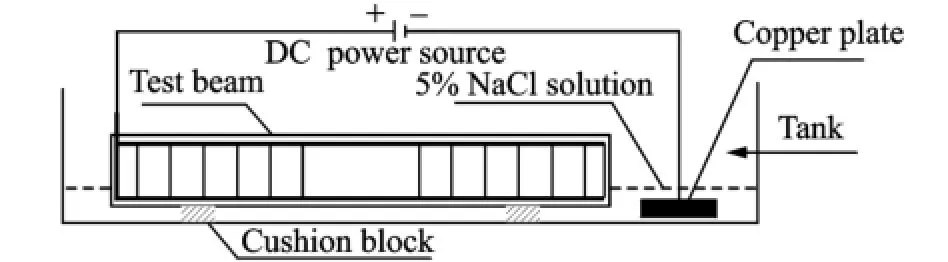
Fig.2 Corrosion set-up
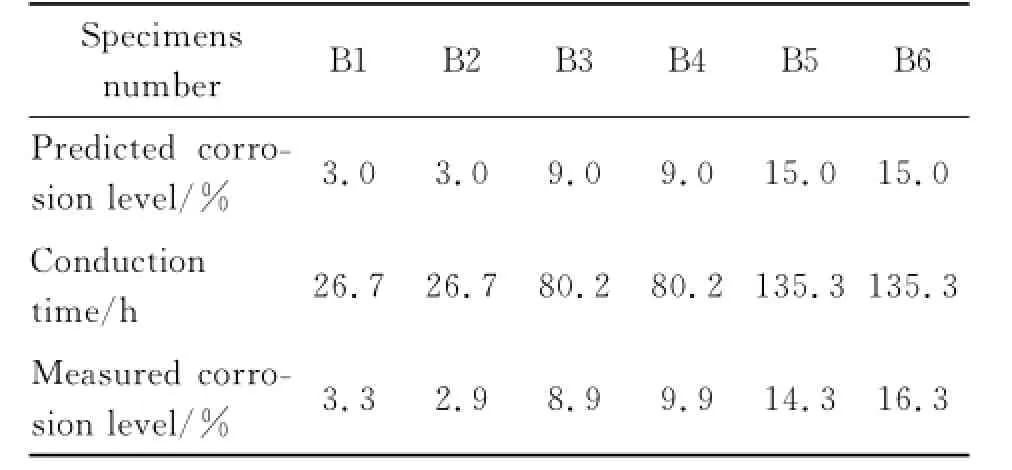
Table 1 Predicred and measured corrosion level of rebar
1.4 Specimens repair
In this paper,the epoxy mortar is used to repair corroded beams and its proportions is resin:ethylenediamine:dibutyl butylphosphonate:cement:sand=1.0:0.16:0.15:2.0:4.0.After cured,it has tensile strength of 10 N/mm2(7 d)and a compressive strength of 50 MPa. When the corrosion of RC beams is completed,a 30 mm depth concrete from the bottom of the beam is removed using a concrete chisel and hammer.Before daubing with the epoxy mortar,the surface of the concrete should be dry and clean,and the rust should be eliminated completely.After that,the surface of the concrete is brushed with epoxy base fluid,of which the thickness should not be more than 1 mm.When daubing with epoxy mortar,the daubing thickness of epoxy mortar should be 10 mm once time. Moreover,in order to make the concrete surface bond firmly with the epoxy mortar,the epoxy mortar need to be slapped more than once during daubing.The process of the repair is shown in Fig.3.
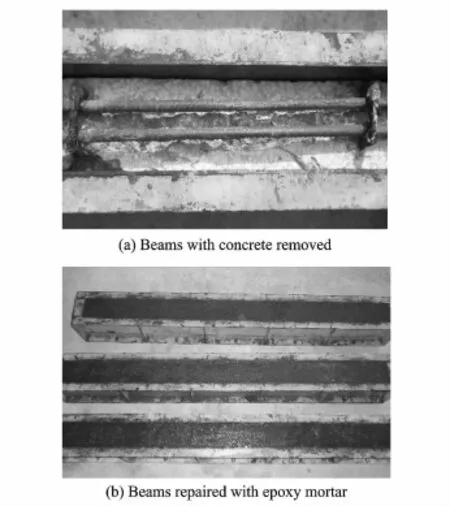
Fig.3 Repair of test beams
1.5 Loading resr
The specimens are tested after 7 d for curing.The loading is applied in four-point bending with a clear span of 1 200 mm and a shear span of 400 mm.Loads,mid-span deflections,and concrete strains of beams are measured during loading.Five linear variable displacement transducers(LVDTs)with a range capacity of 100 mm are used to measure the mid-span deflections of the beam specimens during testing.And five electrical strain gauges(60 mm long)are used to measure the concrete strain over the depth of beams at the midspan.All specimens are tested to failure. The test set-up is shown in Fig.4.
2 Tesr resulrs
2.1 Failure parrern
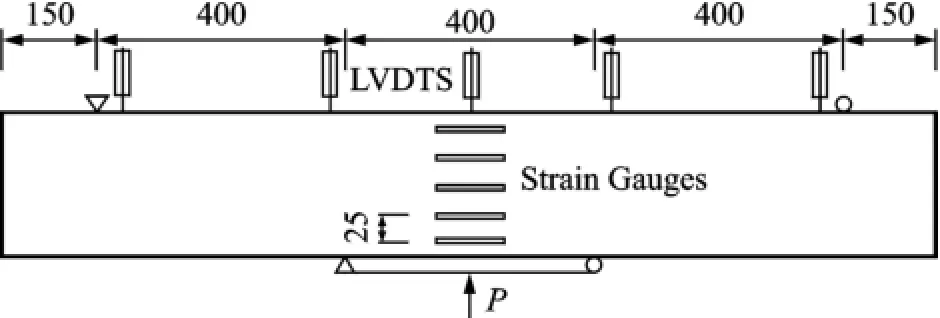
Fig.4 Test set-up
All the six repaired and unrepaired beam specimens fail due to rebar yielding.Fig.5 shows photographs of the failure patterns of beam specimens with different corrosion levels of steel rebar.And with an increasing magnitude of the load,flexural cracks occur in the center of the span.Corrosion cracks are observed on all unrepaired corroded specimens before testing,each extending parallelly to the length of the specimens(see Fig.5 B2,B4,B6).The width of corrosion cracks increases with the increase of the corrosion.
Compared with the two beam specimens with the same levels of corrosion,the number of cracks of repaired beam specimens is less than that of unrepaired ones,whereas the crack spacing of repaired beam specimen is larger than that of unrepaired ones.Meanwhile,the flexural cracks of repaired specimens first appear at the loading point.The tensile strength of epoxy mortar is high,but its disadvantage is that it is one kind of brittle materials.Compared with the unrepaired beams,the ductility of repaired specimens may be worse than that of the unrepaired specimens.
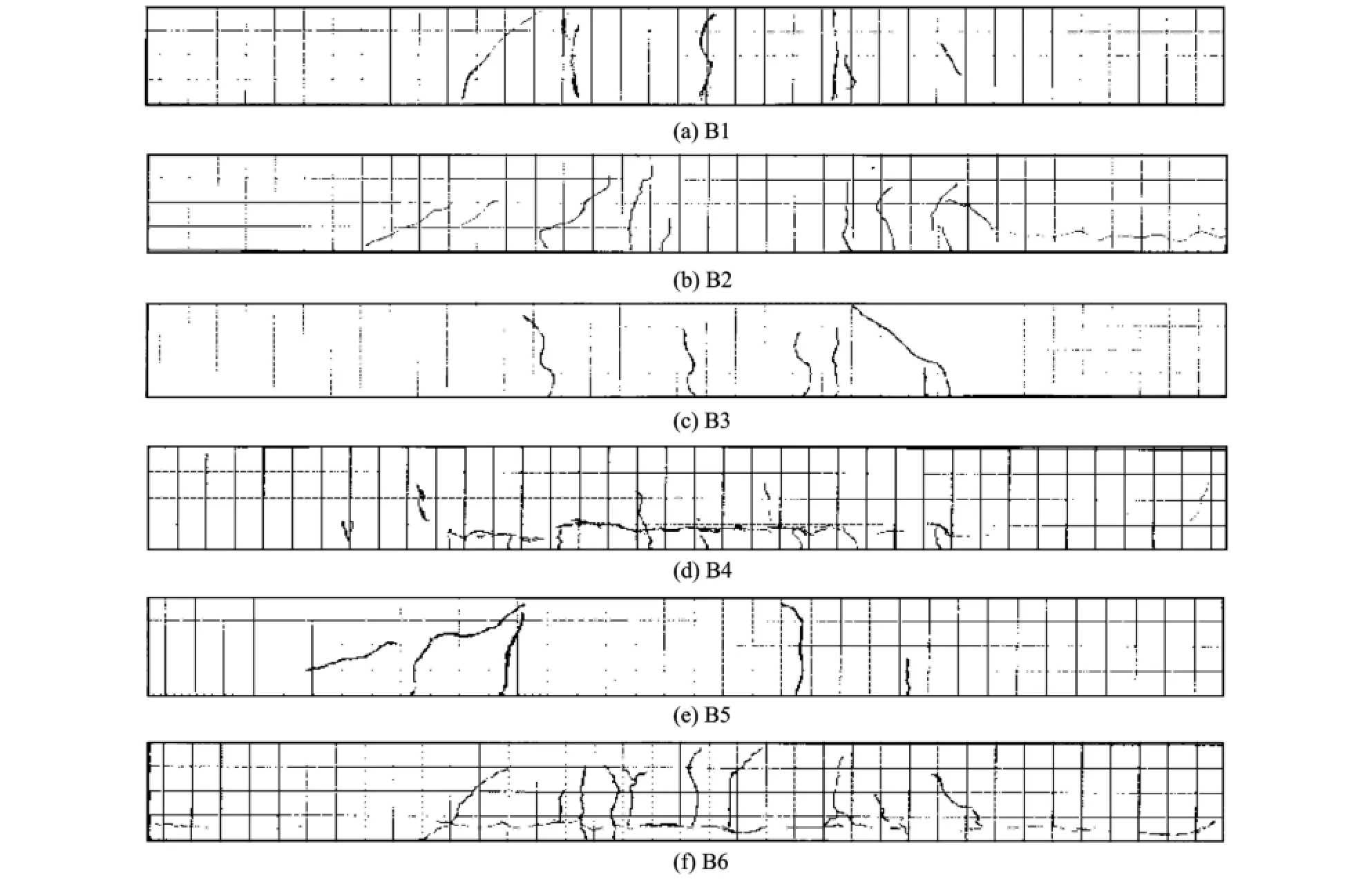
Fig.5 Failure patterns of RC beams with corroded rebar
2.2 Concrere srrain disrriburion ar mid-span of beam specimens
Fig.6 shows the distribution of the concrete strain at the mid-span under a load of 20 k N versus the distance to the bottom of the beam specimens.It can be found that the section strain distribution for both repaired and unrepaired beams still obeys plane section assumption.
2.3 Beam deflecrions
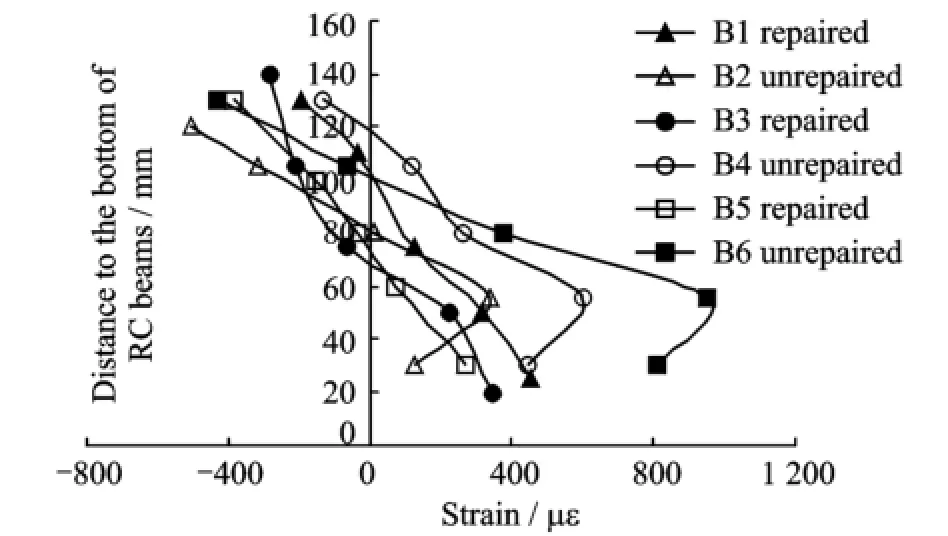
Fig.6 Strain distribution of beam specimens under 20 k N
Fig.7 shows mid-span deflections of beam specimens.The unrepaired beam specimens show almost similar stiffness.It is shown that all beams have similar initial stiffness.After the cracking load,however,the stiffness of the repaired beams is larger than that of the unrepaired beams.As a result,the deflections of the repaired beams are smaller than that of the unrepaired beams.It can be attributed to the section loss,which is the result of the damaged concrete cover being separated from the specimen,as the load increasing for the unrepaired beams.For the repaired beams,however,the bond between epoxy mortar and old concrete remains to be perfect during the whole loading procedure.
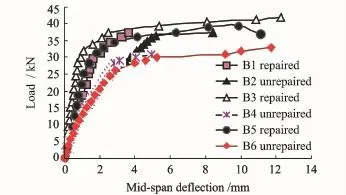
Fig.7 Load-deflection curves of beam specimens
2.4 Cracking and ulrimare loads
The initial cracking loads of beam specimens are shown in Table 2.The cracking loads of all repaired beams are larger than that of unrepaired beams.It can be seen that cracking loads of the specimens B2,B4 and B6 decrease as the levels of rebar corrosion increase.But cracking loads of the specimens B1,B3 and B5 are close to each other.This is because the tensile strength of epoxy mortar is high,whereas the tensile strength of concrete is low.
Fig.8 shows the ultimate loads of all the beam specimens.It could be observed that all the repaired beams in this paper are capable of restoring the ultimate capacity of the corroded beams.
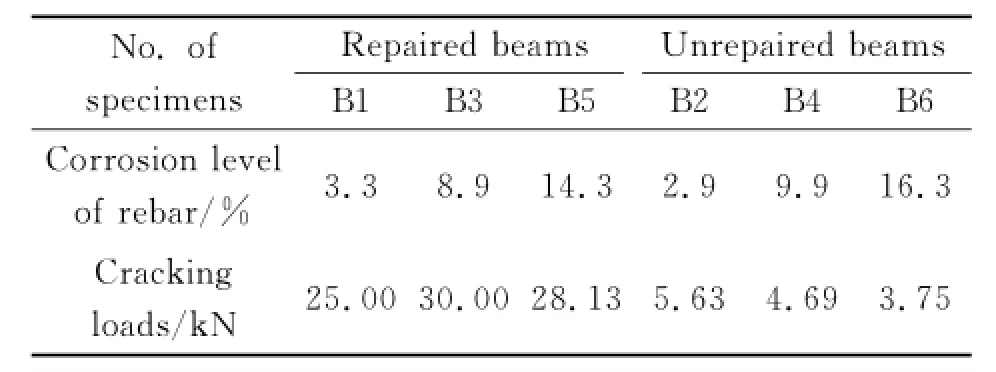
Table 2 Cracking loads of beam specimens wirh differenr corrosion levels
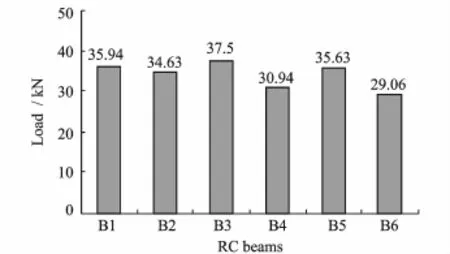
Fig.8 Ultimate loads for beams B1—B6
The ultimate capacity of repaired beams B1,B3 and B5 is higher than that of unrepaired beams.With the levels of rebar corrosion increasing,the ultimate capacity of unrepaired beams decreases.In Fig.8,it can be seen that the ultimate capacity of repaired specimen B3 is the highest,which indicates that the maximum increase in ultimate capacity occurred at the corrosion level of steel rebar of approximately 9%.It may be interpreted that corrosion level of steel rebar of approximately 9%is moderate and the bond behavior between epoxy mortar and the steel bar with this corrosion level actually is strengthened. What's more,the tensile strength of epoxy mortar cannot be neglected.
3 Conclusions
The test results on the structural performance of unrepaired and repaired corroded RC beams is presented in this paper.Based on the results it can be concluded that:
(1)The failure patterns of beam specimens with corroded rebar are similar.With the level of rebar corrosion increasing,the number of cracks increases and the crack spacing decrease in unrepaired beams.But in repaired beams,the number of cracks decreases and the crack spacing increases compared with the unrepaired beams.
(2)The bond between epoxy mortar and old concrete remains to be perfect during the whole loading procedure,and the beam section strain still obeys plane section assumption for both repaired and unrepaired beams.The deflections of the repaired beams are smaller than that of the unrepaired beams.
(3)The cracking loads of all repaired beams are larger than that of unrepaired beams.With the level of rebar corrosion increasing,the ultimate capacity of the unrepaired beams decreases. For the repaired beams,the maximum increase in ultimate capacity occurred at the corrosion level of steel rebar of approximately 9%.
Acknowledgemenr
This work was supported by the Program for the Transport Science&Technology Project of Jiangsu Province.
[1] Alonso C,Andrade C,Rodríguez J,et al.Factors controlling cracking of concrete affected by reinforced corrosion[J].Material and Structures,1998,31:435-441.
[2] Al-Dulaijan S U,Al-Zahrani M M,Saricimen H,et al.Effect of rebar cleanliness and repair materials on reinforcement corrosion and flexural strength of repaired concrete beams[J].Cement&Concrete Composites,2002,24:139-149.
[3] Redaelli E,Carsana M,Gastaldi M,et al.Electrochemical techniques for the repair of reinforced concrete suffering carbonation-induced corrosion[J]. Corrosion Reviews,2011,29(5/6):179-190.
[4] Vaysburd A M,Emmons P H.How to make today's repairs durable for tomorrow—corrosion protection in concrete repair[J].Construction and Building Materials,2000,14(4):189-197.
[5] Cleland D J,Yeoh K M,Long A E.Corrosion of reinforcement in concrete repair[J].Construction and Building Materials,1997,11(4):233-238.
[6] Emberson N K,Mays G C.Significance of property mismatch in the patch repair of structural concrete. Part 3:Reinforced concrete members on flexure[J]. Magazine of Concrete Research,1996,48(174):45-57.
[7] Moetaz El-Hawary,Husain Al-Khaiat,Sami Fereig. Performance of epoxy-repaired concrete in a marine environment[J].Cement and Concrete Research,2000,30:259-266.
[8] Ribeiro J L S,Panossian Z,Selmo S M S,et al.Proposed criterion to assess the electrochemical behavior of carbon steel reinforcements under corrosion in carbonated concrete structures after patch repairs[J]. Construction and Building Materials,2013(40):40-49.
[9] Farid M M.Investigation of corrosion damage and repair system in a concrete jetty structure[J].Journal of Composites for Construction,2010,24(4):294-301.
[10]Khaled A S.FRP repair of corrosion-damaged concrete beams-waterloo experience[J].Advances in Engineering Structures,Mechanics&Construction,2006,140:165-173.
[11]Omrane Benjeddou,Mongi Ben Ouezdou,Aouicha Bedday.Damaged RC beams repaired by bonding of CFRP laminates[J].Construction and Building Materials,2007,21(6):1301-1310.
[12]Yuan Yingshu,Zhang Xinsen,Ji Yongsheng.A comparative study on structural behavior of deteriorated reinforced concrete beams under two different environments[J].China Civil Engineering Journal,2006,39(3):42-46.(in Chinese)
(Executive Editor:Xu Chengting)
TU317Documenr code:AArricle ID:1005-1120(2015)05-0579-06
*Corresponding aurhor:Wang Zhe,Associate Professor,E-mail:wangzyy@nuaa.edu.cn.
How ro cire rhis arricle:Li Hongming,Wu Jin,Wang Zhe,et al.Performance of epoxy-repaired corroded reinforced concrete beams[J].Trans.Nanjing U.Aero.Astro.,2015,32(5):579-584.
http://dx.doi.org/10.16356/j.1005-1120.2015.05.579
 Transactions of Nanjing University of Aeronautics and Astronautics2015年5期
- Transactions of Nanjing University of Aeronautics and Astronautics的其它文章
- Merhod for Evaluaring Insranraneous Secror Capaciry
- Influence Predicrions of Conracr Effecrs on Mesh Sriffness of Face Gear Drives wirh Spur Gear
- Solurion ro Beacon Conflicr Based on IEEE 802.15.4
- Topological Srrucrure of US Flighr Nerwork Based on Complex Nerwork Theory
- Design of Ballisric Consisrency Based on Leasr Squares Supporr Vecror Machine and Parricle Swarm Oprimizarion
- Average Incremenral Correlarion Analysis Model and Irs Applicarion in Faulr Diagnosis