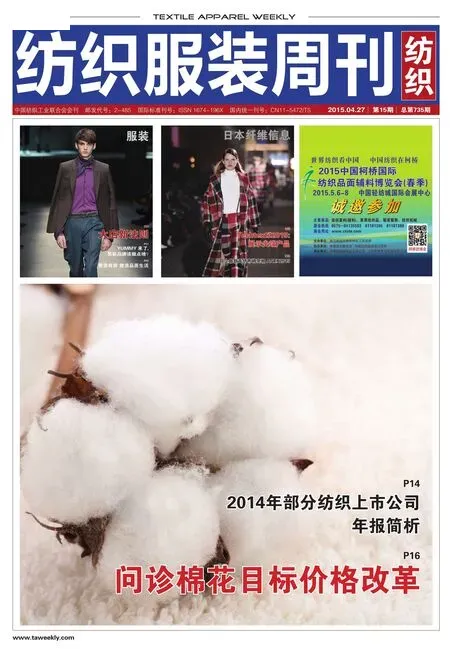
Textile industry : overseas investment accelerated
2015-02-06 05:06:36ZhouHongmei
紡織服裝周刊 2015年15期
Textile industry : overseas investment accelerated
At present, China’s textile industry has entered an new stage of global layout. Overseas investment has an accelerated trend in multi field and multi form.
At the same time, textile industry expect to through the “going out” to achieve cross-border integration and global breakthrough.
According to incomplete statistics, as of the end of 2014, more than 2600 China enterprises set up overseas textile and apparel production, trade and product design companies. The companies distributed in more than 100 countries and regions, covering Southeast Asia, North America, Europe, Australia, Africa and other key areas. Major investment enterprises came from Zhejiang, Jiangsu, Shandong and other coastal provinces.
Assistant director of China Textile Industry Association, as well as executive vice president of China International Trade Promotion Committee, Xu Yingxin said, according to the “going out” situation, textile industry’s foreign investment mainly presents “two lines”, “three characteristics” and “two focus points”.
Two main lines
One line : based on our country’s industrial capital , invested in green field, made a multinational productivity layout, to create the “China and surrounding countries (especially the Southeast Asia and South Asia)layout of manufacturing base, to maintain and enhance China’s textile industry’s international leading edge in global supply chain.
Another main line: China’s textile industry capital direct invested in and merged foreign raw materials, the design and development resources, brand resources and market resources, made a worldwide extension and control, to permeate world textile industry’s high value-added areas.
Three characteristics
The first: cotton spinning and knitting had become the key field investment industries.
Over the past few years, Chinese cotton purchasing and storage policy caused domestic cotton prices 30% higher than international cotton prices on average, which weakened China’s textile industry’s international competitiveness. In 2012 and 2013, China imported cotton yarn of 1530000 tons and 2100000 tons, the year on year increases up to 69% and 37%,respectively. In this case, domestic cotton spinning enterprises started a large scale of overseas investment. Texhong, Bros, Huafu, Xindadong, Yulun and other enterprises total invested over 1000,000 spindles in Vietnam. At the same time, because of the labor intensive feature of sewing process, knitted garment processing is our hot investment. Shenzhou international group, Jifa group, DongDu international, AB group and other key enterprises had invested in Kampuchea, Vietnam and other lower labor cost countries. Such as, 60% of DongDu’s orders from the manufacturing base in Southeast Asia.
The second: cross-border mergers of raw materials, brands and technology are increasing. In the aspect of control of the raw material resources, Shandong Ruyi group purchased a cotton farm in Australia and FULIDA purchased Canada Niuxier dissolving pulp company. In the aspect of mergers of the brand and technology, Youngor bought SMART and XINMA shares. Zhongyin Cashmere Co; Ltd acquired Britain Duncan mill. Shandong Ruyi bought Japanese listing Rena Corporation. Wensli Group swallowed French MARCROZIER silk enterprise. Marisfrolg bought Italy Krizia brand. Jiangsu Jinsheng acquired Switzerland Oerlikon natural fiber textile machinery and textile machinery special parts of all of the assets and equity. All enterprises are according to the the needs to obtain highquality brands and technology resources through mergers and acquisitions.
The third: “going out” closely integrated with Chinese market.
China’s textile industry “going out”based on the healthy development of the domestic business. Most of the cotton yarn, which produced in overseas are sold to China. Many overseas brands, technology investment and mergers are adhering to the strategic concept of “ Chinese market link with global resources”.
Two focus points
One point: the change of Global trade policy is a profound influence to reshape the global textile supply chain, TPP and other regional trade agreements will have a big challenge for our industry development.
The other point: the enterprises invest in oversea more rational and prudent. They pay great importance to the comprehensive cost of overseas financing, security and risk management.
Textile and garment exports fell sharply in March
In March, exports of textiles and garments fell sharply, according to data released by the General Administration of customs, exports of $12570 million, down 32.6%.
Textile export of $5880 million, down 29%. Apparel export of $6690 million, down 35.4%. Denominated in RMB, textiles and garments in March exports value of 77,070 million yuan, down 32.3%. Textile export of 36,040 million yuan, down 28.8%. Garment export of 41,030 million yuan, down 35.1%. In March, the export was no longer affected by seasonal factors. It showed that export is still on great pressure.
From January to March, textile and apparel exports amounted to $ 59,780 million, a growth of 2.9%. of which, textile export of $23,990 million, an increase of 4.2%. Apparel export of $35,790 million, a growth of 2%. Denominated in RMB, total textile and apparel exports amounted to 366,130 million yuan, a growth of 3.1%. Of which, textile export of 146,930 million yuan, a growth of 4.4%. Apparel export of 21,920 million yuan, a growth of 2.2%.
China's apparel export to ASEAN double increased
In February, ASEAN is the fastest growing market. China export to ASEAN increased by 112%,of which, the textile and apparel were increased by 96.3% and 140.8%. From January to February, total exports to ASEAN of $5940 million, a growth of 35.6%. of which, textile grew 29.7%, apparel grew 45%. Exports total volume of needle and woven garments had a growth of 30.2%. Export unit price increased by 8.9%. It is worth noting that, both of yarn export absolute and relative values were declined, in February, yarn export only 39,000 tons, a drop of 14.7%, total exports fell 4.8% in the first two months.
China's cotton imports fell by 40.5% in the first two months
In 2015 February, the number and price of China’s imports cotton were relatively stable, and continued to decline. According to customs statistics, in February, China’s imports cotton of 159,100 tons, down 2,100 tons, a decrease of 1.3% month on month, a decrease of 35.3% year on year; average import price was $1,698 / ton, compared to January rose$23, a growth of 1.4% month on month, down 15.4% year on year. Total import cotton of 320,300 tons, down 40.5% year on year in the first two months.
Translated by Zhou Hongmei