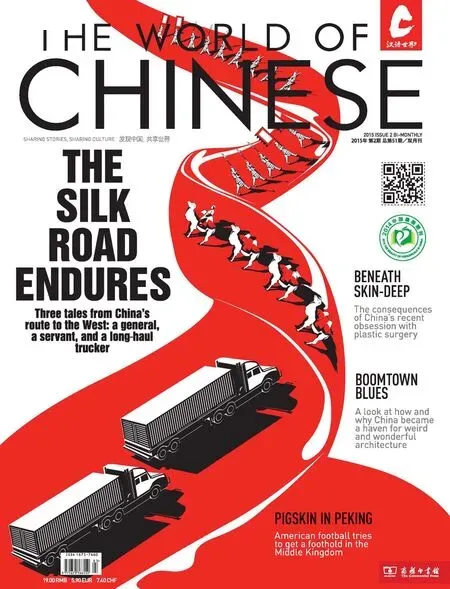
PIGSKIN IN PEKING
2015-01-18 02:43:58BYLlONELDONOVAN
漢語世界 2015年2期
BY LlONEL DONOVAN
PIGSKIN IN PEKING
BY LlONEL DONOVAN
American football is putting its cleats into the Chinese market
在美國集萬千寵愛于一身的橄欖球到了中國會不會水土不服?
The US loves American football. I mean, really loves it. It’s the country’s number one sport in terms of popularity and attendance. More people go to NFL football games in the US than any other sporting event in the world, and the championship game, the Super Bowl, ranks among the most-watched sporting events globally. This makes the sport—known in some countries as gridiron football to distinguish it from soccer—a fnancial powerhouse, with the NFL bringing in around ten billion USD a year. Despite all of this, in the bigger picture, American football has stayed pretty resolutely grounded to North America. But that isn’t to say other countries haven’t been getting in the game. A handful of other countries are showing interest, with teams and leagues popping up all over the world—including China. Leading the charge is Shawn Liu from Hebei Province, captain and safety of the Beijing Cyclones football team and a devoted Troy Polamalu fan. Shawn found the sport in Singapore and has been in love with it ever since. “I frst saw a US football game was when I was in college; I went to college in Singapore, so it was a Super Bowl game, I think. Everybody was crowded around watching the TV. It was Chinese New Year. I couldn’t understand the game then, but I knew it was interesting. I could see the hits—it was very powerful, very amazing.”Afterwards, Shawn left the game with an itch he couldn’t scratch, and he started to do some research into the sport.“I started looking on the internet, and I searched for the rules, and I started to watch the game. Once I understood the rules, I felt like this game was so amazing! I started to study football, and when I came back to China, I learned how to coach football players, because I used to run track when I was in college...I’d study the plays and the strategies, and then I started a team.”Chris McLaurin, commissioner of the American Football League of China (AFLC) and an avid Detroit Lions fan, originally came to China to study Chinese culture, but once his football past came out, he found himself sharing a bit of his own. “When I came to China, I met a group of guys, about ten or 15 guys in Chongqing, who were really interested in learning from me about how to play football. So I worked with them over the course of a year to help found the frst football team in Chongqing. We moved from 15 guys to 25 guys to 35 guys, now we have about 65 players on the roster. So there’s a genuine interest in the game in China.”
THE FULL DEVELOPMENT OF THlS SPORT MEANS PLAYERS AND A CULTURE OF PLAYlNG, SOMETHlNG OTHER US SPORTS SEEM TO HAVE DONE EXTREMELY WELL
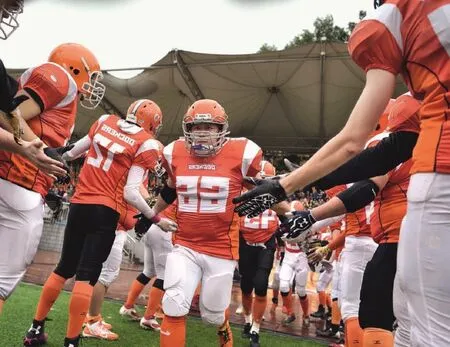
The Chongqing Dockers hit the field for a championship game
When you talk American football overseas, it’s important to note that there are two types of football to be discussed—arena and outdoor, and China has both brands in the form of the AFLC for outdoor football and the burgeoning China American Football League (CAFL) for arena. In October of 2014, the CAFL sponsored the frst intercollegiate Chinese football playoffs, and it is certainly garnering a fan base. Over 3,000 people attended the championship game (admittedly a far cry from US numbers in the sport) in which the Shanghai Nighthawks won the day. The AFLC also celebrated their championship game in early 2014, with the Chongqing Dockers winning 24 – 16 over the Shanghai Warriors. However, the full development of this sport means players and a culture of playing, something other US sports seem to have done extremely well.
China has always seemed to be open to sporting events from all over the world, and has teams playing everything from cricket to sepak takraw (somewhat like a lovechild of soccer and volleyball which is positively amazing). But, as far as bringing sports to the Chinese public, the only ones to have gotten real traction are soccer and basketball. Chris knows all about the challenges of bringing US football to China, noting how it won’t be as easy as another one of US’s favorite sports: basketball. “Basketball’s been in China much longer than football’s ever been recognized here. So it’s a longer curve…People know how to play basketball, they know who’s good, they’ve knownthe NBA since Michael Jordan, and Yao Ming of course, and football doesn’t have that.”
Chris goes on to say that watching the game isn’t enough to get everything down. It’s something that has to be experienced. “Football has a complex set of rules, a lot of rules, a lot of positions, and a lot of moving parts. So the best way to teach China football is by putting a football in their hands.”
The problems in this area aren’t insurmountable. Not long ago, the internationally (at least by Americans abroad) beloved Super Bowl, according to CSM Kantar Research, already had 14 million fans in China, representing growth from only one million in 2010. The NFL in the US is all-too aware of this following and has been making attempts at capitalizing on potential consumers, including bringing the likes of Barry Sanders, Tony Dorsett, Kordell Stewart, and Joe Montana to hobnob with Chinese fans over the past few years. They’ve also invested in an NFL on Tour semi-truck to cruise the cities of China, complete with a fold-out, big-screen TV in what they dub the “mobile audio/visual NFL experience”. In 2014, the truck made appearances in Hangzhou, Tianjin, Beijing, Xi’an, Chengdu, Chongqing, Wuhan, Shanghai, Changsha, and Guangzhou. The battle for fans in China is on.
Another hurdle for bringing US football to the Middle Kingdom isn’t just the sport itself, but rather the culture that comes with it. US football is heavily ingrained in American culture, which is the main reason behind its success. So, the question is, will that translate to China? Chris seems to think so and believes that there are a lot of aspects about football that could be useful to China’s youth. “I think community is so much more important in football than it is in basketball. Our guys come back because they love their friends, they love the community they’ve built up. They get together, they all play football together, and that, I think, is something that is very unique in China—to bond with so many different people on an athletic feld.”
“WlTH BASKETBALL, YOU DON’T NEED PADS OR A HELMET, YOU JUST NEED A BALL. BUT FOOTBALL lS A TEAM SPORT.”
The man behind this push for the gridiron in China via the CAFL is Martin Judge, founder, chairman and CEO of AFL Global and part-owner of the Philadelphia Soul. He’s also got some A-list help on both sides of the pond, including journalist andpresident of Ganlan Media International Wu Hua, former NFL quarterback Ron Jaworski (veteran of the Chiefs, Dolphins, Eagles, and Rams), and former coach Dick Vermeil, who led the Rams to a Super Bowl ring in 1999. He has big plans for the sport, saying in a China Daily interview, “I even have my own stamp in China…I’m not happy with that. I want a statue.” He also told Forbes, “It’s possible that someday the CAFL could be bigger in China than the NFL is [in the US]...With the backing of the Chinese government, the sky is the limit for how we can grow American football in the vast, untapped Chinese marketplace.”
As much as Shawn loves the sport, he also knows that football culture won’t be as easy to introduce.“With basketball, you don’t need pads or a helmet, you just need a ball. But football is a team sport. It’s not like basketball. The Chicago Bulls had Michael Jordan, and he was very good, but in football it’s not like that. Even if you have Peyton Manning, if you don’t have a receiver, you can’t win the game. So it’s very different. Here in China, people like heroes. They like people like Michael Jordan, but they don’t like teamwork. So it’s very diffcult for them to fall in love with football…You can see how many basketball fans like Kobe Bryant and Lebron James, but it’s just the NBA stars, they don’t like the teams they play on, they don’t like the game itself. But they like the stars, so the NBA is popular.”
Chris agrees with the sentiment. “I’d go even further to say that the game has even more value embedded in it, and that’s why it’s a little more diffcult to communicate to people just by watching a game on TV. Football players have helmets on. You don’t even know what these guys look like! So that’s another barrier for branding in China, to show people what Jerry Rice looks like, who he is, and translating that to China’s audience. So it’s defnitely a more diffcult task.”
WHEN lT COMES TO FOOTBALL, WHERE SOMETlMES THE ENTlRE POlNT OF THE GAME lS TO RUN lNTO PEOPLE AS FAST AND HARD AS YOU CAN, THERE’S A GOOD CHANCE THAT YOU MlGHT LEAVE THE FlELD WlTH A SCRATCH OR TWO
But, there is potential for both Chinese talent and foreign talent in the China leagues. The CAFL’s arena football league is just getting off the ground, but players in countries like Australia are already looking at the Chinese leagues as a viable option. The Sydney Morning Herald reported in December of 2014 that foreign players can make as much as 5,000 Australian dollars a game if they are drafted to one of the eight Chinese teams. The AFLC is more of a homegrown brand and boasts the more popular outdoor type of football the world is used to seeing in the Super Bowl. They’re also doing their part tomake sure the sport gets off the ground, with articles on their website explaining to newcomers exactly how football works.
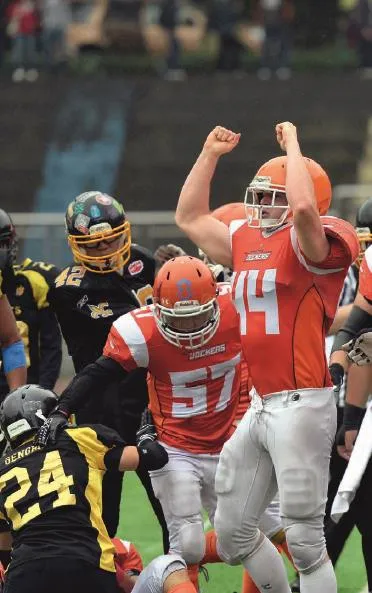
The Chongqing Dockers celebrate after a play in the league's second championship in 2014
For the actual players in the AFLC, the full contact of the game is somewhat of an issue. When it comes to football, where sometimes the entire point of the game is to run into people as fast and hard as you can, there’s a good chance that you might leave the feld with a scratch or two. As a lifelong player, Chris knows about the roughness that comes with stepping on the gridiron, but he thinks it benefts the players.
Shawn knows all about getting banged up, but that hasn’t stopped him from playing the game he loves. “I mean, every sport has the potential for injury. Even in badminton, you can injure your knee. So it’s normal to be injured…I had an injury before. It was in the game against Chongqing. I broke two bones in my hand. But it’s a part of the game, it’s normal. I just recovered and got back to it.”
Shawn also knows that not everyone is built like him, and some players have other opinions. “Chinese parents don’t want to see their children get injured. And when the players get married, the wife doesn’t want to see her husband get injured. And that’s a big problem. Their families will stop them from playing, which is a problem for us and our team. Some very good players stopped playing because of their family’s feelings. But it’s all in the mind. They’re scared of injuries. But if your technique is good, you can avoid injury.”
Despite the risks, the football community in China is growing. Shawn loves the sport, and enjoys spreading the gospel of football to anyone who’s willing to listen, but he knows that, to take it to the next level, he’s going to need some help from the big boys. “In China, sports depend on the government, you know? So once the government says, ‘Okay, this sport is good, we will develop this sport in China,’ it will much easier for the sport to develop in the country. Right now it’s just people like me who are playing, and we’re just amateurs. Football can’t develop like this, only when we have support from the government. That’s how it is in China, it’s different than in the US. It’s market controlled over there. Here, it’s government controlled.”Chris has high hopes for where the sport is headed in the future. “I’d like to see it get to a self-sustaining point where you can fnd players in China to play at a high school, or college level. I think they can totally accomplish it. We’d need more support from sponsors, from the government.”
Despite the money and the sheer joy of seeing a new sport take off, there is another reason for having American football—arena or outdoor—take off in China: cultural barriers. It may seem a little silly now, but ping-pong diplomacy (乒乓外交) four decades ago seriously impacted US-China relations, changing hearts and minds. And, American football can perhaps (on a much smaller scale) do the same. Teams are made up of both American and Chinese players, according to Judge, who stated in The New York Times that his league would be, “divided evenly between American and Chinese players.”
As football gains more traction on a global level, China is sure to follow suit. Chris takes comfort in that, and football’s acceptance into China’s mainstream seems almost inevitable. “Football is coming under review by the Olympic Committee for 2022, so there’s now some effort to build coalitions to spread the game to places like China. So, I think it has a bright future, and I think it’ll get nothing but bigger. Without the support of the government, it’s a little slow going. We’d like to see more involvement in spreading a game that has so much value and can bring so much value to society at large. But it’s coming along.”
For now, American football has nowhere to go but up, and with a little luck, people from Xinjiang to Fujian will be hitting the feld to toss the pigskin around. Although some may see this as just another sport, Chris and Shawn see something beyond the pads and frst downs. To them, the sport is a bigger cultural question about what’s going on during the game—when players really start to use what they’ve learned once the whistle blows.
“Football is like a tool for education…because football relies more on teamwork. It’s not like basketball or volleyball. It’s all about teamwork in football. That’s what the children need to learn. It’s not like, ‘I want to be Michael Jordan.’ It’s, ‘I want to be a team player.’That’s football. It helps kids build character, it makes them tougher, mentally and physically,” Shawn says.
Chris feels the same, and hopes that China’s youth can learn more than just plays when they decide to head onto the football feld. “There’s no better way than American football to instill the core values of teamwork, hard work, perseverance, discipline—all these things that are crucial for China at this point in its development, especially with so many kids who are being spoiled and not given holistic training for their life trajectory. They’re studying for tests all day; it’s purely academic. Football really allows you to be a leader in a way that you need to be in, say, business, than you can’t get from studying for a test. It’s not about creating the next accountant; it’s about creating the next CEO.”