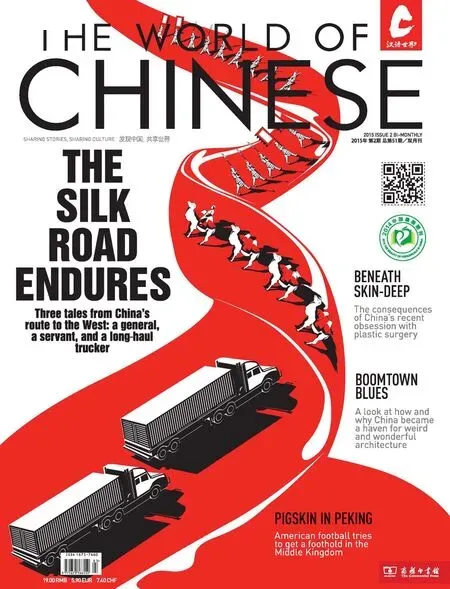
Faithful Isaac
2015-01-18 03:00:43
漢語世界 2015年2期
Faithful Isaac
This is the story of a servant, an Armenian named Isaac with a wife and a family in his home in Lahore. On a fateful day in around 1603, he would meet a Jesuit traveler on a doomed quest over the Silk Road.
Benedict Go?s sought a lost empire, a utopia. Legend spoke of a wise and just Christian king called Prester John—descended from the Three Wise Men of Christian myth hidden somewhere in Central Asia, a benevolent ruler with a mystical mirror that showed all the provinces of his rule. Benedict was on a mission to fnd his kingdom, a 300-year-old fable.
For safety’s sake, Benedict had taken to wearing Armenian garb and calling himself Abdula. The Jesuit arrived in Lahore with four converted Muslims, but they were all dismissed as “useless”. Upon meeting this strange foreigner speaking excellent Persian, Isaac took the place of the four Muslims, and on January 6, 1603, Isaac set out with Benedict and his two other companions, a Greek priest and a merchant, on a treacherous march across the Silk Road to Cathay.
It is important to mention that they were looking for Cathay, not China. For all the learning, technology, and ideology that passed over the Silk Road, those in the West were still confused as to whether China and Cathay were one or two nations—with the hope that Cathay would host a descendant of the legendary Prester John.
Their journey took them north to Kashgar, where Isaac and Benedict would travel with a caravan of over 500 people. From there Isaac followed Benedict and his entourage to Afghanistan. Thieves and murderers abounded. They traveled to Ghideli, where the bandits callously rolled boulders onto unsuspecting merchants below—so dangerous that merchants traveled with weapons in hand.
There in Kashgar, the Greek priest and the merchant gave up on their trek and turned back. For the most dangerous part of the journey, Benedict and Isaac were on their own. The relationship between the two is perhaps debatable, but Benedict is referred to as Isaac’s master, and in Wells Williams’ 19th century The Middle Kingdom, Isaac is simply called Benedict’s “faithful Armenian servant”.
They traveled north of the Taklimakan Desert, by far the most treacherous part of the Silk Road, over the dreaded Sarikol mountain range. No horse could make it, and both Isaac’s and Benedict’s mules went lame. Many in their company froze to death. Here, Isaac fell from a cliff into a freezing river, and Benedict worked for eight hours to save his life.
Benedict, despite being Isaac’s employer, was also his passport. Passage needed to be given by the local leaders’ whims, and Benedict achieved it by trading in European oddities. For example, the Jesuit traded a pocket watch to Mahomed Khan for the right of royal passage to Cathay.
They continued across the desert in a caravan that promised to take them all the way to Cathay. Besides the terrain and the bandits, in Benedict’s tale Muslims presented another problem for the travelers. The great Ottoman Empire was at its height in the 17th century and for Christians presented an all-purpose bad guy. Once, fearing persecution, Benedict and Isaac left each other weeping, wondering if death was at hand—only to be treated to questions and dinner from their Muslim hosts.
“WHAT ANGEL HAS BROUGHT THEE HlTHER TO RESCUE ME FROM SUCH A PLlGHT?”
After staying a long, dangerous while in a place known as Cialis, Isaac and Benedict made, once again, a serendipitous discovery. They met with a caravan returning from Beijing, the Cathay they so desired. As it happened, the merchants were billeted with members of his own Jesuit society in Beijing, and it was here that Benedict found that his fabled land was not to be found—that Cathay was indeed China. In HenryYule’s translation in China and the Way Thither, it reads,“Our travellers were greatly refreshed with all this intelligence, and now they could no longer doubt that Cathay was but another name for the Chinese Empire, and that the capital which the Mahomedans called Cambalu was Peking, which indeed Benedict before leaving India had known.”

Though there was no Christian kingdom to be found, their journey had an end, one where they would meet those of their faith in comfort and safety.
China stood frm under their feet, but they were far from safe. In one near tragedy, Benedict was thrown from his horse, and the others in his party had ridden ahead too far for anyone to notice. Isaac turned back for him, searching in the dark of the barren plain for his master and friend. Isaac heard someone calling on the name of Jesus, and as he approached, Benedict said, “What angel has brought thee hither to rescue me from such a plight?”
Finally, the Great Wall was in sight. They arrived in a place called Suzhou in modern day Gansu Province, and, for one of their party, this was the journey’s end. Ancient Chinese bureaucracy prevented them from going any further, so Benedict wrote for help from Beijing twice, with little hope that the letters would fnd their intended. Far from the civilization of Beijing, Isaac and Benedict were trapped, and their long stay completely drained their coffers.
The Jesuits in Beijing sent a young John Ferdinand to rescue Brother Benedict from his troubles, arriving on March of 1607, only to fnd Benedict on the verge of death, a suspected poisoning. Isaac still with him, the great Benedict Go?s—the man to discover for the West that China was China—died.
For the frst time in years, Isaac was alone, his only companion this new foreigner Ferdinand sent from Beijing whom he could not understand. But, his service to Benedict was not over. It was either the custom or just plain greed of the people there that a dying man’s property should be divided among the rest. They grabbed Isaac and tied him up, threatening to kill him. Ferdinand tried to save him but landed himself in jail for months.
In a somewhat comical turn of events, their time in court raised some odd problems. Isaac prattled on in a few words he had learned in Portuguese, while Ferdinand recited the Lord’s Prayer. The Suzhou judge decided that they were both from the province of Canton and were speaking their dialect. By this time, Ferdinand had picked up a bit of Persian and could speak to Isaac. To prove that they weren’t Muslims trying to sneak into China, Ferdinand pulled a piece of pork from his sleeve and fed it Isaac. The Muslims in the crowd were visibly disgusted, but the judge decided in their favor, allowing them to continue.
Isaac completed his patron’s journey, going with Ferdinand to Beijing, where he was greeted as if he were Jesuit brethren. He stayed in the strange capital of Beijing for a month and related the travels of his friend Benedict to one Father Mathew. Then, he traveled the much easier journey home via Macao, where a safe and regular passage was made for him.
On the way home, he was attacked by pirates in the seas of Southeast Asia, stripped of his belongings, and taken prisoner. In one last act of mercy, the Portuguese of Malacca ransomed him and sent him on his way home to Western India. But, before he could get there, news of his wife’s death reached him. He went no further. He settled in Indonesia, and it is here that history loses track of Benedict’s Armenian servant.
Benedict is known as the man who made Cathay and China the same nation in the minds of many; his epitaph was “Seeking Cathay Found Heaven”, and his story was immortalized by the tale of “The Journey of Benedict Go?s Overland from India to China”. Hidden in that tale, a short three chapters, is the story of the servant Isaac.
And what of Isaac? Perhaps his legacy was decided by Mateo Ricci, who called him: fdus Achates, referring to the faithful travelling companion of Aeneas. Little is truly known of Isaac. But, like many travelers of the Silk Road, he left a story. It is the story of a man who left his family to travel the Orient with a Jesuit on a doomed quest for utopia, an almost imperceptibly small thread on the colossal tapestry of the Silk Road.
– TYLER RONEY