
TEAHOUSE EXCHANGE, BOOM AND BUST
2015-01-17 06:05:55BYllUSHA劉莎
漢語世界 2015年6期
BY llU SHA 〔劉莎〕
TEAHOUSE EXCHANGE, BOOM AND BUST
BY llU SHA 〔劉莎〕
China’s first stock market and how it went belly up
一百多年前中國茶館里的股市風云
lt was a pleasant sunny morning with a chilly autumn breeze;over 20 men in deep blue robes and long braids sat down around a table in the Huifangrong Teahouse in the busiest corner of Foochow Road inside the ceded territories of Shanghai in 1881. All of them were anxious. They asked a waiter to get them a pot of Tieguanyin, a premium Chinese oolong tea, and then, like many other people in the teahouse, instead of chitchatting about operas and anecdotes, they started discussing what stocks were worth purchasing. This was China’s teahouse stock exchange.
Evidence throughout the late Qing Dynasty (1616 – 1911) presents a reminder that China—in which structured, modern companies are commonly believed to have (somewhat ironically) begun with the Communists—caught a nasty case of stock fever over 100 years ago. After drinking half a pot of
Tieguanyin and exchanging the latest trading news and rumors, a man in a suit with chic, black, unbraided hair walked into that tea house. Everyone stopped talking to stare at the broker.
With electronic buying and selling almost a century away, investors purchased and sold stocks, in the form of featured paper bills, mainly through brokers who knew their stocks and were closely connected with various companies. In those teahouses, many deals were sealed verbally.
The stock trading boom began amid the “Self-strengthening Movement” (1861 – 1895), during which Chinese intellectuals, officials, and entrepreneurs looked to Western knowledge and technology in order to“strengthen the country” after a series of military defeats and concessions to foreign powers.
In 1872, Li Hongzhang (李鴻章), a top general in the Qing imperial court, first suggested building a shipping enterprise with a shareholding system, something Chinese investors had never known before. The share price of the company would not rise until 1881, having financed more than a million liang(兩), or 50 million grams, of silver dollars via selling shares.
The following year the share price would reach 260 liang with an issue price of 100. The soaring price was a result of the improved company performances and less government interference, not to mention shareholder fervor.
With that, more companies held IPOs (initial public offering) and investors looked for more, ignoring the actual performance of these companies, according to local newspaper Shen Bao in September 1882. The topic of discussion atteahouses had just one theme: the stock market.
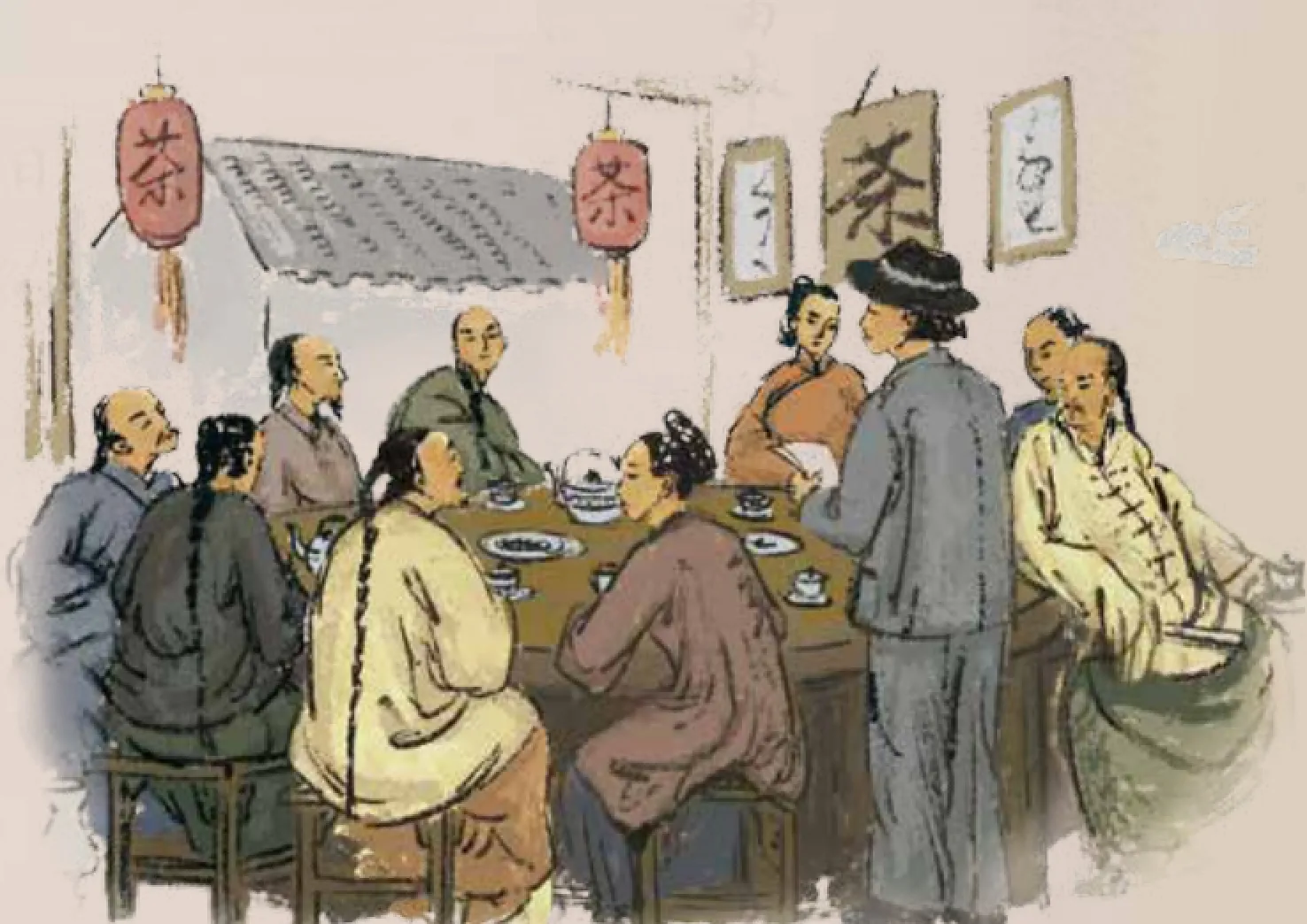
Demand far outstripped supply. The Shanghai Mechanical Textile Bureau planned to finance 40,000 liang of silver dollars through an initial offering of 4,000 stocks. With so many buyers, the company had to issue another 1,000 stocks to meet demand, but people were still seeking brokers and lined up in front of the headquarters to buy until the company announced in the newspaper that it had stopped issuing new stocks.
On that particular autumn day in 1882 and inside the Huifangrong Teahouse, the broker in the black suit told investors some important news: Li Wenyao was coming to Shanghai.
The investors winked at each other and didn’t say a word; they didn’t need to. They were thrilled. Mining stocks were the most desirable, and Li, the owner of a large silver mining company, had not listed on the“teahouse exchange” yet. Lying in wait for Li were mobs of investors begging him to issue stocks. Personally, he had no wish to do so, but he followed the public will and listed.
Between 1830 and 1890, China experienced two opium wars and foreign powers like the UK and France, with advanced arms, had smashed the wooden doors of the Middle Kingdom for decades and continued to expand as the Qing imperial court grew weaker. In those days, Shanghai, with its harbor and trade with foreign shores, was the most prosperous place in China. The city, rather than becoming the frontline of battles, was ceded to several countries—with Western-style shops, schools, and churches, which, like it or not, provided a window for local Chinese to learn more about the West.
China’s first attempt at modern investment lacked a mature system to keep everything on track. Investors leveraged heavily from “money houses” (錢莊), old-style private banks—to trade in teahouses. How could they know that a crash was just around the corner?
First came the rumors of the Qing imperial court that they, out of jealousy of civil wealth, had embezzled company funds. The rumors were never confirmed, but shareholders began to wobble.
Then, the private banks tightened up their leverage. Due to the excessive liquidity in the market, before the end of 1882, banks took a conservative attitude and attempted to settle accounts with debtors who had to sell the stocks to pay their credit—sending the teahouse stock market tumbling.
The death knell was the fall of the market leaders. In the spring of 1883, the Jinjiaji Silk Company, which sold Chinese silk, shut down and over 20 other silk production companies were affected. The money houses further tightened their credit practices and many announced an end to lending.
But it was the bankruptcy of a tycoon that caused the crash to truly hit home: Hu Xueyan(胡雪巖), China’s richest man of the age. Hu, a private banker, had intimate connections with the imperial court and was the owner of hundreds of private money houses around China. Hu could be viewed as both victim and perpetrator of the stock disaster.
In 1882, in order to break foreign monopolies in China that had been manipulating the silk export businesses, Hu united all raw silk producers in Zhejiang and Jiangsu, major silk production areas, and bought all the raw silk so that he and his partners could set the market price.
In 1883, Hu did the same thing, but this time the demand for silk had dropped due to a global economic recession—not to mention overall anger about Hu’s “plot”. The plan failed and the silk he held encountered sold short—the losses unrecoverable.
To ensure normal cash flow, Hu took money from his Fukang Money House, a heavy stock speculator that was already suffering a downturn.
The news leaked, and the headlines hit: “Hu Bankrupt”. Creditors rushed to Fukang Money Houses to get their deposits back.
As the run continued, Fukang’s currency reserves were exhausted, and so it passed to those nationwide branches of Fukang money houses—perhaps equivalent to the Morgan Stanley or Goldman Sachs of the time—which went bankrupt without a safety net. Too big to fail they might have been, but fail they did.
The chain reaction had three main components: people could not get their money back from the banks, shops dependant on the banks closed, and unemployment ran rampant.
In 1884, the crisis worsened with the Sino-French War, and the stocks held by investors became useless pieces of paper. China’s first stock boom cooled and it would take years for disappointed investors to regain confidence.
In the end, Hu came out of the crash well, remembered as the man who dared take on the foreign monopolies. Today, he is revered as one of China’s greatest businessmen, and the Hu Qing Yu Tang (胡慶余堂), the famous TCM chain clinic in Hangzhou, Zhejiang Province, still remains as a testament to his legacy. However, it seems that, for all its volatility and toxicity, the modern economy thrives on investor confidence, so while it’s impossible to distance oneself entirely from the events of the past, it might be a good idea to heed the painful lessons it imparts.
