英語“動詞+定冠詞+名詞”習語的變體研究
2014-12-28 05:29:26賀阿麗
重慶交通大學學報(社會科學版) 2014年4期
賀阿麗
(1.山西師范大學外國語學院,山西 臨汾041004;2.中央民族大學,北京100081)
習語在英語中指“結構相對固定的詞組或短句,它的意義不是其構成詞意義的相加”[1]。習語的特征可以歸納為整體性、凝固性和不可替代性[2]。McMordie認為:“一般說來,習語是不能改動的;習語中的任何詞都不能以其它同義詞來代替,習語中詞的排列也很少能加以變動;任何改變措詞和搭配的做法往往都會破壞習語,或可能使之變得毫無意義。”[3]
一般認為習語不允許發生詞匯和句法層面的變體,但事實上,習語變體的可能性比預料到的要大得多。英語中有許多結構不同的習語,筆者在此選擇“動詞+定冠詞+名詞”結構的習語作為本文的研究對象。本文語料來自BNC(British National Corpus英國國家語料庫)和Webcorp(網絡語料庫)以及相關詞典和書籍,希望通過本文盡量說明習語的變體程度、原因以及定冠詞“the”的重要性。
一、研究方法
Collins COBUILD Dictionary of Idioms(《柯林斯合作成語詞典》,1995)中收錄了英國、美國以及澳大利亞等英語國家所使用的4400條習語。筆者從中搜集了71個“動詞+定冠詞+名詞”結構的習語。其中,有12個習語中的名詞短語是復數形式。筆者在BNC(大型英式英語語料庫,有九千萬詞匯文本材料和一千萬英語口語材料)中搜索了這些習語的標準形式,也在Webcorp(網絡語料庫)上搜索了它們的非標準形式。
69個“動詞+定冠詞+名詞”結構的習語有6個在BNC中檢索不到,它們是 push the envelope,get the bump,count the beans,thumb the tube,spread the wildlife 及 get the axe。所以,研究對象主要是63個習語,其中,有些習語的語義基本相同,如:Kick the bucket,bite the dust及 buy the farm意思都是“死”;Stem the tide和stem the flow意思都是“制止……的蔓延;遏止……的勢頭”;Weather the storm和ride out the storm意思是“平安度過難關”;Bend the rules和stretch the rules意思是“變通規則;通融”;Learn the ropes和know the ropes意思是“掌握訣竅”;Test the water和test the waters意思是“試探反應;調查民意”;Grease the wheel和oil the wheels意思是“使某事順利進行”。盡管以上習語意義相同,筆者還是搜索了這些習語,看看習語中同義詞的替代能給搭配帶來什么變化。本文的“變體”(modification)指用名詞、形容詞、限定詞或不定冠詞來替代“動詞+定冠詞+名詞”結構習語中定冠詞的現象。
二、英語習語內部變體
(一)Spill the beans的變體
寫作的藝術是用行之有效的方法來吸引讀者的興趣。習語變體就是作者在寫作時使用的一種文字創新。在筆者的數據庫中,spill the beans是63個“動詞+定冠詞+名詞”結構習語中唯一可以在內部結構及句法上創造出不同程度變體的習語。盡管在BNC中沒有搜索到這個習語的任何變體,但是在網絡上卻搜索出62個變體的例子。WebCorp提供了這一習語的不同變體形式,在這些不同的變體中,四類前置修飾成分替代了原來的定冠詞the出現在beans的前面。參看表1:
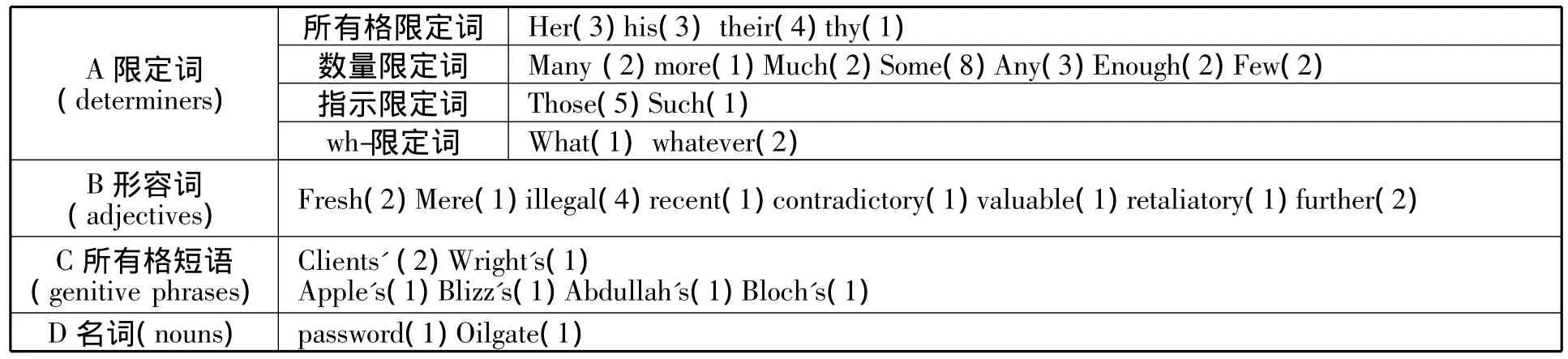
表1 spill the beans的內部變體(前置修飾成分變體)形式
根據表1,以下幾類限定成分可以置于beans之前:所有格限定詞、數量限定詞、指示限定詞、wh-限定詞。
1.限定詞。所有格限定詞,如(1)I asked a handful of our top-performing members—including Neil—if they'd be good enough to come along and spill their beans。量詞限定詞,如(2)Time to spill some beans.(3)Parasound didn't really spill much beans on this one,but they've got an“audiophile grade”。指示限定詞,如(4)This is the part of the story with the most spoilers,though,so I won't spill those beans right now。Wh-限定詞,如(5)As Bolton fell over himself with enthusiasm to spill whatever beans he could on the Syrian/North Korean/Iranian weapons proliferation cooperation。
2.形容詞,如(6)General manager spill fresh beans.(7)Iglasias says Goodling“Holds the keys to the kingdom”,which doubtless means she doesn't spill mere beans;she spills the meat。
3.所有格短語,如(8)Of course,that's no excuse for some thoughtless PR department to spill Apple's beans.(9)SEC may force lawyers to spill clients'beans。
4.名詞,如(10)ANC funder to spill Oilgate beans。
這些前置修飾詞很自然地置于beans之前。如名詞的例子(10),所有格短語的例(8)和例(9),形容詞和量詞限定詞的例(6)和例(2)都來自報紙文章的標題。在這些標題中,spill或以原形或以非曲折變化的形式出現。這表明spill the beans習語在有關“泄密”的新聞標題中作用重大,但在新聞的主體部分,spill the beans卻沒有出現。可見,這種變體只是為了吸引讀者的注意力,此類標題暗示報道內容會非常轟動。這類新聞中,泄密內容與beans前置修飾詞的所指相關。如“spill Oilgate beans”中,Oilgate指“石油公司”的丑聞。-gate意為“丑聞”,來源于“Watergate”(水門事件)丑聞,在此,-gate的使用和對spill the beans的變體都表明這則新聞具有轟動效應。
在spill much beans中,使用了修飾不可數名詞的限定詞much而不是合乎語法規則的many來修飾beans這一復數形式。這一例子表明,作者已根據習語中的spill和the beans分析了習語的意義:spill和the beans在語義上分別等同于“泄露”和“秘密(信息)”,“秘密”是不可數名詞,所以語義上作者有使用much的理據。Spill mere beans和spill the meat進行對比的例子中,beans作為食物,在生活中沒有meat那么重要,所以spill the meat是想要表達“泄露的是最重要的秘密”而非“一般的秘密”。Meat常具有“重要”這一習語語義,如在be meat and drink中,meat意為“受歡迎的東西”,這種變體可稱為對比變體,表明有的習語也跟正常的短語一樣可以分解。
(二)名詞、所有格或限定詞引起的習語變體
一些習語可被名詞、所有格或限定詞(所有格、指示詞或數量詞)或被二者同時修飾。筆者發現了20個這類習語。如:pass the baton,soften the blow,catch the eye,run the gauntlet,shoot the messenger,miss the boat,leave the nest,rule the roost,cross the Rubicon,stem the flow,ride the storm,bend the rules,stretch the rules,read the runes,test the waters,grease the wheels,oil the wheels和 foot the bill。例如:
(11)One has to leave one's nest and friends to pursue one's dreams and ambitions partly because of parents'wishes.
(12)The new Republican creed is to shoot any messenger of bad news.
以上習語變體形式的使用是為更明確地描述有關的人、事、概念或信息的接收人。習語的意義并沒有因為形式的改變而被誤解。媒體上出現的習語大都可以為取得特殊效果而采用變體形式。
(三)形容詞引起的習語變體
在筆者所列63個習語中,只有5個習語可以通過形容詞引起內部變體。如:foot the bill,ring the changes,cut the cord,get the picture 以及 tip the scales。例如:
(13)Knowsley Tax Payers to foot massive bill!
(14)Tokelauans tipped to cut colonial cord to Wellington.
(15)Confidently negotiate and tip difficult scales in your favor.
以上3例都是文章的標題。標題中習語變體的目的是要使語義更適合特殊的情景。形容詞在句法上是名詞短語的前置修飾成分,在語義上可在數量和質量方面起修飾作用,也就是說,形容詞的修飾可有助于明確名詞的所指對象。例(13)中,納稅人不得不支付“巨額”賬單;例(14)中,屬于新西蘭的島嶼Tokelau,可能要尋求從Wellington的“殖民”中獨立出來。
(四)新聞標題中的習語變體
大量英語習語可通過變體來適應商業、體育或廣告類標題的需要。這些習語通常要通過名詞、所有格和形容詞的修飾來產生變體。當習語為適應新聞標題而變體后,往往使新聞標題變得幽默或嚴肅,從而產生各種效果,引起讀者的注意[4]。語言的這種創新還可激起讀者的閱讀興趣,給讀者留下很深的印象。用于標題的習語有:make the grade,sweep the board,miss the boat,turn the table,stem the tide,stem the flow,rule the roost,foot the bill,tip the scales和soften the blow。例如:
(16)Will India's outsourcers rule China's roost?
(17)UNFPA charts new course to stem population tide
三、英語習語句法變體
Stathi(2006)繼Gibbs等(1989)對習語的研究之后,又發現有一種習語的句法是可分析的。他解釋說:“這類習語的構成成分同習語的語義部分是一致的。”[5]如:

這種可分解性使這類習語可以發生一定程度的句法變體。如上述習語spill the beans的賓語the beans可在被動式中做主語,其語義reveal the secret和“動詞+定冠詞+名詞”結構習語有相同的句法結構。但是單單這一個例子不足以說明所有“動詞+定冠詞+名詞”結構都能變為被動式。被動化的主要原因是:可分解的“動詞+定冠詞+名詞”習語結構中的名詞短語所表現的是這一習語的主要語義,而不是表現習語中動詞的語義。筆者遇到過這樣的例子:go the distance意思是reach the goal,這個結構不能變為被動式,因為習語的主要語義由動詞reach而不是名詞goal承載。
筆者發現有6個習語可以在句法上發生變體,尤其是變為被動式。這些習語的語義結構同其句法結構相同,習語和名詞短語都在習語中表現重要語義。
(18)Goodling got the limited immunity based upon at minimum an outline of the beans she will spill(usually known as a‘proffer’).
上例中,the beans后跟含動詞spill的關系從句。名詞短語the beans從動詞短語spill the beans中游離出來,用作介詞of的補語,好像the beans一詞的意思就是“秘密信息”。這不僅僅是內部變體,而且是句法變體。BNC提供了習語beg the question變體的兩個例子。如下:
(19)For they beg the questions they ask by simply assuming the truth of individualism.
(20)It follows from this that any anthropologist who selects a particular category word from his own mother tongue,e.g.incest,marriage,family,myth,religion,and then embarks on some kind of cross-cultural study of institutions which he learns together under such headings,is begging all the questions which are serious interests!
例(19)尤為令人感興趣,句中question與動詞beg和ask共現。但很明顯,我們不能交換兩個動詞的位置,如they ask the question they beg,beg the question在這里的語義是潛在的。在例(20)中,復數形式the questions把all作為前置修飾成分,關系從句作為后置修飾成分。這一習語變體既含有句法變體又含有內部變體。由于短文討論的內容有關亂倫、婚姻、家庭、神話、宗教等,筆者認為作者在此有意改變了習語的固定搭配,以便吸引讀者的注意。筆者還在網絡上找到了習語結構變為被動式的4個例子:prick the bubble意為阻礙某事成功,ring the changes意為變換說或做的方式,miss the boat意為錯過機會,pass the baton意為傳遞責任。
(21)Sorry conspiracy theorists prices of homes rose in response to blow off demand,and prices are now declining as the bubble was pricked.
(22)When he turned from the gay and corrupt world in which he lived,where the changes were rung incessantly upon self-interest,falsehood,pride,and the various,more or less refined forms of sensuality,
(23)Does the report effectively target the mounting problems that Western Sydney currently faces,or has the boat been missed on some issues?
(24)In fact,so successfully has the baton been passed on to his daughter Ameeta that Usha-breds have been enjoying a banner year(2003-05),smashing all opposition in the country.
(25)This article aims to understand how the dynamics of the public debate about the European Constitution changed when the baton was passed from the Convention to the Intergovernmental Conference and to the different national arenas that were expected to ratify the Constitution.
四、“動詞+定冠詞+名詞”習語中的定冠詞
(一)定冠詞的用處
Davis引用 Lyons在 Definiteness(1999)一書中所說:“標準英語中,定冠詞使用的四個原因是:熟悉度、可識別性、獨特性和包容性。”[6]但是用于“動詞 + 定冠詞 + 名詞”結構習語中的定冠詞卻和這四個原因無關。習語短語通常用于比喻,如kick the bucket的意思并不是“踢一個‘可識別’的桶的動作”,而是比喻“死”,來源于豬死時踢掉桶的習俗。而且在分析beg the question時,筆者發現這個表達式據說譯自于拉丁語表達式petitio principii,但不是逐字翻譯。在拉丁語表達式中,“petition”是名詞,“principia”是所有格單數。拉丁語中沒有冠詞。從語言學的角度來說,“beg the question”是早期現代英語的變體形式,不是原始拉丁語直接的譯借。筆者認為這個定冠詞促成了習語語義的形成,可以參考由Lyons使用的術語“semantic definiteness(語義定指)”[7]。
(二)不定冠詞替代定冠詞
筆者發現在兩個習語中,不定冠詞可以替代定冠詞。這兩個習語是:prick the bubble和take the mickey。
(26)Those jokes have always been in pantomime,it's always been a place where you could take a mickey out of certain people and situations.
(27)He said monetary tightening is a highly inefficient tool to prick a bubble,and cites several instances where this has failed.
上兩例中,作者似乎特意把定冠詞換成了不定冠詞,因為不定冠詞不定指具體的情景。例(27)中,作者很了解定冠詞指的是語義的確定性,所以他使用不定冠詞來指語義的不確定性。
五、結論
習語變體是一個豐富的領域。經過變體的習語表達既新穎又有趣,而且可以表明變體的目的和意圖。通過名詞、所有格或限定詞變體的習語所指對象更加明確;通過形容詞變體的習語能更好地表現習語中的名詞短語。習語變體的目的主要是為達到特別效果或是改變語體,大多數習語通過名詞或限定詞變體。
促成習語變體的主要原因是新聞標題的需要。新聞標題中使用習語變體往往會引起人們對新聞內容的好奇心,有時習語變體也是作者故意使用的策略,以便達到特殊的語體效果,吸引更多讀者的注意。
研究還表明,kick the bucket或bite the bullet習語之所以不發生變體,是因為它們的變體對形成習語語義沒有任何意義。在筆者所列出的習語中,有20個習語沒有發生任何變體。
習語變體并不意味著習語不再是習語,相反,說明每一個變體都源于有意識的語言改動和深思熟慮后的符號選擇。了解習語的變體給人們打開一個從社會心理層面了解英語的重要窗口,使人們具有更敏銳的語言洞察力。
使用互聯網語料庫有一定的風險,因為網絡上某些習語的變體可能只是為取得詼諧或特別的效果而使用的臨時變體。但網絡上也會發現一些可信度高的非臨時變體,可以反映變體習語當前的用法。
眾所周知,“動詞+定冠詞+名詞”結構習語大多數時候是較為固定的,但由于它們在詞匯、語義以及句法上具有一定的靈活性,在一定語境中會發生各種變體。如果不能發生變體的習語可稱為“完全固定的習語”(completely frozen idioms),那么這些能夠靈活變體的習語便可稱為“最不固定的習語”(least frozen idioms)。
[1]駱世平.英語習語研究[M].上海:上海外語教育出版社,2006:13.
[2]衡孝軍.英語成語研究述略[J].外語教學與研究,1990(2):.
[3]McMordie W.English Idioms and How to Use Them[M].Oxford:Oxford University Press,1954:6.
[4]肖小月.英美新聞標題語言特色分析[J].重慶交通大學學報:社會科學版,2013(2):133-136.
[5]Stathi K.Corpus linguistics meets cognitive linguistics:A frame work of the analysis of idioms[C]//German Cognitive Linguistics Association,2006:28.
[6]Davis E H.The Definite Article in American English slang[EB/OL].[2013-09-23].http://209.85.173.104/search?q=cache:rNsSw_yawaEJ:www.cs.cmu.edu/~dhdavis/%27The%27%2520Paper.pdf+The+definite+article+in+American+English+slang.&hl=en&ct=clnk&cd=1.
[7]Sinclair J.Collins COBUILD Dictionary of Idioms[M].2nd ed..Glasgow:HarperCollins Publishers,2002.
猜你喜歡
中華詩詞(2021年3期)2021-12-31 08:07:22
大連民族大學學報(2021年2期)2021-07-16 05:41:42
開放教育研究(2020年2期)2020-03-31 01:54:14
中華詩詞(2018年3期)2018-08-01 06:40:40
中華詩詞(2018年11期)2018-03-26 06:41:32
現代語文(2016年21期)2016-05-25 13:13:44
國際漢語學報(2016年2期)2016-05-17 04:04:08
大連民族大學學報(2015年2期)2015-02-27 08:28:11
當代修辭學(2014年3期)2014-01-21 02:30:46
當代修辭學(2011年6期)2011-01-29 02:49:50