
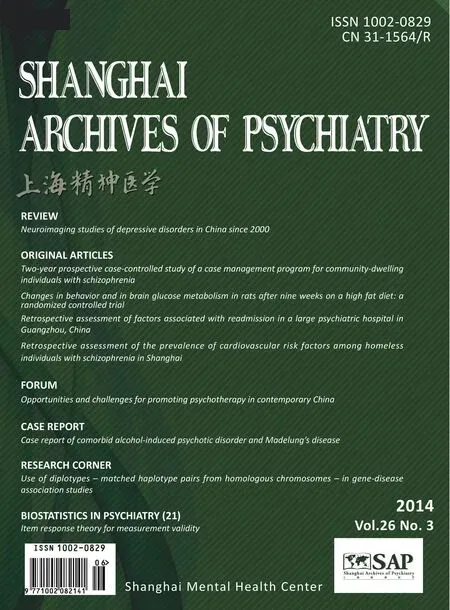
Opportunities and challenges for promoting psychotherapy in contemporary China
2014-12-09 07:00:09XudongZHAO
上海精神醫學 2014年3期
關鍵詞:心理
Xudong ZHAO*
?Forum?
Opportunities and challenges for promoting psychotherapy in contemporary China
Xudong ZHAO1,2*
psychotherapy, mental health law, China
Over the last 30 years in China, the gradually increasing provision of client-friendly psychotherapeutic services to the population (primarily in urban areas) has helped to decrease the negative beliefs about psychiatry that continue to persist in the general community and, to a certain extent, in general medicine. Nonetheless, the rate of development of psychotherapy has lagged far behind that of biological psychiatry. There remains a huge unmet need for psychotherapeutic services in contemporary China, particularly in the rural parts of the country.
1. Challenges
The new Chinese Mental Health Law[1], which went into effect in May 2013, is an evolutionary milestone for psychiatry in China. Among several new initiatives,it recognizes psychotherapy as a scientific and effective treatment method and specifies that psychotherapeutic services should be provided in all types of medical facilities. Given that very few general hospitals currently provide these types of services,implementing this component of the law will be a tremendous challenge. First the expectations outlined in the law need to be converted into operational regulations in each jurisdiction (i.e., provinces and independent municipalities like Shanghai and Beijing) and then the resources needed to implement these local regulations regarding the provision of psychotherapy need to be developed, allocated and managed.
The resource that is in shortest supply is qualified psychotherapists. At the end of 2013, the National Health and Family Planning Commission of the People’s Republic of China formulated the ‘Regulations for the Practice of Psychotherapy’[2]which listed 13 types of psychotherapy to be practiced at medical facilities. At present this is a theoretical model that is far from the reality on the ground. There have been some small-scale projects that have adapted Western practices for use in China and demonstrated the feasibility of training clinical staff to provide these types of psychotherapeutic services. But several major problems need to be addressed before it will be possible to expand these programs to train the large numbers of psychotherapists needed and to test different methods for integrating these psychotherapists into a variety of medical care settings.
The current medical system in China does not support the development of multi-disciplinary teams of providers that most countries consider essential to the provision of high-quality health care. Even within psychiatric hospitals there are few trained psychotherapists and most of the current psychotherapists are psychiatrists who have been trained in psychotherapy, not psychologists. Hospitals are not willing to recruit specialized psychotherapists with a psychology background; and the few trained professional psychotherapists that do exist cannot make a living. Social workers, another key actor in multi-disciplinary teams, are virtually non-existent in psychiatric hospitals or in other medical settings.This leads to an overemphasis on biologically focused treatments and a limited ability to provide community-based rehabilitation services, the type of services that are most needed as chronic health conditions like diabetes, cancer, and mental illnesses become an evermore important component of the burden of illness in the country. Changing this situation will require a major shift in the health care environment in China,a shift that will take decades of concerted effort to develop, implement and monitor changes in policies related to the training of health professionals and to the organization and financing of services.
As an initial step along the long path, two core issues must be addressed.
1.1 Restriction of the role and function of the psychotherapists
According to the new mental health law, both psychiatrists and psychotherapists can provide psychotherapy in medical facilities. However, the formal qualification for becoming a psychotherapist established by the Chinese Ministry of Health in 2002 only indicated that persons with medical licenses were eligible, so many (but not all) provinces in China do not allow psychologists to take the exam that would enable them to work as psychotherapists. This precluded professionals with a psychology background from being employed in the Psychiatry Department or Psychology Department of general hospitals (or other institutions).Even in the locations where they were hired, they were hired as technicians who could not be promoted to senior positions in the institution. Moreover, the new law also stipulates that psychotherapists can only provide services in medical facilities, individuals with a psychology background who do not work at a medical facility cannot legally provide psychotherapy even if they are qualified to do so.
1.2 Few psychiatrists are able or willing to provide psychotherapy
The ‘Mental Health Law’ allows psychiatrists to provide psychotherapy but it does not require them to receive training to do so. There are about 20,000 psychiatrists in China, making the psychiatrist-to-population ratio about 1.5 per 10,000 (compared to a ratio of 13.5 per 10,000 in the United States). Thus the clinical demand for services for the severely mentally ill – most of whom are treated with medications– is high. The profits for both institutions and for individuals of providing drug-based treatments for mental disorders is much greater than those generated by time-consuming psychotherapy, so there is little incentive to provide such services. Moreover, there are very few institutions in the country that have qualified clinical supervisors who could provide highquality training in psychotherapy, so few psychiatric hospitals include formal training in psychotherapy as part of the required experience for being qualified as a psychiatrist (the clinical requirements for registration as a psychiatrist are determined at the provincial, not national, level).
The biopsychosocial model of psychiatric care has been promulgated for more than 20 years in China,but currently available services are moving further and further away from achieving this type of integration.Whether or not the new mental health law will be successful in changing this trajectory remains to be seen.
2. Recommendations for expanding the provision of psychotherapeutic services
To address the problem of ‘allowed but incapable’,psychiatrists should be encouraged to learn psychotherapy. To address the problem of ‘capable but not allowed’, the provision of psychotherapy by psychologists without the direct supervision of medical doctors should be legalized in both medical and non-medical centers. This will require a number of policy initiatives that could initially be tested in specific jurisdictions like Shanghai and then, after being revised a couple of times based on the experience in these test sites, subsequently promulgated around the country.Examples of such policies could include the following.
?Require all psychiatrists to obtained formal supervised training in psychotherapy as part of the process of being registered as a psychiatrist.
?Legalize the provision of psychotherapy by qualified clinical psychologists without the direct supervision of medical doctors.
?Require medical insurance firms to reimburse psychotherapeutic services – provided by either a psychiatrist or a clinical psychologist—at a commensurate level with biological treatments
?Establish career trajectories with promotion opportunities for psychotherapists within different types of medical institutions.
?Provide incentive systems both for individuals and for institutions to encourage psychiatric psychotherapists and clinical psychologists to provide psychotherapeutic services in general hospitals, community clinics and other locations outside of specialized psychiatric hospitals.
?Establish clear criteria for ‘clinical supervisors’,that is, psychiatrists and clinical psychologists who can act as clinical supervisors for persons being trained in providing psychotherapy(without whom training is not effective),and actively expand the numbers of these supervisors by providing financial and promotion incentives for individuals who achieve these criteria and subsequently provide clinical supervision to trainees.
?To encourage young professionals to commit their careers to the development of psychotherapeutic services in the country,establish targeted funding specifically focused on research into the provision of psychotherapy.
Conflict of interest
The author declares no conflict of interest related to this manuscript.
1. Chen HH, Phillips MR, Cheng H, Chen QQ, Chen XD, Fralick D, et al. Mental health law of the People’s Republic of China (English translation with annotations). Shanghai Archives of Psychiatry. 2012;24(6): 305-321. doi: http://dx.doi.org/10.3969/j.issn.1002-0829.2012.06.001
2. National Health and Family Planning Commission of the People’s Republic of China. [Regulations for the Practice of Psychotherapy (version 2013)]. 2013. pp: 1-32. Chinese

Dr. Zhao is a professor at Shanghai Tongji University, Director of the Department of Medical Humanities and Behavioral Medicine at Tongji University School of Medicine, and the head of the Clinical Psychology Department at the East Hospital affiliated with Tongji University. His interests include psychotherapy, psychosomatic medicine, and transcultural psychiatry. He is an awardee of the China ‘National Excellence in Service’ and ‘Sigmund Freud Award of International Psychotherapy’.He is also the Chair of the Psychotherapy and Psychological Counseling Chapter of the Chinese Association of Mental Health, and the Vice-President of the World Congress of Psychotherapy. He is a visiting Professor at Peking University Institute of Mental Health and Ritsumeikan University(Japan).
當代中國推廣促進心理治療的機遇與挑戰
趙旭東
心理治療,精神衛生法,中國
Summary:China’s first mental health law, which went into effect last year, envisages a world in which psychotherapy is an integral part of all levels of medical care. There are many obstacles to achieving this goal. The new law empowers psychiatrists to provide psychotherapy but few of them have the time or inclination to do so because of the lower incomes generated by non-biological treatments. Trained clinical psychologists are in very short supply partly because of the lack of supervised training opportunities and partly because the current medical system – and the new mental health law – does not empower them to diagnose or treat patients without the direct supervision of a physician. Achieving the laudable goals of the new law will require substantial changes in the regulations and, perhaps more importantly, in attitudes about the role and status of psychologists within the medical care delivery system.
http://dx.doi.org/10.3969/j.issn.1002-0829.2014.03.007
1Tongji University School of Medicine, Shanghai, China
2Department of Clinical Psychology, Shanghai East Hospital, Shanghai, China
*correspondence: zhaoxd@tongji.edu.cn
A full-text Chinese translation of this article will be available at www.saponline.org on July 25, 2014.
概述:中國第一部精神衛生法于去年開始生效,將心理治療整合到各級醫療保健之中。但實現這一目標還存在著很多障礙。新法案賦予精神科醫生提供心理治療的權力,但是由于非生物學治療所得到的收入較低,很少有醫生會有時間或愿意去做。訓練有素的臨床心理治療師非常緊缺,部分原因是缺乏督導培訓的機會,也與目前的醫療制度有關,新的精神衛生法未給予他們在沒有醫生直接監督下診斷或治療病人的權力。為了實現新法律的崇高目標,需要大幅度修改法規;也許更重要的是大力改變人們對于心理治療師在醫療保健服務體系中作用和地位的態度。
猜你喜歡
光明少年(2024年5期)2024-05-31 10:25:59
當代陜西(2022年4期)2022-04-19 12:08:54
International Journal of Nursing Sciences(2022年1期)2022-02-08 03:23:58
中老年保健(2021年10期)2021-08-24 06:43:04
中老年保健(2021年8期)2021-08-24 06:24:28
閱讀(快樂英語高年級)(2020年3期)2020-07-16 03:41:38
娃娃畫報(2019年11期)2019-12-20 08:39:45
人生十六七(2016年14期)2016-12-01 05:24:26
文理導航·科普童話(2015年6期)2015-07-29 16:53:22
健康之家(2006年1期)2006-01-01 00:00:00
- 上海精神醫學的其它文章
- Item response theory for measurement validity
- Use of diplotypes – matched haplotype pairs from homologous chromosomes – in gene-disease association studies
- Case report of comorbid alcohol-induced psychotic disorder and Madelung’s disease
- Retrospective assessment of the prevalence of cardiovascular risk factors among homeless individuals with schizophrenia in Shanghai
- Retrospective assessment of factors associated with readmission in a large psychiatric hospital in Guangzhou, China
- Changes in behavior and in brain glucose metabolism in rats after nine weeks on a high fat diet: a randomized controlled trial