
Living History
2014-11-24 16:13:17byHeXilai
China Pictorial 2014年10期
by+He+Xilai
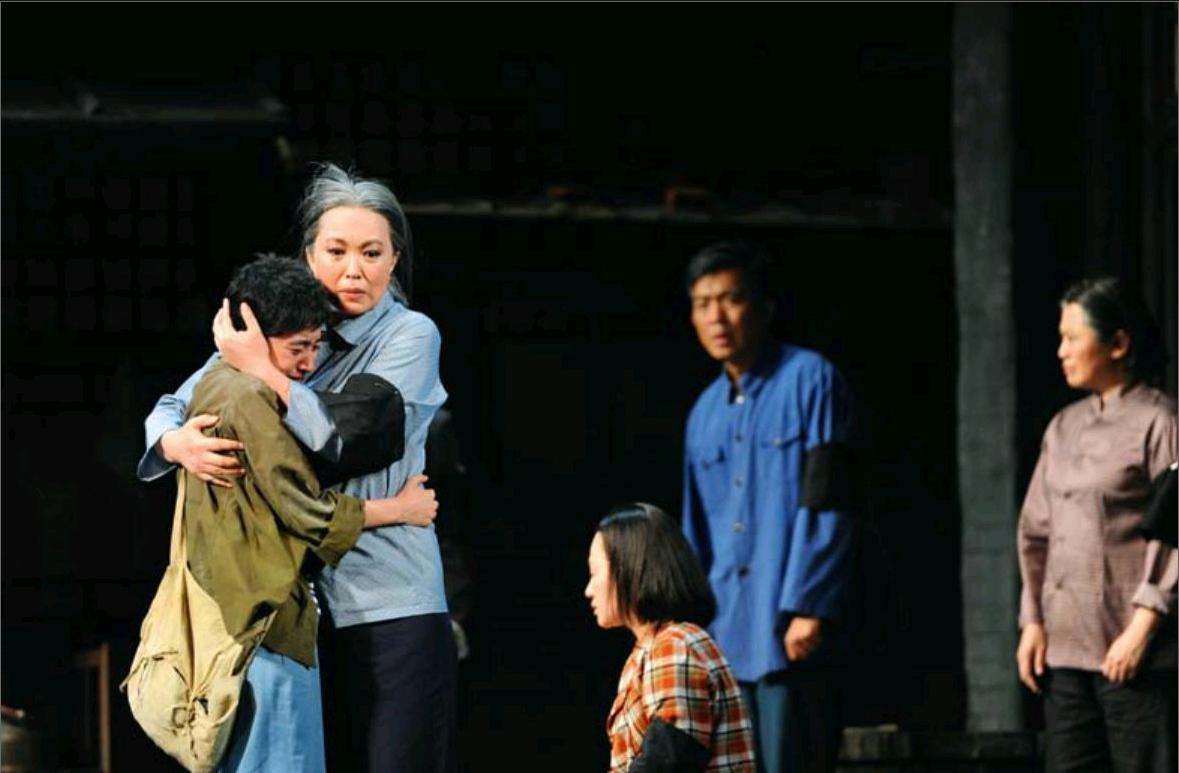
The magnum opus of contem- porary Chinese dramatist Li Longyun (1948-2012), Xiaojing Hutong was created in 1981 and debuted at the Capital Theater in 1985. Set in a hutong (backstreet or alley) named Xiaojing in southern Beijing, the drama portrays the ups and downs its local residents endured across three decades from the late Kuomintang reign until the end of the “cultural revolution” (1966-1976), mirroring the tortuous path the Peoples Republic of China walked during its first 30 years.
In 2012, Beijing Peoples Art Theater decided to revive the drama. In 2013, Xiaojing Hutong was restaged at the Capital Theater, and a year later at the National Center for the Performing Arts.
Many compare Xiaojing Hutong to Teahouse, a drama created by renowned dramatist Lao She in 1957, which is still globally popular. Both trace the rise and decline of the country through ordinary lives and feature strong flavors of Beijing hutong culture and deep contemplation of history – not purely rational, but based on daily struggles of local residents from all walks of life.
Xiaojing Hutong depicts a plethora of characters residing in the hutong, including a tram worker, a noodle restaurateur, a petty proprietor, a former prostitute, and Kuomintang police and soldiers. Even in war time, local residents still abide by the moral codes passed down from their forefathers, and in this way, they maintain dignity. The hutong in which they live, of course, is neither “Peach Blossom Land”(a secluded place to take refuge) described by ancient Chinese poet Tao Yuanming nor the “Nation of Amity” described by Li Ruzhen, a famous writer of the Qing Dynasty (1644-1911), in the fantasy novel Flowers in the Mirror. Life is tough in Xiaojing Hutong, but most people get along well with their neighbors.
Even Little Huanzi, a character who is greedy, lazy, and shameless, doesnt subvert the moral codes that local residents follow.“Young Housewife,” however, a rural-born woman who married into the area, does make a mess in Xiaojing Hutong. As a devout “leftist,” she sticks her nose in everyones business during the “cultural revolution.” In the chaotic period, local residents almost see their humanity dissolve.
Compared to Young Housewife, Little Huanzi is hardly an antagonist. Local residents attempt to dissuade his behavior with strong rebukes and even slaps in the face. However, despite becoming enraged by Young Housewife, they dare not speak out. It isnt her own superpowers they fear, but her backing by the “social system” and“ideology” that no one could openly oppose. Her neighbors dont find relief until Little Huanzi sets her up for major public humiliation. Later, Mr. Shi, a restaurant keeper, collaborates with crematorium employees to have Young Housewife carried to the crematorium alive, which almost scares her to death.
Such mischief marks a big victory for the local residents over Young Housewife, which helps them regain their dignity. The plot can inspire laughter and tears at the same time. So is the profun- dity of stellar drama.
Li Longyun showed great talent in creating his characters. Xiaojing Hutong includes dozens. Except for nameless faces such as “Red Guards” and crematorium staffers, the others are vividly brought to life. In the play, Little Housewife becomes the paramount villain and is responsible for the suffering local residents endure during the “cultural revolution.” A peasant liberated through the “land reform,” she felt superior to everyone else during the era. In a time that confounded good and evil, she didnt see her destructive behavior as wrong, but just part of her fate. In some ways, this reflects the dramatists compassion. With his depiction of Young Housewife, the dramatist attempts to explain that the “cultural revolution” didnt erupt for nothing and wasnt just a conspiratorial power grab; it was a logical and inevitable historical step.
Xiaojing Hutong depicts a total of about 50 characters from five households and has 13 storylines. Needless to say, it is difficult to vividly portray the ups and downs of so many characters across three decades in a five-act drama. But, Li Longyun completed the task admirably, likely enabled by similar experiences in his hometown. He shared the same fate, life and feelings as the characters he depicted. He loved the characters and understood the kindness at the bottom of their hearts. None of his characters are perfect, and the dramatist injected compassion into their defects and helplessness. In this way, the drama still radiates warmth and the bright side of human nature as it depicts dark times such as the Anti-Rightest Movement and the “cultural revolution.”
The profound reflections on history featured in Xiaojing Hutong generated a considerable impact on China in the 1980s. The drama contains greater cultural connotations than most other famous reflective literature of the era. The reflections on history that the dramatist made are not depressing, but eyeing a brighter future. More importantly, he explored the eternal goodness hidden in the hearts of Xiaojing residents. Such goodness is attributed to long influence of traditional culture.
Xiaojing Hutong has been cited by renowned Chinese drama critic and historian Wang Jisi as one of the “Top 10 Serious Dramas of Contemporary China.” As a representative drama of the 1980s, its lofty position is beyond debate. The revival of Xiaojing Hutong, directed by Yang Lixin, who appeared in the 1985 original, has solidified the plays status as a classic. Todays spectators still see humanity as the eternal theme. After the dramas 1985 debut, Li Longyun wrote: “The countryside is the foundation of a writers survival. It creates my dignity and paints the bottom of my soul. It teaches me what is good, what is right, and persistence, and about the dignity of ordinary people.” Even today, the drama remains touching. This is largely due to the true-to-life characters. The fictional ordinary people give life to the drama, but more importantly, their lives inject breath into history.
