Dawn of Digital Dunhuang
2014-11-24 05:29:46byHuangLiwei
China Pictorial 2014年11期
by+Huang+Liwei
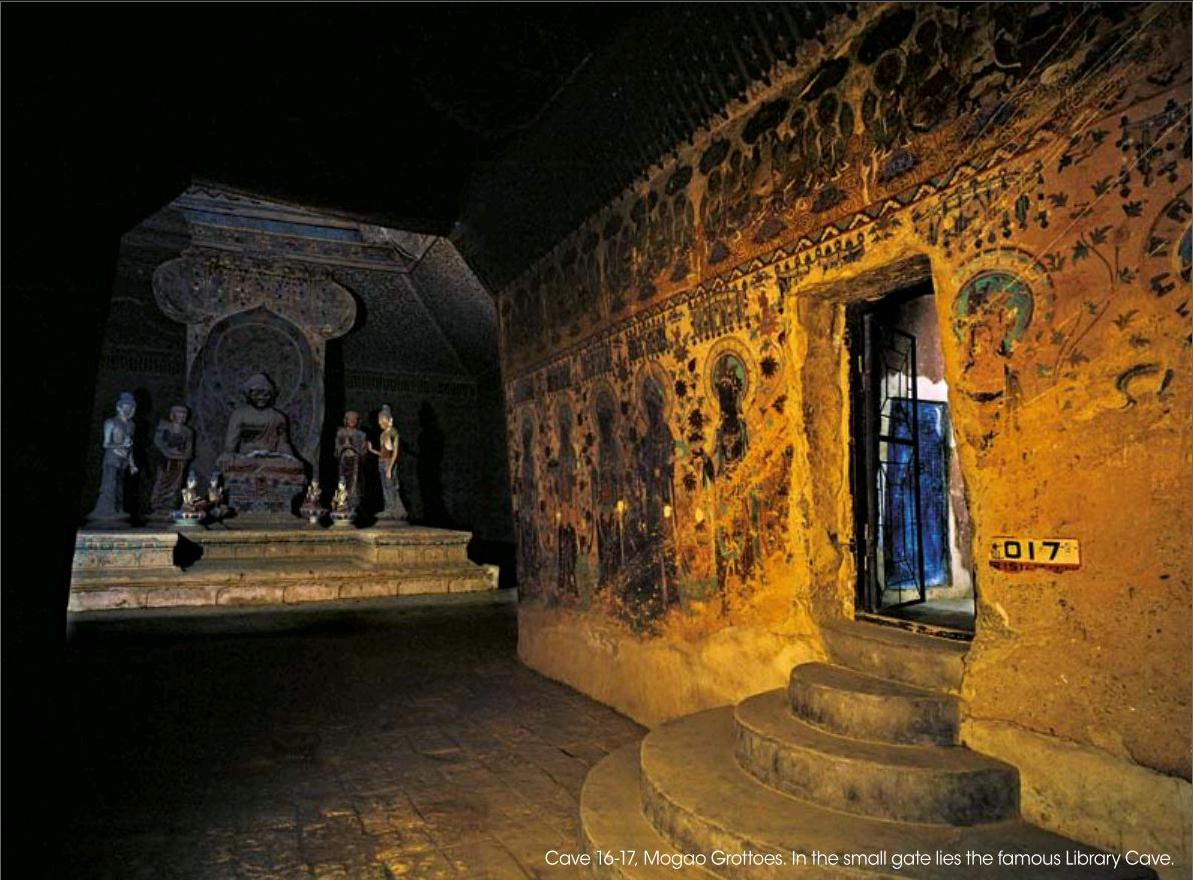
Dunhuang, once an important cultural and economic hub, gradually faded from prominence as the Ming Dynasty (1368-1644) government closed the Jiayu Pass. The Mogao Grottoes in Dunhuang, once a gallery of ancient art, ultimately fell into ruin by the early 20th Century. Shortly after the Library Cave was discovered a century ago and began attracting Western explorers, relics and documents were looted, and frescoes and painted sculptures were devastated. The grottoes thus suffered both natural and human damage.
In order to restore and protect the Dunhuang Grottoes, National Dunhuang Art Institute, which later became Dunhuang Academy, was founded in 1944.
Protection & Precaution
When the institute was first established, organizers started from scratch. Amidst far-from-ideal circumstances, Chang Shuhong, the first director of the institute, led his team in clearing sand from the lower caves, building stairs to connect caves and installing doors on a few. After two years of hard work, an 800-meter-long wall was erected to fend off flocks of sheep, thieves and sand storms. But with limited labor and economic resources, their efforts could only hope to slow further deterioration. Only after the founding of the Peoples Republic of China in 1949 did protection and maintenance of the grottoes become an officially recognized national project.
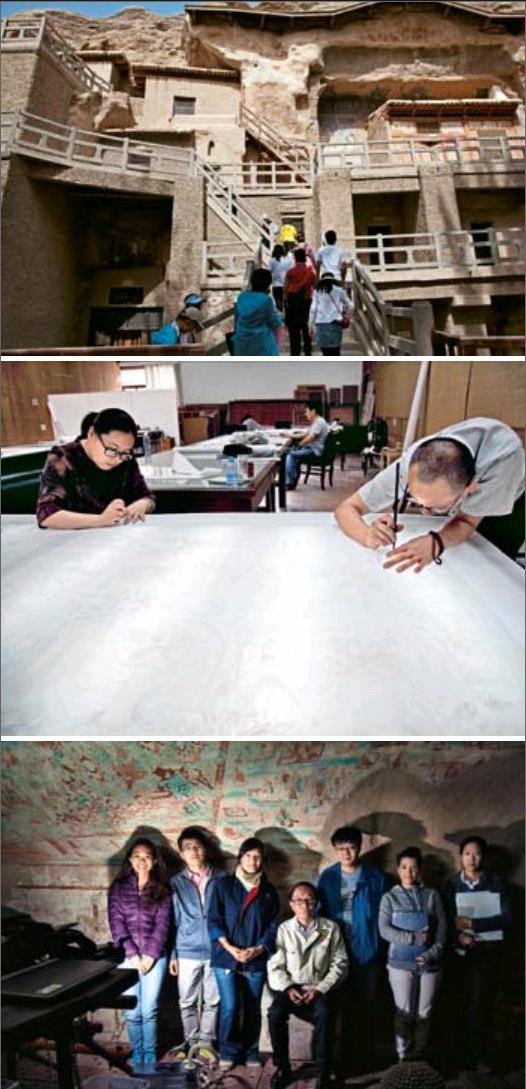
Already a desirable destination for artists and historians, Dunhuang has now become a mecca for scientists involved in relic protection, with over 60 technicians with various academic backgrounds including computers, chemistry, physics, and geology, permanently stationed there. “We are using hard science to learn more about the humanities,” remarks Su Bomin, head of the protection department of the Dunhuang Academy.
“My major was chemistry,” adds Su. “So, at the very beginning, I didnt find the caves very interesting. I considered them all identical and even boring. As I grew to understand them more, I gradually fell in love with the frescoes.” Contrasting historians and artists, Su focuses on the murals health rather than content. He precisely analyzes the state of the relics with the most advanced instruments. Su endeavors to cure frescos plagued by “disease,” a mission which frequently leaves him gleaming when his “patients” regain health.
The academy introduced an entire suite of technology for fresco analysis, which produced a comprehensive index about the caves. The ancient frescos were created with diverse drawing methods and pigments, but sometimes variances are so slight that they can hardly be noticed by the naked eye. New technology helps staffers “see”more detail and verify original pigments, which greatly enhances renovation efforts. Previous protection focused primarily on repair work in the wake of damage, which not only lost original characteristics, but often caused new problems. In recent years, protection began focusing more on precautionary measures. The academy strengthened analysis of deterioration causes and researched how salinity, temperature and humidity affect frescos. In 1989, the academy started cooperating with US-based Getty Conservation Institute. The joint research efforts not only minimized damage during restoration but also produced cures for common ailments afflicting the relics.
The highest standards of relic protection have underscored the importance of maintenance of the surrounding environment to minimize direct stress on the relics themselves. Last May, a comprehensive monitoring system began operation, which covers the macro environment of the Mogao scenic area, the caves micro environment, relics, tourism traffic and working staff, as it determines an environmental index including factors such as temperature, humidity, and concentrations of carbon dioxide and nitric oxide.
Digital Dunhuang Grottoes
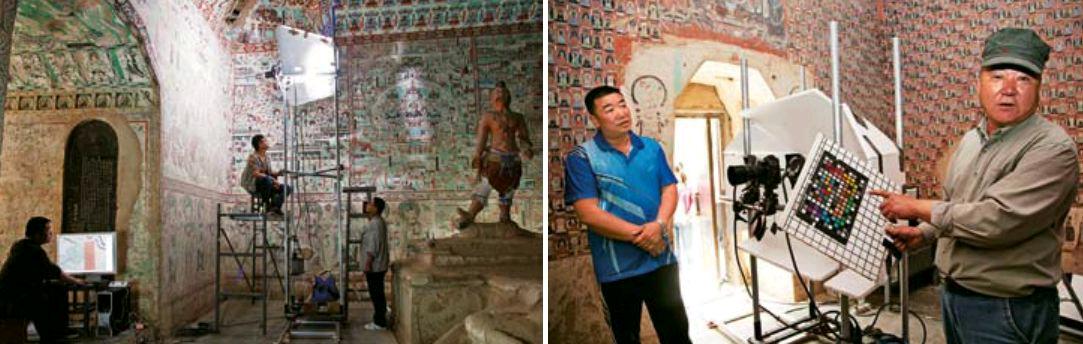
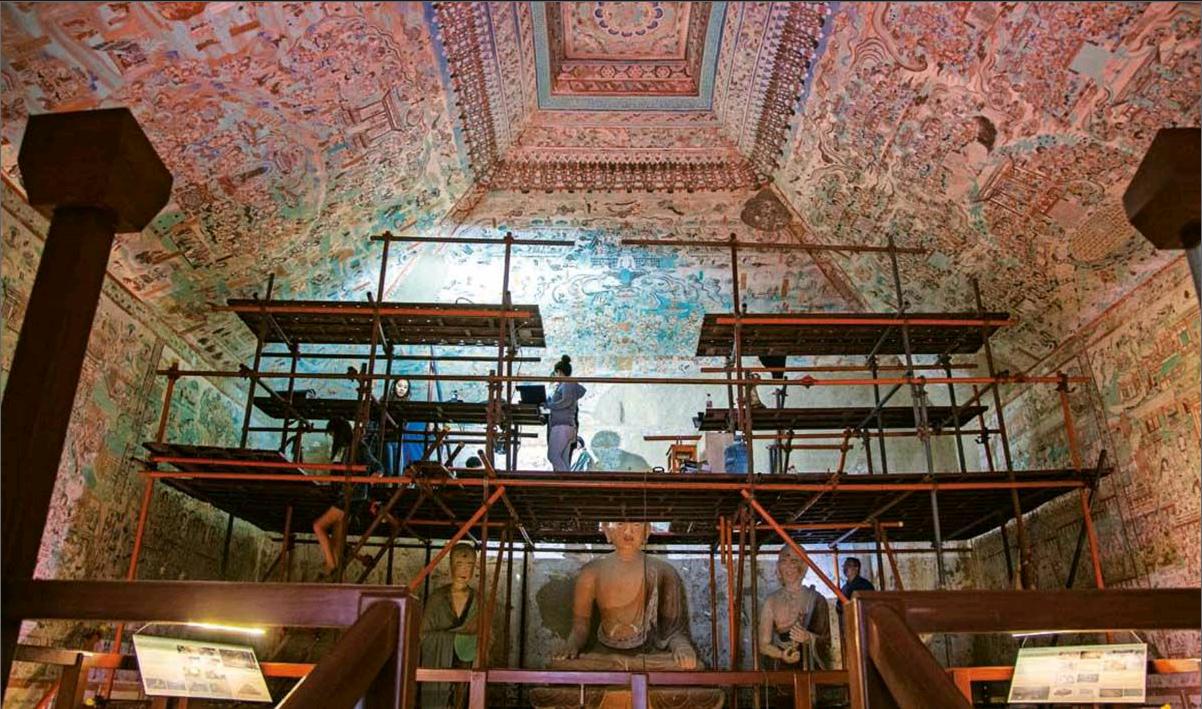
October was off-season for the Dunhuang Grottoes. In a temporarily closed cave, Sun and his team set up a track to support cameras, with reflective devices creating natural light and causing no damage to the caves. Their mission is the most basic but important task in establishing Digital Dunhuang Grottoes: digital analysis. They collected more than 5,000 high-resolution pictures over two months of work in the caves, but still need more time to finish it entirely.
Thanks to technologies of photogrammetry and remote sensing, virtual Mogao Grottoes will be born on a computer – not an easy task. In the digital center, over 20 professionals arrange mosaics of pictures. A mosaic for an averaged-sized cave requires the merging of more than 4,000 individual images. The center must col- lect and process about 100,000 pictures every year. Since the founding of the center in 2006, its staff has completed image collection for 80 caves and pieced together those of 30 caves.
The Digital Dunhuang Grottoes can be “moved” anywhere, becoming accessible to a greater audience and enabling a wider range of scholars to study them. Also, digital Dunhuang can produce virtual three-dimensional caves, which make actual “touch” of the caves possible, according to Wu Jian, head of the center. Such an experience has already been realized in Mogao Grottoes Visitor Center.
In the centers Dome Theater, visitors are given the sensation of physically entering the actual grottoes, which allows them to remotely appreciate some of the most revered caves of various dynasties. Additionally, they can even zoom in on an image, which creates an even richer experience than real-life.
In order to ease the stress on the caves caused by tourists and better protect the landscape and environment surrounding the relics, the center keeps some distance from the reserve area of the grottoes and lies near Dunhuang airport and railway station. The center also includes a digital and multimedia display area, a digital and a dome theater as well as a shopping center. Visitors can first acquire cultural information about the Dunhuang Grottoes in the center and then experience the real caves with professional guides.
The digital Dunhuang project not only aims to protect the relics themselves but takes the bigger picture into consideration. And it helps strike a balance between protection and use. Most importantly, the physical Dunhuang Grottoes could still ultimately end up as dust, but digital Dunhuang can perfectly preserve the historic treasure forever.