
Influence of airflow uniformity over the duct outlet of vehicle air-condition on cooling performance*
2014-07-31 20:22:31ChenguangLAIKaipingWENChaoMAN
機床與液壓 2014年2期
Chen-guang LAI ,Kai-ping WEN,Chao MAN
1College of Vehicle Engineering, Chongqing University of Technology, Chongqing 400054, China;2Institute of Fluid Science, Tohoku University, Sendai 980-8577, Japan
Influence of airflow uniformity over the duct outlet of vehicle air-condition on cooling performance*
Chen-guang LAI?1, 2,Kai-ping WEN1,Chao MAN1
1CollegeofVehicleEngineering,ChongqingUniversityofTechnology,Chongqing400054,China;2InstituteofFluidScience,TohokuUniversity,Sendai980-8577,Japan
CFD (computational fluid dynamics) method is applied to research the influence of airflow uniformity over the duct outlet of vehicle air-condition on cooling performance. Considering the solar radiation and body heat dissipation, the cooling processes of two airflows with the same flux and different uniformity are simulated. The result shows that the airflow with higher uniformity is beneficial to cooling performance and thermal comfort by comparing the cooling time, flow field and temperature distribution. The reasons are also analyzed using the submerged turbulent jet theory.
Vehicle air-condition, Cooling performance, Airflow uniformity, Turbulent jet, Thermal comfort
1.Introduction
Energy conservation and environment protection are the basic subjects for the development of vehicle. The air-condition which consumes the power of vehicle is an indispensable part both for the traditional combustion engine vehicle and the new energy vehicle. On the premise of satisfying the demand of occupant thermal comfort, improving the work efficiency of vehicle air-condition is the requirement of energy saving and emission reduction.
Many studies are focus on the improvement of the efficiency of vehicle air-condition. According to PENG Xin[1], the contribution of the air-condition compressor to the power dissipation accounts for 5%~20% of total dissipation, hence some new techniques such as wind refrigeration and waste heat cooling are performed to improve it. From LU Zubin et al.[2] and YANG Juan[3], it can be seen that the condition of flow field in cab determines the cooling efficiency and the thermal comfort of passengers. A series of contrastive researches with different cooling air inlet/outlet position, inlet pattern, inlet velocity and angle were carried out to analyze the influences. Ashok Patidar et al. Reference[4] investigated the fluid flow for three different modes of a vehicle air-condition system and judged the performance by parameters like air discharge rate at cabin level and pressure drop through the system. The uniformity of air flow is an important factor to affect the cooling performance and passenger thermal comfort, and deserves to study in details.
The computational fluid dynamics (CFD) is applied in the present work. The cooling processes of different airflow uniformities are simulated. In this study, the cooling time and passenger thermal comfort are regard as the criteria, and the velocity and temperature flied is analyzed using the turbulent jet theory.
2.Model and mesh
The cabin model for this research is shown in Figure 1. The engine bay and the trunk are ignored for they have little influence on the flow field in the cabin. The model is a full scale model and is appropriately simplified to reduce the time on generating mesh. Three duct outlets, which relative to the cabin are inlets, are seated on instrument board and two air return opening at the bottom.
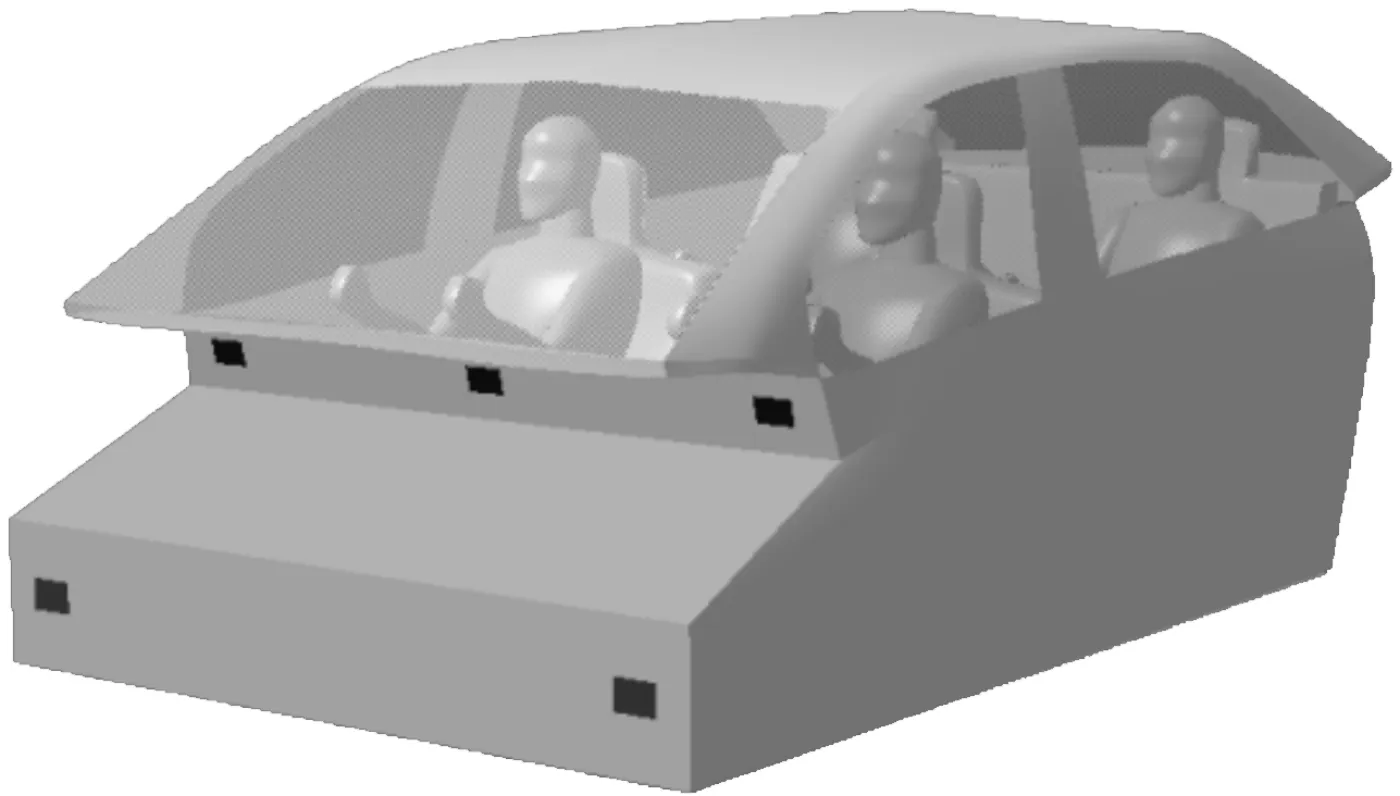
Figure 1.The cabin model
The unstructured tetrahedral cells are used in the simulation. To guarantee the computational precision and control the total number of grid, mesh density areas are created in the large gradient place. Figure 2 shows the surface mesh distribution.
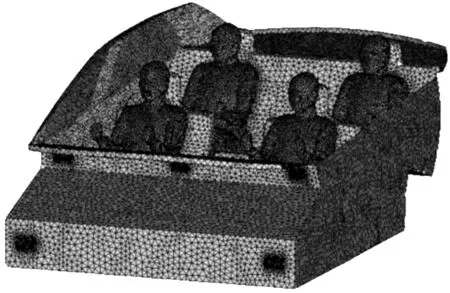
Figure 2.The surface mesh distribution
3.Turbulent model and radiation model
The airflow in the cabin is considered as incompressible turbulent flow. The natural convection caused by the change of air density is simulated by Boussinesq model in software Fluent. This model treats density as a constant value in all solved equations, except for the buoyancy term in the momentum equation. The Realizablek-εturbulent model is chosen for the present study because it can give a better jet expansion angle[5]. Considering the solar radiation, DO Irradiation solar radiation model is chosen to simulate the radiation in Chongqing, China. The total radiant intensity is 866.2 W/m2.
4.Boundary conditions
The uniformity index is used to evaluate the flow uniformity, and which is given by:

Figure 3 shows two different uniformity index airflows from the outlet. Both are velocity inlet and have the same temperature of 17 ℃. As shown in Figure 3, case A is the constant velocity of 3 m/s, and case B has the lower uniformity index with high velocity in the center and low velocity around. Their flux is the same as 0.014 kg/s.
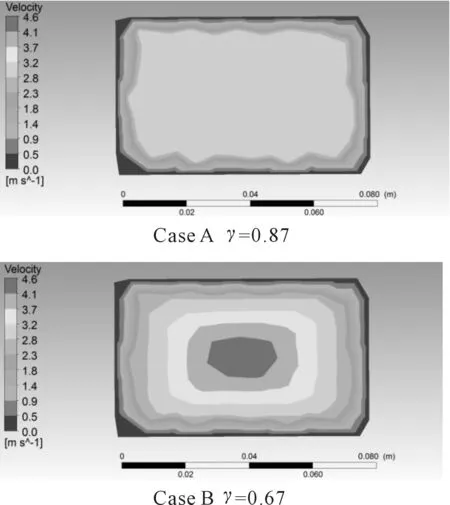
Figure 3.Two different uniformity velocity inlets
Car body and glasses are heat convection boundary condition and glasses are considered as semitransparent wall. Occupant body is heat flux boundary condition with the heat rate of 58 W/m2[7].
5.Result and analysis
5.1.Cooling time
The initial cabin temperature is 323 K (50 ℃). In case A, the temperature decreasing from 50 ℃ to 30 ℃ spends 11 min, about 1 min less than that of case B (as shown in Figure 4). After 13 minutes, there is no obvious change and difference between two kinds of airflow.
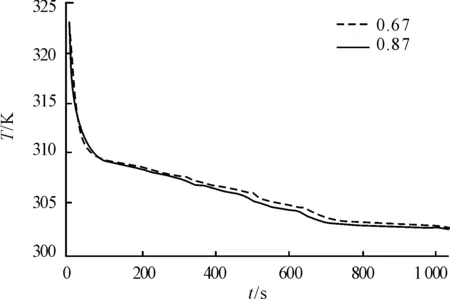
Figure 4.The cooling time
5.2.Jet range
Jet is the fluid ejected from orifice or slit and then blended with the surrounding flow. The airflow ejected from vehicle air-condition is a kind of typical Jet. Figure 5 shows the jet range of two kinds of airflow. The jet range of case A is longer and wider than that of case B. After the flow jets out, it will draw the static hot air in cabin. As the process going, the range expends and the center velocity decreases.
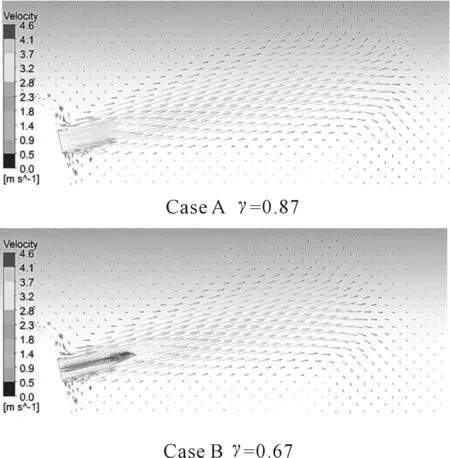
Figure 5.The contrast of jet range
Figure 6 shows the cross section velocity contours of the airflow ejected from the middle air-condition duct outlet. The valueLmeans the distance to the instrument board. At the section of 0.15 m, the center velocity of case A decreased from 3 m/s to 2.6 m/s, and the velocity loss (0.4 m/s) is much less than that of of case B (2 m/s). At the section of 0.45 m, two airflows have the same center velocity of 1.9 m/s. At the section of 0.6 m, the center velocity of case A is larger than that of case B. By checking the processes of the two different uniformity index airflows, it can be seen that the airflow with higher uniformity have a longer jet length. Although there is a larger center velocity at the start, case B has lower boundary velocity so that the turbulent fluctuation caused by entrainment and admixture spreads to jet center faster.
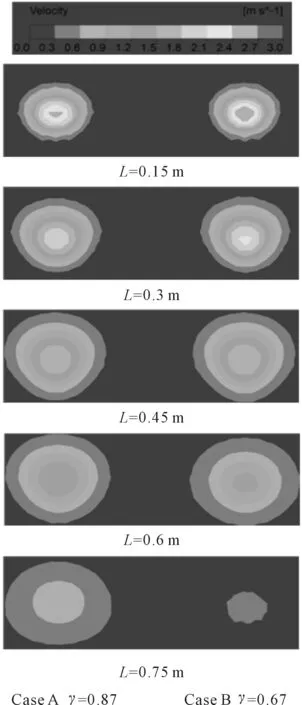
Figure 6.The velocity contours of cross sections (left is for case A, and right is for case B)
5.3.The center temperature
The process of velocity attenuation is also the process of heat transfer. It can be seen from Figure 7 that the center temperature of case B increases faster than that of case A, which means that the center of the airflow is affected by the surrounding heat air earlier and it exchanges heat more intense. Thecenter temperature increasing too early is not beneficial to the cooling of the whole cabin room. This is corresponding with the analysis of center velocity. It is noticed that the center temperatures of the two kinds of airflow suddenly increase faster at the section of 0.6 m and 0.7 m, respectively. Compared with the velocity contours, it is found that the location between these two sections is the place where the airflow converts from diffusion to shrink.
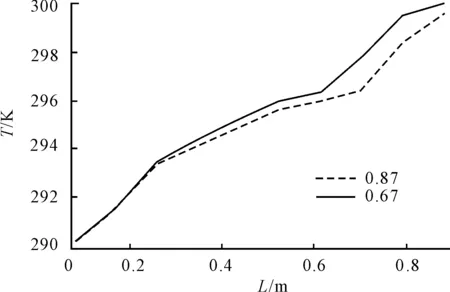
Figure 7.The center temperature comparison
5.4.The analysis of temperature field in cabin
The airflow ejected from the side air-condition outlet belongs to the forced submerged jet, which is limited by the door and the window. For this reason, only one side of the airflow entrains surrounding air so that the airflow attenuates slowly and has a longer range. Figure 8 shows the cabin temperature distribution at 20 min. It is obvious that case A affects more space and the temperature area from 25 ℃ to 27 ℃ is larger than that of case B.
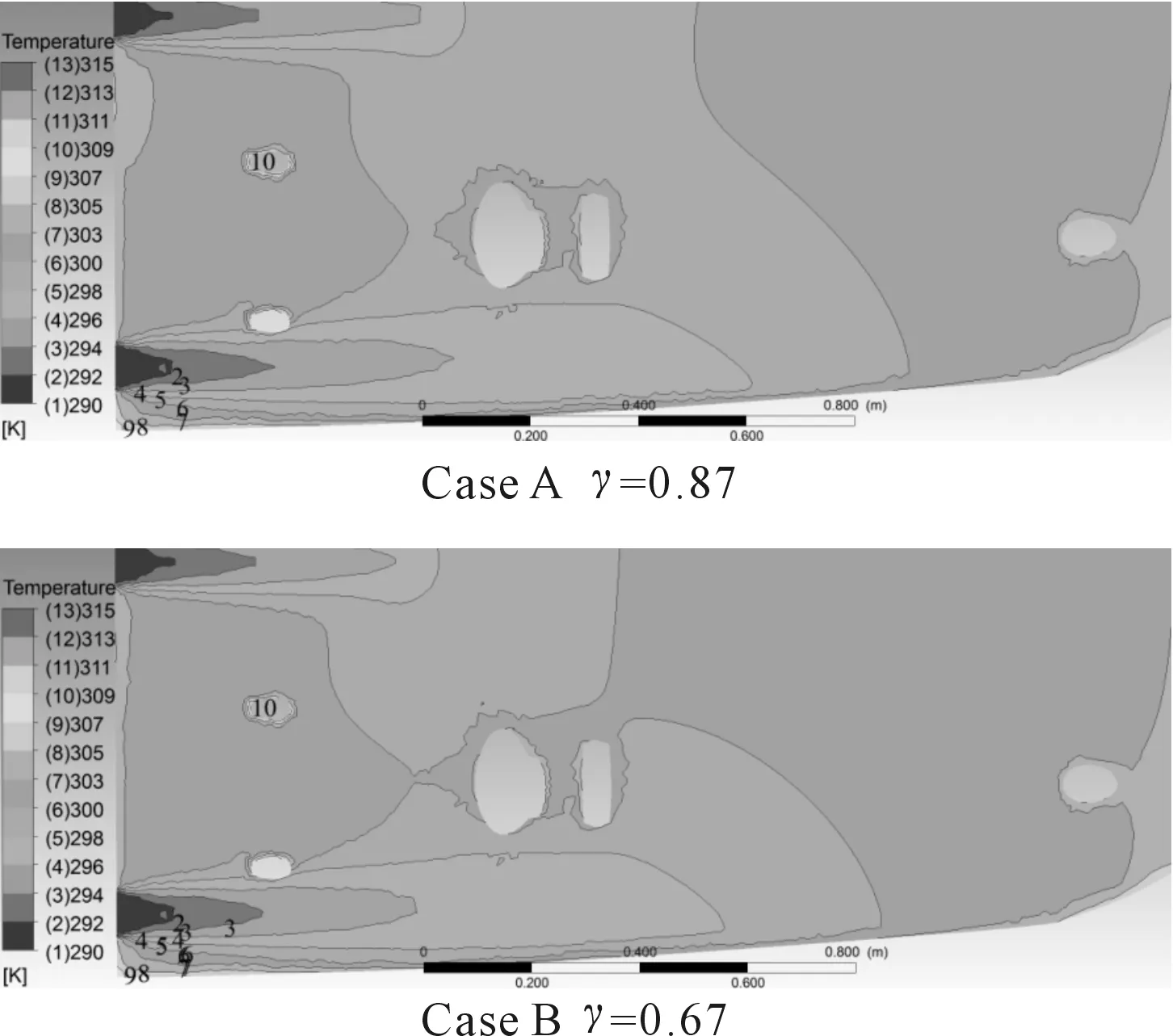
Figure 8.The temperature distribution in the cabin
5.5.The vortices analysis
The streamlines show the trails of airflow (as shown in Figure 9). At the front of the rear passengers, the vortices of case B are more intense than that of case A. The vortices, which against the cooling efficiency, are usually reduced or placed away from workspace in the designing of the air-condition system. The result indicates that the high uniformity index airflow contributes to reduce the vortices.
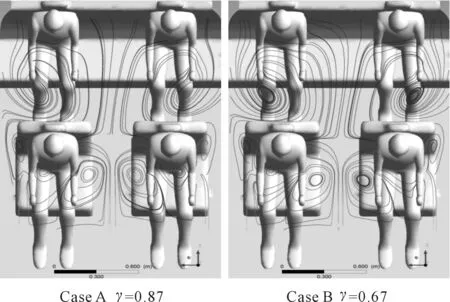
Figure 9.The streamlines in cabin
5.6.Occupant thermal comfort
Figure 10 shows the occupant thermal comfort range and the temperature at the body parts of the back-right row occupant at 20 min[7-8]. The temperature at almost all parts of the body of case A is 0.5~1 ℃ lower than that of case B. Comparatively, occupant feels better in the uniform airflow.
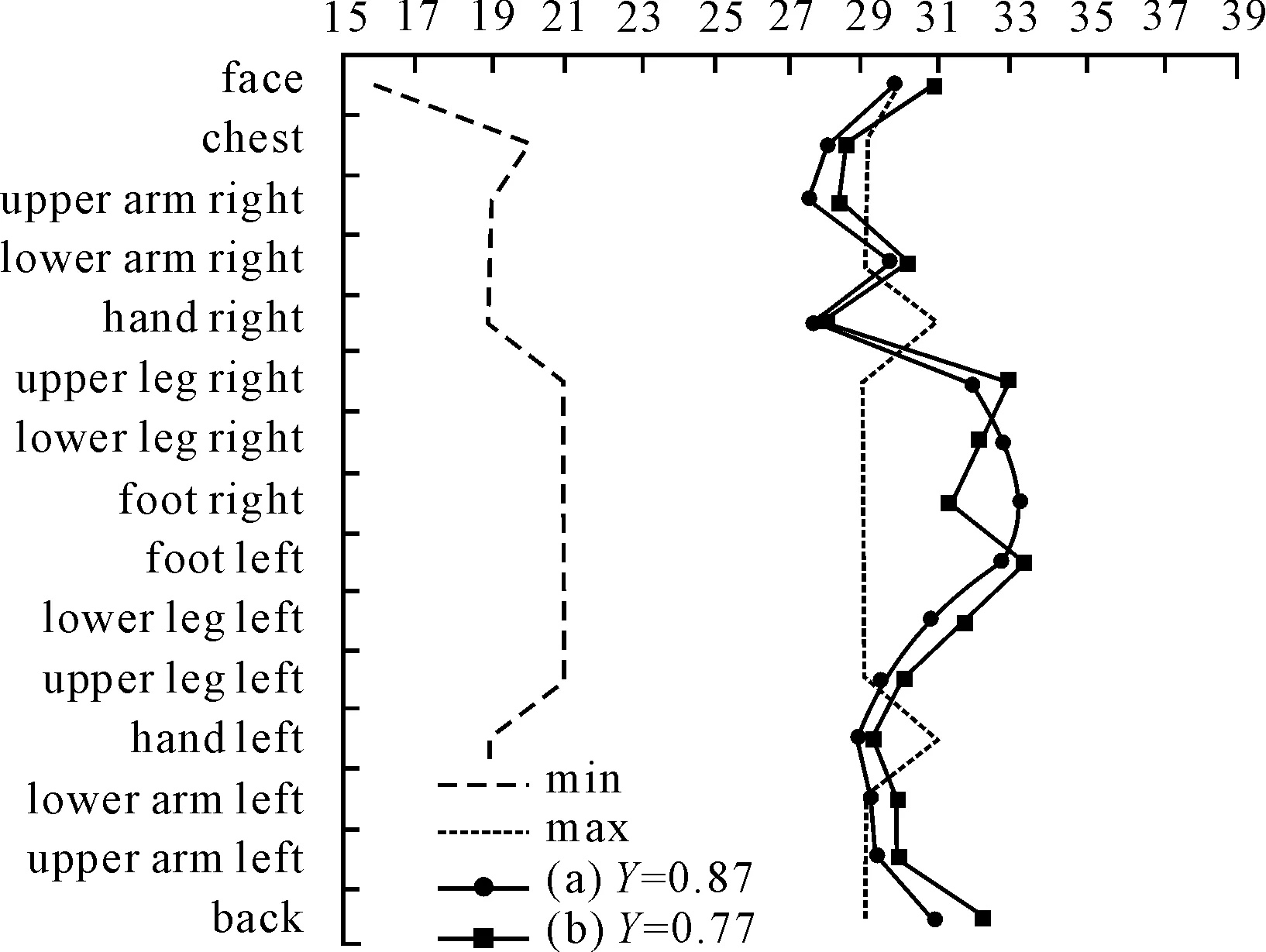
Figure 10.The occupants thermal comfort
6.Conclusion
The results from performed studies indicate how the uniformity of airflow influences the cooling performance. It has been shown that the airflow with higher uniformity is beneficial to keep the energy in the process of entrainment and admixture, so that the center velocity and the center temperature attenuate slowly. This makes the airflow spread further and absorb more heat. It is concluded that the airflow with higher uniformity is beneficial to the cooling performance and occupant thermal comfort, and it should be taken into consideration in order to optimize the vehicle air-condition system. Furthermore, from the view of energy saving and emission reduction, enhancing the uniformity over the duct outlet is an effective way to improve the utilization coefficient of the engine power.
[1] PENG Xin, JI Zhao-liang.Application and Development of Auto Air-conditioning Technology in China[J].Refrigeration Air Condition and Electric Power Machinery,2011(3):1-5.
[2] Lu Bingzu,The Numerical Simulation Research of the Influence of the Outlet Arrangement on the Cabin Thermal Environment[J].Beijing Automobile,2009(6):10-14.
[3] Yang Juan,The Numerical Simulation Research of the Airflow Organization in a Air Condition Car[D].Qingdao:Qingdao University,2006.
[4] Ashok Patidar,Shankar Natarajan and Manoj Panda.CFD Analysis and Validation of an Automotive HVAC System[C].SAE World Congress,2009,1(0535).
[5] Wen Zheng,Fluid Computing Application Tutorial[M].Beijing:Tsinghua University press,2013.
[6] Weltens,H,Bressler,et al.Optimization of Catalytic Converter Gas Flow Distribution by CFD Prediction[J].SAE,1993(0780).
[7] JIANG Tao,GU Zheng-qi,YANG Yi,et al.Influence of Solar Incidence on the Thermal Comfort of Car Occupants[J].Journal of Hefei University of Technology,2011(8):1135-1137.
[8] Fiala D,Lomas K J,Stohrer M.Omputer prediction of human thermoregulatory and temperature responses to a wide rang of environment condition[J].J Biometeorology,2001.
汽車空調出風口氣流均勻性對冷卻性能的影響*
賴晨光?1,2, 文凱平1,滿 超1
1.重慶理工大學 車輛工程學院,重慶 400054;2.Institute of Fluid Science, Tohoku University, Sendai 980-8577, Japan
采用計算流體力學(CFD)的方法,研究了汽車空調出風口處氣流均勻性對冷卻性能的影響及其原因。考慮了太陽輻射和人體散熱對流場的影響,模擬了2種流量相同而均勻性不同的冷卻氣流對車室的降溫過程。通過對比2種冷卻氣流的冷卻時間、流場組織和溫度分布情況,發現均勻性好的冷卻氣流對車室的冷卻性能更好,而且更有利于改善人體熱舒適性。結合淹沒紊動射流理論,從流體力學的角度分析討論了產生這種不同冷卻效果的原因。
汽車空調;冷卻性能;氣流均勻性;紊動射流;熱舒適性
U463.85+1
2014-04-05
10.3969/j.issn.1001-3881.2014.12.004
*Project supported by National Natural Science Foundation of China(No.51305477),Natural Science Foundation Project of CQ CSTC (CSTC, 2011BB6113);Part of the work was carried out under the Collaborative Research Project of the Institute of Fluid Science, Tohoku University, Japan
? Chen-guang LAI, Professor. E-mail: chenguanglai@cqut.edu.cn
猜你喜歡
環球人文地理(2022年8期)2022-09-21 03:49:42
中學生數理化·八年級物理人教版(2022年3期)2022-03-16 05:55:08
當代陜西(2021年2期)2021-03-29 07:41:24
意林·全彩Color(2019年11期)2019-12-30 06:08:38
重慶行政(公共人物)(2018年5期)2018-11-06 07:42:18
建筑熱能通風空調(2018年5期)2018-07-09 03:16:38
池州學院學報(2017年3期)2017-10-16 01:38:35
今日重慶(2017年5期)2017-07-05 12:52:25
中國塑料(2016年3期)2016-06-15 20:30:00
消費者報道(2016年3期)2016-02-28 19:07:32

- 機床與液壓的其它文章
- Design and realization of signal acquisition digital system for leak detection of water supply pipeline*
- Experimental study of chip formation and cutting force during
- Adaptive strategy of error anomaly processing in human simulated intelligent control*
- Phase-Lock technology of full digital UPS based on DSP*
- Software development for on-machine measurement of large CNC gear shape*
- Intelligent automobile pedal controller based on CAN bus