
Influence of Patch Side of Heat-Ray Absorbing Film on One-Dimensional Unsteady Thermal Stresses in Window Glass
2014-04-24 10:53:34YoshitakaIyamaYoshihiroObata
Yoshitaka Iyama,Yoshihiro Obata
Department of Mechanical and Aerospace Engineering,Graduate School of Engineering,Tottori University,Tottori 680-8552,Japan
1 Introduction
Recent new offices and houses have been built with sufficient thermal insulating properties and air-tightness to save energy for air conditioning against the global warming.On the other hand,the window area has not so decreased from viewpoint of daylight and design.As a result,the energy loss via windows is estimated to be about 70%of total energy loss.It is important to decrease heat-ray from windows to save energy.
Some of solar radiation is reflected,the other is absorbed and the rest transmits through the glass of the windows into the rooms.We must increase the quantity of heat-ray reflected and/or absorbed to reduce the quantity of heat-ray transmitting into the rooms,because the total quantity of heat-ray reflected,absorbed and transmitting is constant.The new type glasses such as heat-ray reflecting glasses and heat-ray absorbing glasses have been developed.The former has demerits that the reflected light may blind driver′s eyes and that the disturbance to mobile phone may occur by blocking electromagnetic rays from outside.The latter has demerit that the glasses are heated by the absorbed heat-ray and heat cracking occurs often.Those glasses have also another demerit that they are expensive to change the existing conventional soda glasses with them.Recently,heat-ray absorbing films have been focused because it can be bonded to the existing conventional soda glasses and it is not so expensive relatively.
This film is made of polyethylene terephthalate(PET)and contains fine particles of metal which are dispersed uniformly.Each fine metal particle absorbs the solar radiation,becomes heat source and warms the film.The temperature of the film increases rapidly because the thickness of the film is very thin.Then the surface of the glass sheet is heated by the bonded high-temperature heat-ray absorbing film.Thermal stresses occur and often yield heat cracking in the sheet glasses.
In this paper,the temperature and thermal stress are analyzed theoretically and discussed.The sheet glass bonded with the heat-ray absorbing film is treated as the two-layered plate with different optical properties such as the absorptivity[1].Two models are assumed:One is that the heat ray absorbing film is bonded at the exterior side;the other is that the heat ray absorbing film is bonded at the interior side.The difference of the position bonding heat-ray film with sheet glass is discussed.
2 Analysis
2.1 Analytical model
We consider a sheet glass bonded with a heat-ray absorbing film as a two-layered plate as shown in Fig.1.Fig.1shows a case that the heatray absorbing film is bonded at the interior side;the other case that the film is bonded at the exterior side is also considered.The thickness of each plate is b1for the exterior side and b2for the interior side,respectively.The origin of the coordinate is the bonded surface of sheet glass and film.The heat-ray I0incomes at the surface of x=-b1.Now we consider that the quantity of heatray incoming at the arbitrary position of xis I(x),because some of the heat-ray is absorbed along the way by the dispersed metal particle.We treat the unsteady problems of heat conduction and thermal stress that the absorbed heat-ray becomes the internal heat generation.We also assume the thermal boundary conditions that heat convection occurs at x=-b1and x=b2with heat transfer coefficient h1and h2between around air,respectively.
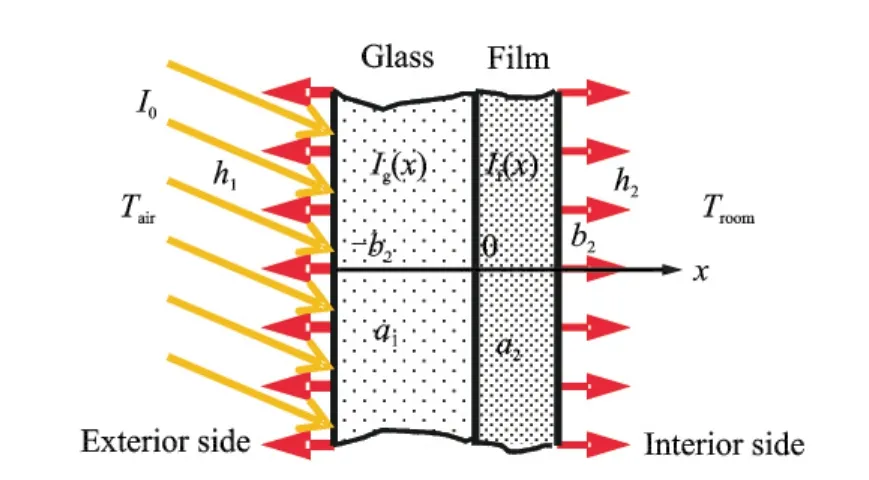
Fig.1 Analytical model of sheet glass bonded with heat-ray absorbing film at interior side
2.2 Influence of patch side of film on heat-ray performance
The heat-ray absorbing film is used by bonding it to the surface of the existing sheet glass.There are two patch sides:(a)interior side and(b)exterior side.We need to discuss the influence of patch side from two view points,the performance of heat-ray absorbing and the thermal stress.We focus our attention on the former in this section.
Although the brochure of glass manufacturer shows the total absorptivity which depends on the thickness of sheet glass,we have proposed the idea of the local absorptivity which does not depend on the thickness of sheet glass.We developed the passing heat-ray I(x)at the position x as follows[1]

where ais the local absorptivity and I0the incoming heat-ray at the exterior side surface.The total quantity of absorbed heat-ray in the sheet glass with thickness bis obtained as follows

where Ais the total absorptivity and b the thickness of the sheet glass.Although those equations are derived for the heat absorbing glass,we may apply these results to the very thin heat-ray absorbing film and the conventional glass with very low heat-ray absorbing property.Then the local absorbtivities of the heat-ray absorbing filmafand the sheet glass agare given as follows
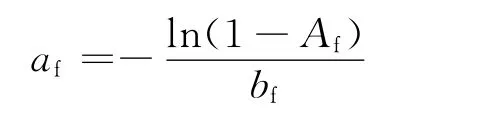

where the indexes f and g mean the film and glass,respectively.
Now we consider that the heat-ray absorbing film is bonded at the exterior side of the exiting conventional glass.The absorbed quantity of heat ray into the film is given as follows

Then the incoming heat-ray at the surface of the exiting conventional glass I′0is the difference between the incoming heat-ray at the film surface and the quantity absorbed in the film,namely

The quantity of heat-ray absorbed in the conventional glass is given as follows

The total quantity of heat-ray absorbed in twolayered plate which consists of the heat-ray absorbing film and the conventional sheet glass is the sum of Eqs.(4,6),namely

On the other hand,if we consider the case that the heat-ray absorbing gilm is bonded at the interior side of the exiting conventional glass,we may have the same result as shown in Eq.(7).Eq.(7)suggests that the total quantity of heatray is absorbed in this system regardless of whether the patch side of film is exterior one or interior one.
2.3 Transient temperature
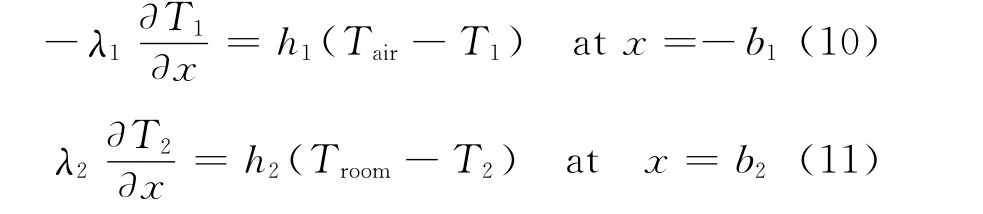
We assume the heat-ray absorbed at dispersed metal becomes into the heat generation.Then the governing equations in two plates at exterior and interior sides,under boundary conditions,the initial condition and the conditions of continuity are given as follows
Basic equations
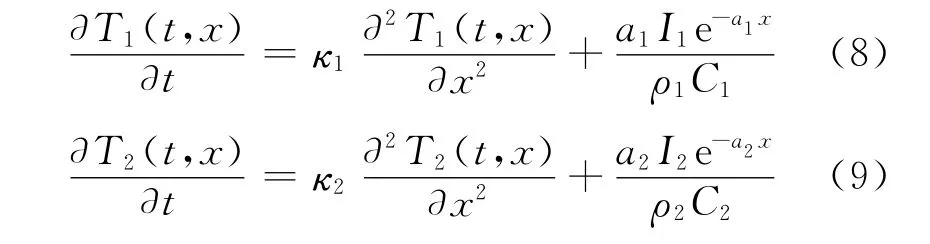
where

Boundary conditions
Initial condition

Conditions of continuity
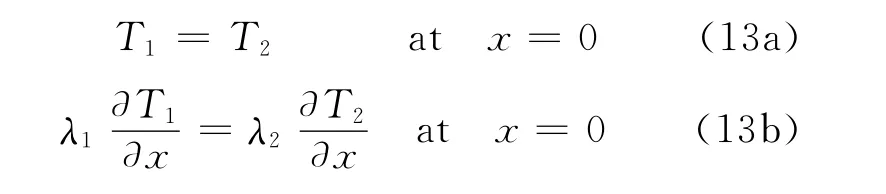
whereλ,ρ,Candκare the thermal conductivity,the density,the specific heat and the thermal diffusivity,respectively.Solving Eqs.(8,9)under the conditions Eqs.(10-13)gives the temperatures.
2.4 Transient thermal stresses
Apply the result of temperature to the thermal stresses of a plate.At the time t,assuming that the distribution of temperature is T(t,x),the strain and curvature at x=0areε0and r0,respectively,the thermal stressσ(t,x)is given by

where Gis the Young′s modulus,αthe coefficient of linear thermal expansion andνthe Poisson′s ratio.The strain and curvature at x=0,i.e.,ε0and r0,are determined to satisfy the mechanical boundary conditions if the elongation and bending are free or clamped.
3 Numeral Results and Discussion
3.1 Absorptivity
Table 1shows the total absorptivity of commercial heat-ray absorbing films and local absorptivity per unit length calculated by Eq.(7a).The thickness is referred to the catalogue of the heatray absorbing film maker.The total absorptivity depends on the thickness of film and the thicker film has the larger total absorptiyity.The local absorptivity per unit length is almost constant regardless of the thickness of films.This resultsuggests that our modeling of internal heat absorbing process is reasonable.The local absorptivities of the conventional soda glass and the heat-ray absorbing glass are 0.020,0.111[1],respectively.The absorptivity of the heat-ray absorbing film is about 50times the heat-ray absorbing glass and about 250times the conventional soda glass.We use these local absorptivities for the numerical calculation.
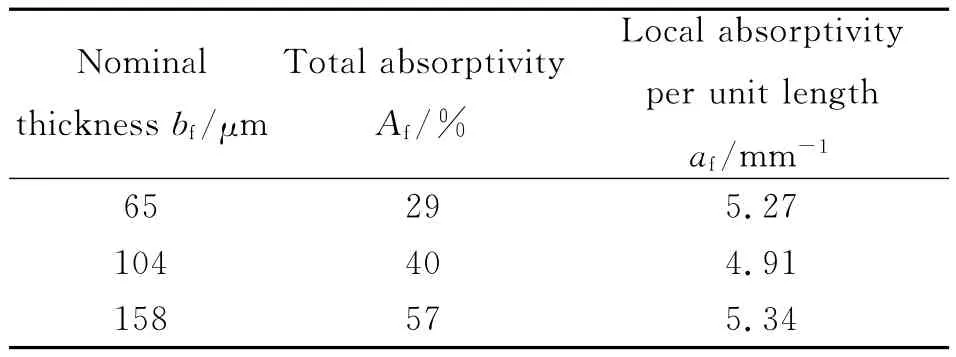
Table 1 Absorptivity of heat-ray absorbing films
3.2 Unsteady temperature and thermal stresses
Fig.2shows the unsteady temperature distribution in the soda glass with thickness 3mm bonded with the heat-ray absorbing film with thickness 104μm at the interior side.The temperature has sharp peak in the thin heat-ray absorbing film.The temperature distribution becomes steady state rapidly in the film,because the heat-ray passes in the film with light speed.The temperature distribution in the glass is almost linear at the all time.It is seem that the thin heatray absorbing film operates as the strong heat source to the soda sheet glass.Although the figure is not shown here,the temperature distribution in the sheet glass bonded with heat-ray absorbing film at the exterior side rises rapidly and the maximum temperature in the film is much larger than that in the case of Fig.2.
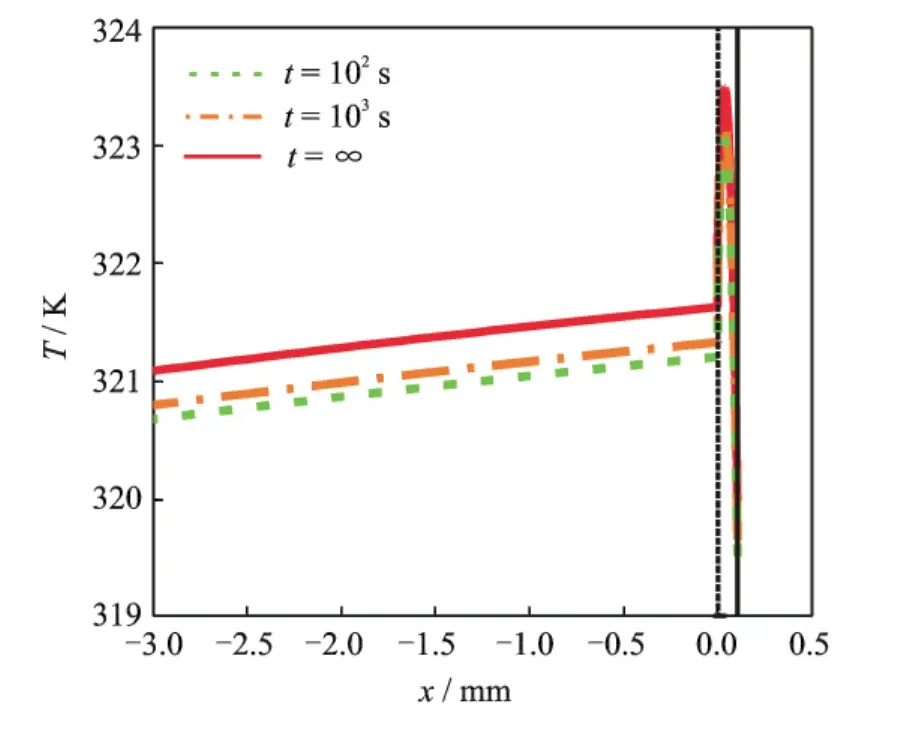
Fig.2 Unsteady temperature distribution in sheet glass bonded heat-ray absorbing film at interior side(bf=104μm)
Fig.3shows the distribution of unsteady thermal stresses in the sheet glass for the temperature distribution in Fig.2.The film is just treated as heat source in this paper because the Young′s modulus of the PET film is much smaller than the soda sheet glass.The mechanical boundary condition that the elongation is clamped and the bending is free is applied.The maximum stress appears at the steady state.
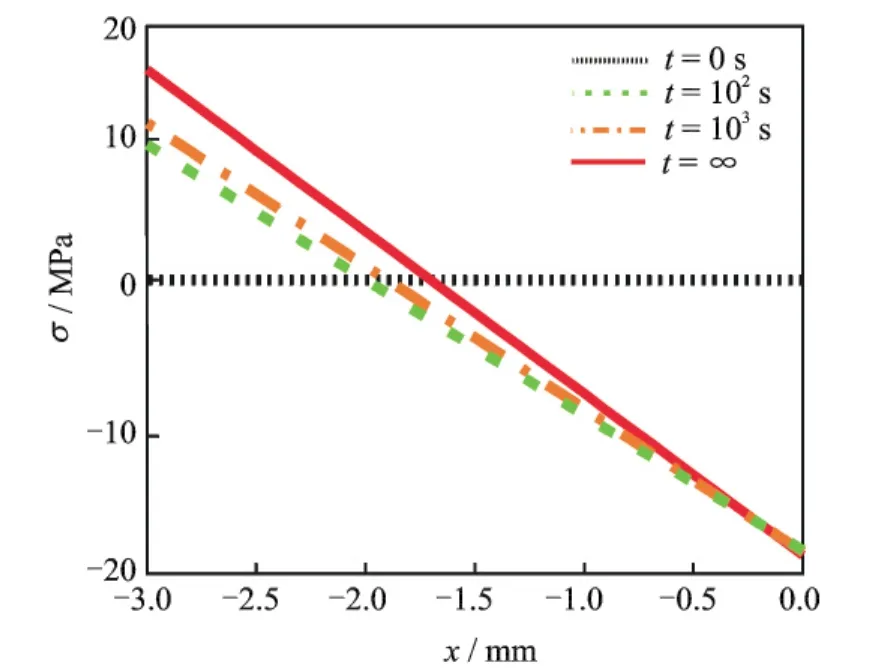
Fig.3 Unsteady thermal stress distribution in sheet glass bonded heat-ray absorbing film at interior side(bf=104μm)
3.3 Influence of film thickness
Now we discuss the influence of film thickness on temperature distribution and thermal stress distribution at steady state.The mechanical boundary condition is that the elongation is clamped and the bending is free.Results are shown in Figs.4,5.
From Figs.4,5we can see that the maximum temperature and stress with the thicker film are larger than that with the thinner film.It means that the thicker heat-ray absorbing film becomes the stronger heat source to the soda glass.
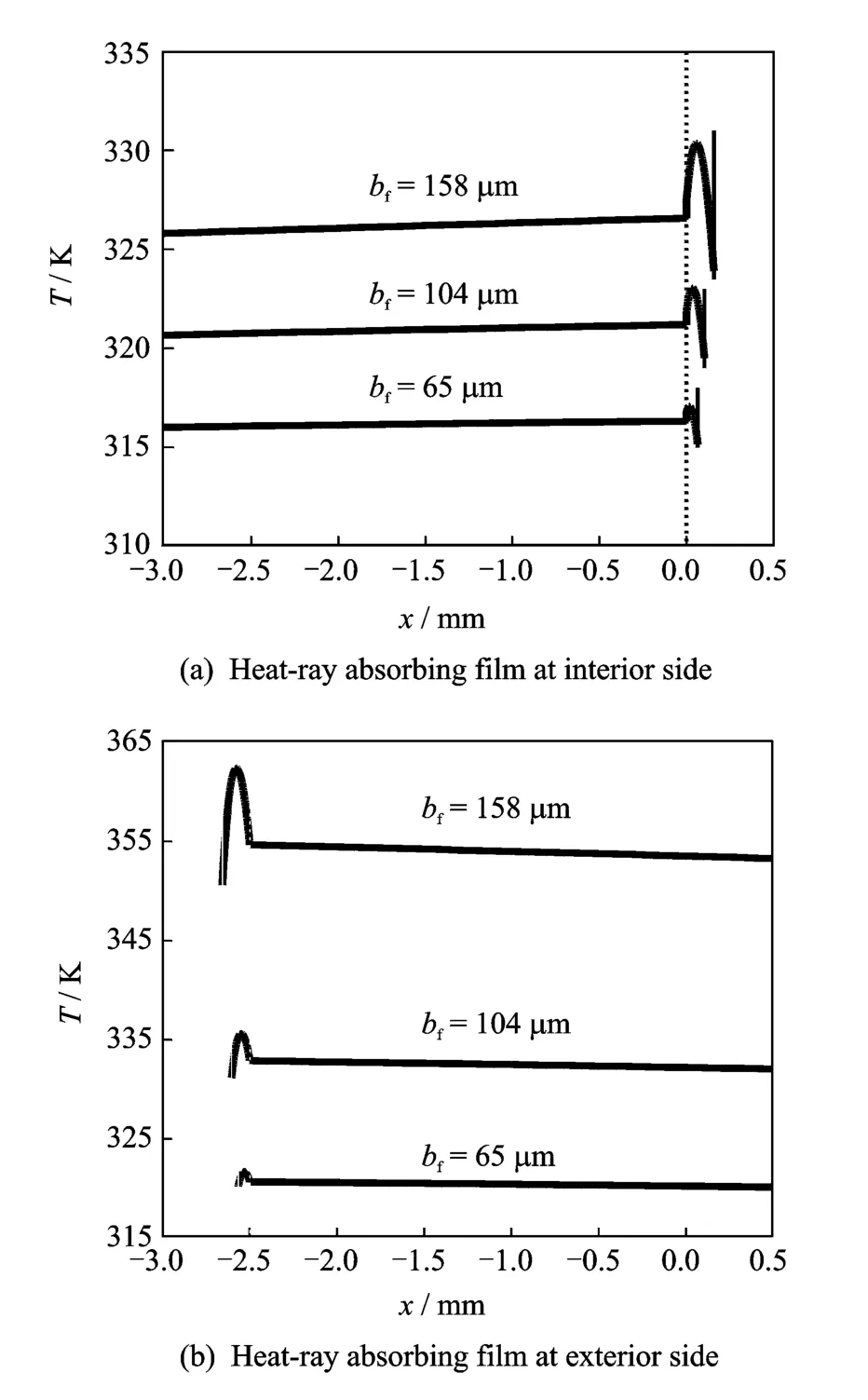
Fig.4 Influence of thickness of heat-ray absorbing films on steady temperature distribution
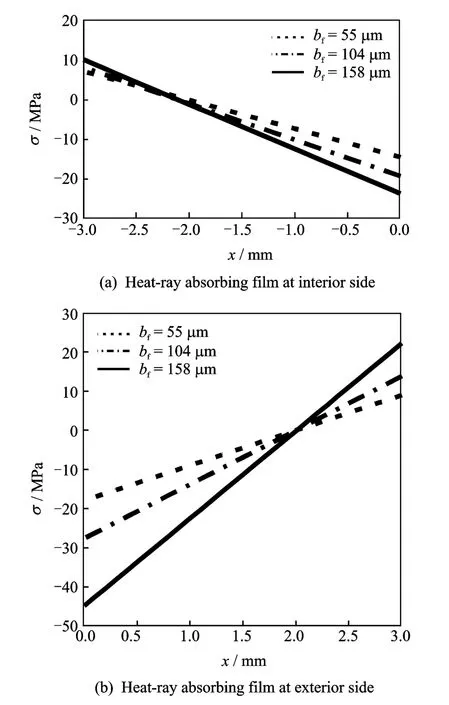
Fig.5 Influence of thickness of heat-ray absorbing films on steady thermal stress distribution
The comparison of the position of the film shows that the exterior side yields much larger temperature and thermal stress.On the other hand,the total amount of absorbed heat-ray is same regardless of the bonded-film position.These results suggest that the thicker film bonded at the interior side of the soda glass is recommended to decrease the heat-ray from window without heat cracking in the glass.
[1] Obata Y,Kono H,Hachiya T.One-dimensional unsteady thermal stresses in heat-ray absorbing sheet glass-Modeling of absorptivity difference depending on plate thickness[C]∥Proceeding of ACMFMS2012.Delhi:[s.n.],2012:329-332.
 Transactions of Nanjing University of Aeronautics and Astronautics2014年2期
- Transactions of Nanjing University of Aeronautics and Astronautics的其它文章
- Experimental Investigation to Evaluate LiFePO4Batteries Anode and Cathode Elastic Properties under Cyclic Temperature Loading Conditions
- Temperature-Dependence of Microstructure Evolution in a Ferroelectric Single Crystal with Conducting Crack
- Optimization of Injection Molding Process of Bearing Stand Based on BP Network Method
- Problem of Circular Hole in Thermopiezoelectric Media with Semi-permeable Thermal Boundary Condition
- One-Dimensional-Unsteady Thermal Stress in Heat-Ray Absorbing Sheet Glass:Influence of a Sudden Weather Change
- Thin Film Lithium-Ionbatteries Crack Initiation Due to Thermal and Electric Effects