
?In this issue?
2014-04-03 07:31:10
上海精神醫(yī)學(xué) 2014年2期
?In this issue?
We would first like to send our sincere thanks to Dr. Julia Lin who is stepping down after serving as one of our three Biostatistical Editors over the last two years. Dr. Lin provided consistent support in identifying contributors for the Biostatistics in Psychiatry section of the journal and in editing the manuscripts they provided. We are pleased to welcome Dr. Hua He from the Department of Biostatistics and Computational Biology at the University of Rochester in Rochester, New York who will replace Dr. Lin and work with our two other Biostatistical editors, Professors Ying Lu and Xin Tu.
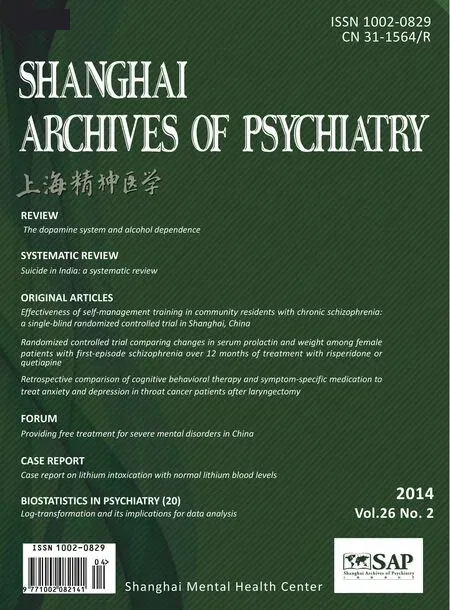
The review by Ma Zhu[1]that starts this issue focuses on research about alcohol use disorders – an issue that is of growing public health importance both globally and in China, but has not, as yet, captured the attention of Chinese mental health researchers. Recent results from the Global Burden of Disease Study for 2010 indicate that globally alcohol use disorders are the third most important mental disorder (after major depression and anxiety disorders) in terms of their contribution to disability life years (DALYs) lost,[2]and in China they are the second most important mental disorder (after major depression).[3]The currently available interventions for the prevention and treatment of alcohol disorders and other addictive conditions are of limited effectiveness, so it is important to further clarify the biosocial mechanisms that promote or inhibit the initiation and continuation of addictive behaviors. One promising line of inquiry has been the relationship of addiction and the dopamine system. This review evaluates research about the relationship of alcohol consumption and the dopaminergic system but finds that the available studies – only a few of which are from China – have contradictory results. The review discusses possible reasons for these inconsistent findings across studies and identifies the challenges that need to be addressed before the field can move forward.
The systematic review by Rane and Nadkarni[4]on suicide in India questions the accuracy of the suicide rates reported from India’s National Crime Records Bureau. Under-reporting of suicides is a problem in all countries but it is, perhaps, most prevalent in the many countries like India where suicide remains a criminal offense. This review identified 36 papers from Indian and international journals that provided data on suicide rates in the country. Some of the rural studies reported rates that were up to 8-fold the official rates reported by the National Crime Records Bureau. Rates were highest in young adults and, among young adults, they were higher in women than in men. The studies reported that economic deprivation, mental illness and interpersonal strife were the factors most closely associated with suicide. Hanging was the most common method of suicide; pesticide-ingestion and, among women, self-immolation were also common methods. Despite the overall weakness of the available data about suicide in India (heterogeneity between studies made it impossible to combine the results into a metaanalysis) the papers considered in the review describe a very different demographic pattern of suicide than that reported in high-income countries. Based on this review of the available evidence, the authors conclude that suicide prevention in India needs to start with the decriminalization of suicide (an issue that is currently under consideration by the government), restriction of access to pesticides, and improved monitoring of suicidal behavior. Interestingly, improving the identification and treatment of persons with mental disorders – the cornerstone of suicide prevention in high-income countries – is not considered a high-priority activity in the overall suicide prevention effort.
The first original research article by Zhou and colleagues[5]is a single-blind, randomized controlled trial that assessed the usefulness of training in selfmanagement in a sample of 201 community-dwelling individuals with chronic schizophrenia. The intervention included weekly group training sessions for 24 weeks based on the ‘UCLA Social & Independent Living Skills Program’.[6]This was followed by monthly booster sessions for 24 months. Over 96% of the 201 enrolled subjects completed the 30-month assessment protocol; this very high adherence rate may be related to the fact that all enrolled subjects were already registered in the municipal registry system of persons with severe mental disorders. Despite the chronicity of their condition (the mean duration of illness was 17 years), this low-cost, low-tech intervention resulted in impressive improvements in both clinical symptoms and social functioning that were sustained throughout the 30-month trial. This type of intervention is potentially most useful in low-resource settings where mental health personnel and resources are scarce or nonexistent. Further study of the intervention with younger, less chronic patients and in rural settings is needed to determine whether or not these exciting results can be replicated in other settings and in a less restrictive group of patients. Subsequent cost-effectiveness studies could provide the rationale for up-scaling the intervention to other sites around China.
The second original research article by Liu and colleagues[7]is a randomized controlled trial about weight gain and hyperprolactinemia in female patientswith schizophrenia following chronic administration of risperidone or quetiapine. The study randomized 80 first-episode, drug-naive female patients with schizophrenia to the two treatment groups (risperidone or quetiapine) and followed them up for 12 months. As expected, the clinical outcomes were similar, though risperidone achieved its maximum effectiveness somewhat earlier than quetiapine. The weight gain commonly seen with chronic administration of atypical antipsychotic medication (a 17% rise in BMI over 12 months in this sample) was also similar in the two groups, with most of the weight gain occurring in the first three months of treatment. However, the effect on serum prolactin was dramatically different in the two groups: serum prolactin was stable throughout the 12-month treatment period in the quetiapine group, but it rose 3.5 to 5.2-fold in the risperidone group. By the end of the study 25 of the 40 (62.5%) individuals in the risperidone group met criteria for hyperprolactinemia. This result is based on a relatively long follow-up (12 months) of a fairly large number (n=80) of drug-naive patients, so the result is not a short-term fluctuation in serum prolactin level, is not the result of fluctuations due to small sample size, and could not be attributed to differences in prior treatment. This study provides fairly strong evidence that the difference in the prevalence of hyperprolactinemia between risperidone and quetiapine is real and, thus, could result in subsequent differences in the prevalence of prolactin-related disorders in menstruation and bone metabolism. Longer follow-up studies are needed to determine whether or not the elevated serum prolactin levels persist with chronic administration of risperidone and whether or not the common negative effects of hyperprolactinemia become prevalent in women receiving this treatment.
The third original article by Chen and colleagues[8]is a retrospective comparison of cognitive behavioral therapy (n=62) and medications (n=56) to treat depression and anxiety symptoms in patients who are unable to speak because they have had a laryngectomy to treat throat cancer. Changes in the level of anxiety and depression before and after 8 weeks of treatment with cognitive behavioral therapy (in which patients’wrote down their responses or questions) or symptomspecific medication (buspirone for anxiety symptoms, sertraline for depressive symptoms, and both if the subject had both types of symptoms) were compared using the Zung Self-rating Anxiety Scale and the Zung Self-rating Depression Scale. Both treatments resulted in significant improvements over the 8 weeks. There were no differences in the outcomes between the two treatment groups, but mild to moderate adverse effects occurred in 32% of the individuals in the medication group. The successful application of cognitive behavioral therapy in this novel setting – where the respondent communicates by writing – is a clear indication of how robust this treatment method is for ameliorating the psychological problems that commonly occur with cancer. Clinicians in China need to be more proactive in identifying depressive and anxiety symptoms in patients with cancer or other life-threatening conditions and, if present, treating them appropriately.
The Forum by Zhu and colleagues[9]proposes that the Chinese government formally assume the responsibility of paying for the care of all individuals with severe mental disorders. Studies both in China and overseas clearly show that persons with severe mental illnesses and their families often live in poverty. Poverty affects the quality of life of the individual and his or her family members and decreases the likelihood that the patient will receive needed psychiatric and medical care. Failure to provide appropriate treatment results in greater disability, increased need for family care-givers (who, thus, are unable to go to work) and more frequent acute episodes of illness during which the individual can be a danger to self or others. Taken together, these consequences of under-treatment or inadequate treatment can have substantial negative effects on a community’s economic status. To address this problem the Chinese government started providing services for some persons with severe mental illnesses in 2004 when it established the ‘686’program that identifies, monitors and, occasionally, pays for the treatment of persons in the community who are at risk of creating social disturbances due to severe mental illness.[10]In most locations the 686 program is run by local public health doctors independently from the mental health system, but in some big cities ,like Shanghai, it is integrated with the overall mental health system. The integrated model results in more comprehensive coverage and better monitoring of patients. The program has grown considerably since 2004, but it is still only supporting the treatment of a small proportion of all individuals with severe mental illnesses. Given China’s rapidly improving economic situation, it is time to start providing comprehensive welfare programs for all citizens who truly need them. Persons with chronic mental illnesses are one such group. Local and national policies are needed to ensure the timely and appropriate care of these disabled citizens. This is both the ethical thing to do and it will probably benefit the overall economic status of the communities that undertake such policies.
The case report by Peng[11]describes a case of serious lithium intoxication in a patient who had a blood concentration at the low end of the therapeutic range (0.57 mmol/L). This is a reminder of the need to be constantly vigilant about the prodromal symptoms of intoxication in all patients taking lithium or any other psychiatric medication even when the blood levels are within the therapeutic range. The failure of the family to identify the potential danger when the patient initially developed appetite disturbances highlights the need for psychiatric clinicians to more fully inform patients and their and their family members of the risks and signs of lithium intoxication. And the failure of the emergency room doctors at the general hospital where the patient was first seen to identify the cause of the symptoms highlights the need to ensure that all physicians regularly ask their patients about the use of psychiatricmedication and that they know how to recognized and provide emergency management of adverse reactions to these medications.
The issue concludes with a Biostatistics in Psychiatry piece by Feng and colleagues[12]about the use of logtransformation in the analysis of non-normal data. Detailed assessment of the function of this commonly used procedure indicates that in most circumstances the log-transformation does not achieve the stated goals of reducing variability or of making the data conform more closely to the normal distribution. Moreover, the results of analyses based on log-transformed data may not represent real differences in the original data. The somewhat startling conclusion is that this standard method of dealing with non-normal data should probably not be used at all or, if used, should be used with extreme caution. The authors recommend abandoning this traditional approach to dealing with non-normal data and replacing it with methods that are much less dependent on the distribution of the data such as generalized estimating equations (GEE).
1. Ma H, Zhu G. The dopamine system and alcohol dependence. Shanghai Archives of Psychiatry. 2014; 26(2): 61-68. doi: hp://dx.doi.org/10.3969/j.issn.1002-0829.2014.02.002
2. Whiteford HA, Degenhardt L, Rehm J, Baxter AJ, Ferrari AJ, Erskine HE, et al. Global burden of disease aributable to mental and substance use disorders: findings from the Global Burden of Disease Study 2010. Lancet. 2013; 382(9904): 1575-1586. doi: http://dx.doi.org/10.1016/ S0140-6736(13)61611-6
3. Yang GH, Wang Y, Zeng YX, Gao GF, Liang XF, Zhou MG, et al. Rapid health transition in China, 1990-2010: findings from the Global Burden of Disease Study 2010. Lancet. 2013; 381: 1987-2015. doi: http://dx.doi.org/10.1016/S0140-6736(13)61097-1
4. Rane A, Nadkarni A. Suicide in India: a systematic review. Shanghai Archives of Psychiatry. 2014; 26(2): 69-80. doi: hp://dx.doi.org/10.3969/j.issn.1002-0829.2014.02.003
5. Zhou B, Zhang P, GuYW. Effectiveness of self-management training in community residents with chronic schizophrenia: a single-blind randomized controlled trail in Shanghai, China. Shanghai Archives of Psychiatry. 2014; 26(2): 81-87. doi: hp://dx.doi.org/10.3969/j.issn.1002-0829.2014.02.004
6. Liberman RP. Dissemination and adoption of social skills training: social validation of an evidence-based treatment for the mentally disabled. J Ment Health. 2007; 16(5): 595-623. doi: http://dx.doi.org/10.1080/09638230701494902
7. Liu JJ, Sun JS, Shen XH, Guo WG, Zhi SL, Song GM, et al. Randomized controlled trial comparing changes in serum prolactin and weight among female patients with firstepisode schizophrenia over 12 months of treatment with risperidone or queapine. Shanghai Archives of Psychiatry. 2014; 26(2): 88-94. doi: http://dx.doi.org/10.3969/ j.issn.1002-0829.2014.02.005
8. Chen J, Chen CC, Zhi SL. Retrospective comparison of cognitive behavioral therapy and symptom-specific medicaon to treat anxiety and depression in throat cancer paents aer laryngectomy. Shanghai Archives of Psychiatry. 2014; 26(2): 95-100. doi: http://dx.doi.org/10.3969/ j.issn.1002-0829.2014.02.006
9. Zhu Y, Zhang WB, Wang YF, Cai J. Providing free treatment for severe mental disorders in China. Shanghai Archives of Psychiatry. 2014; 26(2): 101-102. doi: http://dx.doi. org/10.3969/j.issn.1002-0829.2014.02.007
10. Ma H. Integration of hospital and community services—the ‘686 Project‘—is a crucial component in the reform of China’s mental health services. Shanghai Archives of Psychiatry. 2012; 24(3): 172-174. doi: http://dx.doi. org/10.3969/j.issn.1002-0829.2012.03.007
11. Peng J. Case report of lithium intoxication with normal lithium blood levels. Shanghai Archives of Psychiatry. 2014; 26(2): 103-104. doi: http://dx.doi.org/10.3969/ j.issn.1002-0829.2014.02.008
12. Feng CY, Wang HY, Lu NL, Chen T, He H, Lu Y, et al. Logtransformation and its implication for data analysis. Shanghai Archives of Psychiatry. 2014; 26(2): 105-109. doi: hp://dx.doi.org/10.3969/j.issn.1002-0829.2014.02.009
http://dx.doi.org/10.3969/j.issn.1002-0829.2014.02.001
A full-text Chinese translaon will be available at www.saponline.org on May 15, 2014.
- 上海精神醫(yī)學(xué)的其它文章
- Log-transformation and its implications for data analysis
- Case report on lithium intoxication with normal lithium blood levels
- Providing free treatment for severe mental disorders in China
- Retrospective comparison of cognitive behavioral therapy and symptom-specific medication to treat anxiety and depression in throat cancer patients after laryngectomy
- Randomized controlled trial comparing changes in serum prolactin and weight among female patients with first-episode schizophrenia over 12 months of treatment with risperidone or quetiapine
- Effectiveness of self-management training in community residents with chronic schizophrenia: a single-blind randomized controlled trial in Shanghai, China