
Environmental Injustice
2014-03-28 17:42:48byYinXing
China Pictorial 2014年3期
by+Yin+Xing
Domestic Inequality
Beijing, Tianjin, Hebei and Shanxi together are known as the Bohai Economic Rim. But now the area has a new embarrassing nickname: Haze Circle around the Capital.
The capital already has reasonable industrial and energy infrastructure; Beijings smog primarily comes from auto exhaust. According to the Tracing the Smog report from the Chinese Academy of Sciences, the biggest source of PM2.5 found in Beijing is vehicle emissions, which account for one fourth of the total. The other two biggest contributors are coal burning and pollution drifting in from peripheral areas, especially Hebei Province. According to statistics from the first quarter of 2013, seven cities in Hebei ranked among the top ten most polluted in China. Once considered the capitals “moat and nutrition base,” Hebei is now known to Beijingers as the chief culprit of Beijings haze.
But actually, Hebei provides for Beijings consumption, supplying the capital with five percent of its electricity. According to statistics from Greenpeace, coal power generators are the largest single source of industrial PM2.5 pollution in Hebei. The Chinese Association of Electricity showed that in 2011, 153 coal power plants in Hebei made up 73 percent of the total installed capacity in the area including Beijing, Tianjin and Hebei. In 2008 when Beijing hosted the Olympic Games, in order to prevent air pollution in the capital, Shougang (Steel) Group was relocated to Caofeidian in Hebei, at a cost of over 50 billion yuan. “The pollution accompanied Shougang here,” the head of one Hebei countys publicity department sighed.“Beijing keeps a high profile and notes that it moved many industries to Hebei. We admit we gained some revenue, but Beijing cannot blame all of its pollution on us. We are under too much pressure.”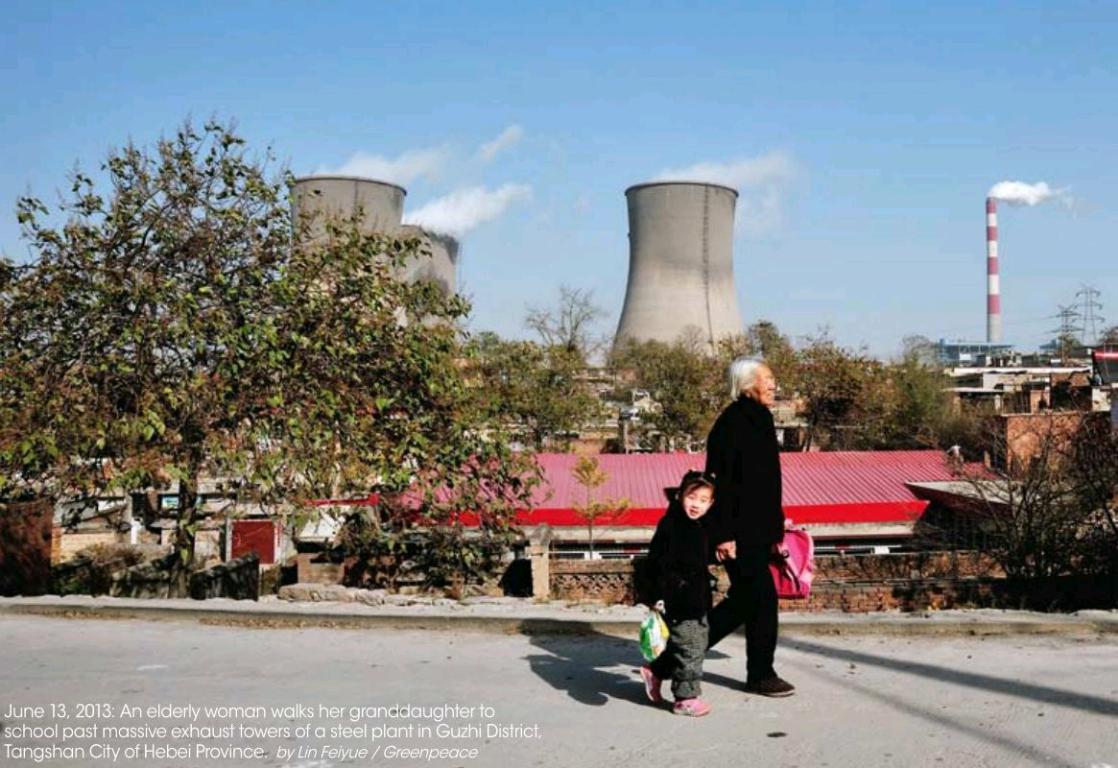
“Hebei is not even the most typical ex- porter of power at the cost of environment,remarks Dr. Liu Zhu, Giorgio Ruffolo Fellow in Sustainability Science at Harvard University. “Over 30 percent of pollution in Inner Mongolia Autonomous Region is the result of power supplied to Beijing. The capital plans to relocate heavy industry and coal power plants to undeveloped western areas of the country. This will increase transport costs and energy consumption, which will result in greater total carbon emissions. Furthermore, poor technology and environmental protection consciousness in central and western China makes it harder to cope with contamination.”
For decades, Chinas resource-rich underdeveloped areas have continuously fu- eled developed regions but without proper compensation. Western China gradually fell behind the eastern areas, where economic clout has risen proportionally while the environment of western areas has deteriorated due to long-term exploitation of forests and mines. A natural protective screen for the country and home to Chinese rivers sources, the western areas have become the victim of poor implementation of the principle “the one who profits should restore the ecology.”
Global Foul Play
The same environmental unfairness also exists between developing and developed countries. The population of developed countries accounts for 14 percent of the worlds population but consumes 80 percent of global commercial energy. In 1992, to bridge the gap, the United Nations Conference on Environment and Development in Rio proposed that developed countries commit 0.7 percent of their GDP to aiding developing countries and transfer their environmental technology for free. Except for a few in northern Europe, most developed nations failed to keep the promise. Also, owners of new energy technologies are reluctant to transfer them to developing countries in the name of intellectual property protection.
Actually, one of the most important contributors to clean air in the West is carbon transfer to developing countries. Developed countries keep research centers in their homelands but move energy-consuming and heavy-polluting industries to developing countries.
As the largest developing country and an industrial exporter with comparatively cheaper labor costs, China is no doubt one victim, becoming the manufacturing base for many international companies. For instance, many smartphone producers choose China for labor-intensive, low-end, heavy-polluting manufacturing but keep high-end departments such as design and sales, which dont pollute but make money, in their own country. As early as 2011, the Institute of Public and Environmental Affairs, a Beijing-based NGO, revealed that at least 27 suspected Apple suppliers in China were causing major environmental problems and endangering public health.
“We know that pollution is emanating from China and is reaching our West Coast,” remarked Gina McCarthy, head of the U.S.s Environmental Protection Agency in late 2013. In The Huffington Post, she also noted, “The threats of air pollution and climate change dont respect international boundaries. We face them together; we must find a way to fight them together.” South Korea and Japan have often complained that China is hurting their air quality. “About millionth of Chinas pollution reaches the U.S.,” notes Guan Dabo, Associate Professor in Environmental Economics in University of Leeds. “But over half of labor-intensive daily necessities and industrial consumables used by the U.S. and other developed countries are provided by China. In 2010, primary PM2.5 pollutants emitted by export production reached two million tons, accounting for one quarter of Chinas total primary PM2.5 pollution. More than 60 percent of those commodities were exported to the U.S. and other developed countries.” Guan believes that not only is Chinas development to blame for the situation, but that global consumption, especially in developed countries, is accelerating Chinas environmental deterioration.
Sharing the same planet and its finite resources, people from various regions and countries must accept the responsibilities together or the situation wont improve. Only environmental justice can guarantee better protection.
