
Six Decades of the People’s Congress System
2014-03-28 05:33:21
China Pictorial 2014年3期
On September 21, 1949, Mao Zedong announced the founding of the Peoples Republic of China at the First Plenary Session of the Chinese Peoples Political Consultative Conference (CPPCC) in Zhongnanhais Huairen Hall in Beijing. The meeting determined the establishment of the National Peoples Congress (NPC) as the highest organ of state power, while the CPPCC plenary session would temporarily exercise the NPCs power before the first NPC assembled.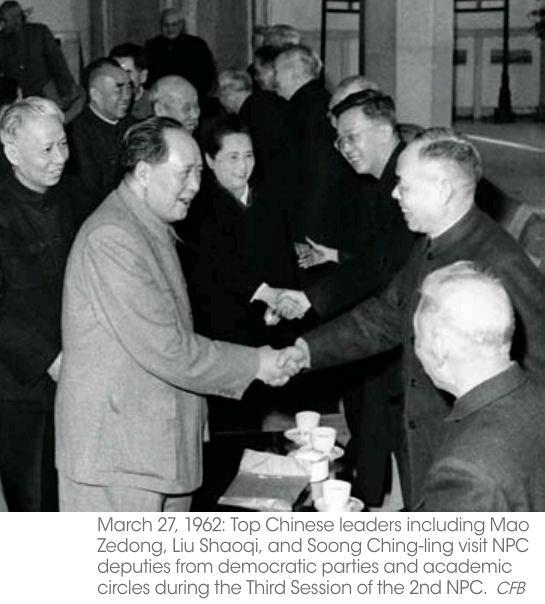
Five years later, more than 1,200 deputies from around the na- tion gathered in Huairen Hall for the First Session of the 1st NPC, marking the official establishment of the peoples congress system in China. The system allows Chinese citizens to elect deputies to form multi-tiered peoples congresses, representing them to exercise their power to govern the state. The year 2014 marks the 60th birthday of Chinas peoples congress system. Over six decades, the system has witnessed increasing advancements in terms of legal system, electoral system, and deputy diversity and constantly moved towards democracy and the rule of law, although it suffered destruction and even regression during the “cultural revolution”period (1966-1976). Its evolvement mirrors the development of Chinese society.
Maturing Legal System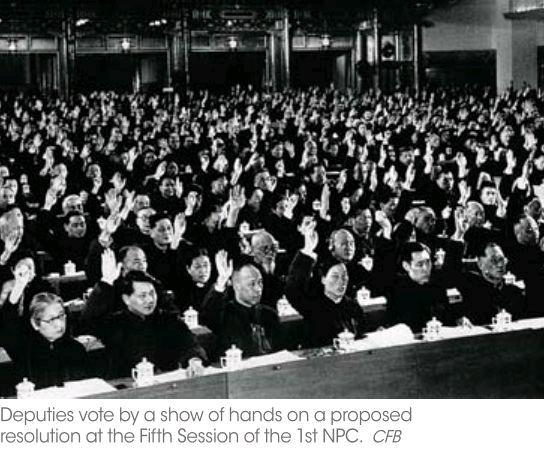
According to Chinas current Constitution, the NPC and its Standing Committee exercise the legislative power of the state. Undoubtedly, the peoples congress system has played a significant role in making China a country under the rule of law.
In 1954, the Constitution of the Peoples Republic of China was passed at the First Session of the 1st NPC. Over the following years, the NPC and its Standing Committee formulated a series of laws and regulations that ensured the smooth operation of the state and society. However, across the two decades from 1957 when the country launched the Anti-Rightist Movement through the “cultural revolution,” Chinas pace of legislation slowed and even paused until 1978 when the Third Plenary Session of the 11th Central Committee of the Communist Party of China (CPC) decided to “bring order out of chaos.” In 1979, seven laws including The Criminal Law, Criminal Procedure Law, Organic Law of the Local Peoples Congresses and Local Peoples Governments of the PRC, Electoral Law for the National Peoples Congress and Local Peoples Congresses, Organic Law of the Peoples Courts, Organic Law of the Peoples Procuratorates, and Law on Chinese-Foreign Equity Joint Ventures were passed at the Second Session of the 5th NPC. Since then, laws and regulations have been passed at every NPC session and even each plenary meeting of its Standing Committee.
In 1982, the Fifth Session of the 5th NPC revised the Constitution, popularly known as the 1982 Constitution. Gu Angran, former director of the Sub-Committee of Legislative Affairs of the NPC Standing Committee, noted, “The 1982 Constitution makes‘improving the socialist legal system a primary task of the country.” After amendments in 1992, the Constitution clearly stated that“The Peoples Republic of China governs the country according to law and makes it a socialist country under the rule of law.”
With the advancement of reform and opening-up and the spread of awareness of rule by law, China began to formulate and enact laws aiming to regulate and restrict the power of government and administrative departments, such as The Administrative Procedure Law, Law on State Compensation, Law on Administrative Punishment, and Administrative Reconsideration Law.
In the spring of 2011, Wu Bangguo, then chairman of the NPC Standing Committee, declared that China had formed a complete socialist legal system. Thanks to persistent efforts of NPC deputies and the prudent examination of the legislative body, many laws aligning with the peoples interests and the countrys actual conditions have finally been enacted. For instance, the Contract Law took 18 years to pass after it was first proposed, Supervision Law took 20 years, and Property Law was ultimately enacted after it was discussed at eight sessions over 14 years.
Improving Electoral System
In 1979, the NPC revised Electoral Law of the National Peoples Congress and Local Peoples Congresses. The law was then amended four times in 1982, 1986, 1995, and 2004, respectively.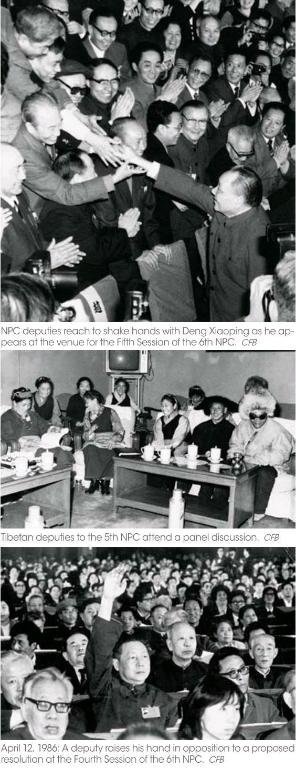
According to the amended Electoral Law, political parties and peoples organizations may either jointly or separately recommend candidates for deputyships, and a joint group of at least 10 voters or deputies may also recommend candidates, which undoubtedly enhance voters nomination rights. In view of the sharp gap between rural and urban population in the early years of the Peoples Republic, the population ratio based on which NPC deputies were elected between rural and urban areas was 8:1, but in the most recent NPC, deputies were elected based on an equal population ratio, so as to guarantee equal rights of all citizens. In addition, deputies to peoples congresses at and below county level are now elected directly by their constituents – previously the rule was only practiced at lower levels such as towns or townships. The change enables the people to better exercise their right to govern the state and determine their own destiny.
Another major breakthrough regarding the electoral system for deputies to peoples congresses is a shift from non-competitive to competitive elections. This not only enables voters and deputies to better exercise their rights to vote, but also encourages candidates to better perform their duties and represent the interests of their constituents, so as to realize the ultimate goal of elections – selecting the most capable.
Diverse Deputies
The NPC and local peoples congresses at different levels are constituted of deputies elected via democratic election. Along with the diversification of Chinas economic entities and society, deputies to peoples congresses at all levels have also seen a diversifying tendency.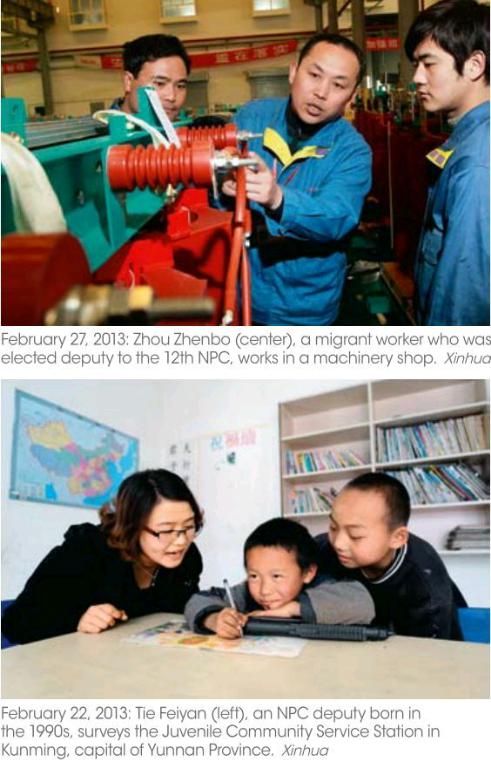
In 1983, Bai Shiming, who operated a private photo studio in Harbin, capital of Heilongjiang Province, was elected a deputy to the 6th NPC. In an era when the private economy was relatively new to the country, the highest organ of state powers acceptance of a private business owner marked a significant breakthrough. Later, Article 11 of the Constitution amended in 1988 added a new paragraph: “The State permits the private sector of the economy to exist and develop within the limits prescribed by law. The private sector of the economy is a complement to the socialist public economy.” In 1993, Liu Guansong, a private entrepreneur in Guangdong Province, was elected an NPC deputy. According to the Constitution amended later, non-public sectors of the economy were placed at a higher position, becoming an“important component of the socialist market economy.” From that point on, more and more private entrepreneurs have been found amongst NPC deputies.
In 2008, three migrant workers including Hu Xiaoyan were elected NPC deputies. Since then, the special group created by Chinas fast but unbalanced economic growth has seen their own“ambassadors” in the highest organ of state power. The social identities of NPC deputies are increasingly diversifying. They include factory workers, farmers, officials, artists, intellectuals, athletes, scientists, lawyers, teachers, medical workers, private entrepreneurs, and religious figures.
Moreover, increasing numbers of young people from the so-called “post-80s” and “post-90s” generations have become deputies to peoples congresses at every level. Statistics show that 74 deputies to the 12th NPC were born in the 1980s in addition to two born in the 90s (Olympic champion Chen Ruolin and toll booth worker Tie Feiyan). Despite their lack of social and political experience, these young deputies have shown great interest in state affairs and impressed veterans with their creativity. For instance, Sun Xiaolei, a 1990s-born senior at Fudan University who was elected a deputy to the Shanghai Municipal Peoples Congress, impressively gathered public opinion via microblogging platforms.
In the worlds most populous country, the peoples congress system enables Chinese people to elect deputies to the NPC and local peoples congresses at various levels to represent their interests when governing the country. Along with Chinas social progress, the system is improving accordingly and will serve as a solid foundation for realizing the peoples dream of national rejuvenation.
