
無脊椎動物胰島素樣蛋白(Insulin-like/related peptides)研究進展
——以昆蟲為例
2014-03-21 06:56:41張龍輝王國棟
生物技術通報 2014年10期
張龍輝 王國棟
(集美大學水產學院,廈門 361021)
無脊椎動物胰島素樣蛋白(Insulin-like/related peptides)研究進展
——以昆蟲為例
張龍輝 王國棟
(集美大學水產學院,廈門 361021)
胰島素樣蛋白(Insulin-like/related peptides,ILPs)是無脊椎動物中胰島素的同源基因。以昆蟲為例,概述了ILPs的結構、表達以及相關通路特別是胰島素信號通路(Insulin signaling pathway),并總結了其在調控機體生長、發育、新陳代謝、繁殖和免疫等生命過程中的作用。
昆蟲 胰島素樣蛋白 胰島素信號通路 調控功能
胰島素自1922年被發現以來,被認為是血糖水平的主要調控因子。魚類、哺乳類等脊椎動物中,胰島素結構和功能保守。無脊椎動物,如線蟲、軟體動物和昆蟲中,存在與脊椎動物胰島素序列相似的蛋白,通常命名為胰島素樣蛋白(Insulin-like peptide,ILP)或胰島素相關蛋白(Insulin-raleted peptide,IRP)。胰島素樣蛋白(Insulin-like/related peptides,ILPs)由胰島素受體(Insulin receptor,IR)結合,進入信號蛋白網絡,啟動胰島素信號通路(Insulin signaling pathway,ISP)、絲裂源活化蛋白激酶(Mitogen activated protein kinase,MAPK)通路信號、雷帕霉素靶蛋白(Target of rapamycin pathway,TOR)信號通路,調控生長、發育、新陳代謝、繁殖及免疫等生命過程。
無脊椎動物胰島素樣蛋白自發現至今,被廣泛研究,特別是對昆蟲ILPs的研究全面而深入。昆蟲ILP蛋白結構保守,其加工修飾、分泌、所參與的信號通路等與脊椎動物比較相似。其他無脊椎動物的ILP的化學性質、基因結構、分泌調控、生理功能等,相關信號通路及其作用機制的研究缺乏系統性,尚需充實。本研究以模式生物果蠅為例,結合其他無脊椎動物,綜述無脊椎動物胰島素樣蛋白的研究進展,以期為線蟲、貝類等無脊椎生物胰島素樣蛋白及相關通路的研究提供參考。
1 無脊椎動物中的胰島素樣蛋白
1984 年,Nagasawa等[1]在家蠶(Bombyx mori)中發現的家蠶素(Bombyxin),這是在無脊椎動物中首次發現ILP。隨后,在B. mori中相繼發現38
種ILPs[2]。核酸測序技術與生物信息學結合運用,在12種果蠅、20個不同種類的昆蟲、4種軟體動物和2種后口動物等38個物種中發現了211個ILPs[2-4]。節肢動物、尾索動物和軟體動物等的ILPs的進化分析表明,節肢動物與軟體動物有共同的原口類祖先[2]。另外,在雜色鮑(Haliotis diversicolor)、耳鮑(Haliotis asinina)[5]、三角渦蟲(Schmidtea mediterranea)[6]、椎實螺(Lymnaea stagnalis)及線蟲(Caenorhabditis elegans)等生物中也相繼發現多種胰島素樣蛋白。
1.1 ILPs結構特點
無脊椎動物ILPs是一類由多種特定基因編碼,分泌后成為蛋白激素、神經遞質和生長因子等。在結構上,這些蛋白與脊椎動物的胰島素類似,包括NH2-端分泌信號肽(Signal peptide,SP)、B chain、不保守的C chain和A chain。其生物活性依賴鏈接B chain 與A chain 的兩個二硫鍵及A chain 內部的一個二硫鍵,并且,B chain、A chain 中半胱氨酸的位置非常保守[7,8]。
圖1為無脊椎動物ILPs蛋白和基因結構示意圖。DILP1-7中包含3個二硫鍵——鏈接B chain 和A chain的2個及A chain內部的1個DILP2,3,4,5與人胰島素一樣,包含SP、B chain、C chain及A chain,且功能域順序、大小相近;DILP1,7的B chain NH2-端較人胰島素長;而DILP6 的C chain短,且包含在B chain中,與人IGF的C chain同源。圖1-C為果蠅DILP1-7、蝗蟲胰島素樣蛋白(Locusta migratoria insulin-like peptide,LIRP)、家蠶Bombyxin A1/E1/G1/A2、樗蠶(Samia cynthia)S.cynthia A2、線蟲C. elegans IRP(Insulin-related peptide)、椎實螺MIP與人胰島素(Human insulin)、人IGFs(Human IGF-I/II)B chain(C-1)、A chain(C-2)序列同源比對結果,半胱氨酸(黑體)數量及位置高度保守。
1.2 昆蟲ILPs表達和分泌
同其他蛋白類激素一樣,昆蟲ILPs在中央神經分泌細胞(Medial neurosecretory cells,MNCs)、中腸表達、脂質體[10,11],且主要在MNCs表達[12]。通常,蛋白類激素是由同一個基因翻譯為長的前體蛋白,“特異性”水解后后成為不同形式的蛋白,而ILPs則是多個不同基因編碼多個不同的蛋白[2]。ILPs在MNCs合成加工后釋直接放到與心側體(Corpora cardiaca,CC)動脈、中腸相連的神經血管[13],其釋放受腦部調控,在血清中水解,或與受體結合后降解[2]。作為蛋白類激素,成熟ILPs在細胞中合成、儲存并分泌,因此ILPs的轉錄本和蛋白含量無顯著相關性[13]。
值得注意的是,MNCs是在胚胎形成時由1對神經母細胞發育分化形成[14],位于神經外皮層;與其相鄰的成神經細胞發育分化為CC,位于神經外皮層,形成環腺的一部分,合成脂動激素(AKH)。這種“布局”與脊椎動物腦中下丘腦-腎上腺軸類似[14]。脊椎動物的IGF和松弛肽(Relaxin)在腦中表達并發揮作用[15],而胰島素在胰島合成分泌后轉運至腸分泌細胞中發揮作用,胰島細胞的形成和功能受轉錄因子PAX6調控;果蠅中MNCs的分化受Eyeless同系物的調控[16]。表明昆蟲ILPs與哺乳動物胰島素功能及其分泌組織存在一定的保守性。
果蠅DILP1-5均在MNCs中表達。此外,DILP3在幼蟲和成體中腸中也有表達,DILP2、4、5、6在胚胎或幼蟲消化道中表達,DILP5也在卵泡和馬氏管中表達。不同發育階段MNCs中不同DILP的表達水平不同,并且受內外因子調控而補償表達,這表明存在不同的啟動因子/加強因子調控DILPs的表達[17]。DILP6、7的組織表達模式不同于DILP1-5。DILP6來自脂質體,其結構、來源、功能與IGF相似[13],DILP7在頭腹部神經節的8對細胞中表達,為神經遞質[18],DILP8由成蟲芽合成分泌,調控生長發育及發育的穩定性[3,4]。
在蚊子、家蠶及蜜蜂(Apis mellifera)等昆蟲中有類似發現。在螞蟻中,ILPs在MNCs、中腸等組織中表達,且某些ILPs在脂質體或中腸特異表達,也可能是IGF的同源基因[19]。蜜蜂(A. mellifera)中有2個ILPs,在腦中有不同的轉錄水平,其他組織中不表達[20];家蠶(B. mori)蛹的血淋巴中分離到來自脂質體的IGF-like 蛋白[21]。
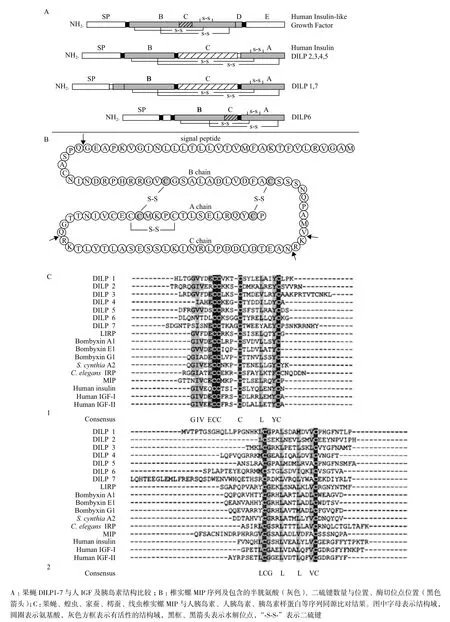
圖1 無脊椎動物ILPs與人胰島素、IGFs的蛋白結構比較和基因同源比對[5,8,9]
在分泌前,與哺乳動物胰島β細胞中分泌胰島素類似,昆蟲ILPs與其相應的加工酶一同“打包”成分泌囊泡,并被加工修飾[22]。脊椎動物前胰島素的B chain和A chain由二硫鍵連接后,C chain被兩
個激素原轉化酶和一個羧肽酶切除[23]。在果蠅中,編碼激素原轉化酶PC2同系物的基因在神經系統到消化道的神經分泌細胞中表達,并與助手基因7B2共表達[24]。PC2的表達是果蠅發育,特別是CC中AKH加工與行使功能是必需的[25],但尚不知其在ILPs加工過程中的作用。盡管如此,這也表明昆蟲中分泌蛋白(ILPs)的酶加工,與哺乳類的胰島素類似。
進入血液的ILPs在血清中被水解,或由結合蛋白(Binding protein,BPs)“保護”轉運至受體[26],受體二聚體化,形成復合體,引發一系列蛋白的磷酸化,激活信號通路,而后被降解,受體回到細胞膜表面。
2 胰島素信號通路
除埃及伊蚊(Aedes aegypti)ILP3外,昆蟲ILPs只有一個受體——胰島素受體(Insulin receptor,IR)[27]。IR為二聚體膜蛋白,包含2個膜外α亞基、2個二硫鍵鏈接的膜內β酪氨酸激酶亞基。昆蟲與哺乳動物細胞中,ILPs(Insulin)與IR結合,激活典型的ISP或TOR通路。
在昆蟲ISP通路中,多種ILPs蛋白異形體與唯一的受體蛋白結合,因此較哺乳類的ISP通路復雜得多[12]。ILPs與IR結合后,胰島素信號啟動,導致一系列蛋白的磷酸化,進而激活ISP通路或MAPK通路的分支及其相關通路,如PI3K通路,果蠅中MAPK通路和PI3K通路交叉串聯。此外,ISP通路的一個分支,能激活TOR信號通路。它們共同調控新陳代謝、細胞存活、組織分化、壽命、生育能力。
圖2為昆蟲中ILPs激活的ISP通路和TOR通路。ILPs在腦MNCs合成并釋放到血淋巴中。ILPs與IR的膜外α亞基結合,引起β亞基構象變化和酪氨酸殘基的磷酸化,激活胰島素信號。激活狀態的IR磷酸化胰島素適配蛋白(Insulin receptor substrate,IRS),為磷脂酰肌醇3-激酶PI3K(p60)提供結合位點。p60與IRS結合激活PI3K催化亞基p110,p110將細胞膜錨定的磷脂酰肌醇二磷酸(PIP2)磷酸化,將其轉化為磷脂酰肌醇三磷酸(PIP3)。磷酸肌醇激酶依賴的蛋白激酶1(PDK1)和Akt激酶,在細胞膜分別與PIP3結合。PDK1磷酸化Akt,激活Akt與p70 S6 核糖體激酶(S6K)。TOR復合物2(TOR-C2)上的TOR的雷帕霉素不敏感分子伴侶(Rictor)將Akt磷酸化,全面激活整個通路。激活態的Akt是許多下游蛋白的鏈接樞紐,包括糖元合成激酶3(GSK-3),結節性硬化復合物(Tuberous sclerosis complex,TSC1/2)——一種負調控TOR通路的調控因子和FOXO轉錄因子。被Akt激活后,FOXO不能進入到細胞核,抑制轉錄,使真核轉錄因子4E結合蛋白(Eukaryotic translation factor 4E-binding protein,4E-BP)、烯醇丙酮酸磷酸羥激酶(Phosphoenolpyruvate carboxykinase,4E-BP)和超氧化物岐化酶(Supper-oxide dismutase,SOD)不能轉錄。ISP通路的抑制因子磷酸酶(Phosphatase)和張力蛋白PTEN同源物將PIP3和PIP2去磷酸化,ISP通路恢復到待激活狀態。TOR通路既可以由上游氨基酸激活,也可由Akt激活。TOR激酶可以形成2種復合體,TOR-C1和TOR-C2。雷帕霉素敏感分子伴侶(Ractor)與TOR-C1結合,而Rictor與TOR-C2結合。TOR-C1磷酸化S6K,抑制4E-BP,啟動轉錄。
3 ILPs的調控功能
果蠅的ILPs通過激活ISP通路和TOR通路,調控生長、發育、新陳代謝、繁殖及免疫等生命過程。在C. elegans基因組中發現39種胰島素樣蛋白,命名為INS1-39。INSs與insulin/IGF-1受體DAF-2結合,激活并參與胰島素/胰島素樣生長因子信號(Insulin/insulin-like growth factor 1 signaling,IIS)通路,調控機體的衰老、壽命及免疫等生命活動[28]。在椎實螺中發現7個ILPs[29],結構同哺乳動物胰島素相似,在神經系統、腸中表達,被認為是神經肽,調控生長發育、產卵等生命活動。三角渦蟲中由ILP啟動的胰島素信號,調控成蟲個體大小、組織內穩態及干細胞分化[6]。
目前對ILPs功能的研究主要集中以下8個方面,以果蠅為例分別介紹如下。
3.1 調控生長發育
昆蟲個體生長和胚胎后期分化是由多個信號通路調控的,參與這些通路的激素有保幼激素(Juvenile hormone,JH)、蛻皮甾醇激素(Ecdysteroid,ECD)
和神經肽,也包括ILPs。對果蠅的研究表明,生長、發育是由ILP激活的ISP通路和營養感應的TOR通路共同調控的[30]。重組突變DILP1-5,果蠅可育,但生長緩慢,個體小;除DILP6、8外,單個DILP突變后,果蠅正常生長,成體體重正常,而DILP6突變后的個體最小;敲除DILP6會致死,而敲除其他DILPs的果蠅能發育到成體,表明脂質體表達的DILP6和MNCs表達DILPs是功能冗余性的[16]。調控幼蟲生長發育的激素,同時調控其組織分化。研究表明,ILP直接誘導不同的組織,促進組織細胞生長、遷移[31,32]由于TOR通路能夠激活ISP通路的下游分子,因此敲除或過表達TOR通路中的相關基因有類似現象。

圖2 昆蟲胰島素樣蛋白激活的ISP 通路和TOR 通路[11]
3.2 調控蛻化類固醇激素的合成
蛻皮激素是昆蟲發育、蛻皮和變態的主要調控因子。ILPs調控昆蟲幼蟲/蛹前胸腺分泌ECD。在幼蟲階段,前胸腺(Prothoracic glands,GP)合成的膳食膽固醇ECDs,釋放到血淋巴,運輸至靶組織。若干神經肽促進或抑制昆蟲ECD的合成,如最早發現的促胸腺激素(Prothoracicotropic hormone,PTTH),以及最近發現的PTTH的受體Torson[33]。無脊椎動物中最早發現的ILP(亦叫做小PTTH)和Bombyxin,促進樗蠶蛹的蛻皮和ECD合成。胎牛胰島素也促進家蠶末齡幼蟲前胸腺ECD分泌[34]。2種合成的樗蠶ILPs調控蛹至成蟲階段的蛻皮[35]。人工合成的ILP(bombyxin-II)刺激節肢動物Rhodnius prolixus ECD的合成[36]。
此外,果蠅中ISP還能夠調控JH的合成[37],但尚缺少ISP直接調控保幼激素(Juvenile hormone,JH)合成的證據。
在不同溫度下,取質量為m=0.01 g 磁性纖維素加入體積10 mL初始濃度不同的pH為7的亞甲基藍溶液中振蕩吸附,吸附時間為2 h,結果如圖5所示。由圖5可知,磁性纖維素對低濃度亞甲基藍溶液,磁性纖維素隨著亞甲基藍溶液濃度的增大吸附容量也迅速增大,而在高濃度階段,吸附容量隨著亞甲基藍溶液濃度的增加而緩慢增加且趨于平穩,表明吸附已經達到飽和狀態。從圖5可知,隨著溫度的增加,磁性纖維素對亞甲基藍溶液吸附容量減小。靜態實驗中吸附溫度宜調為293 K。
3.3 調控生殖
通常較大個體的生殖能力較強。JH、ECDs、神經肽(包括ILPs)調控昆蟲的生長和發育,進而調控其生殖[38]。除雙翅類外,JH是雌性昆蟲非常
重要的促性腺激素,它能激活脂質體和卵巢分泌卵黃蛋白原(Vitellogenin,VG)和卵黃蛋白(Yolk polypeptides,YP)[39]。雙翅類的卵巢是流通的ECDs主要來源,卵母細胞周圍的卵泡合成ECDs,補充變態時退化的PG功能[40]。在JH作為促性腺激素的昆蟲中,ECDs也是VG合成的終止因子[41]。
果蠅和蚊子中,JH是脂質體和卵巢發育必需的激素。單一或組合敲除果蠅胰島素樣肽(Drosphila insulin-libe peptides,DILPs)后,與野生型相比,僅敲除DILP6(IGF同系物),或同時敲除DILP2-3-5后,果蠅終生產卵量顯著下降(分別下降46%和69%)[17]。果蠅卵細胞的成熟與哪個DILPs相關及其機制尚不清楚,但JH和ISP通路都調控卵細胞形成、YP的合成與吸收。IRS突變的雌果蠅,體型小且不育,而JH、ECD水平正常[42]。異常的ISP通路影響果蠅的營養狀況及滯育,進而影響其繁殖和壽命,甚至交配和求偶行為[43];YPs在脂質體和卵泡中的合成依賴ISP通路和ECD信號[12]。表明昆蟲ISP通路與其繁殖非常相關。TOR通路通過ISP依賴、ISP非依賴途徑也影響卵的成熟[44]。
此外,ISP通路可強化繁殖相關的表型和形態多樣性(輸卵管數量進化多樣性),并與卵巢、干細胞的形成發育有較大關系[45,46]。
3.4 新陳代謝
昆蟲攝取的營養物質和能量被直接消耗,或儲備以供生長、發育和繁殖需要。蛻皮、滯育、蛹甚至成蟲階段,饑餓或缺少食物的昆蟲體內,能量會重新分配和調動,以延長存活時間。有兩類神經肽及其參與的信號通路調節昆蟲中的能量儲備和能量調動:ILPs(胰島素)誘導細胞吸收葡萄糖并轉化為糖元,從分解代謝參與到脂質合成和蛋白代謝[27];AKH(脂動激素)是胰島素的拮抗物質,通過G蛋白伴侶受體和cAMP/三磷酸肌醇信號通路,激活糖代謝、脯氨酸代謝和脂質儲備[47]。脂質體是昆蟲主要的代謝調節、營養儲備部位,對ILP/TOR通路和AKH信號敏感。中腸、絳色細胞也對以上通路敏感,并且通過尚未知的機制調控脂質體中能量代謝與分配[44]。DILP1-5單獨或共同調節糖類、脂類代謝[17]。
人工合成的ILPs直接影響昆蟲新陳代謝。Bombyxin-II注射到頸部結扎幼蟲中,海藻糖和糖元水平下降,顯著加速儲備糖類的消耗[48]。人工合成的Ae. aegypti ILP3注射削去頭部并投喂白糖的雌Ae. aegypti中,促進海藻糖消耗及糖元與脂肪的儲備,且存在劑量依賴[49]。胰島素降解酶(Insulin-degrading enzyme,IDE)是非常保守的胰島素降解酶。果蠅中該基因的同源物質在整個生活史及細胞系中表達。相同條件下,果蠅的IDE可降解哺乳類的胰島素[50],且敲除IDE后,果蠅海藻糖(Trenalose)水平提高,抑制生長[51]。但是,DILP、ISP通路相關基因對營養攝取情況的響應并不一致[52]。
滯育(Diapause)是動物受不利環境條件的誘導產生的,由內分泌系統調控的,新陳代謝和發育靜止的一種類型,它常發生于一定的發育階段。脊椎動物IGF同源基因DILP在末齡幼蟲期表達激增,變態期下降,若缺失DILP6發育阻滯[53];雙翅類中,ISP通路異常使成蟲滯育[54]。鱗翅目Sa. Cynthia[55]和 Pieris brassicae[56]的蛹,注射哺乳動物胰島素后滯育終止并恢復發育。敲除果蠅PI3K(Dp110)后,果蠅滯育率高,而在神經系統中過表達Dp110,滯育率下降。秋季雌尖音庫蚊(Culex pipiens)滯育,脂肪大量儲備,卵巢停止發育;而干擾未滯育雌蚊子的IR,其卵巢也停止發育;即將滯育的雌蚊子中ILP1和ILP5表達量比雄性低,且敲除ILP1,未滯育雌蚊子卵巢停止發育[57]。這些研究表明,未激活的ISP通路可引發滯育,激活后滯育終止或緩解。這與未滯育昆蟲中,ISP通路促進合成代謝的理論相悖,但在線蟲(Caenorhabditis)中是一致的。
3.6 攝食與營養
中樞神經系統中表達的各種ILPs可激活不同神經信號通路的ISP通路,調控營養攝取行為。抑制果蠅DILPs表達或抑制ISP通路后,果蠅攝食量增加,且能耐受食物中的有害化學物質,而在饑餓果蠅中抑制或過表達DILP或ISP通路,攝食行為都會減弱[58]。ISP通路的突變使果蠅對酒精的耐受性提高[59],表明DILPs和ISP通路與上癮行為相關。食物缺少條件下,或通過PI3K/Akt等通路“屏蔽”ISP通路,果蠅表皮色素沉降下降,而TOR通路則刺激
表皮色素的沉降[60]。
3.7 免疫功能
昆蟲的先天免疫系統識別病原體,產生抗原,避免感染。果蠅感染海魚分枝桿菌(Mycobacterium marinum)后,Akt、GSK-3及合成代謝相關基因表達下調,血糖升高,脂肪和糖元含量降低,與FOXO突變個體相比壽命縮短[61]。突變IRS抑制ISP通路,使果蠅對革蘭氏陽/陰性菌抵抗力增強,壽命延長[62]。饑餓果蠅的ISP信號減弱,即使無病原感染,抗菌肽(Antimicrobi peptide,AMP)表達上調,表明其免疫能力提高[63]。綜上所述,果蠅受感染后,ISP通路受到抑制,儲備能量以提高免疫能力。脂質體是果蠅主要的免疫組織和能量儲存組織。Diangelo等[64]發現,在突變體果蠅脂質體中激活Toll受體,AMP表達上調,而Akt磷酸化率降低,甘油三酸酯含量降低;dFOXO調控抗菌肽的表達,能量代謝失衡對免疫系統極為不利[65],進一步表明,ISP通路與免疫是直接相關的。蚊子、蜻蜓等昆蟲的ISP通路也與免疫相關[66]。
3.8 衰老和壽命
對果蠅、蚊子等昆蟲ISP通路在神經系統、脂質體、中腸等組織的功能的同時發現,ISP通路調控果蠅的衰老和壽命。下調果蠅神經系統DILP2[17]、脂質體等組織中IRS(chico)、SH2B(Lnk)[67]表達,果蠅壽命延長;過表達果蠅神經系統、脂質體中ISP通路的拮抗基因,果蠅壽命延長[68,69]。但目前ISP通路調控衰老和壽命的機制需進一步的研究。模式變化,機體內穩態及先天免疫相應改變。
昆蟲、線蟲,甚至貝類等無脊椎動物基因組測序越來越普遍,非模式生物遺傳學技術的不斷發展,以及ILP人工合成和生物化學技術的發展,將極大促進ILP信號通路的研究。
4 結語
無脊椎動物ILPs結構、功能及所參與的信號通路,甚至分泌、作用器官,同脊椎動物胰島素非常相似,表明胰島素、胰島素信號是非常保守的。有趣的是,無脊椎動物中,多個ILPs與唯一的IR結合,調控不同組織的生理活動,并與其他通路“合作”調控個體行為,使個體順利完成生長、發育和繁殖。ILPs通過ISP通路調控ECD和JH的分泌,可直接或與其他通路“合作”調控發育和繁殖;營養攝食、能量消耗/儲備,以正反饋調節方式顯著影響ISP通路和TOR通路,并調節不同組織中的基因表達和生物化學過程;病原感染使ISP通路相關基因表達
[1]Nagasawa H, Kataoka H, Isogai A, et al. Amino-terminal amino acid sequence of the silkworm prothoracicotropic hormone:homology with insulin[J]. Science, 1984, 226(4680):1344-1345.
[2]Antonova Y, Arik AJ, Moore W, et al. Insulin-like peptides:structure, signaling, and function[OL]//Gibert LI. Insect Endocrinology. Elsevier Academic Press, 2012:63-92.
[3]Garelli A, Gontijo AM, Miguela V, et al. Imaginal discs secrete insulin-like peptide 8 to mediate plasticity of growth and maturation[J]. Science, 2012, 336(6081):579-582.
[4]Colombani J, Andersen DS, Léopold P. Secreted peptide Dilp8 coordinates Drosophila tissue growth with developmental timing[J]. Science, 2012, 336(6081):582-585.
[5]York PS, Cummins SF, Lucas T, et al. Differential expression of neuropeptides correlates with growth rate in cultivated Haliotis asinina(Vetigastropoda:Mollusca)[J]. Aquaculture, 2012, 334:159-168.
[6]Miller CM, Newmark PA. An insulin-like peptide regulates size and adult stem cells in planarians[J]. International Journal of Developmental Biology, 2012, 56(1):75-82.
[7]Claeys I, Simonet G, Poels J, et al. Insulin-related peptides and their conserved signal transduction pathway[J]. Peptides, 2002, 23(4):807-816.
[8]Brogiolo W, Stocker H, Ikeya T, et al. An evolutionarily conserved function of the Drosophila insulin receptor and insulin-like peptides in growth control[J]. Current Biology, 2001, 11(4):213-221.
[9]Smit A, Vreugdenhil E, Ebberink R, et al. Growth-controlling molluscan neurons produce the precursor of an insulin-related peptide[J]. Nature, 1988, 331:535-538.
[10]Veenstra JA, Sellami A. Regulatory peptides in fruit fly midgut[J]. Cell and Tissue Research, 2008, 334(3):499-516.
[11]Veenstra JA. Peptidergic paracrine and endocrine cells in the midgut of the fruit fly maggot[J]. Cell and Tissue Research,
2009, 336(2):309-323.
[12]Antonova-Koch Y, Riehle M A, Arik AJ, et al. Insulin-like peptides[OL]//Abba JK. Handbook of Biologically Active Peptides. Elsevier Academic Press, 2013:267-275.
[13]Géminard C, Rulifson EJ, Léopold P. Remote control of insulin secretion by fat cells in Drosophila[J]. Cell Metabolism, 2009, 10(3):199-207.
[14]Wang S, Tulina N, Carlin DL, et al. The origin of islet-like cells in Drosophila identifies parallels to the vertebrate endocrine axis[J]. Proceedings of the National Academy of Sciences, 2007, 104(50):19873-19878.
[15]Callander G, Bathgate R. Relaxin family peptide systems and the central nervous system[J]. Cellular and Molecular Life Sciences, 2010, 67(14):2327-2341.
[16]Clements J, Hens K, Francis C, et al. Conserved role for the Drosophila Pax6 homolog eyeless in differentiation and function of insulin-producing neurons[J]. Proceedings of the National Academy of Sciences, 2008, 105(42):16183-16188.
[17]Gr?nke S, Clarke DF, Broughton S, et al. Molecular evolution and functional characterization of Drosophila insulin-like peptides[J]. PLoS Genetics, 2010, 6(2):e1000857.
[18]Yang Ch, Belawat P, Hafen E, et al. Drosophila egg-laying site selection as a system to study simple decision-making processes[J]. Science, 2008, 319(5870):1679-1683.
[19]Badisco L, Claeys I, Van Hiel M, et al. Purification and characterization of an insulin-related peptide in the desert locust, Schistocerca gregaria:immunolocalization, cDNA cloning, transcript profiling and interaction with neuroparsin[J]. Journal of Molecular Endocrinology, 2008, 40(3):137-150.
[20]Ament SA, Corona M, Pollock HS, et al. Insulin signaling is involved in the regulation of worker division of labor in honey bee colonies[J]. Proceedings of the National Academy of Sciences, 2008, 105(11):4226-4231.
[21]Okamoto N, Yamanaka N, Satake H, et al. An ecdysteroid-inducible insulin-like growth factor-like peptide regulates adult development of the silkmoth Bombyx mori[J]. FEBS Journal, 2009, 276(5):1221-1232.
[22]Hernández-Sánchez C, Mansilla A, De La Rosa E, et al. Proinsulin in development:new roles for an ancient prohormone[J]. Diabetologia, 2006, 49(6):1142-1150.
[23]Steiner D, Park SY, St?y J, et al. A brief perspective on insulin production[J]. Diabetes, Obesity and Metabolism, 2009, 11(s4):189-196.
[24]Rayburn LY, Rhea J, Jocoy SR, et al. The proprotein convertase amontillado(amon)is required during Drosophilam pupal development[J]. Developmental Biology, 2009, 333(1):48-56.
[25]Rhea JM, Wegener C, Bender M. The proprotein convertase encoded by amontillado(amon)is required in Drosophila corpora cardiaca endocrine cells producing the glucose regulatory hormone AKH[J]. PLoS Genetics, 2010, 6(5):e1000967.
[26]Sajid W, Kulahin N, Schluckebier G, et al. Structural and biological properties of the Drosophila insulin-like peptide 5 show evolutionary conservation[J]. Journal of Biological Chemistry, 2011, 286(1):661-673.
[27]Wen Z, Gulia M, Clark KD, et al. Two insulin-like peptide family members from the mosquito Aedes aegypti exhibit differential biological and receptor binding activities[J]. Molecular and Cellular Endocrinology, 2010, 328(1):47-55.
[28]Kaletsky R, Murphy CT. The role of insulin/IGF-like signaling in C. elegans longevity and aging[J]. Disease Models & Mechanisms, 2010, 3(7-8):415-419.
[29]Smit A, Spijker S, Van Minnen J, et al. Expression and characterization of molluscan insulin-related peptide VII from the mollusc Lymnaea stagnalis[J]. Neuroscience, 1996, 70(2):589-596.
[30]Shakhmantsir I, Massad NL, Kennell JA. Regulation of cuticle pigmentation in Drosophila by the nutrient sensing insulin and TOR signaling pathways[J]. Developmental Dynamics, 2013, 243(3):393-401.
[31]Nakahara Y, Matsumoto H, Kanamori Y, et al. Insulin signaling is involved in hematopoietic regulation in an insect hematopoietic organ[J]. Journal of Insect Physiology, 2006, 52(1):105-111.
[32]Nijhout HF, Grunert LW. Bombyxin is a growth factor for wing imaginal disks in Lepidoptera[J]. Proceedings of the National Academy of Sciences, 2002, 99(24):15446-15450.
[33]Rewitz KF, Yamanaka N, Gilbert LI, et al. The insect neuropeptide PTTH activates receptor tyrosine kinase torso to initiate metamorphosis[J]. Science, 2009, 326(5958):1403-1405.
[34]Gu SH, Lin JL, Lin PL, et al. Insulin stimulates ecdysteroidogenesis by prothoracic glands in the silkworm, Bombyx mori[J]. Insect
Biochemistry and Molecular Biology, 2009, 39(3):171-179.
[35]Nagata K, Maruyama K, Kojima K, et al. Prothoracicotropic activity of SBRPs, the insulin-like peptides of the saturniid silkworm Samia cynthia ricini[J]. Biochemical and Biophysical Research Communications, 1999, 266(2):575-578.
[36]Satake SI, Masumura M, Ishizaki H, et al. Bombyxin, an insulinrelated peptide of insects, reduces the major storage carbohydrates in the silkworm Bombyx mori[J]. Comparative Biochemistry and Physiology Part B:Biochemistry and Molecular Biology, 1997, 118(2):349-357.
[37]Belgacem YH, Martin JR. Hmgcr in the corpus allatum controls sexual dimorphism of locomotor activity and body size via the insulin pathway in Drosophila[J]. PLoS One, 2007, 2(1):e187.
[38]Raikhel A. Vitellogenesis of disease vectors, from physiology to genes[OL]//Biology of Disease Vectors. Elsevier Academic Press, 2005:329-346.
[39]Tufail M, Takeda M. Molecular characteristics of insect vitellogenins[J]. Journal of Insect Physiology, 2008, 54(12):1447-1458.
[40]Rees DA, Giles P, Lewis MD, et al. Adenosine regulates thrombomodulin and endothelial protein C receptor expression in folliculostellate cells of the pituitary gland[J]. Purinergic Signalling, 2010, 6(1):19-29.
[41]Hatle JD, Juliano SA, Borst DW. Hemolymph ecdysteroids do not affect vitellogenesis in the lubber grasshopper[J]. Archives of Insect Biochemistry and Physiology, 2003, 52(1):45-57.
[42]Richard DS, Rybczynski R, Wilson TG, et al. Insulin signaling is necessary for vitellogenesis in Drosophila melanogaster independent of the roles of juvenile hormone and ecdysteroids:female sterility of the chico insulin signaling mutation is autonomous to the ovary[J]. Journal of Insect Physiology, 2005, 51(4):455-464.
[43]Wigby S, Slack C, Gr?nke S, et al. Insulin signalling regulates remating in female Drosophila[J]. Proceedings of the Royal Society B:Biological Sciences, 2011, 278(1704):424-431.
[44]Gutiérrez A, Nieto J, Pozo F, et al. Effect of insulin/IGF-I like peptides on glucose metabolism in the white shrimp Penaeus vannamei[J]. General and Comparative Endocrinology, 2007, 153(1):170-175.
[45]Green DA, Extavour CG. Insulin signalling underlies both plasticity and divergence of a reproductive trait in Drosophila[J]. Proceedings of the Royal Society B:Biological Sciences, 2014, 281(1779):20132673.
[46]Gancz D, Gilboa L. Insulin and target of rapamycin signaling orchestrate the development of ovarian niche-stem cell units in Drosophila[J]. Development, 2013, 140(20):4145-4154.
[47]G?de G. Regulation of intermediary metabolism and water balance of insects by neuropeptides[J]. Annual Reviews in Entomology, 2004, 49(1):93-113.
[48]Satake SI, Nagata K, Kataoka H, et al. Bombyxin secretion in the adult silkmoth Bombyx mori:sex-specificity and its correlation with metabolism[J]. Journal of Insect Physiology, 1999, 45(10):939-945.
[49]Stoppelli MP, Garcia JV, Decker SJ, et al. Developmental regulation of an insulin-degrading enzyme from Drosophila melanogaster[J]. Proceedings of the National Academy of Sciences, 1988, 85(10):3469-3473.
[50]Garcia JV, Fenton BW, Rosner MR. Isolation and characterization of an insulin-degrading enzyme from Drosophila melanogaster[J]. Biochemistry, 1988, 27(12):4237-4244.
[51]Galagovsky D, Katz MJ, Acevedo JM, et al. The Drosophila insulin degrading enzyme restricts growth by modulating the PI3K pathway in a cell autonomous manner[J]. Molecular Biology of the Cell, 2014, 25(6):916-924.
[52]Liu Y, Zhou S, Ma L, et al. Transcriptional regulation of the insulin signaling pathway genes by starvation and 20-hydroxyecdysone in the Bombyx fat body[J]. Journal of Insect Physiology, 2010, 56(10):1436-1444.
[53]Okamoto N, Yamanaka N, Yagi Y, et al. A fat body-derived IGF-like peptide regulates postfeeding growth in Drosophila[J]. Developmental Cell, 2009, 17(6):885-891.
[54]Sim C, Denlinger DL. Insulin signaling and the regulation of insect diapause[J]. Frontiers in Physiology, 2013, 4:189.
[55]Bokovec AB, Gelman DB. Insect neurochemistry and neurophysiology[OL]//Wang ZS, Zheng WH, Guo F.Effect of Bombyx 4KPTTH and bovine insulin on testis development of indian silkworm, Philosamia cynthia ricini. US:Humana Press, 1986:335-338.
[56]Arpagaus M. Vertebrate insulin induces diapause termination in Pieris brassicae pupae[J]. Roux's Archives of Developmental Biology, 1987, 196(8):527-530.
[57]Williams KD, Sokolowski MB. Evolution:how fruit flies adapt to
seasonal stresses[J]. Current Biology, 2009, 19(2):R63-R64.
[58]Wu Q, Zhang Y, Xu J, et al. Regulation of hunger-driven behaviors by neural ribosomal S6 kinase in Drosophila[J]. Proceedings of the National Academy of Sciences of the United States of America, 2005, 102(37):13289-13294.
[59]Corl AB, Rodan AR, Heberlein U. Insulin signaling in the nervous system regulates ethanol intoxication in Drosophila melanogaster[J]. Nature Neuroscience, 2004, 8(1):18-19.
[60]Shakhmantsir I, Massad NL, Kennell JA. Regulation of cuticle pigmentation in drosophila by the nutrient sensing insulin and TOR signaling pathways[J]. Developmental Dynamics, 2014, 243(3):393-401.
[61]Dionne MS, Pham LN, Shirasu-Hiza M, et al. Akt and foxo dysregulation contribute to infection-induced wasting in Drosophila[J]. Current Biology, 2006, 16(20):1977-1985.
[62]Libert S, Chao Y, Zwiener J, et al. Realized immune response is enhanced in long-lived puc and chico mutants but is unaffected by dietary restriction[J]. Molecular Immunology, 2008, 45(3):810-817.
[63]Becker T, Loch G, Beyer M, et al. FOXO-dependent regulation of innate immune homeostasis[J]. Nature, 2010, 463(7279):369-373.
[64]Diangelo JR, Bland ML, Bambina S, et al. The immune response attenuates growth and nutrient storage in Drosophila by reducing insulin signaling[J]. Proceedings of the National Academy of Sciences, 2009, 106(49):20853-20858.
[65]Loch G, Jentgens E, Bülow M, et al. Metabolism and innate immunity:FOXO regulation of antimicrobial peptides in Drosophila[J]. Innate Immunity :Resistance and Disease-Romoting Principks, 2013, 4:103-111.
[66]Corby-Harris V, Drexler A, de Jong LW, et al. Activation of Akt signaling reduces the prevalence and intensity of malaria parasite infection and lifespan in Anopheles stephensi mosquitoes[J]. PLoS Pathogens, 2010, 6(7):e1001003.
[67]Slack C, Werz C, Wieser D, et al. Regulation of lifespan, metabolism, and stress responses by the Drosophila SH2B protein, Lnk[J]. PLoS Genetics, 2010, 6(3):e1000881.
[68]Hwangbo DS, Gersham B, Tu MP, et al. Drosophila dFOXO controls lifespan and regulates insulin signalling in brain and fat body[J]. Nature, 2004, 429(6991):562-566.
[69]Tatar M, Post S, Yu K. Nutrient control of Drosophila longevity[J]. Trends in Endocrinology & Metabolism, 2014:S1043-2760(14)00042.
(責任編輯 狄艷紅)
Insulin-like Peptides in Invertebrates and Their Signaling Pathways—Take Insects,for Example
Zhang Longhui Wang Guodong
(Fisheries College of Jimei University,Xiamen 361021)
Insulin-like/related peptides(ILPs)of invertebrate are homologous of vertebrate insulin. This article rewiewed the structure, expression, signalling pathway of ILPs. The functions of ILPs were also summarized in regulating growth, development, metabolism, reproduction and immunity.
Insects Insulin-like peptides Insulin signaling pathway Regulation of multipul processes
2014-02-03
國家自然科學基金項目(41006105,4176152)
張龍輝,女,碩士研究生,研究方向:水生生物的遺傳與育種;E-mail:zhlonghui@163.com
王國棟,男,博士,副教授,研究方向:水產動物功能基因和繁殖生物學;E-mail:gdwang@jmu.edu.cn
猜你喜歡
人人健康(2023年26期)2023-12-07 03:55:46
鴨綠江(2021年35期)2021-04-19 12:24:18
考試與評價·高一版(2020年6期)2020-11-02 02:45:24
中國生殖健康(2019年2期)2019-08-23 08:12:10
中國生殖健康(2019年3期)2019-02-01 06:12:26
鑿巖機械氣動工具(2016年3期)2016-03-01 04:00:25
中國衛生標準管理(2015年1期)2016-01-14 03:41:27
海軍航空大學學報(2015年3期)2015-11-11 17:20:00
藥學與臨床研究(2015年4期)2015-06-05 11:35:51
中國醫藥科學(2015年15期)2015-02-27 12:32:27
