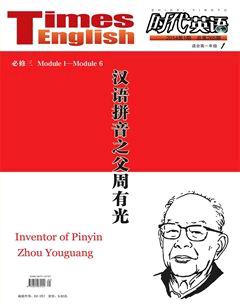
漢語拼音之父:周有光
2014-02-28 07:21:48
時代英語·高一 2014年1期
周有光,如果不是研究漢語或是對漢語感興趣的人,或許對這個名字很陌生。殊不知,這位今年108歲高壽的學者就是我們每天工作學習都離不開的漢語拼音的創始人之一。現在,就讓我們一起走進周老先生的世界吧。
Even at 108 years old, Zhou Youguang is the kind of creative thinker that Chinese leaders regularly command the government to cultivate in their bid to raise their nation from the worlds factory floor.
Mr Zhou is the inventor of Pinyin, the Romanized spelling system that linked Chinas ancient written language to the modern age and helped China all but stamp out illiteracy. He was one of the leaders of the Chinese translation of the Encyclopedia Britannica in the 1980s. He has written about 40 books, the most recent published in 2011.
Chinese characters do not directly correspond to sounds. Pinyins phonetic alphabet enabled learners to match words easily to actual speech.
“It had an enormous impact on literacy,” said Victor H. Mair, a professor of Chinese language and literature at the University of Pennsylvania. All Chinese students now begin to read and write using Pinyin before moving on to characters.
Sweet-natured but wry and rigidly dispassionate, Mr Zhou works at a tiny wooden desk in a government-provided, third-floor walk-up apartment with unpainted concrete walls. His longtime colleague Chen Zhangtai, 82, said Mr Zhou thought renovations would be too distracting.
He described Mr Zhou as the embodiment of a “true scholar.” He added, “His blog entries range from the modernization of Confucianism to Silk Road history and Chinas new middle class. Computer screens hurt his eyes, but he devours foreign newspapers and magazines. A well-known Chinese artist nicknamed him ‘Trendy Old Guy ”.
Mr Zhou was born on Jan. 13, 1906, when the Qing Dynasty ruled and women bound their feet. The son of a Qing Dynasty official, he married the daughter of a wealthy family and went into banking.
After the Japanese invaded in 1937, his family was forced into the countryside to escape Japanese bombs in Chongqing, Chinas wartime capital. His 5-year-old daughter died from appendicitis.
In 1946, Mr Zhou and his family moved to New York, where he represented the Xinhua Trust and Savings Bank. He toured the United States in luxury Pullman cars, rode the Queen Elizabeth ocean liner to Europe and fended off offers from Western banks. His intellectual life was equally rich: he had several lengthy chats with Albert Einstein.
In 1949, Mr Zhou brought his family home. He taught economics at a university in Shanghai and studied linguistics as a hobby.
In 1955, Zhou Enlai, prime minister, called him to Beijing. The party wanted to make Mandarin Chinas national language, simplify Chinese characters and devise a new phonetic alphabet.
Mr Zhous son, Zhou Xiaoping, an astrophysicist, said his father protested that he was a mere amateur. He was told: “Everyone is an amateur.”
In his new job, Mr Zhou found tremendous confusion, but also a foundation for his work. In the late 1500s, the Italian Jesuit Matteo Ricci had formulated a system to Romanize Chinese characters. Many English speakers were already using the British Wade-Giles system developed in the 19th century. Chinese linguists had devised other alternatives.
Mr Zhou argued for the Roman alphabet, to better connect China with the outside world. In 1958, after three years of work, Pinyin—literally “to piece together sounds”—was finished and quickly adopted.
Mr Zhou says Chinese characters will exist for centuries to come. But to his delight, Pinyin has proven ever more useful. Chinese now rely on Pinyin-to-character programs to input chinese characters, text messages, post on Internet microblogs and write e-mails.
盡管已經108歲高齡,周有光老先生仍然是一位極富創見的思想家。我國領導人時不時地都會要求政府工作人員去聆聽他的意見,以提高中國在世界工廠中的地位。
周老先生發明了拼音,用拉丁字母來拼寫古老的中國漢字,讓我國文字現代化,這幾乎幫助我國消滅了文盲。20世紀80年代,他曾主持翻譯中文版的《不列顛百科全書》。他有40余本著作,最近一本是2011年出版的。
漢字本身并不直接表示發音。拼音的音標字母使學習者能夠輕而易舉地將文字與發音匹配在一起。
“它對讀寫識字產生了重要的影響。”賓夕法尼亞大學中國語言與文學教授Victor H. Mair這樣說,“現在所有的中國學生在學習漢字以前都先學習使用拼音讀寫。”
周老天性溫和,嚴厲公正又不失詼諧。他住在一處政府提供的三層樓高的公寓里,他有一個木制辦公桌,水泥墻面并沒有粉刷。他的老同事,82歲的陳章太說:“周老覺得裝修實在是太麻煩了。”
陳章太認為周老是真正的學者。他說:“他只不過看上去似乎與這個世界和平相處。”他還是為這個世界著迷。他的博客談古論今,從儒學現代化到絲綢之路的歷史,再到中國新中產階級。電腦屏幕對他的眼睛不好,他就花時間去看外國的報紙雜志。一位家喻戶曉的中國藝術家給他取了個綽號叫‘新潮老頭。”
周老生于1906年1月13日,那是清朝末年婦女還裹小腳的時代。他的父親是一位清朝官員。后來周老娶了一位有錢人家的小姐,進了銀行業。
1937年,日本入侵以后,他全家被迫逃亡鄉下,躲避日軍在戰時首都重慶的炮火。他5歲的女兒死于闌尾炎。
1946年,周老一家遷居紐約,當時他是新華信托儲蓄銀行的代表。他搭乘奢華的普爾曼臥鋪車環游美利堅,乘坐伊麗莎白女王號遠洋郵輪奔赴歐洲,還拒絕了西方一些銀行的工作機會。他的學術生活也同樣豐富,他曾多次與愛因斯坦長談。
1949年,周老帶著家人返回中國。他在上海的一所大學教經濟學,并出于愛好而研究語言學。
1955年,時任國家總理周恩來邀請他去北京。國家希望將普通話設立為中國的官方語言,簡化漢字,并且要設計一套音標字母。
周老的兒子、天體物理學家周曉平說:“當時我父親反對說他只是個業余語言學家,但得到的反饋是‘大家都很業余。”
面對新工作,周老也很彷徨,不過也找到了一些工作的基本原則。16世紀晚期,來自意大利的耶穌會士利瑪竇發明了一套中國漢字的拉丁化系統。許多說英語的人也早已開始使用在19世紀發展的英國韋氏音標。中國的語言學家們也已經設計了一些其他的注音方法。
周老贊同使用羅馬字母,這樣會更好地讓中國同世界連在一起。1958年,經過三年的工作,拼音系統(字面意義就是“把聲音拼湊起來)完成,并且很快地得到采納。
周老表示,中國漢字還會在未來幾個世紀里繼續存在。不過他很高興見到拼音是那么有用。現在中國人都依賴拼音進行漢字輸入、發短信、寫電子郵件,還有寫微博。