ON THE CHARACTER
2014-02-27 01:19:25
漢語世界 2014年4期
ON THE CHARACTER
Migration and metamorphosis
不論是遠古還是現(xiàn)代,背井離鄉(xiāng)的移民們追尋的都是改變
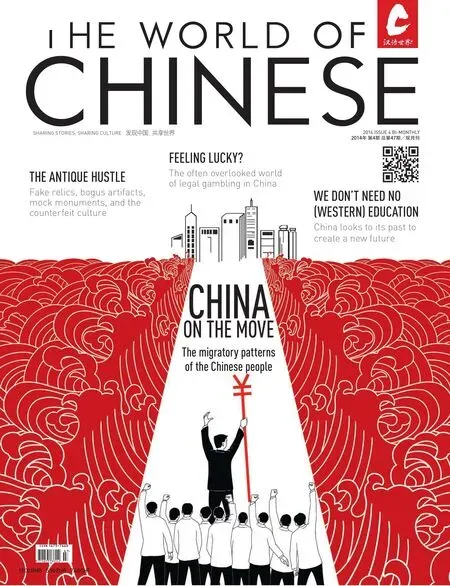
Thousands of years ago in China, Northerners fl ed from their war torn states to the peaceful yet largely unexplored south. A few hundred years ago, the pilgrims on the Mayf l ower crossed the Atlantic to reach the New World. Today, Chinese rural workers seek their fortune in the urban jungle while the nouveau riche try to secure a foreign passport for their children. All migrants, or 移民 (yímín), want to leave their hometown in search of a better life. It's an instinctual hope, the hope for change; as such, the character 移 (yí) is a perfect expression of this spirit, meaning both “to move” and “to change”.
Alterations have appeared in the evolution of the character itself. Like over 80 percent of Chinese characters, 移 is a phono-semantic compound. 多 (duō) on the left indicates the character's pronunciation, yet, as phonetics developed over time, the two diverged. This is also the case with the original meaning of the character:“The way seedlings softly swing in the wind” with 禾 (hé, seedlings) on its left. As poetic as it may have sounded, such expressions gave way to the more practical meaning,“to move”. For instance, 我把桌子移到外面。(Wǒ bǎ zhuōzi yídào wàimiàn. I moved the table outside.)

Alone, 移 is a verb. Combined with other characters, it is able to constitute a series of words and idioms related to“moving”. A well-known fable coined the commonly used term 愚公移山(Yú Gōng yí shān), literally, “the foolish old man moves mountains”. The story goes that two gigantic mountains blocked the path of a village to the outside world. A 90-year-old villager named Yu Gong decided to remove them, digging and transporting the earth and rocks bit by bit through pure manpower. He was laughed at for holding such an unrealistic goal, but he argued that his sons, grandsons, and many generations of descendants thereafter would all continue with the task until they succeeded. The gods were impressed by his perseverance and removed the mountains. Accordingly, the idiom is used to describe determination and courage in the face of extreme diff i culty.
One can move physically, as in 遷移 (qiānyí), to migrate from one place to another; or emotionally, as in 移情別戀 (yí qíng bié liàn), meaning to divert one's affections to another—think of Jason abandoning Medea or Carmen leaving José for the toreador. Naturally, the word has a strong tone of moral judgment. To 轉(zhuǎn)移(zhuǎnyí) is to move a subject from place to place, such as in 轉(zhuǎn)移財產(chǎn) (zhuǎnyí cáichǎn, to transfer assets). 漂移 (piāoyí) means to drift. Apparently, today's fearless youth have even invented the recreational activity of drifting on land: 汽車漂移 (qìchē piāoyí, car drift); 移交 (yíjiāo) means to turn over or hand over, as in 案件移交 (ànjiàn yíjiāo, the handover of cases); and 移植 (yízhí) means to transplant, as in 器官移植 (qìguān yízhí, organ transplant).
移動 (yídòng) means “to move” or“mobile”, which is fairly common in today's technological landscape: 移動電話 (yídòng diànhuà, mobile phone), 移動硬盤 (yídòng yìngpán, removable hard disk), 移動電源(yídòng diànyuán, portable power source), and移動設(shè)備 (yídòng shèbèi, portable device).
Also, 移 indicates change. 堅定不移(jiāndìng bù yí) literally means “to be steady without change”, as in 堅定不移的信念 (jiāndìng bù yí de xìnniàn, unswerving faith). Another idiom, 移風(fēng)易俗 (yí fēng yì sú), means “to change outmoded habits and backward customs”—a word frequently used in revolutions and reforms, often accompanied by top-down movements banning something, which, as history shows us, happens rather a lot.
Can we really change? 本性難移 (běnxìng nán yí) suggests that our innate nature is extremely diff i cult or altogether impossible to alter. It even goes as far as to state that江山易改,本性難移 (jiāngshān yì gǎi, běnxìng nán yí)—meaning “to change one's character and behavior is harder than moving mountains and rivers”. But, 潛移默化 (qián yí mò huà) says people's thoughts and character can go through a quiet and unconscious transformation when subjected to subtle inf l uences, most commonly, the environment and your peers. Take your pick.
There are also a few other useful idioms involving 移 that you might not expect. For instance, 斗轉(zhuǎn)星移 (dǒu zhuǎn xīng yí), literally, “stars change their positions in the night sky”, is an elegant way to say“the change of the seasons”. 移山倒海 (yí shān dǎo hǎi), literally, “to move mountains and drain the ocean”, is a fi gure of speech commenting on man's power to change nature. Last but not the least, 移花接木 (yí huā jiē mù) is “to move branches with fl owers and attach them to a different tree”, which describes the trickery of secretly substituting fake characters or objects for real ones.
The philosophy behind the character移is worth remembering: in moving, there's always change. Whether it's for better or worse will largely depend on you.- HUANG WEIJIA(黃偉嘉)AND LIU JUE(劉玨)