
COAL-TO-GAS NOT A POLLUTION SOLUTION
2014-02-27 08:38:00
漢語(yǔ)世界 2014年5期
關(guān)鍵詞:環(huán)境
COAL-TO-GAS NOT A POLLUTION SOLUTION
Fixing Beijing's smog problem but punishing the planet
煤制氣: 解決空氣污染的靈藥,還是更大的環(huán)境隱患?
lt is not exactly a secret that China's horrif i c air pollution is at the top of many people's agendas—a key concern for most Chinese people and more now than ever before. Earlier this year, Premier Li Keqiang vowed to fi ght pollution with an all-out war, but long before that, China started to organize a systemic battle to fi ght smog: monitoring stations were installed, real time PM 2.5 readings were offered to the public, heavy industries were relocated from areas prone to smog, and certain regions were told they have to burn less coal. Recently, there has even been talk about building “wind tunnels” to quell smog. But, there is one particular solution that is garnering a great deal of attention.
The authorities, corporations, and investors are all interested in a technology called coal-to-gas, or coal gasif i cation. Put simply, it is a thermo-chemical process that converts coal to gas by burning it partially in the presence of oxygen. This breaks down coal into a gas mainly comprised of carbon monoxide and hydrogen, and this product is called “synthetic natural gas” (SNG) or “syngas”. Currently there are only two coal-to-gas facilities in operation—China Datang Corporation's Kesigten Banner plant in Inner Mongolia and China Kingho Group's Xinjiang plant. But a rush for coal-to-gas is already shaping, with many more facilities set to be built in the foreseeable future, mostly in China's coal rich northwest.
The logic of using this technology as a weapon to fi ght regional air pollution is straightforward and pragmatic. Coal is a primary source of air pollution, particularly small particulate matter; burning gas produces far fewer small particlesand less SO2(a major airborne pollutant) than burning coal, all meaning that cities relying on this gas will be saved from some of the worst aspects of air pollution, albeit not all.
There has been a sharp change in the Chinese authorities' attitude toward this technology. Just a couple of years ago, it was seen as too risky, but according to a Greenpeace analysis, in order to support the urgent battle against air pollution, 50 coal-to-gas projects will be built and become operational, producing 225 billion cubic meters of synthetic natural gas per year—that is, if all goes according to plan.
Unfortunately, this highly anticipated weapon is a double-edged sword. It doesn't make the problem go away; rather, it simply changes and moves the problem—possibly even exacerbating it.
First of all, coal-to-gas plants, mostly set to be built in the country's coal-rich northwestern regions such as Inner Mongolia and Xinjiang, transfer air pollution from the east to remote communities in the less developed west.
Proponents of coal-to-gas tend to argue that it reduces air pollution emissions, including the elements that make up smog, such as sulphur dioxide and nitrogen oxides. But researchers at Tsinghua University have warned that the coal-to-gas technology may not effectively lower the emission of air pollutants such as nitrogen oxides—a main contributor to China's smog problem. In Xinjiang Province, near Kingho's Xinjiang pilot coal-to-gas plant, there have been reports of health impacts from air pollution as well as protests.
“l(fā)T lS NElTHER DESlRABlE NOR FEASlBlE TO KEEP YOURSElF ClEAN BY PlllNG GARBAGE AT YOUR NElGHBOR'S DOOR”
The dean of the Research Institute of Coal Industry Planning and Design, Zhou Tong, commented: “This is a process of pollution transfer which I feel is not rational... It is neither desirable nor feasible to keep yourself clean by piling garbage at your neighbor's door.”
Second, coal-to-gas plants suck up huge amounts of water from what is an already dry and arid region. The process of turning coal into gas consumes huge amounts of water: about fi ve to six tonnes of water is needed for each 1,000 cubic meters of synthetic gas produced. Around 80 percent of the predicted output of SNGs from the 50 plants will come from areas at high or extremely high water risks—areas of high demand or low supply. If these plans are carried out, the region's agriculture and ecology will face a dire, if not desperate, water problem.
Apart from these more location-specif i c impacts, China's potential coal-to-gas empire could also become a global climate concern. China is the world's largest emitter of climate-changing greenhouse gases. The net effect of gasifying coal instead of just burning the stuff is that more CO2emissions are released. This is because you need to use energy to gasify the coal, so you're actually burning more coal. This results in more CO2emissions than if you had just burned the coal in the fi rst place. About 85 percent of the emissions generated in the life cycle are as a result of the conversion process.
Greenpeace calculates that if all 50 coal-to-gas plants (that are operational, under construction, or in some stage ofplanning) are built by 2020, they will produce 225 billion cubic meters of gas per year, resulting in 1.087 billion tons of CO2emissions per year. This is around one eighth of China's CO2emissions in all of 2011 (8.71 billion tons).
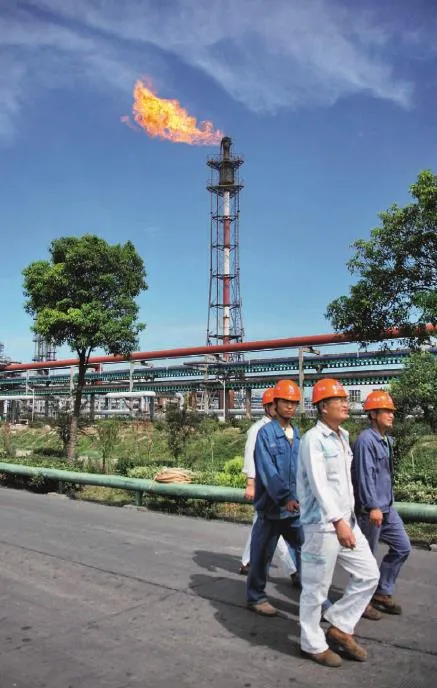
A fully-operational coal-to-gas plant in Huaibei, Anhui Province
This sounds like a huge amount of CO2. But how does it relate to burning the same amount of regular natural gas or your run-of-the-mill coal-f i ring? As it turns out, quite a bit. In a 2013 paper published inNature Climate Change, researchers from Duke University highlighted that nine newly signed coal-to-gas deals would mean seven times more CO2emissions than just burning natural gas. The same study states that when synthetic gas is used to generate electricity its greenhouse gas emissions from the whole process, start to fi nish, are around 36 to 82 percent higher than coal power.
A peer-reviewed modeling study in the journalEnergy Policyfrom earlier in 2013 found that life-cycle CO2emissions are 20 to 108 percent higher than coal when synthetic gas is used for cooking, heating, and power generation. The authors concluded that coal-to-gas expansion was not compatible with China's 2020 carbon reduction targets.
This is a view shared by Li Junfeng, supervisor at China's National Center for Climate Change Strategy and International Cooperation: “Given the need to control the peak level of our greenhouse gas emission as well as total energy consumption, China should not develop coal-to-gas production on a large scale.”
Take Datang's Inner Mongolia plant for example. This demonstrator project is contracted to provide Beijing with four billion cubic meters of SNG a year. This will result in a signif i cant net increase in coal consumption—and thus of CO2emissions by around 3.77 million tons—according to Tsinghua University's “Report on China's Low-carbon Development, 2014”.
A possible way to offset this climate implication is through carbon capture; however, carbon capture technology, use, and storage are at the extremely early stages of development. Also, the hypothetical cost of CCS will make the already weak economics of coal-to-gas an absolute money pit.
To further aggravate issues, China may set an absolute cap on its CO2emissions in 2016 as a result of severe air pollution and its health impacts. This would be on top of China's 2013 National Air Pollution Plan, which resulted in various provinces and cities including Beijing, Tianjin and Hebei committing to coal consumption reduction targets.
If China builds all 50 coal-to-gas plants without carbon capture and storage and isn't prevented from doing so by a global climate deal, the acute disease of air pollution in eastern China will be eased to some extent, but the country's arid west will suffer from increased air pollution and water crises, further adding to the planet's serious CO2problem. The National Energy Administration has called for caution in the development of coal-to-gas projects and is expected to roll out several more documents to regulate the industry. This shows that China's energy authority is clearly concerned that its big plan for coal-to-gas plants could go wrong, and that there is at least some ambition to fi x it. In the short term, however, the plan is to simply shuff l e China's pollution problem to somewhere less noticeable.- DAMlN TANG,an international communications off i cer at Greenpeace East Asia.
猜你喜歡
中老年保健(2021年12期)2021-08-24 03:30:40
中國(guó)傳媒大學(xué)學(xué)報(bào)(自然科學(xué)版)(2021年1期)2021-06-09 08:43:00
中國(guó)生殖健康(2020年6期)2020-02-01 06:28:50
新世紀(jì)智能(英語(yǔ)備考)(2019年12期)2020-01-13 06:07:18
瘋狂英語(yǔ)·新策略(2019年9期)2019-10-17 01:51:34
中國(guó)生殖健康(2019年11期)2019-01-07 01:28:02
中國(guó)生殖健康(2018年6期)2018-11-06 07:09:28
濰坊學(xué)院學(xué)報(bào)(2017年2期)2017-04-20 08:44:31
中國(guó)環(huán)境監(jiān)察(2016年5期)2016-10-24 05:25:52
中國(guó)商論(2016年33期)2016-03-01 01:59:38
