
GOLD FEVER
2014-02-27 11:56:44BYTYLERRONEY
漢語世界 2014年6期
關鍵詞:含義
BY TYLER RONEY
GOLD FEVER
BY TYLER RONEY
How China's lust for gold is changing the country
黃金具有特殊的文化含義,也是節假日熱銷商品。金礦業的繁榮,同時也對環境產生著深遠的影響。
Gold is extraordinary—forged in the death throes of a colossal star and shot across the void of deep space over millions of years to land on earth to be mined, sold, and fought over. There are very few things on this planet that produce such a raw sense of both greed and ambition, and China has become the world's premier producer and consumer of this oh-so precious metal. Gold miners in North America, from the California Gold Rush to modern day, call gold “the color”, and to the Chinese people there are few colors that inspire more glee than the pleasant luster of gold. It would be easy to put China's gold demand down to sheer self-indulgence, but China has an insatiable, cultural desire for gold as well. To some, gold simply means money, but for many Chinese, the element means weddings, Lunar New Year, and even Mother's Day. Everyone from China'sdama(“big mothers”) to thetuhao(vulgar rich) seem obsessed with this stunning metal. China went nuts for the gold iPhone 5s, the gold market itself was almost turned on its ear by old Chinese ladies bulk buying, and even the newPeople's Dailybuilding is gilded with “the color”. To China, gold is revered, but the story of where it comes from, the changes it is making to China's economy, and the damage done to the planet is less well known.
From the steamy heaven of Beiya (北衙) in Yunnan Province where the locals suffer through gold mine pollution to China's border with Kyrgyzstan in Xinjiang where a gold rush is imminent, mines around the nation are trying to bring this metal to the surface to sell for record prices. And, it is China's middle class that is driving the domestic demand. Gold jewelry demand in China has increased 344 percent in the past decade and investment demand is up well over 5,000 percent over the same period according to statistics from the World Gold Council. A press release from that organization stated, “China is now at the center of the global gold market—the engine driving the shift from West-to-East in terms of wealth creation, economic growth, and gold production and consumption.”
Much like everything else in China, the gold mining industry experienced an incredible boost over the past decade, with yields more than doubling. In 2004, China pulled up 6,287,000 ounces of gold from mines around the country; that number rocketed up to 14.5 million ounces in 2014—an over 100 billion dollar industry—putting the nation into the midst of a modern day gold rush of national signif i cance.
With China's explosion in the gold market has come market reforms, including new regulations allowing foreign investors to buy into China's gold reserves as of September this year, and while this may sound like little more than chest thumping, in actuality it strengthens the RMB as a global currency and gives the entire nation more stable purchasing power. So, while China's economy booms and expands into what sometimes looks like a bubble ready to burst, the ever-increasing gold markets have the power to safely gild that bubble to keep it, and the currency, stable.
So, in China, gold means more than money: it's stability, it's a spearhead for reforms in resource mining, it's a sustainable source of revenue, and it's a culture icon without equal. But, there are costs to doing business with Mother Nature—costs even more dear than 7,600 RMB an ounce.
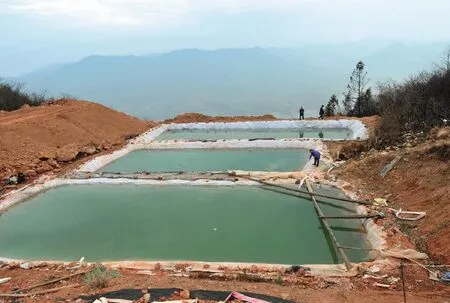
Gold is washed through huge vats of cyanide in Hubei Province, a process that, if not done correctly, can cause devastation to local wildlife
DESPITE PRECAUTIONS, SPILLS AND MINE WASTE CAN CAUSE DEVASTATION TO LOCAL WILDLIFE
Cyanide and Gold
Large-scale gold mines (LSGMs) perform capably and usually have all the necessary licenses and permits that come with such a task; however, even legitimate large-scale mines can cause major damage and leave behind pervasive, common toxins and poisons. The fi nal step of separating gold from other ores is time-consuming, diff i cult, and expensive without the right equipment. But, cyanide is a gold magnet—a cheap and effective way to collect microscopic bits of gold mixed in with other ores.
Kristina Shafer, executive director for the Institute for Sustainable Mining (a.k.a Artminers), visited Axi mine (阿希金礦) in Xinjiang: “The Axi mine is a large-scale industrial mine, utilizing state-of-the-art technologies including closed circuit cyanide vats.” Cyanide is actually one of the safer means by which microscopic gold can be found, but it can still be extremely dangerous to wildlife.
“The gold mined today is dust, not nuggets. Gold particlescan be caught up in rocks, dirt, waterways, and, signif i cantly, gold is still sitting in tailings piles from a countless number of abandoned mine sites. Even the modern sluice boxes of today lose gold particles smaller than 300 to 150 microns,” says Shafer. This means that the use of something like cyanide can be worth tens of thousands of dollars a day to large mines. But, despite its common use, cyanide is still a dangerous chemical that can severely harm the brain and heart and can even lead to death. Despite precautions, spills and mine waste can cause devastation to local wildlife, and a process known as “heap leaching” leaves behind tons of rocks leaking toxic chemicals into the environment.
Gold, having traveled all the way from a Type II Supernova millions of years ago, is obviously found underground among heaps of rocks and other ores, where it is of little use to markets, buyers, jewelers, and governments. Getting it out of the ground is a complex and varied process—involving trommels, dredges, sluice boxes, miners' moss, and a whole host of heavy equipment. But when it comes to micro-gold, cyanide is the cheapest and most readily available option for many large and small mines.
Kristina Shafer's trip to the Axi mine in Xinjiang was to champion the use of a new technology called Cleangold, developed by David Plath—it's a technology that is hoped to end the use of things such as cyanide in gold mining. “[It's] a specially designed magnetic plate that creates an adsorptive matrix from the heavy black sands (magnetite) commonly found in fi ne gold deposits. When ore is passed across a Cleangold sluice, gold becomes trapped on the sluice, while unwanted lighter materials pass through,” says Shafer.
The use of cyanide is ingrained in gold miners around the world, and Kristina Shafer and others hoping for a more technological, safer method have their work cut out. In places like China's wild west of Xinjiang, which hosts a wealth of biodiversity and agriculture, the paradigm shift towards technological answers could be a price well worth paying, as David Plath toldTWOC, “I feel that the region in the west is too important as an agricultural area for the government to allow small scale mining, especially with cyanide, to occur.”
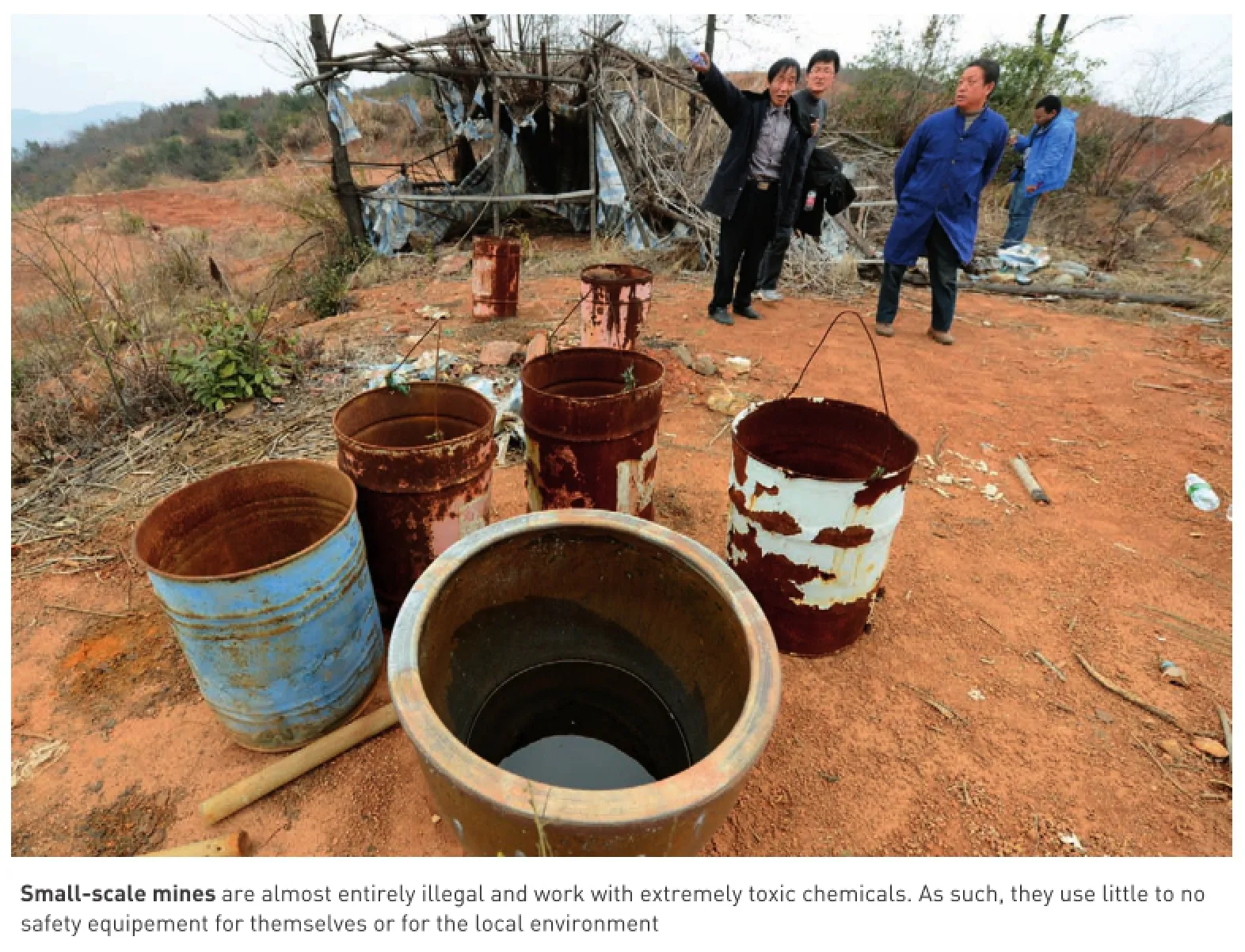
Hg for Au
Unfortunately for China's miners and environment, cyanide is one of the cleanest chemical methods for extracting microscopic gold, and some of China's smaller mining interests use something far more dangerous and pervasive: mercury. Cyanide, as frightening as it sounds, has only an immediate effect on wildlife and will decompose in sunlight. Mercury creates an amalgam upon coming into contact with gold, and while this is an interesting science experiment to watch, the consequences for the environment and the miners can be grave and long-lasting indeed.
The affects of mercury poisoning are all-too familiar in China—found in everything from food to skin-whitening products. But the sheer amount of mercury put into the environment through gold mining is staggering.Estimates vary and are extremely hard to come by, but as recently as 2004, over 50 metric tons of mercury entered China's environment via gold mining, according to the World Business Council for Sustainable Development. This mercury affects everything from fi sh to vegetables and can have serious and tragic affects on the nervous system, heart, lungs, kidneys, and poses a signif i cant risk to women's reproductive capabilities, even in small doses.
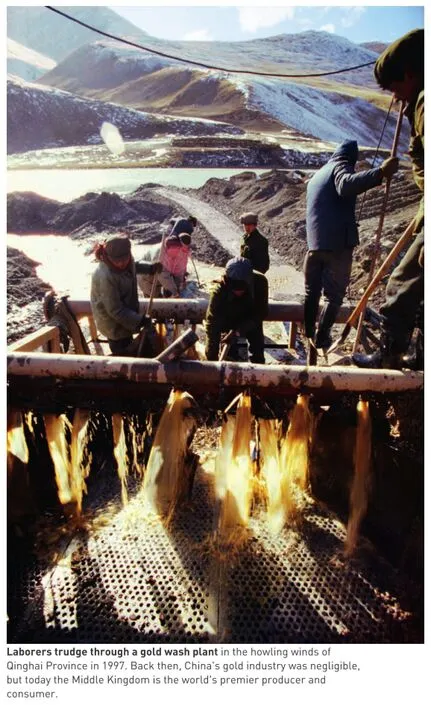
IT CAN CAUSE PERMANENT DAMAGE TO THE NERVOUS SYSTEM, AMONG OTHER HEALTH PROBLEMS, INCLUDING SUICIDAL TENDENCIES AND TREMORS
Indeed, China's problems with mercury hardly began with gold mining. It extends to everything from coal to batteries, but, it's not just the environment that suffers: the miners are directly in danger. The process of dealing with the amalgam involves melting off the mercury, a reaction which releases breathable, highly-dangerous mercury vapor. Miners simply put the mercury and gold amalgam on a stove to purify their stock, but when inhaled by the miners, it can cause permanent damage to the nervous system, among other health problems, including suicidal tendencies and tremors.
The use of mercury in gold mining around the world is controversial to say the least, and the danger is increasingly being brought on by artisanal and small-scale gold mines (ASGMs). Realizing the threat to the environment—and doubtlessly the threat to private and state-owned companies—China has attempted to shut down most ASGMs around the country, but enforcement remains extremely diff i cult. The practical illegality of small-scale gold mining means statistics are almost impossible to come by, but miners employed by ASGMs in the recent past have been estimated to be in the hundreds of thousands.
“Not too much that I can say about small scale mining there, having been told that ‘there isn't any,'” says David Plath. The denial of the existence of ASGMs takes a heavy toll on both enforcement and the realizing of cleaner and safer technologies. While even the use of cyanide would be a step up, technologies like Cleangold can be applied safely and cheaply; if ASGMs are encouraged to use them, they may even be able to help clean up previously polluted mining sites.
“Cleangold recovers mercury lost from past mining operations, offering the potential for reclamation,” Shafer says. “I think with government engagement to legalize and license small miners who operate responsibly, it could be a tremendous opportunity to spur ground-up economic development for impoverished communities,while providing revenue to the government.”
These miners often don't have access to closed circuit cyanide vats, and China, as one of the world's foremost producers of mercury, provides a relatively available alternative—an alternative that can effect generations of people and wildlife.
Big Mines and Big Money
The outlawing of ASGMs in their current state makes sense, as they present both a personal and environmental danger that China is simply not ready to deal with or regulate. Most of China's gold comes from large-scale mines, and at over 14 million ounces a year, there's a lot of competition. Most of China's gold mining fi rms are homegrown and strangely private, but China has opened up to the world in many ways and now there is foreign competition for these resources.
Eldorado Gold, a Canadian mining operation run out of Vancouver, runs mines in Guizhou, Jilin, and Qinghai provinces. “Eldorado operates three gold mines in China: Jinfeng (錦豐), Tanjianshan (灘間山), and White Mountain (白山) . Together, these produce almost 300,000 ounces of gold per year,” says Louise Burgess, a spokesperson for Eldorado Gold. Eldorado has more active gold mines in China than any other country in which it does business, with big plans for a mine near the Chinese-Russian border. Burgess explains,“We are developing the Eastern Dragon project in northeast China. Eastern Dragon is a high-grade epithermal gold-silver deposit.”
Domestic large-scale mines are raking in the cash and doing what they can, at least on paper, to keep mining operations as green as possible. What makes large-scale mining operations so much more environmentally friendly and viable for safety is that, unlike their smaller counterparts, they have to deal with the ever-present threat of accountability.
The Zijinshan Gold & Copper Mine (紫金山金銅礦), for example, is the largest open pit mine in China, located in Fujian Province. Records of gold mining in the area date back to around 1040 C.E., but it has only been in the past 20 years that the area has realized its true potential. Back in 1992, the Zijinshan mine was the sole property of the Zijin Mining Group—employing a grand total of 76 employees and pulling a meager eight kilograms of gold out of the ground a year. And, after operations costs are deducted, the mine made a paltry 8,800 USD. Fast forward to 2009 and the mine was digging up 75.4 tons of gold and making almost 600 million USD in prof i ts, reaching a net equity of over three billion. The mine is a perfect example of the rapid expansion China has made in the fi eld of gold mining and how the entire economic landscape has so drastically changed.
As a larger mine Zijinshan is set environmental targets, ones it can meet easily. In fact, this year, it has excelled in its reforestation project, completing 188 percent of their original target, growing arbors and fl owering shrubs. The total effected area reaches a whopping 742,393 square meters. However, just because the Zijin Mining Group is large does not mean that it is altogether safe with either its workers or waste. Indeed, in 2010, acidic run-off from the mine killed or poisoned 1.89 million kilograms of fi sh in Fujian Province; admittedly this was from one of the company's copper mines, but it shows that even the most renowned mines in China deal with potentially catastrophic chemicals and consequences.
Even with the massive inf l uxes of cash and foreign inf l uence, gold mining is a treacherous business. The famously bleak life of a miner—especially one that fl ies under the government radar—can be harrowing, and there is little in the way of protection. A gold mine collapse in 2010 trapped more than 300 people, another that same year claimed over 25 lives in Hunan Province, nine people were killed in a carbon monoxide incident in a gold mine in 2013 outside Huadian city, and three more were killed that same month in a collapse in Shandong Province. Though the death toll pales in comparison to China's coal mining deaths, gold mining, which is a much smaller industry, amounts for 10.2 percent of all mining deaths, according to statistics published by Xinhua.
As China gears up for a literal golden age, it might be worth taking a look at the systematic problems so painfully apparent in current practices. Government support or stringent regulation of ASGMs can save lives and the environment, and new technologies like Cleangold have the potential to take hold in places still using mercury to clean up gold. China is entering the New Year season, and gold jewelry and ornaments will no doubt play a part; even though the gold rush is fueling China's economy and strengthening its currency, it might not be a bad idea to think about how much blood goes into an ounce of gold.
猜你喜歡
英語世界(2022年9期)2022-10-18 01:11:46
瘋狂英語·新策略(2019年9期)2019-10-17 01:51:32
瘋狂英語·新讀寫(2018年8期)2018-11-29 00:57:01
法律方法(2018年2期)2018-07-13 03:22:22
中學生數理化·八年級物理人教版(2017年10期)2018-01-22 03:04:00
中學生數理化·七年級數學人教版(2017年3期)2018-01-20 12:45:49
高中生·天天向上(2017年5期)2017-06-12 06:55:06
知識窗(2017年4期)2017-04-12 22:26:05
學生天地(2016年16期)2016-05-17 05:45:55
中國工程咨詢(2015年6期)2015-02-16 05:33:56
