
Water Barely Retained
2014-02-25 16:19:52ByXinYing
China Pictorial 2014年2期
By+Xin+Ying
The weather in August is turbulent on the QinghaiTibet Plateau. The swirling of heavy clouds hints that rain is on its way.
Before it comes, Lhamo Damdru must move the cow dung drying in front of his tent to a safer place. It is the familys only fuel. Although rain causes extra stress at home, frequent precipitation nourishes the grassland, enriches water resources of the wetland, and favors herding in general.
Rainfall is the simplest way to provide water for wetlands on the plateau. After rainfall, the river by Flower Lake swells, where Sonam, Lhamo Damdrus daughter, fetches water for her family. The family of ten exhausts a 40-kilogram tank of water in a couple of days.
Herdsmen of Zogye County, Aba Prefecture, Sichuan Province, have imbibed water from the wetlands for generations. However, they have been bothered recently by decreasing supply.
Yu Sigang, deputy magistrate of Zogye, explains the respective rainfall retention situations of yesterday and today. Historically, several days of rainfall could be saved in lakes, ponds, and rivers for one to three months. Today, however, two or three days of rain will only survive for several days or a week at most. For many years, the county has seen steady rainfall, which has not been retained. Locals assumed the grass was to blame.
Qinghai-Tibet Plateau possesses the youngest soil on Chinas mainland. Millions of years of weathering have left the soil only 20 centimeters deep. As time passes, countless creatures live and die, making the soil fertile enough to nourish grass. Most of the grass is buried into the earth and the roots are responsible for reinforcing the soil and retaining water.
As the temperature rises early in the morning, water on the surface begins to evaporate and forms dew on plants. The dewdrops accumulate slowly and patiently send water underground before the sun rises high in the sky. This is an extremely important method for storing water resources on the plateau. It is through such persistent gathering that the wetland can rid itself of reliance on monsoons because water can be more evenly transported through the river, which is estimated to have total moisture storage capacity of 700 billion cubic meters.
Zhang Dehai, chairman of the Standing Committee of the Peoples Congress of Hongyuan County, also in Aba, believes that a higher volume of vegetation intensifies water content, which in turn helps retain rainfall, particularly after storms, through surface retention. It takes long for springs to flow together into rivers after being deposited and filtered underground.
Nevertheless, any method of accumulating water other than direct rainfall is fragile because even the slightest change in conditions can cause massive destruction of vegetation.
“Natural ecosystems are closely related to each other,” remarks Zhang Dehai. “Its a biological chain. One tiny imbalance can easily break the whole food chain, leading to a biological catastrophe.”
Zogye, located on the northern rim of the QinghaiTibet Plateau, is the largest alpine marsh wetland in China. Today, however, 7.2 hectares of its pastures have become desert, which expands at a rate of 10 percent every year. Excessive herding is believed to be one of the major causes of desertification.
For a long time, the population density on the plateau has remained less than one person per square kilometer. The majority of the land remains untouched. The sparsely-scattered herdsmen have never had a problem with the tradition of “more children and more cattle and sheep.”
According to Yu Sigang, in 1953, the county had a population of 30,000 and a total of 330,000 domestic animals in a marshy pasture of 808,000 hectares. Today, the area of the pasture remains unchanged, but the population of citizens and animals has jumped to 75,000 and 1.2 million respectively.
The growth cycle of pastures on the plateau is no longer than 90 days, not to mention limited in quantity. Vegetation is not sustainable unless three hectares of grass are available for each sheep. During the 1970s, 1,000 kilometers of ditches were dug across the wetland, resulting in abrupt degradation of marshes in the county.
Today, all that is left of the ditches on grassland is bone-dry low-lying land, which will never give birth to lush pastures.
Wetland degradation worsens across the entire Qinghai-Tibet Plateau both naturally and artificially. A recent survey counts more than 6,400 species of highelevation plants on the plateau and 130 species of water birds in Tibet alone. Worsening wetland degradation will undoubtedly threaten these animals and plants.
“The biological chain on the Qinghai-Tibet Plateau is more tightly linked than in other places,” notes Zhang Dehai. “The extinction of one species could possibly cause a catastrophic blow to the entire eco-environment in the region.” Alpine regions tend to have their own unique ecosystems characterized by the cold, dry, windy, sunny climates of high elevations. Therefore, their ecological chains are more dependent on each individual link. One missing plant will never be replaced by another and leave only the muted colors of bareness.
The growing pains of global warming and human activity have created new challenges for the fragile ecoenvironment on the plateau. As statistics show, alpine meadows on the Qinghai-Tibet Plateau vanish at an average of more than 5,000 hectares a year, while deserts expand by 5.2 hectares annually. Rapid desertification has aggravated water and soil erosion at a loss of 21 square kilometers annually in the three-river (Yangtze, Yellow, and Lancang) source region. Every year, the upper reaches of the Yangtze and Yellow rivers discharge approximately 100 million tons of sand in Qinghai Province.
An issue concerning every inhabitant of Earth today is how to retain water and soil on the Qinghai-Tibet Plateau.
Lei Guangchun, president of the College of Nature Conservation of Beijing Forestry University, holds that the plateau ecosystem situation affects the safety of drinking water for at least two billion people. If its completely destroyed, the wetland will lose all functionality for water storage, causing more floods in the future.
The Qinghai-Tibet Plateau is richly endowed with wide expanses of peat, and a third of the marshes and wetlands in China are found there. Global climate change will also be exacerbated when a massive volume of greenhouse gases is discharged from the wetland into the atmosphere.
Free Lunch: Changing China Softly
Deng Fei, Sino-Culture Press,
January 2014
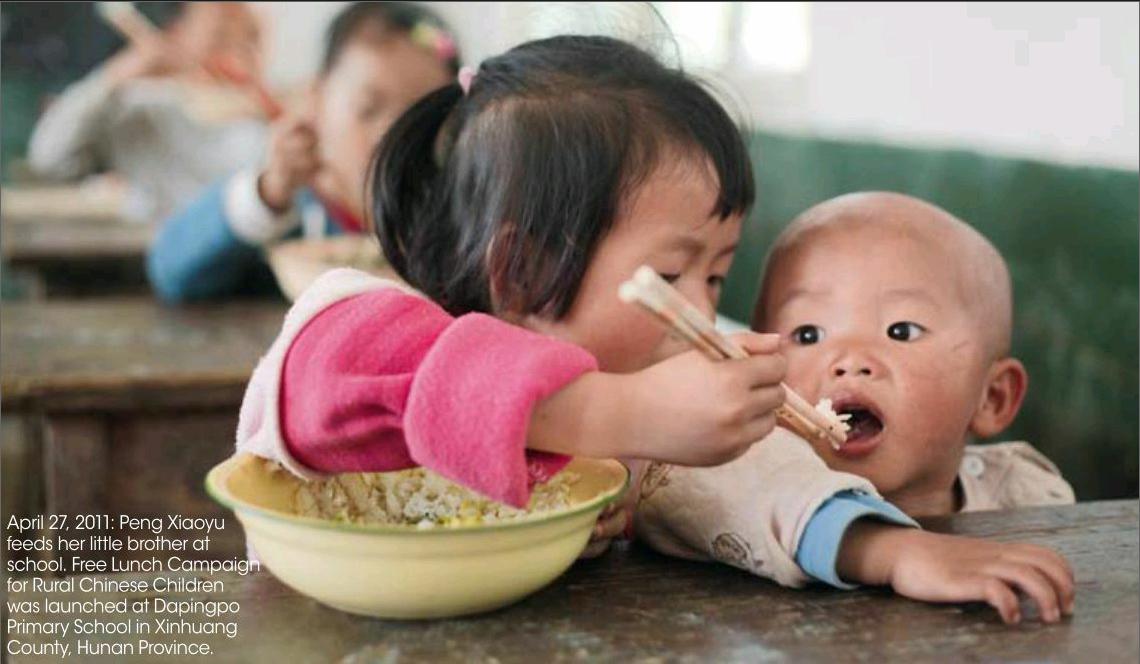
For 11 years, Deng Fei served as a journalist specializing in investigative reports on issues arising from Chinas rapid progress. In early 2011, he covered an issue at a Guizhou Province elementary school, where students were prevented from going home for lunch due to a school merger. The situation behind the school merger caused by an integration of villages has brought a dramatic change and an end to an era. Chinas modern attempt to accelerate urbanization by sacrificing villages and townships and institutionally evacuating rural labor, resources, and capital left 61 million children under tremendous stress. In April 2011, 500 journalists joined Deng Fei in promoting Free Lunch Campaign for Rural Chinese Children on Weibo (Chinas Twitter).
Free Lunch: Changing China Softly recounts the entire process of the campaign, which was conducted transparently online. The team carried out the campaign efficiently through a professional management system. “I found a sympathetic contractor in the huge social community,” Deng illustrates. “Weibo gives people incredible power – its the most state-ofthe-art tool, in a soft, transparent, and collaborative way. State leaders saw the gigantic snowball of popular sentiment as well as solutions we worked out. Then Premier Wen Jiabao announced the allocation of 16 billion yuan from the Central Government to solve nutrition problems for 26 million rural children in poverty-stricken areas.
New media has made a huge difference in solving social problems by encouraging collaboration between governmental and nongovernmental institutions. Free Lunch made it possible for China to change in a soft way. Moreover, the campaign integrated various other programs involving children via Weibo such as crackdowns on abduction, health insurance, and the Warm Current Program through establishing an online community to support rural Chi- nese children. They are organizing more alliances for the protection of childrens rights and funneling urban philanthropic resources back to rural schools to provide nutrition, books, medical treatment, personal safety, and daily necessities, as well as mental comfort and educational balance. The campaign has provided services to 61 million left-behind children, who can now grow up safe, healthy, and equal to other children.
Chinese National Character through the Window of Modern History
Zhang Ming, Gold Wall Press,
September 2013
Its hard to understand todays China without grasping mod- ern Chinese national character. Professor Zhang Ming from the Department of Political Science of Renmin University of China illustrates individual behavior at every level, including monarch and subjects, warlords, elites, and civilians. Understanding modern China requires digging deep through its historical fragments, playing back every event, big and small, and reviving periodic views through an outsiders eyes. He straightforwardly reveals distortions resulting from historical neglect.
Zhang Ming serves as a professor in the Department of Political Science of Renmin University of China. His distinctive personality enhances his writing, showing his great concern for the world with a heart sated with profound cultural concepts and incisive humanistic care. He endeavors to unveil the truth behind the sensational mask of historic events and figures. Over the last few years, Professor Zhang has published a series of academic writings including 1911 Revolution: Rocky China, Northern Fission: Warlords and the May Fourth Movement, Eighty Years of Rural China: Changes of Farmers Consciousness during Chinas Modernization, and Changes of Social Power and Cultural Structure in Rural China.
