
Worries in the Heyday
2014-02-24 21:16:43byCho-yunHsu
China Pictorial 2014年1期
by+Cho-yun+Hsu
Cho-yun Hsu on History: Contrast Between Chinese and Western Civilizations
by Cho-yun Hsu Zhejiang Peoples Publishing House November 2013
Master historian Cho-yun Hsu sketches the contours of the development of both Oriental and Western civilizations from a macro perspective of parallel bilateral histories, which ebbed and flowed alongside each other, while finding unique turning points. Eventually, China became a unified country while Europe became the community of individual nations we see today.
Since the Ming and Qing dynasties (1368-1911), China has suffered disastrous decline while Europe cracked open the door to modern civilization with the industrial revolution in the wake of discovery and colonization of the New World. Those were the turning points that relegated Chinese civilization to a historical follower.
Cho-yun Hsu on History: Contrast Between Chinese and Western Civilizations dissects the reasons behind successes and failures by contrasting each side in terms of geographical environment, social system, and ideology and culture, as well as predicting challenges China might face during its contemporary renaissance.
Born in Wuxi, Jiangsu Province, in 1930, Cho-yun Hsu serves as Emeritus Professor of History and Sociology at the University of Pittsburgh and a member of Academic Sinica in Taiwan. Over the last 20 years, Hsu has tirelessly worked to popularize history and highlight its practical significance through his books, published both in China and abroad.
During the more than 200 years between Ming Emperor Wanlis reign (1573-1620) and Qing Emperor Jiaqings reign (1796-1820), on the other side of the world, sea-routes were opening and the New World was discovered. Europe was marching towards a new era with evolved kinetic energy, like birds of prey, or even fish, soaring in the sky.
Actually, a considerable chunk of the profits reaped by European imperialism flowed indirectly to China, which enjoyed a favorable balance of trade for some 200 years. The Ming and Qing governments, rather than appropriately taking advantage of the influx of cash, considered the change a challenge threatening the order of the nation afforded by its isolation from the outside world.
Following Emperor Wanlis reign, China saw an expansion of business within non-governmental maritime groups along coastal areas, even an increasing influx of capital from inland, including capital accumulated from merchants of Anhui. The Ming government tightened its ban on maritime trade with foreign countries, making great efforts to stop Chinese sea traders as if they were associates of pirates.
While the European powers were strengthening their sea forces, China continued focusing on its social order, ignoring the tremendous significance of increasing globalism, missing its best chances to become more involved in maritime trade.
The southern and southeastern regions of China became fairly well-off during the Ming Dynasty due to trade surpluses, while regions north of the Yellow and Huaihe Rivers remained chained by poverty because they werent exporting. The economic network actually fractured into two pieces: the South remained rich but unable to help the poverty-stricken North. Even the northern-based central government depended on financial support from the South, not to mention civilians struggling for survival because so much of their farmland was dominated by royalty and aristocracy, who were committed to keeping the country unified through power politics. The gap between the North and South widened, minimizing mutual benefits of the economic network.
China, its southern region in particular, witnessed considerable urbanization during the Qing Dynasty(1644-1911), yet missed the so-called “sprout of capitalism” as well as the arrival of the industrial revolution. Patterns of production, marketing and supply around the world began changing when Western capitalist countries used their colonial gains to transform outdated economic structures. The industrial revolution in the West bypassed the late Qing Dynasty smoothly. Commodities such as textiles and new products created by industrial production began being exported to China slowly, leaving the country at a new low within the foreign trade landscape.
Such a situation lasted for three centuries. Externally, the country knew little about the world, and internally, the relationship between master and pawn nullified the integrity and ambition of all who adhered to moral principles. The royal system of the Qing Dynasty, as part of a traditional political system handed down for generations, was largely ruined by widespread corruption within court politics, which decimated institutions that had balanced society and gathered and utilized information necessary to effectively govern the country. How could such dynasties survive for 300 years? Their longevity was a sort of pathetic miracle.
Changing pattern and rulers apathy towards change are consequences of the imperial examination system during the Ming and Qing dynasties. This system framed thought within a small box. What the emperors expected was stability, which required cement on the other side to dry. Such a massive empire teetered on disaster due to decaying institutions while zero adjustments were made both internally and externally.
Comparing Chinese and Western histories sideby-side over the previous eight chapters evidences that Western countries cast off their religious bondage of the people, embracing the Age of Enlightenment and its new values of open, free minds, which gave rise to innovation that defied all expectations of the era. Apprehensive about the new situation, China took an opposite path, refusing to move forward and tightening its outdated operational modes, thus weakening its power. Historically, China, a country that remained stable under the same rulers for extremely long periods of times compared to Europe, enjoyed comparatively better developed economics and civilization than the West until its prosperity fell off a cliff during the Ming and Qing dynasties.
Tracing history, today we can no longer remain indifferent as China rests at the crossroads of a new era. The unfolding of post-modern civilization has brought new questions for inheritors of Chinese culture both within the country as well as East Asia at large: How can our culture survive? And what can we do to push it forward?
Here is the most important takeaway from this historical landscape: Our vision can no longer be narrow and short. Our structure and thought can no longer be calcified. Looking into the future, we cannot restrict our pace and tolerate obstacles we place ourselves. Challenges result in opportunities. Being blessed is our own doing.
Stealing Fire
Complied by Yan Bin and Ma Peijie Guangxi Normal University Press January 2014
A collection of conversations concerning vision statements on current topics, Stealing Fire gathers dialogues and opinions from Chinese intellectuals sharing insight and ideas. Liu Yu, Liu Junning, and Xu Zhiyuan discuss“what politics are and how to talk about them,” Mo Luo and Chen Yuan explain “why we are a generation of self-examination,”Lin Yihua, a well-known Chinese theater director, illustrates “how to take the pulse of our absurd era with drama,” and Guo Yuhua and Sun Liping address “the hardships of our era – opportunity structure and social justice.”
Topics cover politics, reform, and economics, from personal experience rather than lofty theory. Sometimes the authors seem like dinosaurs clinging to cliches about freedom and hardship, or like stubborn teachers stressing values like reading, literature, and self-reflection. Their concern for modern reality and longing for dreams of the era pull them up and down, to the edge, gentle and heartfelt, cold, and flaming. Plato dreamed of building a utopia, while Stealing Fire aims to construct a modern incarnation by arousing concern for society as well as the maturation and development of souls from perspectives of aesthetics, psychology, ethics, economics, and philosophy.
My Memories of Old Beijing
Text by Lin Haiyin illustrations by Guan Weixing New Star Press, November 2013
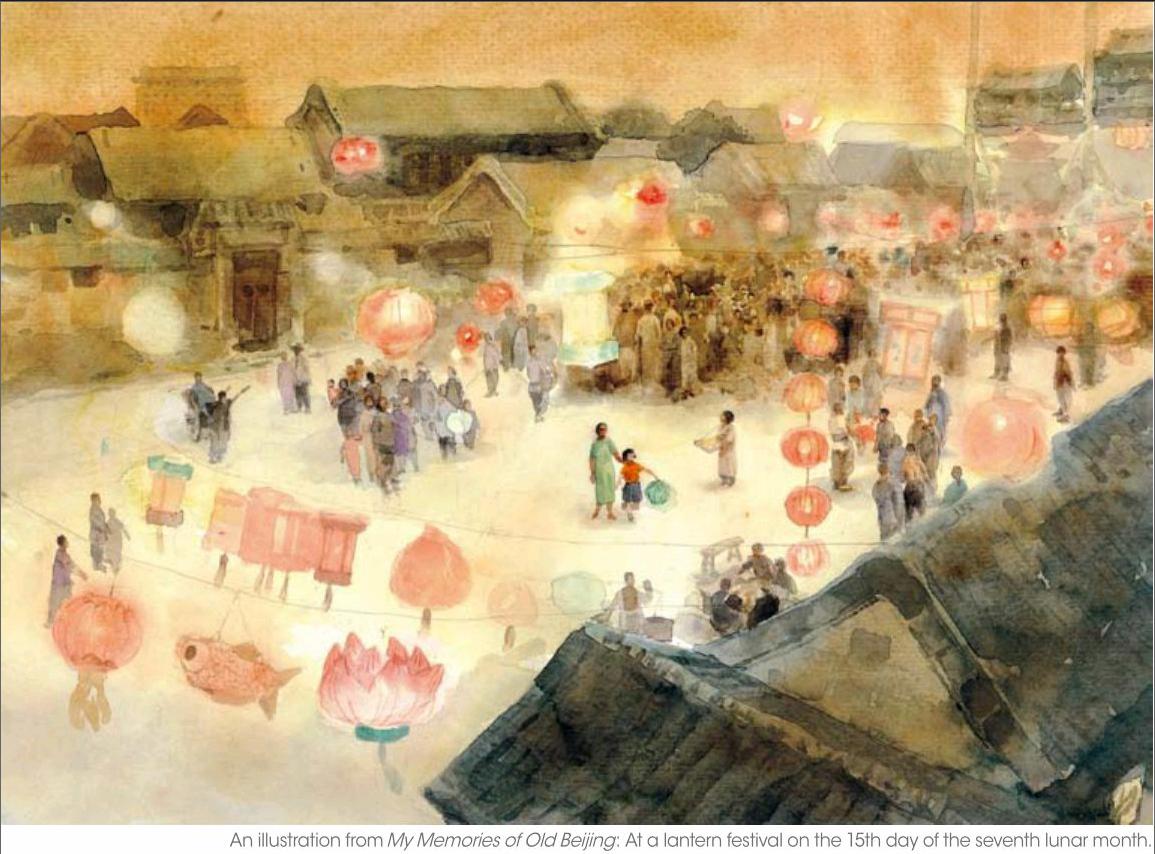
About half a century ago, Lin Yingzi, a little girl from Taiwan, moved to a narrow lane, or hutong, in Beijing. Everything was fresh: battlements and ruins, busy markets, and busy life in the secluded alleys. Through innocent eyes, the novel recounts stories of adult world and vicissitudes of life of the time. Its light, na?ve text unveils complex emotions about the world. My Memories of Old Beijing is an autobiographical novel first published in 1960 by Lin Haiyin, a famous modern Chinese author. Chronicle of a girls life from age seven to thirteen, the book has seen many editions and was dubbed one of the Top 100 Chinese Novels of the 20th Century by Asiaweek. It has touched several generations in China since the 1980s when it was adapted into movie and TV series.
This edition is based on the 1994 Taiwan green picture book, with over 70 watercolor illustrations by Guan Weixing, a modern master painter. It was thoroughly revised by a team of experts with elements of other versions and textual research of names, events, and dialects mentioned in the book.
