
32個切花菊品種的耐低磷特性
2013-12-09 06:01:17陳素梅房偉民蔣甲福管志勇陳發棣
生態學報 2013年21期
劉 鵬,陳素梅,房偉民,蔣甲福,管志勇,陳發棣
(南京農業大學園藝學院,南京 210095)
32個切花菊品種的耐低磷特性
劉 鵬,陳素梅,房偉民,蔣甲福,管志勇,陳發棣*
(南京農業大學園藝學院,南京 210095)
利用砂培試驗對32個切花菊品種進行了苗期耐低磷篩選和鑒定。結果表明,供試切花菊品種耐低磷能力存在明顯的基因型差異,表現在幼苗相對干重(低磷脅迫/正常供磷)、相對磷含量和相對磷積累量存在較大的基因型間變異(CV分別為12.14%、20.99%和26.41%),相對干重、相對磷含量和相對磷積累量之間均呈極顯著正相關(Plt;0.01)。通過聚類分析可將32份供試品種的耐低磷脅迫能力分為極強、強、中等、弱、極弱5個級別,南農銀山對低磷的忍耐能力最強,屬耐低磷能力極強的品種;南農紅楓、南農香檳和優香對低磷脅迫的忍耐能力最差,屬耐低磷能力極弱的品種。相對干重、相對磷含量和相對磷積累量可作為切花菊耐低磷特性的篩選指標,為切花菊育種、栽培管理、磷營養學研究提供參考。
切花菊;基因型差異; 低磷脅迫;篩選指標
花卉種植業是精細農業的代表,植物營養調控作為精細農業的重要組成部分,開發高效營養型的花卉品種將會有助于花卉精準栽培的實現。同時控制肥料用量也成為花卉取得國際認證、打入國際市場的保證[1]。切花菊是世界四大切花之一,在花卉種植業中占據重要地位[2],因此研究切花菊的營養利用能力十分必要。
磷是植物最重要營養元素之一,植物體內的絕大部分代謝都離不開磷的參與。磷礦作為一種不可再生的資源,預計在不久的將來將會耗竭[3]。另外,施入土壤的磷肥極易被土壤吸附或固定,磷肥的當季利用率僅為10%—25%,未被利用的磷素長期或暫時滯留在土壤中,造成磷素資源的浪費和土壤次生鹽漬化,加大淋溶損失所造成的污染風險[4]。切花菊一般采用設施栽培且復種指數高,為維持高產優質需要大量施用化肥,導致肥料浪費和土壤連作障礙,造成的環境污染也較大田更為嚴重[5- 6]。
利用作物對土壤營養元素吸收和利用的遺傳性差異,篩選或培育能提高土壤磷利用率的耐低磷品種是經濟、環保的有效方法[7]。為了在較大范圍內對切花菊的磷利用狀況進行評價,篩選出磷高效利用品種和磷低效利用品種,并為切花菊的栽培、磷營養學研究和品種選育工作提供參考和依據,本文在借鑒大田作物篩選方法的基礎上,結合切花菊特點,探討切花菊苗期耐低磷種質的篩選方法。
1 材料和方法
1.1 試驗材料
供試材料為南京農業大學中國菊花品種資源保存中心保存的32份切花菊品種(表1)。
1.2 方法
1.2.1 篩選體系
2010年進行預實驗確定篩選體系與合適的篩選壓力,2011年進行正式試驗。試驗選用石英砂作為培養基質,石英砂按毛達如等的方法處理[8]。設全磷(KH2PO4300 μmol/L)、低磷(KH2PO415 μmol/L,用KCl使鉀鹽濃度與正常供磷一致)2個處理。營養成分配方參照荷蘭花卉研究所巖棉滴灌用配方[9],取其1/3用量。除磷酸鹽外的各成分分別為:KNO31.67 mmol/L,MgSO4250 μmol/L,K2SO4300 μmol/L,CaCl2750 μmol/L,Fe-EDTA 15 μmol/L,H3BO345 μmol/L,MnCl24.5 μmol/L,ZnSO41 μmol/L,H2MoO40.13 μmol/L,CuSO40.16 μmol/L。全部營養液pH調至5.8。
1.2.2 試驗處理
選取長勢一致的切花菊插穗扦插于生根基質(1∶1的蛭石和珍珠巖),15d后插穗生根形成扦插苗。將洗凈基質的扦插苗置于全磷營養液中預培養3d,然后定植于砂培槽中,澆入相應的營養液,各處理每個品種20株,7d換1次營養液,換營養液前從砂面澆蒸餾水淋洗1次,每天視光照和氣溫調整灌溉次數以補充水分消耗,防止萎蔫,每隔2—3d調節pH 1次。處理20d后各品種間出現明顯差異,進行數據采集。
1.2.3 數據采集與分析
測量的指標包括株高、干重、磷含量、磷積累量。植物材料置于105℃殺青0.5h,80℃烘干至恒重后測干重。材料經濃H2SO4和H2O2消煮后用鉬銻抗法測磷含量[10]。磷積累量(吸磷量)=生物量×磷含量。為了消除不同品種間固有生物學差異,采用相對耐性指數,如:相對株高、相對干重等綜合指標來衡量不同品種間的耐低磷脅迫能力。相對耐性指數 = (低P處理的測定值/完全培養液的測定值)×100%,包括相對株高(RPH)、相對總生物量(RPW)、相對磷含量(PPC)、相對磷積累量(RPA)。試驗結果利用Excel和SPSS軟件進行統計分析。
2 結果及分析
2.1 低磷脅迫下切花菊品種的生物學性狀差異
低磷脅迫下,32個供試品種均出現生長變緩、根冠比變大、部分品種下部葉片黃化,整體上與全磷處理組呈顯著性差異,如磷含量(t=21.95gt;gt;t0.01)、干重(t=14.55gt;gt;t0.01)均達到極顯著差異。
表1中的數據顯示,供試切花菊品種間在磷利用能力上存在差異,其中差異最大的是相對磷積累量(RPA),變異系數達到26.41%。相對株高(RPH)、相對總生物量(RPW)、相對磷含量(PPC)的變異系數也較大,分別為12.66%、12.14%和20.99%,這表明切花菊品種的耐低磷能力存在明顯的基因型差異。
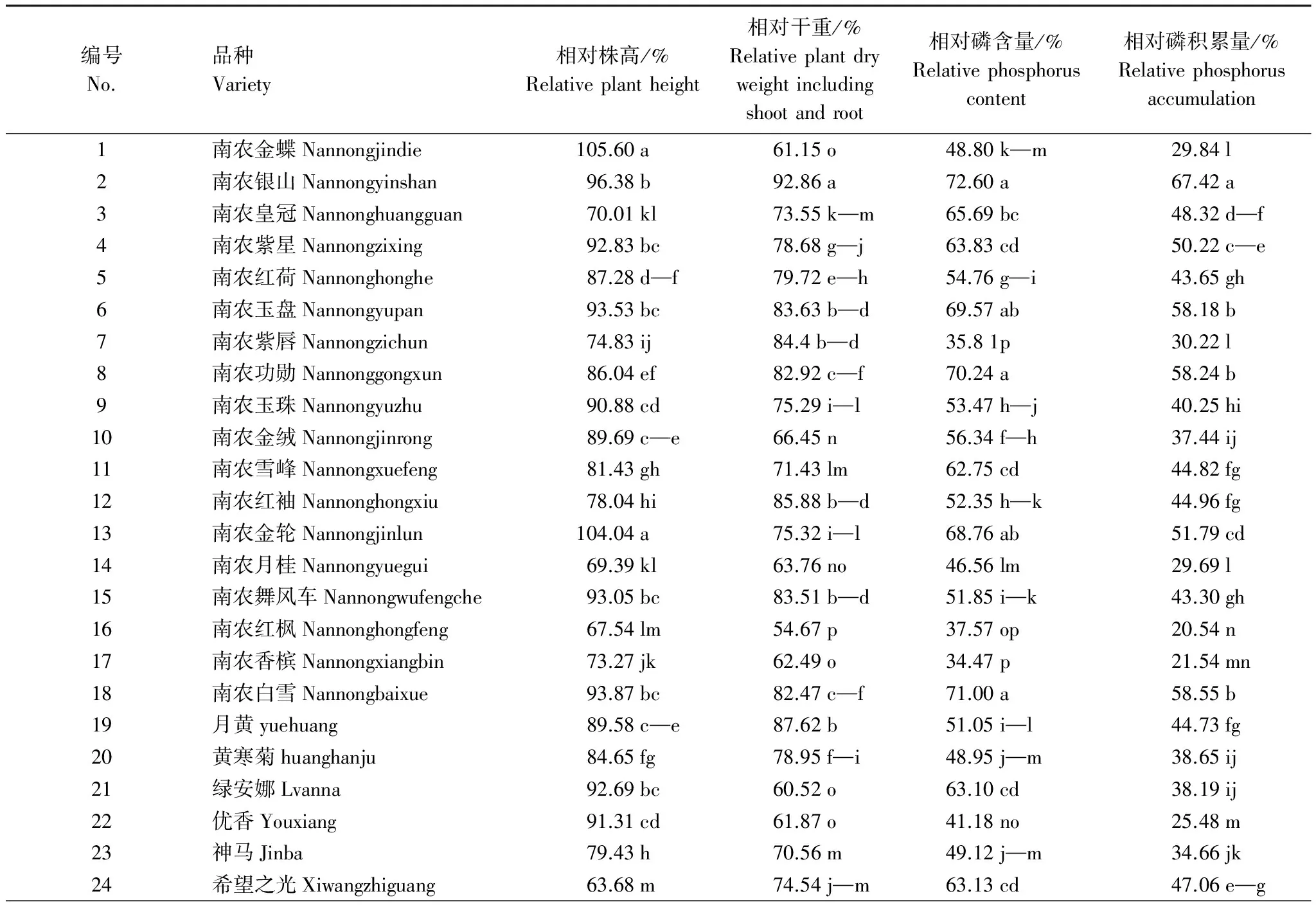
表1 32個切花菊品種在低磷脅迫下的生物學性狀統計
續表
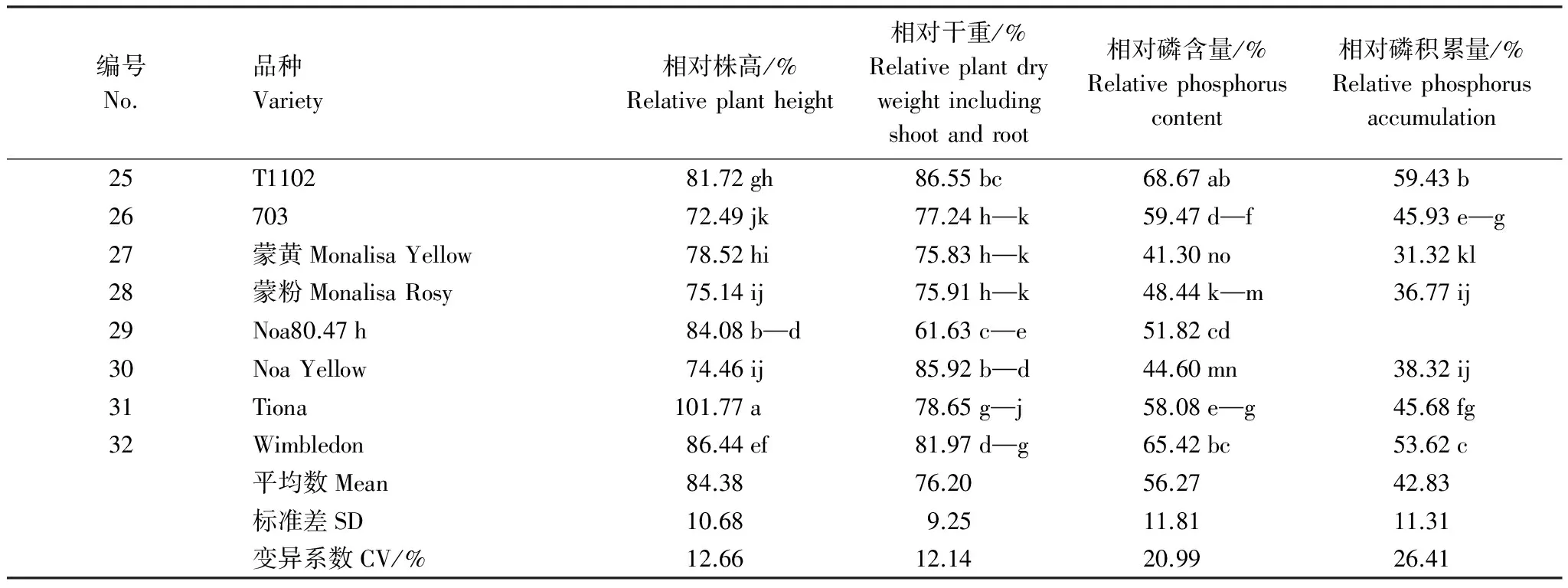
編號No.品種Variety相對株高/%Relativeplantheight相對干重/%Relativeplantdryweightincludingshootandroot相對磷含量/%Relativephosphoruscontent相對磷積累量/%Relativephosphorusaccumulation25T110281.72gh86.55bc68.67ab59.43b2670372.49jk77.24h—k59.47d—f45.93e—g27蒙黃MonalisaYellow78.52hi75.83h—k41.30no31.32kl28蒙粉MonalisaRosy75.14ij75.91h—k48.44k—m36.77ij29Noa80.47h84.08b—d61.63c—e51.82cd30NoaYellow74.46ij85.92b—d44.60mn38.32ij31Tiona101.77a78.65g—j58.08e—g45.68fg32Wimbledon86.44ef81.97d—g65.42bc53.62c平均數Mean84.3876.2056.2742.83標準差SD10.689.2511.8111.31變異系數CV/%12.6612.1420.9926.41
同一列中數據后跟相同小寫字母者表示在1%水平差異不顯著
2.2 篩選指標的建立
由表2可知,相對株高(RPH)、相對干重(RPW)、相對磷含量(PPC)和相對磷積累量(RPA)兩兩之間均呈正相關,其中相對磷積累量(RPA)與相對干重(RPW)、相對磷含量(PPC)之間呈極顯著正相關(Plt;0.01),相關系數分別達到0.7391和0.8258。

表2 低磷脅迫條件下不同切花菊各篩選指標間的相關系數
*Plt; 0. 05 ; **Plt; 0. 01
部分切花菊品種在低磷脅迫下株高出現反常現象,如南農金蝶植株表現為又細又高,即較高的株高、較低的干物質積累和磷含量,因此相對株高(RPH)只能作為鑒定切花菊耐低磷特性的輔助指標。相對干重、相對磷含量和相對磷積累量反映切花菊對磷素的吸收及同化能力,這些指標在各品種間差異顯著且變異系數較大(表1),且各指標間呈顯著正相關(表2),可作為切花菊耐低磷特性的評價指標。根據這3個評價指標計算耐低磷指數,耐低磷指數= (RPW+ RPC+RPA)/3,見表3。
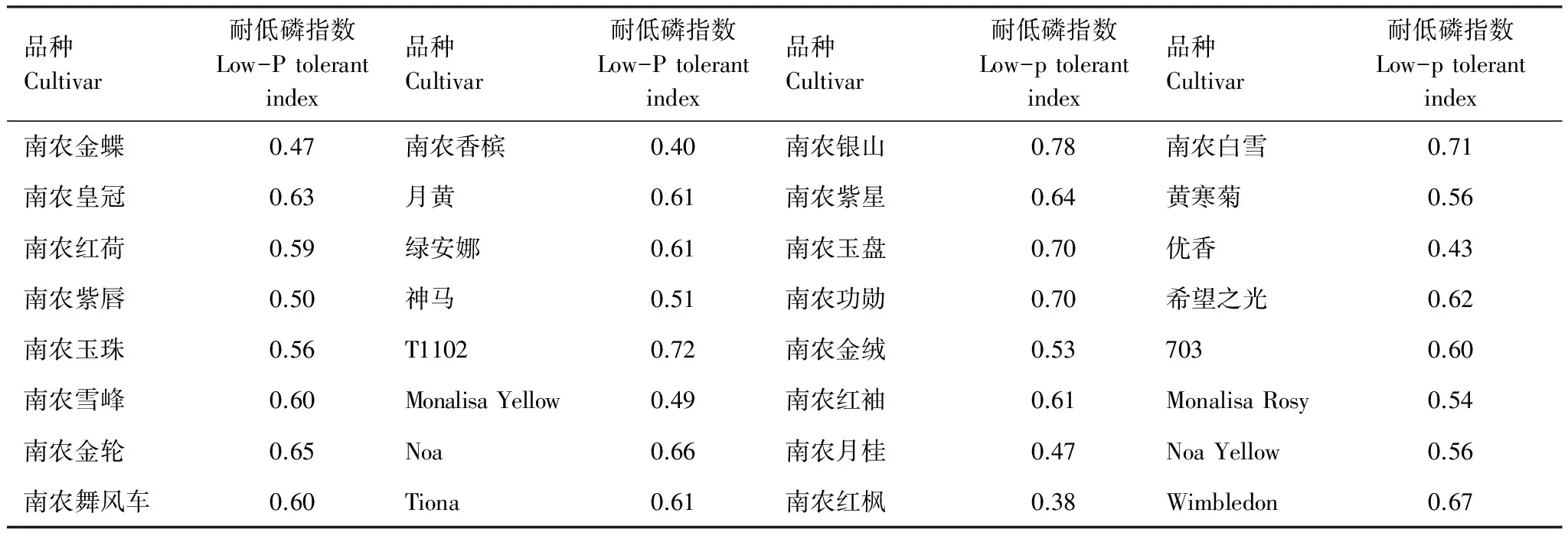
表3 32個切花菊品種耐低磷指數
2.332個切花菊品種耐低磷特性的評價結果

圖1 32個切花菊品種耐低磷性的聚類圖 Fig.1 Cluster tree of tolerance to low phosphorus of 32 cultivars of cut chrysanthemum
以耐低磷指數為變量,將數據在0—1標準化,采用系統聚類法,當類間距離為5時可將32份供試品種的耐低磷脅迫能力分為極強、強、中等、弱、極弱5個級別(圖1),其中耐低磷能力極強(1份):南農銀山;耐低磷能力強(4份):T1102、南農玉盤、南農功勛、南農白雪;耐低磷能力中等(14份):南農紅袖、南農雪峰、南農皇冠、南農金輪、南農紫星、南農舞風車、南農紅荷、綠安娜、希望之光、Tiona、月黃、Wimbledon、703、Noa; 耐低磷能力弱(10份):南農玉珠、黃寒菊、蒙黃、蒙粉、Noa Yellow、南農金絨、南農金蝶、南農紫唇、南農月桂、神馬;耐低磷能力極弱(3份):南農紅楓、南農香檳、優香。
3 討論
植物在營養元素利用能力上存在基因型差異[11- 12]。由于磷元素參與沉積循環,磷礦是一種不可再生的資源,存儲量有限,選育耐低磷的作物品種是一種比單純施用磷肥更為持續有效地解決作物對磷素需求的方法[13]。
由于作物耐低磷脅迫的生理生化和遺傳機制非常復雜,因而與之有關的性狀指標也非常多,采用合適的評價指標才能對作物的耐低磷特性進行準確評價。相對地上部干重、相對分蘗數是水稻耐低磷種質篩選的指標[7, 14- 17],相對根長、相對根表面積、相對根體積可為玉米耐低磷基因型的篩選指標[18]。喬振江等[19]的研究發現隨著土壤磷素水平的增加,大豆植株的生物量和葉片葉綠素含量顯著增加,根冠比則顯著下降。磷素對切花菊的生長影響很大,缺磷會導致切花菊的一系列反應,如下部葉片出現黃斑、生長變緩、根冠比增大等。姜貝貝[20]等指出不同切花菊苗期干物質重的差異在一定程度上能反應它對養分的吸收、轉運和利用效率的差異。本研究發現,利用植株相對干重、相對磷含量和相對磷積累量來綜合評價切花菊的磷利用效率較為有效。
本研究發現切花菊品種間在幼苗階段磷利用能力上存在差異,這為不同切花菊品種的差異化施磷和精準栽培體系的建立提供了依據。但是,由于切花菊的營養調節最終要歸結到切花的品質,因此需進一步深入研究低磷脅迫對切花菊全生育期和切花生產的影響。研究還發現切花菊品種南農銀山是典型的耐低磷品種,該品種在低磷環境中能維持較高的干物質積累量和磷含量,這說明該品種具有磷高效吸收、轉運的遺傳學基礎。人們正試圖從這些磷高效利用品種中找到磷高效利用基因[21],揭示切花菊磷高效利用的分子生物學機制,進而利用分子生物學手段改良現有的主栽切花菊品種。
[1] Wang Y, Wu D. The impact of flower certification on the development of Chinese floral industry. Forest Research, 2007, 20(6): 763- 767.
[2] Ministry of Agriculture. Flower industry statistics in 2010. China Flowers amp; Horticulture, 2011, 13: 22.
[3] Oelkers E, Valsami J E. Phosphate mineral reactivity and global sustainability. Elements, 2008, 4: 83- 88.
[4] liu Y, Chen J N, Mol A P. Comparative analysis of phosphorus use with national and local economies in china. Resoures, Conservation and Recycling, 2007, 51: 454- 474.
[5] Yu H Y, Li T X, Zhang X Z. Nutrient budget and soil nutrient status in greenhouse system. Agricultural Sciences in China, 2010, 43(3): 514- 522.
[6] Wang X M, Hou Y l. Phosphorus Fractions and Its Vertical Distribution in a Soil of Vegetable Field under Solar Greenhouse in Suburb of Anyang City. Journal of Agro-environmental Science, 2004, 23 (1): 72- 75.
[7] Guo Z H, He L Y, Huang W, Xu C G. Screening of rice for tolerance to low phosphorus stress. Plant Nutrition and Fertilizer Science, 2006, 12 (5): 642- 648.
[8] Mao R D, Shen J B. Plant nutrition esearch methods. Beijing: China Agricultural University Press, 2005: 25- 29.
[9] Guo S R, Wang X F. Science of soilless culture. Beijing: China Agriculture Press, 2003: 113.
[10] Bao S D. Analysis of soil agrochemical. Beijing: China Agriculture Press, 1999: 268- 270.
[11] Wissuwa M. How do plants achieve tolerance to phosphorus deficiency? Small causes with big effects. Plant physiology, 2003, 133: 1947- 1958.
[12] Rose T J, Pariasca T J, Rose M T, Fukuta Y, Wissuwa M. Genotypic variation in grain phosphorus concentration, and opportunities to improve P-use efficiency in rice. Field Crops Research, 2010, 119: 154- 160.
[13] Wissuwa M, Ae N. Genotypic variation for tolerance to phosphorus deficiency in rice and the potential for its exploitation in rice improvement. Plant Breeding, 2001, 120: 43- 48.
[14] Liu Y, Li Z C, Mi G H, Zhang H L, Mu P, Wang X K. Screening and identification for tolerance to low phosphorus stress of rice germplasm (OryzasativaL.). Acta Agronomica Sinica, 2005, 31(2): 238- 242.
[15] Song A M, Huang X P, Sun S B, Zhang Y L, XU G H. Screening and identification of rice cultivars with relatively high nitrogen use efficiency for tolerance to phosphorus deficiency at seedling stage. Chinese Journal of Rice Science, 2010, 24(5): 479- 486.
[16] Li Y F, Luo A C, Wang W M, Yang C D, Yang X E. An approach to the screening index for low phosphorus tolerant rice genotype. Chinese journal of applied ecology, 2005, 16(1): 119- 124.
[17] Zang Y W, Du J, Pu X Y, Zhang H, Zhou G H, Yang S M, Yang X J. Characterstics of nitrogen and phosphorus efficiency of core collection for rice landraces in Yunnan, China. Acta Ecologica Sinica, 2008, 28(12): 6355- 6363.
[18] Zhang J H, Gao S B, Yang K C, Zhang Z M, Lin H J,Huang N, Zheng M, Xu K C, Cheng Y X, Pan G T. Screening and identi fication for tolerance to low phosphorus stress of maize germplasm resources. Journal of Plant Genetic Resources, 2008, 9(3): 335- 339.
[19] Qiao Z J, Cai K Z, Luo S M. Interactive effects of low phosphorus and drought stress on dry matter accumulation and phosphorus efficiency of soybean plants. Acta Ecologica Sinica, Acta Ecologica Sinica, 2011,31(19): 5578- 5587.
[20] Jang B B, Fang W M, Chen F D, Gu J J. Effects of N, P and K ratio on the growth and development of cut chrysanthemum ‘Jinba’. Journal of Zhejiang Aamp;F University, 2008, 25(6): 692- 697.
[21] Nussaume L, Kanno S, Javot H, Marin E, Nakanishi T M, Thibaud M C. Frontiers: Phosphate import in plants: focus on the PHT1 transporters. Frontiers in Plant Traffic and Transport, 2011, 2: 1- 12.
參考文獻:
[1] 王雁, 吳丹. 花卉認證對我國花卉產業發展的影響. 林業科學研究, 2007, 20(6): 763- 767.
[2] 農業部. 2010年全國花卉業統計數據. 中國花卉園藝, 2011, 13: 22.
[5] 余海英, 李廷軒, 張錫洲. 溫室栽培系統的養分平衡及土壤養分變化特征. 中國農業科學, 2010, 43(3): 514- 522.
[6] 王新民, 侯彥林. 日光溫室土壤磷素形態及其空間分布特性研究. 農業環境科學學報, 2004, 23(1): 72- 75.
[7] 郭再華, 賀立源, 黃魏, 徐才國. 耐低磷水稻篩選與鑒定. 植物營養與肥料學報, 2006, 12(5): 642- 648.
[8] 毛達如, 申建波. 植物營養研究方法. 北京: 中國農業大學出版社, 2005: 25- 29.
[9] 郭世榮, 王秀峰. 無土栽培學. 北京: 中國農業出版社, 2003: 113.
[10] 鮑士旦. 土壤農化分析. 北京: 中國農業出版社, 1999: 268- 270.
[14] 劉亞, 李自超, 米國華, 張洪亮, 穆平, 王象坤. 水稻耐低磷種質的篩選與鑒定. 作物學報, 2005, 31(2): 238- 242.
[15] 宋愛梅, 黃新朋, 孫淑斌, 張亞麗, 徐國華. 氮高效水稻品種苗期耐低磷種質的篩選與鑒定. 中國水稻科學, 2010, 24(5): 479- 486.
[16] 李永夫, 羅安程, 王為木, 楊長登, 楊肖娥. 耐低磷水稻基因型篩選指標的研究. 應用生態學報, 2005, 16(1): 119- 124
[17] 曾亞文, 杜娟, 普曉英, 張浩, 周國華, 楊樹明, 楊曉娟. 云南地方稻核心種質氮磷高效性. 生態學報, 2008, 28(12): 6355- 6363.
[18] 張吉海, 高世斌, 楊克誠, 張志明, 林海建, 黃寧, 鄭溟, 徐克成, 陳義軒, 潘光堂. 玉米耐低磷種質資源的篩選與鑒定. 植物遺傳資源學報, 2008, 9(3): 335- 339.
[19] 喬振江, 蔡昆爭, 駱世明. 低磷和干旱脅迫對大豆植株干物質積累及磷效率的影響. 生態學報, 2011, 31(19): 5578- 5587.
[20] 姜貝貝, 房偉民, 陳發棣, 顧俊杰. 氮磷鉀配比對切花菊‘神馬’生長發育的影響. 浙江林學院學報, 2008, 25(6): 692- 697.
Preliminaryevaluationontolerancetophosphorousdeficiencyof32cultivarsofcutchrysanthemum
LIU Peng, CHEN Sumei, FANG Weimin, JIANG Jiafu, GUAN Zhiyong, CHEN Fadi*
CollegeofHorticulture,NanjingAgriculturalUniversity,Nanjing210095,China
Cut chrysanthemum(Chrysanthemum×moriflorumRamat.) is one of the most important ornamental plants in cut flower market all over the world. Phosphorus is a principal limited factor for plant growth, more than 90% of the added fertilizer phosphorus may rapidly be transformed to phosphorus forms that are not easily available to plants. Due to low natural phosphorus and high fixation capacity, a heavy dose of phosphorus is needed to achieve high production. Developing cultivars with tolerance to phosphorus deficiency may represent a more sustainable solution than sole reliance on fertilizer application. The possibility of exploiting genotypic differences in absorption and utilization of phosphorus to improve efficiency of phosphorus fertilizer use or to obtain higher productivity on phosphorus deficient soils has
considerable attention in recent years. In this study, to assess genotypic variation of cut chrysanthemum for tolerance to phosphorus deficiency, 32 cultivars of cut chrysanthemum were screened and evaluated for tolerance to low phosphorus using sand culture at seedling stage with two treatments of low phosphorus(15 μmol/L) and normal phosphorus(300 μmol/L) in the Chrysanthemum Germplasm Resource Preserving Centre, Nanjing Agricultural University, China. The results showed that there existed evident genotype differences in different cultivars of cut chrysanthemum in tolerant ability to low phosphorus stress. Among all the characters studied, relative plant dry weight (low phosphorus supply / normal phosphorus supply), relative phosphorus content and relative phosphorus accumulation demonstrated significant genotypic variation (the CV was 12.14%, 20.99% and 26.41%, respectively). Moreover, correlation analysis showed that there were significant positive correlations between relative plant dry weight and relative phosphorus content, between relative plant dry weight and relative phosphorus accumulation, and between relative phosphorus content and relative phosphorus accumulation (Plt;0.01), the correlative coefficients are 0.3067, 0.7391 and 0.8258 respectively. Therefore, relative plant dry weight, relative phosphorus content and relative phosphorus accumulation were suggested as screening indexes of cut chrysanthemum on tolerance to low phosphorus stress. A comprehensive evaluation of low phosphorus tolerance of 32 cultivars was made by using hierarchical clustering analysis. Clustering analysis showed that 32 cultivars could be divided into extremely low phosphorus tolerant, low phosphorus tolerant, moderately low phosphorus tolerant, low phosphorus sensitive and extremely low phosphorus sensitive group respectively. Among 32 tested materials, the tolerant ability to low phosphorus stress of Nannongyinshan is higher than other cultivars, belonging to extremely low phosphorus tolerant cultivar; T1102, Nannongyupan, Nannonggongxun and Nannongbaixue are low phosphorus tolerant cultivars; Nannongyuzhu, Nannongjinrong, Nannongjindie, Nannongzichun, Nannongyuegui, huanghanju, Monalisa Yellow, Noa Yellow, Monalisa Rosy and Jinba are low phosphorus sensitive cultivars; the tolerant ability to low phosphorus stress of Nannonghongfeng, Nannongxiangbin and Youxiang are lower than other cultivars, these cultivars are extremely low phosphorus sensitive genotypes; the others are moderately low phosphorus tolerant cultivars. Efficient genotypes with the desirable characteristics can be used directly in advance field trials or in breeding programs to cope phosphorus deficiency.
cut chrysanthemum; genotypic differences; low phosphorus stress; screening index
江蘇省科技支撐計劃資助項目(BE2011325);國家農業科技成果轉化資助項目(2010GB2360063);863計劃資助項目(2011AA100208);教育部新世紀優秀人才支持計劃資助項目(NCET-10-0492);江蘇省高校科研成果產業化推進資助項目(JHB2011-8);國家自然科學基金資助項目(31272202)
2012- 07- 17;
2012- 10- 26
*通訊作者Corresponding author.E-mail: chenfd@njau.edu.cn
10.5846/stxb201207171016
劉鵬,陳素梅,房偉民,蔣甲福,管志勇,陳發棣.32個切花菊品種的耐低磷特性.生態學報,2013,33(21):6863- 6868.
Liu P, Chen S M, Fang W M, Jiang J F, Guan Z Y, Chen F D.Preliminary evaluation on tolerance to phosphorous deficiency of 32 cultivars of cut chrysanthemum.Acta Ecologica Sinica,2013,33(21):6863- 6868.
猜你喜歡
發明與創新(2022年30期)2022-10-03 08:40:56
中等數學(2022年2期)2022-06-05 07:10:50
音樂探索(2022年2期)2022-05-30 21:01:37
小學生學習指導(低年級)(2020年6期)2020-07-25 02:31:36
小天使·一年級語數英綜合(2019年8期)2019-08-27 02:23:00
小學生學習指導(低年級)(2018年9期)2018-09-26 05:59:44
瘋狂英語·新讀寫(2018年2期)2018-09-07 09:32:10
人大建設(2018年6期)2018-08-16 07:23:10
小學科學(學生版)(2018年7期)2018-08-13 09:33:04
文理導航·科普童話(2017年5期)2018-02-10 19:42:14
